Unit 2 · Topic 2.4 · about 30 minutes · 7 parts · 11 scored checks, 2 of them multiple choice, plus 2 from earlier lessons
AP Macroeconomics 2.4: Price Indices and Inflation
Unit 2: 12 to 17% of the multiple-choice section
What you'll be able to do
- Define the consumer price index (CPI), inflation, deflation, disinflation, the inflation rate and real variables; explain how a price index gives the inflation rate and lets you compare nominal values across years; and calculate the CPI, the inflation rate and changes in real variables.
- Describe the shortcomings of the CPI as a measure of the true inflation rate.
Key vocabulary
| Term | What it means | The exam trap |
|---|---|---|
| Consumer price index (CPI) | The cost of a fixed basket of goods and services in a given year relative to its cost in the base year, times 100. | An index of 324.8 means the basket costs about 3.25 times what it did in the base period, not that it costs $324.80 or that prices rose 324.8 percent. |
| Base year | The year a price index compares every other year with, where the index equals 100. | Setting the base year only fixes where the index equals 100, so two indexes with different base years are compared by their percent changes, never by their levels. |
| Inflation | A rise in the general price level. | One price falling does not make it deflation: inflation is a rise in the general price level, so the index can climb in a year when internet service got cheaper. |
| Inflation rate | The percentage change in a price index, such as the CPI or the GDP deflator, from one period to the next. | Points are not percent: a CPI that goes from 250 to 260 rose 10 points but only 4 percent, because the change is divided by the starting index. |
| Deflation | A fall in the general price level, which gives a negative inflation rate. | Deflation means the price level itself falls and the inflation rate is negative, so a drop from 6 percent inflation to 2 percent is not deflation. |
| Disinflation | A fall in the inflation rate while the price level is still rising. | Prices are still rising during disinflation, only more slowly, so an index that goes from 180 to 189 to 198 shows disinflation even though it gains 9 points each year. |
| GDP deflator | A price index for all the final goods and services counted in GDP, which 2.6 shows how to calculate. | Because the GDP deflator is a price index too, its percent change is an inflation rate, worked exactly the way you work the CPI's. |
| Nominal variables | Values measured in the dollars of the time they are paid or earned, with no adjustment for prices. | Bigger paychecks can buy less: a nominal wage that rises 10 percent while prices rise 15 percent is a fall in the real wage. |
| Real variables | Nominal variables deflated by the price level, such as real wages, so they measure buying power. | To get a real value you divide by the index over 100, so a $54,000 salary at a CPI of 120 is $45,000 in base-year dollars; multiplying by 1.20 goes the wrong way. |
| Substitution bias | The CPI's overstatement of inflation that comes from keeping its basket fixed while buyers switch away from goods whose prices rose. | Substitution bias makes the CPI overstate inflation, not understate it, because the fixed basket keeps counting the old amount of a good buyers switched away from. |
 Tap to open the picture full size
Part 1 Think first Four dollars more an hour
Guess before you learn. A wrong guess still makes the answer stick.
Predict first
In 2015 Imani earned $11 an hour at a sandwich shop. In 2025 she earns $15 an hour. Over the same ten years, the rent, groceries and bus fares she pays for rose by about 40 percent. Compared with 2015, what can her hourly pay buy in 2025?
In short. A price index follows what a fixed basket of goods and services costs over time, and the percent change in that index is the inflation rate.
- The CPI is the cost of the basket in a given year divided by its cost in the base year, times 100.
- Dividing a nominal value by the price level (the index over 100) gives a real value, its buying power at base-year prices.
- Because buyers switch away from goods whose prices rise, the CPI tends to overstate the true inflation rate.
Part 2 Learn it Four short ideas, each checked as you go
2a. The CPI prices one fixed basket
Prices do not all move together. Gasoline jumps, televisions get cheaper, rent creeps up. To get one number for the price level, the consumer price index (CPI) picks a fixed basket: a list of goods and services and how much of each a typical household buys. Then it prices that same basket year after year.
One year is the base year. The CPI for any year is
CPI = (cost of the basket in that year ÷ cost of the basket in the base year) × 100
so the base year's CPI is always 100. Say the basket costs $400 in the base year, 2020, and $460 in 2025. The 2025 CPI is 460 ÷ 400 × 100 = 115.
That 115 tells you something about living costs. The same basket now costs 15 percent more, so a household that earned $40,000 in 2020 needs $40,000 × 1.15 = $46,000 in 2025 to buy what it bought before. That is what the CPI measures: the change in income a consumer needs to keep the same standard of living under the new prices.
Quick check · Calculate
A city's price index uses a fixed basket of 15 gallons of gasoline, 6 boxes of cereal and 400 kilowatt-hours of electricity. In the base year, gasoline was $3.20 a gallon, cereal $4.00 a box and electricity $0.12 a kilowatt-hour. This year they are $3.60, $4.50 and $0.135. What is this year's value of the index, to one decimal place?
2b. Inflation is the percent change in a price index
Inflation is a rise in the general price level, and the inflation rate says how fast it rose. You get it from any price index, the CPI or the GDP deflator alike:
inflation rate = (new index − old index) ÷ old index × 100
If the CPI goes from 250 to 265, the inflation rate is 15 ÷ 250 × 100 = 6 percent.
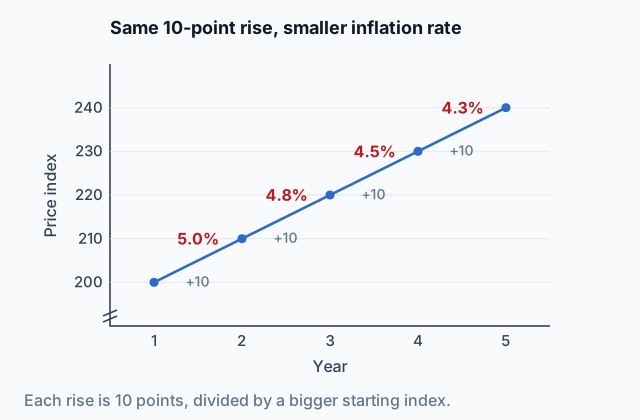
Divide by the old index, the one you start from. A change in index points is a percent only when the old index happens to be 100. The graph at the top of this page shows why that matters: an index that climbs 10 points every year has a falling inflation rate, because each 10 points is a smaller share of a bigger starting number.
Two more words name what the rate does. Deflation is a fall in the price level, so the inflation rate is negative. Disinflation is a fall in the inflation rate while prices are still rising: going from 6 percent to 2 percent is disinflation, not deflation.
Quick check · Sort it
Each card gives a price index in three years. Work out the inflation rate from Year 1 to Year 2 and from Year 2 to Year 3. Tap a card, then tap what happened in the second of those two years.
The inflation rate rose
Disinflation
Deflation
2c. Nominal and real, in both directions
A nominal value is counted in the dollars of its own day: a $54,000 salary, a $15 wage. A real value is the nominal value deflated by the price level, so it measures what the money can buy.
real value = nominal value ÷ (price index ÷ 100)
If the CPI is 120, a $54,000 salary is worth $54,000 ÷ 1.20 = $45,000 in base-year dollars.
You can compare any two years the same way, using the ratio of their indexes. Suppose the CPI was 240 in 2023 and 250 in 2025.
- Nominal to real. A $50,000 salary in 2025 is worth $50,000 × (240 ÷ 250) = $48,000 in 2023 dollars.
- Real to nominal. Someone who earned $48,000 in 2023 needs $48,000 × (250 ÷ 240) = $50,000 in 2025 to live as well as before.
When you only know percents, compare them. If pay rose more than the inflation rate, the real wage rose. If pay rose less, as Imani's did, the real wage fell, even though the paycheck is bigger.
Quick check · Decide and justify
From 2024 to 2025, Ari's nominal wage rose 10 percent and the consumer price index rose 15 percent. What happened to Ari's real wage?
Which reason supports your choice?
2d. Why the CPI overstates inflation
A fixed basket has a weakness. When beef gets expensive, many households buy less beef and more chicken. Their cost of living rises, but by less than it would if they kept buying the same beef. A fixed basket keeps counting the old amount of beef at the new price, so the CPI shows a bigger rise than these households really face. This is substitution bias, and it makes the CPI overstate the true inflation rate.
The Bureau of Labor Statistics publishes the CPI for all urban consumers (CPI-U) and a second index, the chained CPI-U, whose basket shifts as buyers switch between goods. The CPI-U has 1982-1984 as its base and the chained CPI-U has December 1999, so compare their percent rises, never their levels. Both series below are not seasonally adjusted (BLS series CPIAUCNS and SUUR0000SA0, read from FRED on October 14, 2026).
| Index | Rise | Dec 2015 | Dec 2024 |
|---|---|---|---|
| CPI-U | 33.4% | 236.5 | 315.6 |
| Chained CPI-U | 30.0% | 134.8 | 175.2 |
Over those nine years the chained index rose less than the CPI in every year but 2020. The fixed basket is not the only weakness. New goods and changes in quality are hard to price fairly too.
Quick check · Multiple choice
From December 2015 to December 2024, the U.S. CPI for all urban consumers rose 33.4 percent, while the chained CPI, whose basket shifts as buyers switch between goods, rose 30.0 percent. What best explains why the CPI rose more?
Part 3 Watch it done Three years of one town's basket
Watch each step, then do the last one yourself.
The statistics office in the town of Wexton prices the same basket every year, with 2023 as the base year:
- 12 bus rides: $2.50 in 2023, $3.00 in 2024, $3.50 in 2025
- 5 loaves of bread: $4.00 in 2023, $4.80 in 2024, $5.20 in 2025
- 1 month of home internet: $30 in 2023, $40 in 2024, $36 in 2025
Find Wexton's inflation rate from 2024 to 2025.
Step 1 · Price the same basket each year
Multiply each quantity by that year's price and add.
- 2023: 12 × $2.50 + 5 × $4.00 + $30 = $80
- 2024: 12 × $3.00 + 5 × $4.80 + $40 = $100
- 2025: 12 × $3.50 + 5 × $5.20 + $36 = $104
The internet price fell in 2025. It still goes in, at its new, lower price.
Why this step?
Why keep the quantities the same every year?
So the cost changes only because prices changed. If the quantities moved too, a bigger bill could just mean people bought more, and the index would no longer measure prices.
Step 2 · Turn each cost into an index
Divide each year's cost by the base-year cost and multiply by 100.
- 2023: 80 ÷ 80 × 100 = 100
- 2024: 100 ÷ 80 × 100 = 125
- 2025: 104 ÷ 80 × 100 = 130
Your step · Calculate
Wexton's CPI was 125 in 2024 and 130 in 2025, with 2023 as the base year (2023 = 100). What was the inflation rate from 2024 to 2025, in percent?
%
Notice that the internet price fell and the index still rose. Inflation is about the whole basket. One price falling does not make it deflation.
Part 4 Try it Practice with new numbers
Try it · Calculate
A country's GDP deflator was 140.0 in 2024 and 147.7 in 2025. What was the inflation rate from 2024 to 2025, in percent, to one decimal place?
Build your own basket. List five things your household buys in a typical month and how many of each. Find what each costs today, and what it cost in the year you were born, from an old receipt, a family member or a news story from that year. Make the year you were born the base year and work out today's index on paper. Which of your five prices rose the most, and would your family still buy as much of it?
Part 5 Explain it Write it the way the exam asks
Nothing you type leaves this page.
Free response is 33.35% of the exam score. This one is shaped like Question 2, Short.
Free-response practice · Question 2 style
In the country of Quessa, the consumer price index (CPI) was 150 in 2024 and 159 in 2025, with 2020 as the base year. (a) Calculate the inflation rate from 2024 to 2025. Show your work. (b) Jordan's nominal wage rose from $40,000 in 2024 to $42,000 in 2025. Did Jordan's real wage increase, decrease, or stay the same? Explain. (c) When the price of name-brand cereal rises, many households in Quessa switch to cheaper store-brand cereal. Does the CPI overstate or understate the true increase in their cost of living? Explain.
Model answer
(a) (159 − 150) ÷ 150 × 100 = 6 percent. (b) Jordan's real wage decreased. The nominal wage rose by $2,000 ÷ $40,000 = 5 percent, less than the 6 percent inflation rate, so the new wage buys less than the old one did. (c) The CPI overstates it. The CPI prices a fixed basket, so it keeps counting the name-brand cereal households stopped buying at its higher price instead of the cheaper store brand they switched to.
Score your own answer. This is a self-check, not a grade. Tick each point your answer makes.
Part 6 Check yourself Read real U.S. data
Read the table first, then answer each question from it.
The table gives two U.S. statistics nine years apart, ending at September 2025 because the September 2026 earnings figure is still preliminary. CPI-U is the CPI for all urban consumers, with 1982-1984 = 100, and the earnings are for all private employees. Neither series is seasonally adjusted. Source: U.S. Bureau of Labor Statistics, series CPIAUCNS and CEU0500000003, read from FRED (Federal Reserve Bank of St. Louis) on October 14, 2026.
| Measure | Sep 2016 | Sep 2025 |
|---|---|---|
| CPI-U | 241.428 | 324.800 |
| Avg. hourly earnings | $25.73 | $36.62 |
Case question 1 · Calculate
Using the CPI for all urban consumers, what hourly wage in September 2025 would keep the same standard of living that average hourly earnings of $25.73 gave in September 2016? Give the answer in dollars, to the nearest cent.
Case question 2 · Calculate
Using the CPI for all urban consumers, express the September 2025 average hourly earnings of $36.62 in September 2016 dollars. Give the answer in dollars, to the nearest cent.
Case question 3 · Multiple choice
What does the CPI value of 324.800 for September 2025 tell you?
The rest stand on their own and do not use the case.
Check yourself · Spot the error
A student worked out an inflation rate from the consumer price index. Tap the first line that goes wrong.
Check yourself · Fill the statement
Tap a blank, then tap a phrase.
Gasoline prices jump, so many households drive less and take the bus more. The CPI's basket keeps the gasoline, so the CPI how much more it costs these households to live as well as before.
Part 7 Keep it Keep it
From 2.3 Unemployment · Calculate
Adrona, an invented country, has an adult population of 2,400,000. Its labor force participation rate is 65% and its unemployment rate is 6%. How many people in Adrona are unemployed?
From 1.5 Supply · Match
Tap an event in the market for pencils, then tap what it does on the supply graph.
In three lines
- The CPI prices one fixed basket and divides by its base-year cost, so the base year is 100.
- The inflation rate is the percent change in any price index, measured from the starting value.
- Real values are nominal values deflated by the price level, and substitution bias makes the CPI overstate inflation.
Exam strategy for this topic
- Section I, Multiple Choice: 60 questions in 70 minutes.
- Section II, Free Response: 3 questions in 60 minutes.
- This lesson's Explain it is shaped like free-response question 2, Short.
- A four-function calculator is allowed on both sections of the exam.
Write the formula with the starting index in the denominator before you put in any numbers. When you say what happened to a real wage, compare the percent change in pay with the inflation rate and state the direction.
Questions students ask
What is the difference between deflation and disinflation?
Deflation is a fall in the price level, so the inflation rate is negative. Disinflation is a fall in the inflation rate while prices are still rising, such as inflation dropping from 6 percent to 2 percent.
How do I turn an old salary into today's dollars?
Multiply by the ratio of the two indexes with the newer year on top. If the CPI was 200 in 2022 and 210 in 2025, a $40,000 salary from 2022 equals $40,000 × (210 ÷ 200) = $42,000 in 2025 dollars.
Why does the CPI overstate inflation?
Its basket is fixed. When a good gets expensive, people buy less of it and more of a cheaper substitute, but the CPI keeps counting the old amount at the new price. That is substitution bias, and new goods and quality changes are hard to price fairly as well.
Is the CPI the same thing as the GDP deflator?
No. The CPI prices a fixed basket of what consumers buy, while the GDP deflator covers all the final goods and services counted in GDP. Both are price indexes, so the percent change in either one is an inflation rate.
Is calculating the producer price index beyond the scope of the AP Exam?
No. Calculating the producer price index (PPI) is beyond the scope of the course and the AP Exam.
Beyond the AP Exam
College Board sets this limit on what the AP Exam asks about this topic. Anything past it is not on the exam.
Calculating the producer price index (PPI) is beyond the scope of the course and AP Exam.
Course alignment, for teachers
AP Macroeconomics topic 2.4, Unit 2: Economic Indicators and the Business Cycle.
- Skill 2.C: Interpret a specific economic outcome using quantitative data or calculations.
This lesson maps all 5 essential knowledge statements of the topic to the part that teaches each one: 5 are checked by a scored question. The map is in the lesson file.