Unit 2 · Topic 2.5 · about 30 minutes · 7 parts · 10 scored checks, 1 of them multiple choice, plus 2 from earlier lessons
AP Macroeconomics 2.5: Costs of Inflation
Unit 2: 12 to 17% of the multiple-choice section
What you'll be able to do
- Explain the costs that unexpected inflation, or unexpected deflation, places on individuals and on the economy.
Key vocabulary
| Term | What it means | The exam trap |
|---|---|---|
| Unexpected inflation | Inflation above the rate people expected when they signed loans, wage deals and other contracts written in dollars. | Only the gap between actual and expected inflation moves wealth, so 6 percent inflation when 2 percent was expected is a surprise of 4 percentage points, and inflation that matches expectations moves nothing. |
| Deflation | A decrease in the general price level, so each dollar buys more than before. | Unexpected deflation reverses the answers: lenders and people on fixed incomes gain, and borrowers lose because the dollars they repay are worth more than planned. |
| Redistribution of wealth | A shift of purchasing power from one group of people to another; unexpected inflation does it without anyone choosing who gains. | What one side loses the other gains, so the answer names the direction, from lenders to borrowers, instead of claiming that inflation makes everyone worse off. |
| Lender | Someone who hands over money now in return for a promise of a set repayment, usually with interest, later. | Savers in fixed-rate accounts are lenders too, because a deposit is a loan to the bank, so unexpected inflation hurts them. |
| Borrower | Someone who receives money now and promises a set repayment, usually with interest, later. | Higher prices at the store do not make a fixed-rate borrower worse off; unexpected inflation helps the borrower, because the dollars repaid buy less than planned. |
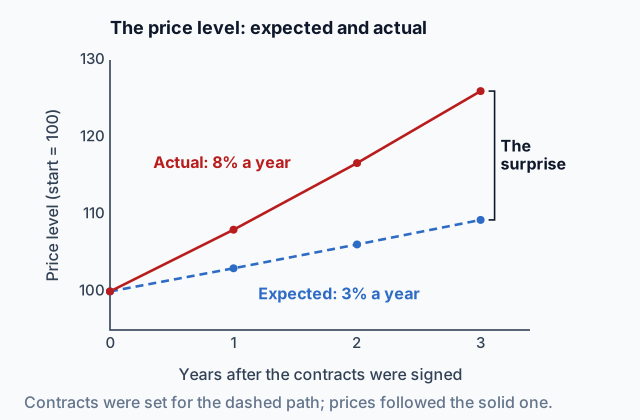 Tap to open the picture full size
Part 1 Think first A raise that looked fair
Guess before you learn. A wrong guess still makes the answer stick.
Predict first
Two years ago, a warehouse worker and her employer signed a contract giving her a 2% raise each year, because everyone expected prices to rise about 2% a year. This year prices rose 7%. Compared with what each side planned when they signed, who comes out ahead this year?
In short. The cost of unexpected inflation is that it moves purchasing power from people who are owed fixed amounts of money to people who owe them, and unexpected deflation moves it the other way.
- Inflation that people expected is written into interest rates, wages and prices when deals are signed, so it catches no one out.
- When inflation runs above what was expected, anyone owed a fixed number of dollars, such as a lender or a person on a fixed income, loses, and anyone who owes those dollars gains.
- Unexpected deflation runs the other way: the dollars repaid are worth more than planned, so lenders gain and borrowers lose.
Part 2 Learn it Three short ideas, each checked as you go
2a. Only the surprise moves wealth
A lot of deals are written in dollars. A loan is repaid in a set number of dollars. A pension pays a set number of dollars a month. What those dollars are worth depends on what they buy, which is the real value from 2.4 Price Indices and Inflation: divide the dollars by the price index and multiply by 100.
People who sign these deals know prices usually rise, so they plan for it. A lender who would charge 3% if prices were steady, and who expects 4% inflation, asks for more than 3%, so the dollars repaid still buy what she wanted. A worker bargaining over next year's pay asks for a raise that at least keeps up with the inflation everyone expects.
So when inflation turns out to be exactly what people expected, the deal already priced it in, and nobody is caught out. What moves wealth from one person to another is unexpected inflation: the gap between the inflation that happens and the inflation people planned for when they signed.
Quick check · Fill the statement
Tap a blank, then tap a word or phrase.
Tomas would lend $1,000 for a year at 2% if prices were steady. Tomas and the borrower both expect prices to rise 5%, so the rate they agree on is 2%. Over the year, prices rise exactly 5%. gains at the other's expense, because the inflation was .
2b. When inflation beats the forecast
Now suppose inflation runs above what everyone expected. Anyone owed a fixed number of dollars gets dollars that buy less than they planned on:
- Lenders at a fixed interest rate, such as a bank holding fixed-rate loans.
- Savers in fixed-rate accounts. A deposit is a loan to the bank, so a saver is on the lender's side.
- People on fixed incomes, such as a pension that pays the same dollars every month.
Anyone who owes a fixed number of dollars gains, because they repay in dollars that buy less than either side planned. That is the borrower.
Here is the size of it. A bank lends $10,000 for a year at 6%, set when everyone expected 2% inflation, so it is owed $10,600. It planned on that repayment being worth about $10,392 in start-of-year dollars ($10,600 / 1.02). Prices actually rise 9%, so it is worth about $9,725 ($10,600 / 1.09), less than the bank lent. The real value of the debt fell by more than expected; put another way, the real interest rate came out lower than expected.
Nobody chose that result or earned it. It falls on whoever happened to sign which side of a dollar contract, which is why economists call the redistribution arbitrary.
Quick check · Calculate
Ruth's pension pays $2,520 a month, a dollar amount that never changes. When the year began, a price index stood at 100 and everyone expected it to reach 102 by the end of the year. It actually reached 112. Measured in start-of-year dollars, what is Ruth's monthly pension worth at the end of the year?
2c. Deflation, and deals that move with prices
Run the story backward. Deflation is a fall in the price level. If prices fall when people expected them to rise, each dollar buys more than planned. The same happens, on a smaller scale, when prices rise less than expected. Now the people owed fixed dollars come out ahead: lenders, savers at fixed rates and people on fixed pensions. Borrowers lose, because the dollars they must repay are worth more than they planned. Unexpected deflation redistributes wealth from borrowers to lenders.
Some deals are written so that a surprise cannot reach them. A wage or pension with a cost-of-living adjustment changes with the price index, and so does a loan whose rate resets with inflation. People holding those deals are neither helped nor hurt by a surprise, because their dollars move with prices.
So for any person and any surprise, ask two questions. Do they owe a fixed number of dollars, or are they owed one? And did prices end up higher or lower than they planned?
Quick check · Sort it
Everyone expected prices to rise 3% this year. Instead the price level fell 2%. Tap each person, then tap how they come out compared with what they planned.
Better off than planned
Worse off than planned
No better or worse off
Part 3 Watch it done A surprise year in Greywater
Watch each step, then do the last one yourself.
At the start of the year, when everyone in Greywater expected 2% inflation, the Halloran family took out a home loan from a bank at a fixed 5% interest rate. Their neighbor, Ms. Lindqvist, is retired and lives on a pension that pays the same dollars every month. Prices actually rose 6% over the year. Decide how each comes out compared with what they planned.
Step 1 · Measure the surprise
Prices rose 6% when 2% was expected, so 4 percentage points of the inflation were unexpected. That surprise is what moves wealth. The expected 2% was already planned for.
Why this step?
Why compare the 6% with the 2%, instead of with zero?
The bank and the Hallorans set the 5% rate knowing prices would probably rise 2%, and a retiree plans her spending the same way. Only the extra 4 points caught anyone off guard.
Step 2 · Ms. Lindqvist's pension
Her pension pays a fixed number of dollars. With prices up 6% instead of 2%, each dollar buys less than she planned, so she is worse off.
Step 3 · Which side of the loan the family is on
The Hallorans borrowed. They owe the bank a fixed schedule of dollar payments, set at 5% when 2% inflation was expected. The bank is the lender.
Your step · Decide and justify
Finish the analysis. Compared with what they planned, how does the 6% inflation leave the Halloran family, who repay a home loan at a fixed 5% rate set when 2% inflation was expected?
Which reason supports your choice?
Part 4 Try it Three surprises
Each question here gives you a deal written in dollars and a year when prices did not go as planned. Before you decide who gains, find who is owed the fixed dollars.
Try it · Match
A bank makes one-year loans each January at a fixed rate set to cover the inflation everyone expects for that year. Tap each year, then tap who came out ahead by the end of it.
Try it · Calculate
Two unions at one factory signed one-year contracts in January, when everyone expected 3% inflation. A millwright earning $4,000 a month gets a fixed raise to $4,120 a month. An electrician earning $4,000 a month has a cost-of-living clause instead: her monthly pay is $4,000 times the current price index divided by 100. The price index was 100 in January and 109 in December. Measured in January dollars, how much more does the electrician's December paycheck buy than the millwright's? Round to the nearest dollar.
Part 5 Explain it Write it the way the exam asks
Nothing you type leaves this page.
Free response is 33.35% of the exam score. This one is shaped like Question 3, Short.
Free-response practice · Question 3 style
In the country of Varenna, households, banks and firms expected an inflation rate of 4% this year. The actual inflation rate turned out to be 9%. (a) Will people whose incomes are fixed in dollars be better off, worse off, or unaffected? Explain. (b) Will a bank that made loans at a fixed interest rate at the start of the year be better off, worse off, or unaffected? Explain. (c) Suppose instead that the price level had fallen by 1% this year. Identify whether a household repaying a loan at a fixed interest rate would be better off, worse off, or unaffected.
Model answer
(a) Worse off. A fixed dollar income buys less than they expected, because prices rose 9% instead of the 4% they planned for. (b) Worse off. The bank set its rate expecting 4% inflation, so the dollars its borrowers repay buy less than it expected: the real value of the debt fell by more than expected, and the real interest rate was lower than expected. (c) Worse off. The dollars the household repays are worth more than it expected, so the real value of its debt rises.
Score your own answer. This is a self-check, not a grade. Tick each point your answer makes.
Part 6 Check yourself Read a loan from its numbers
Read the table first, then answer both questions from it.
Priya borrowed $20,000 from Millbrook Credit Union for one year. When they signed, both sides expected inflation of 2% for the year, and they set a fixed interest rate of 5%. Prices are measured with a price index that stood at 100 on the day of the loan.
| Item | Value |
|---|---|
| Amount borrowed | $20,000 |
| Fixed interest rate | 5% |
| Repayment due after one year | $21,000 |
| Price index when the loan was made | 100 |
| Price index both sides expected after one year | 102 |
| Actual price index after one year | 108 |
Case question 1 · Calculate
Millbrook Credit Union is repaid $21,000 for Priya's one-year loan. Measured in dollars of the day the loan was made (price index 100), how much less is that repayment worth at the actual index of 108 than at the index of 102 that both sides expected? Round to the nearest dollar.
Case question 2 · Multiple choice
Suppose that over the year of Priya's $20,000 loan at a fixed 5% rate, the price index had instead risen from 100 to 102, the rise both sides expected. Compared with what Priya and the credit union planned, which is true?
The rest stand on their own and do not use the case.
Check yourself · Spot the error
A student explained what happened to a bank in a year when everyone expected 3% inflation. Tap the first line that goes wrong.
Check yourself · Select all
Everyone expected 2% inflation this year, but prices rose 8%. Which two of these people are worse off than they planned? Select two.
Select 2 answers, then check.
Part 7 Keep it Keep it
From 2.4 Price Indices and Inflation · Decide and justify
From 2024 to 2025, Ari's nominal wage rose 10 percent and the consumer price index rose 15 percent. What happened to Ari's real wage?
Which reason supports your choice?
From 2.2 Limitations of GDP · Match
Tap a situation, then tap what GDP misses in it.
In three lines
- Inflation everyone expected is already priced into loans, wages and pensions.
- Unexpected inflation helps those who owe fixed dollars and hurts those owed them.
- Unexpected deflation does the reverse: lenders gain and borrowers lose.
Exam strategy for this topic
- Section I, Multiple Choice: 60 questions in 70 minutes.
- Section II, Free Response: 3 questions in 60 minutes.
- This lesson's Explain it is shaped like free-response question 3, Short.
- A four-function calculator is allowed on both sections of the exam.
Write the verdict first: better off, worse off or unaffected. Then give the reason in terms of what fixed dollars buy compared with what was expected, such as "the real value of the debt fell by more than expected."
Questions students ask
If prices rise exactly as expected, does anyone lose?
No one is caught out. The lender asked for a rate that covered the expected inflation and the worker bargained for a raise that kept up with it, so the deal had already priced it in.
Why is a saver treated like a lender?
A bank deposit is a loan to the bank. If the account pays a fixed rate and inflation runs above what was expected, the dollars the saver gets back buy less than planned.
Who is protected from an inflation surprise?
Anyone whose deal moves with the price index, such as a wage or pension with a cost-of-living adjustment, or a loan whose rate resets with inflation. Their dollars move with prices, so a surprise cannot reach them.
How do I work out what a fixed pension is worth after prices rise?
Divide the dollar amount by the actual price index and multiply by 100. A $3,000 monthly pension with the index at 120 is worth $3,000 ÷ 120 × 100 = $2,500 in start-of-year dollars.
Why do economists call this redistribution arbitrary?
Nobody chose it or earned it. It lands on whoever happened to sign which side of a contract written in dollars.
Course alignment, for teachers
AP Macroeconomics topic 2.5, Unit 2: Economic Indicators and the Business Cycle.
- Skill 3.A: Determine the outcome of an economic situation using economic concepts, principles, or models.
This lesson maps the one essential knowledge statement of the topic to the part that teaches each one: 1 is checked by a scored question. The map is in the lesson file.