Unit 3 · Topic 3.2 · about 30 minutes · 7 parts · 10 scored checks, 2 of them multiple choice, plus 2 from earlier lessons
AP Macroeconomics 3.2: Multipliers
Unit 3: 17 to 27% of the multiple-choice section
What you'll be able to do
- Define the expenditure multiplier, the tax multiplier, the marginal propensity to consume and the marginal propensity to save, then explain and calculate how changes in spending and taxes change real GDP.
Key vocabulary
| Term | What it means | The exam trap |
|---|---|---|
| Autonomous expenditures | Spending that does not depend on the current level of income, such as new investment, government purchases or exports. | Stopping at the first round undercounts: a $10 billion rise in investment with an MPC of 0.8 can raise aggregate demand by up to $50 billion, not $10 billion. |
| Disposable income | The income households have left to spend or save after taxes. | Taxes come out before households decide anything, so a tax cut raises disposable income first and raises spending only by the MPC times the cut. |
| Marginal propensity to consume (MPC) | The change in consumer spending divided by the change in disposable income: the share of an extra dollar that is spent. | Divide the change in spending by the change in disposable income; $540 billion of spending out of $600 billion of income is the share of all income spent, not the MPC. |
| Marginal propensity to save (MPS) | The share of an extra dollar of disposable income that is saved, equal to 1 minus the MPC. | Saving and spending shares add to 1, so an MPC of 0.75 means an MPS of 0.25 and a multiplier of 1 ÷ 0.25 = 4, not 1 ÷ 0.75. |
| Expenditure multiplier | The number, 1 ÷ MPS, that a change in any component of aggregate demand is multiplied by to give the maximum change in aggregate demand; also called the spending multiplier. | Questions ask for the maximum change because the formula assumes every round is spent at the MPC; multiply a change in spending by it, but divide a target change in AD by it. |
| Tax multiplier | The number, MPC ÷ MPS, that a change in taxes is multiplied by to give the size of the change in aggregate demand, which moves opposite to the tax. | Smaller by exactly 1 than the expenditure multiplier and opposite in direction: with an MPC of 0.8 it is 4, so a $10 billion tax increase lowers aggregate demand by up to $40 billion. |
 Tap to open the picture full size
Part 1 Think first Bridges or rebate checks?
Commit to a guess first. Being wrong now makes the right answer easier to remember.
Predict first
A government has $40 billion to put into the economy. It can buy $40 billion of new bridges and rail lines, or it can mail households $40 billion in tax rebates. Households there save some of every extra dollar they get. Which choice raises total spending in the economy more?
In short. A multiplier tells you how far aggregate demand can move when spending or taxes change, and its size depends on the share of each extra dollar that households spend.
- The marginal propensity to consume is the change in consumer spending divided by the change in disposable income, and it plus the marginal propensity to save equals 1.
- The expenditure multiplier is 1 ÷ MPS; multiply it by a change in any component of aggregate demand to get the maximum change in aggregate demand.
- To find the change in spending needed for a target change in aggregate demand, divide the target by the multiplier.
Part 2 Learn it Four short ideas, each checked as you go
2a. The marginal propensity to consume
Disposable income is what households have left after taxes. When it goes up, they spend part of the extra and save the rest.
The marginal propensity to consume (MPC) is the share of an extra dollar of disposable income that households spend:
MPC = change in consumer spending ÷ change in disposable income
The marginal propensity to save (MPS) is the share they save. Every extra dollar is either spent or saved, so MPC + MPS = 1.
Say disposable income rises from $600 billion to $680 billion and consumer spending rises from $540 billion to $600 billion. The MPC is $60 billion ÷ $80 billion = 0.75, and the MPS is 1 − 0.75 = 0.25.
Use the changes, never the levels. $600 billion ÷ $680 billion is about 0.88, the share of all income that is spent, and that is not the MPC. The rule works the same when income falls: both changes are negative, and the MPC is still a positive share.
Quick check · Calculate
In a recession, disposable income in Norland falls from $640 billion to $560 billion, and consumer spending falls from $584 billion to $532 billion. What is Norland's marginal propensity to consume? Give a decimal.
2b. One dollar, many rounds
Spending that does not depend on this year's income, such as a firm's new factory, a government purchase or a sale abroad, is autonomous expenditure. A change in it does not stop where it lands.
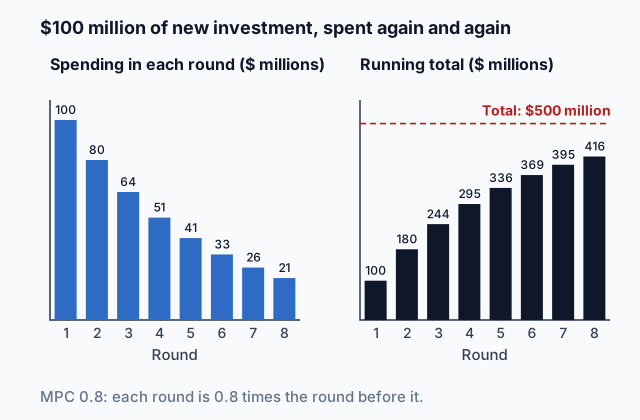
Suppose a firm spends $100 million more on a factory and the MPC is 0.8. That $100 million is income for builders and suppliers. They spend 0.8 of it, $80 million, which becomes someone else's income. Those people spend 0.8 of that, and so on. Each round is the MPC times the round before.
| Round | Spending in the round | Running total |
|---|---|---|
| 1 | 100 | 100 |
| 2 | 80 | 180 |
| 3 | 64 | 244 |
| 4 | 51.2 | 295.2 |
| Every round | 500 |
The rounds add up to the expenditure multiplier (often called the spending multiplier) times the first change:
expenditure multiplier = 1 ÷ (1 − MPC) = 1 ÷ MPS
Here it is 1 ÷ 0.2 = 5, so the $100 million can raise aggregate demand, and real output, by up to $500 million. Questions ask for the maximum change because the formula assumes every round is spent at the MPC, with nothing else leaking out on the way. In a real economy some of each round goes to taxes or imports, so the actual change is smaller. The same multiplier works for a change in any part of aggregate demand: consumption, investment, government purchases or net exports.
Quick check · Decide and justify
Households in Country A spend 90 cents of each extra dollar of disposable income. Households in Country B spend 60 cents. Which country has the larger expenditure multiplier?
Which reason supports your choice?
2c. Taxes start one step later
Cut taxes by $100 million and disposable income rises by $100 million, but none of that is spending yet. With an MPC of 0.8, households spend $80 million and save $20 million. The first round of new spending is smaller than the tax cut, so every round after it is smaller too.
The tax multiplier measures how far aggregate demand moves after a change in taxes:
tax multiplier = MPC ÷ MPS
With an MPC of 0.8 it is 0.8 ÷ 0.2 = 4. So a $100 million tax cut can raise aggregate demand by up to $400 million, where $100 million of government purchases could raise it by $500 million. Both multipliers are built from the MPC.
The tax multiplier gives the size. The direction is opposite to the tax: a tax cut raises aggregate demand, and a tax increase lowers it.
If government purchases and taxes both rise by $100 million, the effects do not cancel. The purchases add $500 million and the taxes take away $400 million, so aggregate demand rises by $100 million, the same as the change in spending.
Quick check · Calculate
In Oakhurst the MPC is 0.9. The government raises taxes by $15 billion, and nothing else changes. What is the maximum change in aggregate demand, in billions of dollars? Give a negative number for a decrease.
2d. Working backward from a target
Often the question runs the other way. Policymakers know how far they want aggregate demand to move, and they need the change in spending that gets it there. The multiplier still links the two:
change in aggregate demand = multiplier × change in spending
so
change in spending = target change in aggregate demand ÷ multiplier
Say the MPC is 0.8 and the goal is to raise aggregate demand by $50 billion. The multiplier is 5, so government purchases need to rise by $50 billion ÷ 5 = $10 billion. Check it forward: $10 billion × 5 = $50 billion.
Two mistakes are common here. One is multiplying the target by the multiplier, which gives $250 billion, twenty-five times too much. The other is the direction: if aggregate demand has to fall, spending has to fall, so the answer is a decrease. For a tax change, divide by the tax multiplier, and remember that raising aggregate demand takes a tax cut.
Quick check · Calculate
In Penwick the MPC is 0.75. Policymakers want aggregate demand to fall by $60 billion, using a change in government purchases alone. By how much should government purchases change, in billions of dollars? Give a negative number for a decrease.
Part 3 Watch it done How big a tax cut?
Watch each step, then do the last one yourself.
Last year in Halvard, when disposable income rose from $5,000 billion to $6,000 billion, consumer spending rose from $4,300 billion to $5,050 billion. Policymakers now want aggregate demand to rise by $90 billion, using a change in taxes alone. By how much should taxes change?
Step 1 · Find the MPC
Use the changes: MPC = (5,050 − 4,300) ÷ (6,000 − 5,000) = 750 ÷ 1,000 = 0.75. So the MPS is 1 − 0.75 = 0.25.
Why this step?
Why not divide $5,050 billion by $6,000 billion?
That gives about 0.84, the share of all income that is spent. A multiplier runs on what people do with an extra dollar, and only the changes show that.
Step 2 · Pick the multiplier
This is a tax change, so it reaches spending only after households decide how much of it to spend. Use the tax multiplier: MPC ÷ MPS = 0.75 ÷ 0.25 = 3. The expenditure multiplier, 1 ÷ 0.25 = 4, would fit a change in government purchases.
Step 3 · Set the direction
Aggregate demand has to rise, and a tax cut is what raises it.
Your step · Calculate
Finish the calculation. By how much should Halvard change taxes, in billions of dollars? Give a negative number for a cut.
billion dollars
Part 4 Try it Every direction, with new numbers
Try it · Multiple choice
In Dunmore the MPC is 0.6. In the same year, the government raises its purchases of goods and services by $40 billion and raises taxes by $40 billion, and nothing else changes. What is the maximum change in aggregate demand?
Part 5 Explain it Write it the way the exam asks
Nothing you type leaves this page.
Free response is 33.35% of the exam score. This one is shaped like Question 3, Short.
Free-response practice · Question 3 style
In Merrin, a fictional country, disposable income fell from $900 billion to $780 billion last year, and consumer spending fell from $820 billion to $724 billion.
(a) Calculate Merrin's marginal propensity to consume. Show your work.
(b) Suppose government purchases increase by $14 billion. Calculate the maximum change in real GDP. Show your work.
(c) Suppose instead that taxes decrease by $14 billion. Will the maximum change in real GDP be greater than, less than, or equal to your answer in part (b)? Explain.
(d) Suppose instead that government purchases and taxes both increase by $14 billion. Calculate the maximum change in real GDP. Show your work.
Model answer
(a) MPC = change in consumer spending ÷ change in disposable income = (724 − 820) ÷ (780 − 900) = −96 ÷ −120 = 0.8. (b) The MPS is 0.2, so the spending multiplier is 1 ÷ 0.2 = 5, and real GDP can rise by $14 billion × 5 = $70 billion. (c) Less than. A tax cut raises disposable income, and households save 20 percent of it before spending anything, so the first round of spending is only 0.8 × $14 billion = $11.2 billion. The tax multiplier, 0.8 ÷ 0.2 = 4, is smaller than 5, so real GDP can rise by at most $56 billion. (d) The purchases add $70 billion and the taxes take away 4 × $14 billion = $56 billion, so real GDP can rise by $70 billion − $56 billion = $14 billion.
Score your own answer. This is a self-check, not a grade. Tick each point your answer makes.
Part 6 Check yourself Read the multiplier from a table
Read the table first, then answer both questions from it.
Lorvik, a fictional economy, publishes its consumption schedule: how much households spend at each level of disposable income.
| Disposable income | Consumer spending |
|---|---|
| 300 | 310 |
| 400 | 400 |
| 500 | 490 |
| 600 | 580 |
Case question 1 · Calculate
Using Lorvik's consumption schedule, what is Lorvik's marginal propensity to consume? Give a decimal.
Case question 2 · Multiple choice
Using Lorvik's consumption schedule, suppose firms in Lorvik spend $8 billion more on new equipment, and nothing else changes. What is the maximum change in Lorvik's real GDP?
The rest stand on their own and do not use the case.
Check yourself · Fill the statement
Tap a blank, then tap a phrase.
A firm spends $50 million building a warehouse, and the MPC is 0.6. The builders it pays spend of that income in the second round, and the people they pay spend in the third round. Each round is times the round before, so all the rounds together add up to .
Check yourself · Spot the error
In Harrowgate the MPC is 0.8, and policymakers want aggregate demand to fall by $200 billion using government purchases alone. A student worked out the change in purchases. Tap the first line that goes wrong.
Part 7 Keep it Keep it
From 3.1 Aggregate Demand (AD) · Sort it
Each event happens on its own. Tap an event, then tap what it does to the aggregate demand curve.
AD shifts right
AD shifts left
No shift: a movement along AD
From 2.1 The Circular Flow and GDP · Fill the statement
Tap a blank, then tap a phrase.
In the factor market, households sell to firms and are paid . They spend that money on goods and services, which is why a year's total spending on final output equals its total . Money and goods travel the loop in directions.
In three lines
- MPC is the change in spending over the change in disposable income; MPC + MPS = 1.
- Expenditure multiplier = 1 ÷ MPS; tax multiplier = MPC ÷ MPS, moving AD opposite to the tax.
- To hit a target change in AD, divide the target by the multiplier and state the direction.
Exam strategy for this topic
- Section I, Multiple Choice: 60 questions in 70 minutes.
- Section II, Free Response: 3 questions in 60 minutes.
- This lesson's Explain it is shaped like free-response question 3, Short.
- A four-function calculator is allowed on both sections of the exam.
Write each step in order: the MPC or MPS, the multiplier you chose, then the multiplication or division. Finish with the direction in words, such as "decrease taxes by $30 billion", so a reader can follow your method.
Questions students ask
Why is the tax multiplier smaller than the spending multiplier?
Government purchases are spent on output in full in the first round. A tax cut is income first, and households save part of it, so with an MPC of 0.8 a $100 million cut starts with only $80 million of spending. Every later round is smaller too, so the tax multiplier is 4 where the spending multiplier is 5.
If government purchases and taxes both rise by $100 million, does aggregate demand stay the same?
No. With an MPC of 0.8, the purchases add up to $500 million and the taxes take away up to $400 million, so aggregate demand rises by $100 million, the same as the change in spending.
When income falls, is the MPC negative?
No. Spending and income both fall, so you divide a negative change by a negative change and get a positive share between 0 and 1.
Why do questions ask for the maximum change in real GDP?
The multiplier assumes every round is spent at the MPC with nothing else leaking out. In a real economy some of each round goes to taxes or imports, so the actual change is smaller.
How do I find the change in spending needed to hit a target?
Divide the target by the multiplier. If the MPC is 0.75 and aggregate demand must fall by $60 billion, the multiplier is 4, so government purchases fall by $15 billion.
Course alignment, for teachers
AP Macroeconomics topic 3.2, Unit 3: National Income and Price Determination.
- Skill 3.C: Determine the effect(s) of a change in an economic situation using quantitative data or calculations.
This lesson maps all 5 essential knowledge statements of the topic to the part that teaches each one: 5 are checked by a scored question. The map is in the lesson file.