Unit 3 · Topic 3.9 · about 30 minutes · 7 parts · 12 scored checks, 2 of them multiple choice, plus 2 from earlier lessons
AP Macroeconomics 3.9: Automatic Stabilizers
Unit 3: 17 to 27% of the multiple-choice section
What you'll be able to do
- Define automatic stabilizers and explain how they moderate business cycles.
Key vocabulary
| Term | What it means | The exam trap |
|---|---|---|
| Automatic stabilizers | Taxes and transfer payments that change on their own as GDP changes, supporting the economy in recessions and keeping it from overheating in expansions. | Rebates or new programs voted during a recession are discretionary, however fast they arrive; only tax and transfer rules already in law that respond on their own count. |
| Tax revenues | The money a government collects in taxes, which rises and falls with GDP when taxes are charged as a share of income. | Tax rates do not have to change for revenue to fall: the same rate charged on a smaller income collects less, and that drop is the stabilizer. |
| Transfer payments | Payments from government to people, such as unemployment benefits, that are not made in exchange for any good or service. | Unemployment benefits are transfers, not government purchases, so they reach AD only through disposable income and consumption. |
| Social service programs | Government programs, such as unemployment insurance, that pay benefits to people who meet the program's rules. | Payments from these programs rise in a recession because more people qualify under existing rules, not because anyone votes for more money. |
| Business cycles | Fluctuations in aggregate output and employment, which automatic stabilizers make smaller in both directions. | Moderating the cycle means smaller swings, not no swings: with stabilizers a recession still happens, but output falls by less. |
 Tap to open the picture full size
Part 1 Think first Laid off on a Friday
Commit to an answer first. Working it out wrong still helps the right answer stick.
Predict first
Joaquin lives in Velmar, a made-up country. He earned $1,000 a week at a furniture plant. $150 of it went to income tax, so he took home $850. The plant lays him off, and under Velmar's existing rules he collects $400 a week in unemployment benefits, which Velmar does not tax. Nobody in government passes anything new. Compared with before, how much less does Joaquin have each week to spend or save?
In short. Automatic stabilizers are parts of the tax and transfer system that respond to changes in real GDP without any new decision by lawmakers, and so moderate the business cycle.
- They reach the economy through disposable income, consumption and aggregate demand.
- They push against the cycle in both directions, supporting a weak economy and holding back an overheating one.
- They differ from discretionary fiscal policy, which needs a decision, and from long-run self-adjustment, which works through wages and SRAS.
Part 2 Learn it Four ideas, one check each
2a. Rules already written into law
Joaquin's tax bill fell and his benefit checks started, and nobody in government did anything new. That is an automatic stabilizer: a tax or transfer rule, already in law, that changes on its own when real GDP changes and pushes against the swing.
Two kinds do the work.
- Taxes on income. Income tax is charged as a share of what people earn. When earnings fall the government collects less, and when earnings rise it collects more, with no change in any tax rate.
- Transfer payments from social service programs, such as unemployment insurance. A transfer is money paid to people who give no good or service in return, so it is not a government purchase. When layoffs spread, more workers qualify and payments rise. When hiring picks up, payments fall.
Compare discretionary fiscal policy from 3.8: lawmakers decide to change spending or taxes, and only then does anything happen. A one-time rebate that Congress votes for during a recession is discretionary, however fast it arrives. Automatic means the rule was written before the downturn, and the downturn sets it off.
Quick check · Fill the statement
Tap a blank, then tap a phrase.
Unemployment insurance pays laid-off workers, who give no good or service in return for the money, so its benefits are a . In a recession the payments , and they count as .
2b. When real GDP falls
Now picture a whole economy going through what happened to Joaquin. In a recession real GDP falls, and household incomes fall with it.
Disposable income is what households have left to spend or save: income, minus taxes, plus transfer payments. Watch what the stabilizers do to it.
- Tax revenue falls automatically, because there is less income to tax.
- Transfer payments rise automatically, because more people qualify.
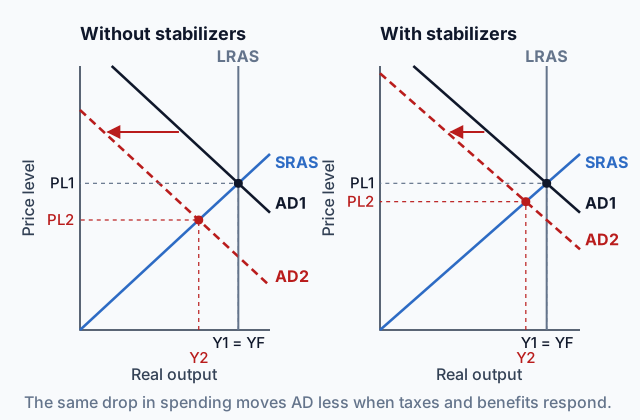
Both changes leave money with households, so disposable income falls by less than income does. Households spend out of disposable income, so consumption falls by less as well. Consumption is part of aggregate demand, so AD shifts left by less than it otherwise would, and real output and employment fall by less.
How much a tax absorbs depends on how it is charged. A tax that takes a bigger share of each dollar absorbs more of the fall. A fee that is the same whatever a household earns absorbs none of it.
That is how stabilizers support the economy in a recession and keep it from falling further. Notice what they do not do: the recession still happens. The fall is smaller.
Quick check · Decide and justify
A recession cuts households' total income before taxes by $80 billion. The country's income tax and unemployment insurance work as they always have, and no new law is passed. Compared with the $80 billion fall in income, how does disposable income change?
Which reason supports your choice?
2c. When real GDP rises
The same rules run the other way in an expansion. Say incomes across an economy rise by $100 billion and the income tax takes 25 cents of each extra dollar. Tax revenue rises by $25 billion with no vote, so disposable income rises by only $75 billion. Fewer people collect unemployment benefits too, which trims the growth of disposable income a little more.
Slower growth in disposable income means slower growth in consumption, so AD rises by less than it otherwise would. A smaller rise in AD means a smaller rise in the price level and less pressure to push output past full employment. Keeping that push smaller is what it means to stop the economy from overheating.
When you explain a stabilizer in writing, give it as a chain: start from the change in income, end at aggregate demand, and make each link the cause of the next. Write every link: one you skip leaves a gap in the explanation.
Quick check · Put it in order
An economy is in an expansion, and no tax or benefit law changes. Tap the steps in the order they happen.
2d. Not self-adjustment, and not a cure
Automatic stabilizers and long-run self-adjustment (3.7) both pull the economy back toward full employment, so they are easy to mix up. Keep them apart by the curve each one moves.
- Automatic stabilizers work through aggregate demand, in the short run. Taxes and transfers change disposable income, which changes consumption.
- Self-adjustment works through short-run aggregate supply, over the long run. Nominal wages, other input prices and inflationary expectations adjust, and SRAS shifts.
If your explanation of a stabilizer mentions wages or SRAS, you have written the other answer. If your explanation of self-adjustment mentions taxes or unemployment benefits, the same mistake runs the other way.
Stabilizers also moderate the business cycle; they do not end it. Joaquin's benefits replaced part of his pay, not all of it, so his spending still fell.
To sort an event, ask: is it a tax or transfer rule responding to income on its own? Then it is automatic. Did someone decide or vote? Discretionary. Is it wages and SRAS? Neither: that is self-adjustment.
Quick check · Sort it
Each event happens in an economy with an income tax and an unemployment insurance program. Tap an event, then tap where it belongs.
Automatic stabilizer
Discretionary fiscal policy
Neither
Part 3 Watch it done A recession in Marrow
Watch each step, then do the last one yourself.
Marrow, a fictional economy, falls into a recession. Its real GDP falls by $250 billion; assume household income before taxes falls by the same $250 billion. Marrow's income tax takes 20 cents of each dollar of income. As layoffs spread, payments from its unemployment insurance program rise by $35 billion. No new law is passed. By how much does disposable income fall?
Step 1 · If nothing cushioned it
Disposable income is income minus taxes plus transfers. If taxes and transfers stayed where they were, disposable income would fall by the full $250 billion.
Step 2 · Taxes respond
The income tax takes 20 cents of each dollar, so $250 billion less income means 0.20 × $250 billion = $50 billion less tax collected.
Why this step?
Why does tax revenue fall when no one cut a tax rate?
The rate is still 20 cents per dollar, but it is charged on a smaller income. Tax revenue is the rate times the income, so it falls when income falls. That is what makes the income tax an automatic stabilizer.
Step 3 · Transfers respond
Unemployment insurance pays $35 billion more to laid-off workers under the rules Marrow already had.
Your step · Calculate
In a recession in Marrow, household income before taxes falls by $250 billion. Income tax revenue falls automatically by $50 billion, and unemployment insurance payments rise by $35 billion. By how many billions of dollars does disposable income fall?
billion dollars
Income fell $250 billion and disposable income fell $165 billion. The other $85 billion was cushioned by rules Marrow had before the recession started, so consumption, and with it aggregate demand, falls by less than the fall in income alone would cause.
Part 4 Try it Two neighbors, one shock
Northland and Southland are neighboring economies of the same size, and both start at full employment. Northland charges an income tax and runs an unemployment insurance program. Southland pays for its government with a fixed yearly fee, the same for every household, and has no unemployment insurance. Then both are hit by the same sharp drop in construction of new office buildings.
Try it · Multiple choice
Northland's tax is a share of income and it pays unemployment insurance. Southland charges every household the same fixed fee and pays no unemployment insurance. Both suffer the same drop in office construction. Compared with where each started, what happens to real output in the short run?
Try it · Select all
During a recession, payments from a country's unemployment insurance program rise by $40 billion under rules already in law. Which two of these follow in the short run? Select two.
Select 2 answers, then check.
Part 5 Explain it Explain it, link by link
Nothing you type leaves this page.
Free response is 33.35% of the exam score. This one is shaped like Question 3, Short.
Free-response practice · Question 3 style
Assume the economy of Lindora is in long-run equilibrium. (a) Draw a correctly labeled graph of aggregate demand and aggregate supply showing LRAS at full-employment output labeled YF, the equilibrium price level labeled PL1 and real output labeled Y1. (b) Businesses in Lindora sharply increase their spending on new warehouses and equipment. On your graph, show the short-run effect, labeling the new price level PL2 and real output Y2. (c) As real output changes in part (b), will transfer payments from Lindora's unemployment insurance program increase, decrease, or stay the same? Explain. (d) Explain how Lindora's automatic stabilizers would limit the change in real output in the short run.
Model answer
(a) Price level on the vertical axis and real output on the horizontal, with a downward-sloping AD1, an upward-sloping SRAS and a vertical LRAS at YF. AD1 and SRAS cross on LRAS at PL1 and Y1, so Y1 equals YF. (b) An arrow shows AD shifting right from AD1 to AD2. Where AD2 crosses SRAS, PL2 is above PL1 and Y2 is to the right of Y1, both marked on the axes with dashed lines. (c) Transfer payments decrease. With more output, firms hire more workers, so fewer people are unemployed and qualify for benefits. (d) As real income rises, income tax revenue rises automatically and transfer payments fall, so disposable income rises by less than income. Consumption therefore grows more slowly, and aggregate demand and real output rise by less than they otherwise would.
Score your own answer. This is a self-check, not a grade. Tick each point your answer makes.
Part 6 Check yourself Read the record
Read the table and the notes around it before you answer.
Unemployment insurance in the United States pays benefits to eligible workers who lose their jobs. Most of it runs under state and federal rules already in law when a recession starts, but Congress can also vote changes during a downturn.
The table uses figures from FRED, the Federal Reserve Bank of St. Louis database, read on October 14, 2026. The unemployment rate is the average of the year's twelve monthly rates. All benefits is the Bureau of Economic Analysis total of unemployment insurance benefits paid to persons. Emergency benefits is the part of that total paid by emergency unemployment compensation, a program Congress created in a law approved June 30, 2008.
That program is not the only vote inside these numbers. The American Recovery and Reinvestment Act, approved February 17, 2009, extended the emergency program, added $25 a week to regular benefits, had the federal government pay the full cost of extended benefits for the rest of 2009, and lengthened extended benefits for railroad workers. The emergency column counts only the emergency program, so the $25 a week and the other 2009 changes are not in it, and these figures cannot separate them from benefits paid under the old rules.
| 2007 | 2009 | |
|---|---|---|
| Unemployment rate (average) | 4.6% | 9.3% |
| All benefits (billions of dollars) | 32.7 | 131.2 |
| Emergency benefits (billions of dollars) | 0.0 | 44.0 |
The table stops before 2020, when the mix is far harder to read. In the monthly version of the all-benefits total, benefits rose from $25.7 billion in February 2020 to $1,366.1 billion in June 2020, both at a seasonally adjusted annual rate. But the CARES Act, approved March 27, 2020, added $600 a week to regular benefits, and the series does not separate that vote from the automatic rise.
Sources: FRED series UNRATE, W825RC1A027NBEA, B1590C1A027NBEA and W825RC1.
Case question 1 · Calculate
In 2009, U.S. unemployment insurance benefits totaled $131.2 billion, and $44.0 billion of that total was emergency unemployment compensation, a program Congress created by law in 2008. What percent of 2009's benefits was emergency unemployment compensation? Round to the nearest whole percent.
Case question 2 · Decide and justify
U.S. unemployment insurance benefits rose from $32.7 billion in 2007 to $131.2 billion in 2009, and $44.0 billion of the 2009 total was emergency unemployment compensation, which Congress created in June 2008. A student says the whole rise came from automatic stabilizers. Is the student right?
Which reason supports your choice?
Case question 3 · Multiple choice
U.S. unemployment insurance paid $131.2 billion in benefits in 2009, with unemployment averaging 9.3%. Suppose households and businesses then spend more each year, hiring picks up for several years, and no law about benefits changes. What happens to benefits paid, and why?
The rest stand on their own and do not use the case.
Check yourself · Match
In each of four economies, household income before taxes falls by $100 billion in a recession, and no tax or benefit law changes. Benefits are not taxed in any of them. Match each economy's rules to how much its disposable income falls.
Check yourself · Spot the error
A student was asked to explain how automatic stabilizers limit the rise in real output during a boom. Tap the first line where the explanation goes wrong.
Part 7 Keep it Keep it
From 3.8 Fiscal Policy · Decide and justify
In Sorrel, the unemployment rate is 3.1 percent, the natural rate of unemployment is 4.6 percent, and prices are rising quickly. Which kind of fiscal policy should Sorrel's government use?
Which reason supports your choice?
From 2.3 Unemployment · Sort it
Tap a worker, then tap the type of unemployment that describes them.
Frictional
Structural
Cyclical
In three lines
- Automatic stabilizers are tax and transfer rules already in law that respond to real GDP with no new vote.
- In a recession tax revenue falls and transfers rise, so disposable income, consumption and AD fall by less.
- In a boom tax revenue rises and transfers fall, slowing consumption; wages and SRAS are self-adjustment, not stabilizers.
Exam strategy for this topic
- Section I, Multiple Choice: 60 questions in 70 minutes.
- Section II, Free Response: 3 questions in 60 minutes.
- This lesson's Explain it is shaped like free-response question 3, Short.
- A four-function calculator is allowed on both sections of the exam.
Write a stabilizer explanation as a chain from the change in income to tax revenue and transfers, then disposable income, consumption and aggregate demand, with each link causing the next. If your answer mentions wages or SRAS, you have explained self-adjustment instead.
Questions students ask
If no one cuts tax rates, how does tax revenue fall in a recession?
The tax is a share of income, so the same rate on a smaller income collects less. With a tax of 20 cents per dollar, a $250 billion fall in income means $50 billion less tax collected.
Do automatic stabilizers stop recessions?
No. They make the swing smaller. Benefits replace only part of lost pay, so spending and output still fall, just by less.
Is a tax rebate that Congress passes during a recession an automatic stabilizer?
No. Someone had to decide on it and vote for it, so it is discretionary fiscal policy.
How do stabilizers keep a boom from overheating?
Suppose incomes rise by $100 billion and the income tax takes 25 cents of each extra dollar. Tax revenue rises by $25 billion with no vote, so disposable income rises by only $75 billion, consumption grows more slowly, and AD rises by less.
How are automatic stabilizers different from self-adjustment?
Stabilizers work through aggregate demand in the short run, by changing taxes, transfers and disposable income. Self-adjustment works through SRAS over the long run, as wages, input prices and inflationary expectations change.
Course alignment, for teachers
AP Macroeconomics topic 3.9, Unit 3: National Income and Price Determination.
- Skill 1.A: Describe economic concepts, principles, or models.
This lesson maps all 4 essential knowledge statements of the topic to the part that teaches each one: 4 are checked by a scored question. The map is in the lesson file.