Unit 4 · Topic 4.1 · about 30 minutes · 7 parts · 12 scored checks, 1 of them multiple choice, plus 2 from earlier lessons
AP Macroeconomics 4.1: Financial Assets
Unit 4: 18 to 23% of the multiple-choice section
What you'll be able to do
- Define liquidity, rate of return and risk, and use them to compare money, bonds and stocks, and explain why the price of a previously issued bond moves opposite to interest rates.
Key vocabulary
| Term | What it means | The exam trap |
|---|---|---|
| Financial assets | Things people own that hold value as money or as a claim to money, such as cash, demand deposits, bonds and stocks. | Students sometimes leave money off the list, but cash and demand deposits are financial assets too, just the most liquid ones, so a question comparing financial assets includes money. |
| Liquidity | How quickly and easily an asset can be used to pay for things at its full value. | High liquidity does not mean high return: cash is the most liquid asset there is and earns nothing, so never pick the most liquid choice as the best earner. |
| Rate of return | What an asset earns in a year, as a percent of what was paid for it. | A low rate of return is not the same as high risk, so a checking account that earns little is still the least risky choice, not the riskiest. |
| Risk | How uncertain an asset's future value and earnings are. | Read risk as uncertainty in both directions: shares that could double could also lose most of their value, and that spread is exactly what makes them risky. |
| Demand deposits | Balances in checking accounts, which the bank pays out whenever the owner asks. | Checking balances count as money right alongside cash, so do not treat money as only bills and coins when a question asks for the most liquid forms. |
| Bonds | Interest-bearing assets: loans to a government or company that promises set interest payments and repayment on a set date. | When interest rates rise, the price of an older bond falls, because its yearly payment was fixed when it was issued and a new bond now pays more for the same price. |
| Stocks | Equity: shares of ownership in a company, with no promised payment or repayment date. | Calling a stock a loan is the classic slip: a stock is ownership, called equity, with no promised payment, while the bond is the loan. |
| Opportunity cost of holding money | The interest that could have been earned by holding other financial assets, such as bonds, instead of money. | Cash that is still $2,000 at year's end was not free to hold; its cost is the interest bonds would have paid, and that cost rises when interest rates rise. |
 Tap to open the picture full size
Part 1 Think first Selling a bond after rates go up
Guess before you learn. A wrong guess still makes the answer stick.
Predict first
Last year Delia paid $1,000 for a newly issued government bond that pays her $30 in interest every year. This year, newly issued government bonds of the same kind pay $50 a year for each $1,000. Delia needs her money now, so she will sell her bond to another investor. What price can she most likely get?
In short. Financial assets differ in how easily they can be spent, what they earn and how sure that is; money is the easiest to spend, and the other assets people hold in its place earn interest or a share of a company.
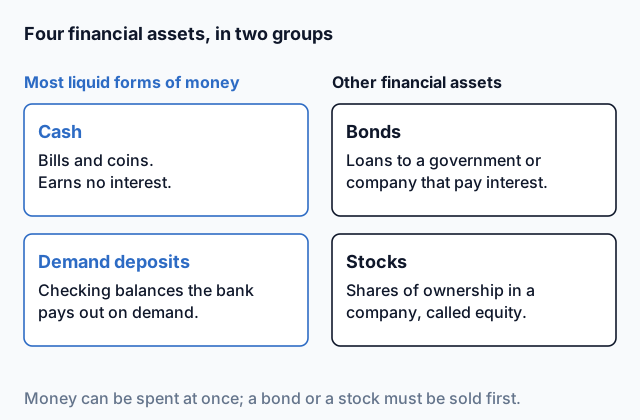
- Cash and demand deposits are the most liquid forms of money.
- A bond is an interest-bearing loan to whoever issued it, and a stock is a share of ownership, called equity.
- A bond already issued keeps its fixed yearly payment, so its price changes when interest rates on new bonds change, and the interest money could have earned is the opportunity cost of holding it.
Part 2 Learn it Four short ideas, each checked as you go
2a. Liquidity, rate of return and risk
A financial asset is something you own that holds value as money or as a claim to money: cash, a bank balance, a bond, a share of stock. Three questions tell them apart.
- Liquidity: how quickly can you use it to pay for something, at its full value?
- Rate of return: what does it earn in a year, as a percent of what you paid for it?
- Risk: how sure can you be of what it will be worth and what it will earn?
The most liquid forms of money are cash and demand deposits. A demand deposit is the balance in a checking account. The bank pays it out whenever you ask, and a debit card or a check spends it on the spot. A $50 bill and $50 in checking both buy $50 of groceries right now.
Other assets, such as bonds and stocks, have to be sold before you can spend them, and selling in a hurry can bring back less than you paid. Liquidity has a price, though: cash earns nothing, and a checking balance earns little or nothing.
Quick check · Select all
Which two of these are the most liquid forms of money? Select two.
Select 2 answers, then check.
2b. Bonds and stocks
People who want to earn more than money pays can hold other financial assets in its place. The two you need are bonds and stocks.
A bond is a loan. Buy a newly issued $1,000 bond and you have lent $1,000 to the government or company that issued it. The issuer promises you interest, a set number of dollars every year, and promises to repay the $1,000 on a set date. That is why a bond is called an interest-bearing asset.
A stock is a share of ownership in a company, which is why stock is called equity. A stockholder is promised no payment and no repayment date. If the company does well, its shares can become worth more; if it does badly, they can lose much of their value. That lack of any promise is a large part of the risk of owning stock.
Neither one is as liquid as money. To spend a bond or a stock, you sell it first, at whatever price buyers will pay that day.
Quick check · Sort it
Each card describes one financial asset. Tap a card, then tap the kind of asset it describes.
Bond
Stock
2c. Why older bonds lose value when interest rates rise
Here is the Think first answer. A bond's yearly payment is fixed on the day it is issued. Interest rates on new bonds are not fixed; they rise and fall over time.
Delia's bond pays $30 a year. When she bought it, a new $1,000 bond paid $30, so $1,000 was a fair price. Now a new $1,000 bond pays $50. If she asks $1,000 for hers, nobody buys: the same $1,000 gets $50 a year instead of $30. She has to cut her price until her $30 a year is as good a deal as a new bond. So when interest rates rise, the price of previously issued bonds falls.
It works the other way too. Suppose rates on new bonds fall instead, so a new $1,000 bond pays only $20. Delia's $30 a year now beats it, buyers compete for her bond, and its price rises above $1,000.
The price of previously issued bonds and interest rates on bonds move in opposite directions.
Quick check · Decide and justify
Three years ago Jonah paid $1,000 for a newly issued bond that pays $60 a year. Today, newly issued bonds of the same kind pay 3% a year, which is $30 for each $1,000. If Jonah sold his bond today, would a buyer pay more or less than $1,000 for it?
Which reason supports your choice?
2d. What it costs to hold money
Cash in a drawer earns nothing, but it can seem free to hold: put $2,000 away in January and there is still $2,000 in December. It is not free. Had you used that $2,000 to buy bonds paying 4% a year, you would have earned $80 by December. Holding money meant giving that up.
The opportunity cost of holding money is the interest you could have earned by holding other financial assets, such as bonds, instead. In this case it is $80 for the year.
That cost moves with interest rates. If bonds paid 6%, the same $2,000 held as cash would give up $120 of interest in a year. At 1%, it would give up only $20. The higher interest rates on bonds are, the more it costs to hold money.
So everyone holding wealth makes a trade. Money is the most liquid asset there is, and the price of that liquidity is the interest it does not earn.
Quick check · Fill the statement
Tap a blank, then tap a phrase.
Keeping $1,000 in cash for a year has an opportunity cost of . If interest rates on bonds rise, that opportunity cost .
Part 3 Watch it done Pricing an older bond after rates rise
Watch each step, then do the last one yourself.
Rafael owns a $1,000 government bond that is repaid one year from today. On that day it pays him its last $40 of interest along with the $1,000. It was issued when new bonds paid 4% a year. Today newly issued bonds of the same kind pay 6% a year. Assume a buyer pays the price that earns the buyer 6% over the year, the same as a new bond. What will a buyer pay for Rafael's bond now?
Step 1 · Compare it with a new bond
A new $1,000 bond now pays 6% of $1,000, which is $60 a year. Rafael's bond pays $40. For the same $1,000, a buyer gets $20 less over the year from Rafael's bond.
Step 2 · Decide which way the price moves
No buyer pays $1,000 for $40 of interest when $1,000 buys $60. Rafael has to cut his price, so it falls below $1,000. It keeps falling until everything the bond pays out next year is 6% more than what the buyer paid for it.
Why this step?
Why does the price stop falling there instead of dropping further?
Below that price, the buyer would earn more than 6% over the year, a better deal than a new bond. Buyers would compete for Rafael's bond and push its price back up.
Your step · Calculate
Finish it. A $1,000 bond is repaid one year from today, when it pays its last $40 of interest along with the $1,000. Newly issued bonds of the same kind now pay 6% a year. A buyer will pay the price that earns the buyer 6% over the year. What is that price, to the nearest dollar?
The interest rate on new bonds rose from 4% to 6%, and the price of Rafael's bond fell from $1,000 to about $981. It fell only a little because he gets his $1,000 back in a year. A bond with many years left would fall much further, since its $40 a year is stuck below the new rate for all those years. The direction holds for every bond: rates up, price down.
Part 4 Try it Choose where the money goes
Try it · Decide and justify
The treasurer of a school robotics club holds $600 in dues that must pay for a bus to a competition in two weeks. She can keep the money in the club's checking account, or buy a bond that pays 5% a year and is repaid in ten years. Where should the $600 go?
Which reason supports your choice?
Try it · Match
Tap an asset, then tap the description that fits it.
Part 5 Explain it Write it the way the exam asks
Nothing you type leaves this page.
Free response is 33.35% of the exam score. This one is shaped like Question 3, Short.
Free-response practice · Question 3 style
Assume that interest rates on newly issued bonds in Norvasta rise from 3 percent to 5 percent.
(a) Will the price of previously issued bonds in Norvasta increase, decrease, or stay the same? Explain.
(b) Identify the opportunity cost of holding money.
(c) As a result of the rise in interest rates, will the opportunity cost of holding money increase, decrease, or stay the same? Explain.
Model answer
(a) The price of previously issued bonds decreases. Their yearly interest payments were fixed when rates were lower, so a new bond now pays more for the same price, and buyers will pay less for an older bond. (b) The opportunity cost of holding money is the interest that could have been earned by holding other financial assets, such as bonds. (c) It increases, because a person who holds money now gives up interest at 5 percent instead of 3 percent.
Score your own answer. This is a self-check, not a grade. Tick each point your answer makes.
Part 6 Check yourself Read the interest rates
Read the table first, then answer both questions from it.
Teravia, a fictional country, reports the interest rate on newly issued government bonds each year:
| Year | Interest rate |
|---|---|
| Year 1 | 2% |
| Year 2 | 5% |
| Year 3 | 3% |
| Year 4 | 6% |
Case question 1 · Multiple choice
A long-term Teravian government bond issued in Year 1 pays a fixed $20 a year for every $1,000 it cost. Assume nothing affects its price except the interest rate on newly issued Teravian government bonds. In which year would it sell for the lowest price?
Case question 2 · Calculate
A Teravian household kept $8,000 in cash through all of Year 2 instead of using it to buy newly issued government bonds paying that year's rate. What was the opportunity cost of holding that cash for Year 2, in dollars?
The rest stand on their own and do not use the case.
Check yourself · Put it in order
Interest rates on newly issued bonds rise. Tap these events in the order they happen for a bond that was issued a year earlier.
Check yourself · Spot the error
A student worked out what it cost Kai to keep $4,000 in cash for a year when bonds paid 3% a year. Tap the first line that goes wrong.
Check yourself · Select all
Ines has $1,000 to put away for five years. She compares a checking account that pays 0.5% a year, a government bond that pays 4% a year, and shares in a young company that pay nothing now and could double in value or lose most of it. Which two statements are true? Select two.
Select 2 answers, then check.
Part 7 Keep it Keep it
From 3.9 Automatic Stabilizers · Decide and justify
A recession cuts households' total income before taxes by $80 billion. The country's income tax and unemployment insurance work as they always have, and no new law is passed. Compared with the $80 billion fall in income, how does disposable income change?
Which reason supports your choice?
From 2.6 Real v. Nominal GDP · Decide and justify
Morvik's nominal GDP rose from $800 billion in Year 1 to $832 billion in Year 2, and its GDP deflator rose from 100 to 104. Did Morvik produce more output in Year 2 than in Year 1?
Which reason supports your choice?
In three lines
- Cash and demand deposits are the most liquid forms of money, and they earn little or nothing.
- A bond is an interest-bearing loan to its issuer; a stock is a share of ownership, or equity.
- When interest rates rise, older bond prices fall and holding money gives up more interest.
Exam strategy for this topic
- Section I, Multiple Choice: 60 questions in 70 minutes.
- Section II, Free Response: 3 questions in 60 minutes.
- This lesson's Explain it is shaped like free-response question 3, Short.
- A four-function calculator is allowed on both sections of the exam.
When rates change, write the bond price direction and the reason in the same sentence: the older bond's payment is fixed, so a higher rate on new bonds pushes its price down. If a part also asks about holding money, name the interest given up as the opportunity cost before you say which way it moves.
Questions students ask
Why would anyone hold cash if it earns nothing?
Because it is the most liquid asset there is. Money you need in two weeks belongs in cash or a checking account, since selling a bond that soon could bring back less than you paid.
Why does an old bond lose value when interest rates go up?
Its yearly payment was fixed when it was issued. If yours pays $30 a year and a new $1,000 bond pays $50, nobody pays $1,000 for yours, so you have to cut the price until it is as good a deal as a new one.
Is a bond a loan or something you own?
Both, in a sense: you own the bond, and the bond is a loan you made to the government or company that issued it. A stock is different. It makes you a part owner of the company, with no payment promised.
How do I calculate the opportunity cost of holding money?
Multiply the money held by the interest rate bonds would have paid. Keeping $8,000 in cash for a year when bonds pay 5% gives up $400.
Does a bond's price change if interest rates fall?
Yes, it rises. A $1,000 bond paying $60 a year beats a new bond paying $30, so buyers compete for it and pay more than $1,000.
Course alignment, for teachers
AP Macroeconomics topic 4.1, Unit 4: Financial Sector.
- Skill 1.D: Describe the similarities, differences, and limitations of economic concepts, principles, or models.
This lesson maps all 4 essential knowledge statements of the topic to the part that teaches each one: 4 are checked by a scored question. The map is in the lesson file.