Unit 4 · Topic 4.2 · about 30 minutes · 7 parts · 11 scored checks, 1 of them multiple choice, plus 2 from earlier lessons
AP Macroeconomics 4.2: Nominal v. Real Interest Rates
Unit 4: 18 to 23% of the multiple-choice section
What you'll be able to do
- Define the nominal and real interest rates, explain how changes in the nominal interest rate, expected inflation and the real interest rate are related, and calculate the nominal and real interest rates.
Key vocabulary
| Term | What it means | The exam trap |
|---|---|---|
| Nominal interest rate | The rate of interest paid for a loan, unadjusted for inflation. | The rate printed on a loan or a savings account is the nominal rate, so a question that quotes a bank's posted rate has not given you the real rate yet. |
| Real interest rate | The interest rate with inflation taken out; in hindsight, the nominal interest rate minus the actual inflation rate. | Subtract inflation from the nominal rate, never add it, and expect a negative answer whenever actual inflation is higher than the nominal rate. |
| Expected real interest rate | The real interest rate lenders and borrowers expect when a loan is made: the nominal interest rate minus expected inflation. | This one uses expected inflation and is known on the day the loan is signed, so it matches the real rate in hindsight only if inflation comes in exactly as forecast. |
| Expected inflation | The inflation rate lenders and borrowers expect over the life of a loan, which they add to the expected real interest rate to set the nominal interest rate. | A rise in expected inflation raises the nominal rate on new loans even when nobody wants a bigger real return, while loans already signed keep the rate written in them. |
 Tap to open the picture full size
Part 1 Think first Two savers, two countries
Guess before you learn. A wrong guess still makes the answer stick.
Predict first
Lucia and Hamid each kept their savings in a bank for the same year, in different countries. Lucia's bank paid 9% interest, and prices where she lives rose 8% that year. Hamid's bank paid 3% interest, and prices where he lives rose 1%. Whose savings grew more in what they could actually buy?
In short. The nominal interest rate counts dollars, and the real interest rate counts what those dollars can buy.
- The nominal interest rate is the rate written on a loan or an account, with no adjustment for inflation.
- When a loan is made, lenders and borrowers set the nominal rate from the real return they want and the inflation they expect.
- Once the year is over, the real rate depends on the inflation that actually happened, not the forecast, and it can be below zero.
Part 2 Learn it Four short ideas, each checked as you go
2a. The rate on the paper
Every loan comes with an interest rate. If a bank lends $10,000 for a year at 6%, the borrower pays back $10,600. That 6% is the nominal interest rate: the rate of interest paid for a loan, counted in dollars, with no adjustment for inflation.
Dollars are only half the story. If prices rose during that year, the $10,600 the bank gets back buys less than $10,600 bought on the day it made the loan. What a lender really cares about is how much more it can buy once it is repaid. That growth in buying power is the real interest rate.
A savings account works the same way. A deposit is a loan to the bank, and the rate the bank posts is a nominal rate. It tells you how many dollars you will have. It says nothing about prices.
Quick check · Fill the statement
Tap a blank, then tap a word.
A dairy farm's loan agreement lists an interest rate of 6.9% a year. That rate is the interest rate. It is for inflation, so what it measures is the extra the farm pays back.
2b. The real rate, in hindsight
Once the loan is over and you know what prices did, you can work out the real rate:
real interest rate = nominal interest rate − actual inflation rate
A 6% loan in a year when prices rose 2% gave the lender a real rate of 6 − 2 = 4%. The bank got 6% more dollars, but each dollar bought about 2% less, so its buying power grew about 4%.
This works only in hindsight. It uses the inflation that actually happened, and nobody knows that number until the year is over.
The real rate can be negative. Suppose a savings account pays 1% and prices rise 3%. The real rate is 1 − 3 = −2%. The saver ends the year with more dollars, but they buy about 2% less than the money she put in. Any time actual inflation is higher than the nominal rate, the real rate is below zero. And when prices fall, the real rate is higher than the nominal rate.
Quick check · Calculate
Marco kept his savings in an account that paid a nominal interest rate of 1.5% for the year. When the year began, forecasters expected inflation of 2.0%. Over the year, prices actually rose 4.0%. What real interest rate did Marco earn, in hindsight? Give a negative number if it is negative.
2c. Setting the rate before anyone knows
A lender has to name a rate before the year's inflation is known. So it starts from two things it can plan on: the real return it wants and the inflation it expects. The borrower runs the same numbers from the other side, and they settle on
nominal interest rate = expected real interest rate + expected inflation
If a bank wants a real return of 3% and expects prices to rise 4%, it asks for about 3 + 4 = 7%. A borrower who also expects 4% inflation can accept 7%, because she expects to repay in dollars that buy about 4% less than the ones she borrowed.
This is why rates on new loans climb when people start expecting more inflation, even if nobody wants a bigger real return. The real part holds still, the inflation part grows, and the nominal rate grows with it. Loans already signed keep the rate written in them.
Quick check · Calculate
A bank wants an expected real interest rate of 2.5% on one-year loans to small businesses, and it expects inflation of 3.5% over the year. What nominal interest rate should it charge?
2d. Reading a rate backward
The same equation can be turned around, so any one of its three numbers can be found from the other two:
- expected inflation = nominal rate − expected real rate
- expected real rate = nominal rate − expected inflation
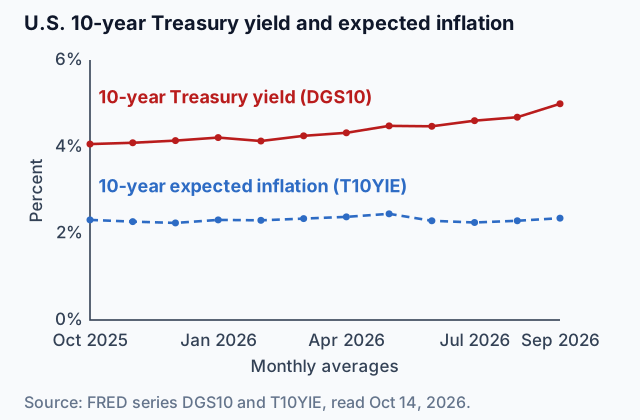
The second line is how you read a real market. In the graph at the top of this page, the 10-year Treasury yield is a nominal rate, and the breakeven inflation rate is the inflation investors expect. The distance between the two lines is the real return investors expected. From October 2025 to September 2026 the yield rose while expected inflation barely moved, so nearly all of that rise was in the expected real part.
Keep the two real rates apart. The expected real rate uses expected inflation and is known the day a loan is made. The real rate in hindsight uses actual inflation and is known only at the end. They match only when inflation comes in exactly as expected.
Quick check · Calculate
A water utility and its bank agree on a one-year loan at a nominal interest rate of 8.2%. Both sides are aiming for an expected real interest rate of 3.4%. What inflation rate are they expecting over the year?
Part 3 Watch it done One loan, two real rates
Watch each step, then do the last one yourself.
A veterinary clinic borrows $80,000 for one year to buy an X-ray machine, at a nominal interest rate of 7.5%. When they sign, the clinic and its bank both expect inflation of 2.5%. Over the year, prices actually rise 4.0%. Compare the real rate both sides expected with the real rate the bank actually earned.
Step 1 · The real rate they expected
On signing day, the only inflation anyone has is a forecast. Expected real rate = nominal rate − expected inflation = 7.5 − 2.5 = 5.0%. That is the real return the bank was counting on and the real cost the clinic agreed to.
Why this step?
Why can't the bank use the 4.0% when it signs?
Nobody knows the actual inflation rate until the year is over. On signing day both sides can only use what they expect, so the nominal rate is built from expected inflation.
Step 2 · A year later
The contract still says 7.5%. What the year adds is the actual inflation rate, 4.0%, and that number now takes the forecast's place in the real-rate calculation. The real rate the bank earned, and how far it landed from 5.0%, are yours to work out.
Your step · Calculate
A one-year loan carries a nominal interest rate of 7.5%. Both sides expected 2.5% inflation, and prices actually rose 4.0%. What is the realized real interest rate minus the expected real interest rate? Give a negative number if the realized rate is lower.
percentage points
Part 4 Try it Every direction
Before you calculate, find one word in the question: expected or actual. A rate set when a loan is made can only use expected inflation. A real rate in hindsight uses actual inflation.
Try it · Calculate
A school district sold two-year bonds paying a nominal interest rate of 4.6% a year. When investors bought them, they expected inflation to average 2.1% a year. Over the two years, inflation actually averaged 3.0% a year. What real interest rate a year did investors expect to earn when they bought the bonds?
Part 5 Explain it Write it the way the exam asks
Nothing you type leaves this page.
Free response is 33.35% of the exam score. This one is shaped like Question 2, Short.
Free-response practice · Question 2 style
In the country of Tarsa, a bank agrees to make a one-year loan to a hotel. Before they sign, the bank and the hotel both expect an inflation rate of 3% for the year, and the bank wants an expected real interest rate of 4%. (a) Calculate the nominal interest rate the bank will charge. Show your work. (b) Over the year, the actual inflation rate is 5%. Calculate the real interest rate on the loan. Show your work. (c) Is the real interest rate the bank earned higher than, lower than, or equal to the real interest rate it expected? Explain.
Model answer
(a) Nominal interest rate = expected real interest rate + expected inflation = 4% + 3% = 7%. (b) Real interest rate = nominal interest rate − actual inflation = 7% − 5% = 2%. (c) Lower. Actual inflation, 5%, was higher than the 3% the bank expected, so the real interest rate it earned, 2%, is below the 4% it expected.
Score your own answer. This is a self-check, not a grade. Tick each point your answer makes.
Part 6 Check yourself Read real rates from U.S. data
Read the table first, then answer both questions from it.
These figures were read on October 14, 2026 from FRED, the economic data site of the Federal Reserve Bank of St. Louis. Buying a U.S. Treasury security is lending to the federal government. The 10-year breakeven inflation rate is, in FRED's words, what market participants expect inflation to be in the next 10 years, on average. The FRED series are DGS1 and DGS10 for the Treasury yields, CPIAUCSL for the consumer price index for all urban consumers, and T10YIE for the breakeven rate.
| Series | Date | Value |
|---|---|---|
| 1-year Treasury yield | Oct 1, 2025 | 3.62% |
| Consumer price index | Sep 2025 | 324.245 |
| Consumer price index | Sep 2026 | 336.298 |
| 10-year Treasury yield | Oct 13, 2026 | 5.21% |
| 10-year breakeven inflation | Oct 13, 2026 | 2.33% |
Case question 1 · Calculate
On October 1, 2025, a one-year U.S. Treasury security paid a nominal yield of 3.62%. The consumer price index was 324.245 in September 2025 and 336.298 in September 2026. Using the percent change in that index as the actual inflation rate for the year, what real interest rate did a buyer earn in hindsight? Give the percent to the nearest tenth, as a negative number if it is negative.
Case question 2 · Multiple choice
On October 13, 2026, the 10-year U.S. Treasury yield was 5.21% and the 10-year breakeven inflation rate, a measure of the inflation investors expect over those ten years, was 2.33%. Which statement about investors who bought a 10-year Treasury security that day is best supported?
The rest stand on their own and do not use the case.
Check yourself · Decide and justify
In the country of Corvia, banks and borrowers have long expected inflation of about 2% a year and have settled on an expected real interest rate of 3%. A new forecast convinces everyone that prices will rise about 6% a year from now on, and the expected real rate both sides want stays at 3%. What happens to the nominal interest rate on new one-year loans?
Which reason supports your choice?
Check yourself · Match
Tap each calculation, then tap what it gives you.
Check yourself · Sort it
Each line describes one year of a loan, an account or a bond. Tap each, then tap the real interest rate it earned in hindsight.
Above zero
Exactly zero
Below zero
Part 7 Keep it Keep it
From 4.1 Financial Assets · Put it in order
Interest rates on newly issued bonds rise. Tap these events in the order they happen for a bond that was issued a year earlier.
From 2.6 Real v. Nominal GDP · Spot the error
An economy's nominal GDP is $800 billion and its GDP deflator is 125. A student converts nominal GDP to real GDP. Tap the first line that goes wrong.
In three lines
- The nominal rate is the dollar rate on a loan, unadjusted for inflation.
- When a loan is made: nominal rate = expected real rate + expected inflation.
- In hindsight: real rate = nominal rate − actual inflation, and it can be negative.
Exam strategy for this topic
- Section I, Multiple Choice: 60 questions in 70 minutes.
- Section II, Free Response: 3 questions in 60 minutes.
- This lesson's Explain it is shaped like free-response question 2, Short.
- A four-function calculator is allowed on both sections of the exam.
Write the equation in words before the numbers, for example "real rate = nominal rate minus actual inflation", then substitute. Circle whether the stem says expected or actual inflation, because that word decides which equation you use.
Questions students ask
How do I find the real interest rate?
Subtract the inflation rate from the nominal rate. A loan at 7% in a year when prices rose 5% earned a real rate of 2%.
Can a real interest rate really be negative?
Yes. If a savings account pays 1.5% and prices rise 4%, the real rate is negative 2.5%. You end the year with more dollars that buy less than the money you put in.
Why do banks charge more when people expect more inflation?
Lenders and borrowers set the nominal rate as the expected real rate plus expected inflation. If the real part they want stays at 3% and expected inflation climbs from 2% to 6%, the rate on new loans climbs from about 5% to about 9%.
What is the difference between the expected real rate and the real rate in hindsight?
The expected real rate is the nominal rate minus the inflation people forecast, so it is known on signing day. The real rate in hindsight subtracts the inflation that actually happened, which nobody knows until the year is over.
If I know the nominal rate and the expected real rate, can I find expected inflation?
Yes, take the real part out of the nominal rate. A loan at 8.2% with an expected real rate of 3.4% means both sides expect inflation of 4.8%.
Course alignment, for teachers
AP Macroeconomics topic 4.2, Unit 4: Financial Sector.
- Skill 1.A: Describe economic concepts, principles, or models.
This lesson maps all 3 essential knowledge statements of the topic to the part that teaches each one: 3 are checked by a scored question. The map is in the lesson file.