Unit 4 · Topic 4.3 · about 30 minutes · 7 parts · 10 scored checks, 2 of them multiple choice, plus 2 from earlier lessons
AP Macroeconomics 4.3: Definition, Measurement, and Functions of Money
Unit 4: 18 to 23% of the multiple-choice section
What you'll be able to do
- Define money and the jobs it does, and calculate measures of the money supply from data.
Key vocabulary
| Term | What it means | The exam trap |
|---|---|---|
| Money | Any asset that is accepted as a means of payment. | A credit card is not money, and neither is its unused limit: the swipe arranges a loan, and the debt is settled later with cash or a checking deposit. |
| Medium of exchange | The job money does when it is handed over to settle a trade, so people do not have to barter. | Look for money changing hands to settle a trade, such as a plumber being paid $150; if the money is only measuring a price, the job is unit of account instead. |
| Unit of account | The job money does when prices are stated in it, so different goods can be compared and added on one scale. | Prices stated in dollars so goods can be compared or added up are this job, even though no money changes hands in the example. |
| Store of value | The job money does when it holds buying power from now until later, though inflation can reduce what it buys. | Inflation weakens money as a store of value without ending it, so $500 kept through a year of rising prices still stored most of its buying power. |
| Money supply | The total amount of money in an economy, measured with monetary aggregates such as M1 and M2. | Credit card balances are debts, not money, so households borrowing more on cards does not add to the money supply. |
| Monetary aggregates | Measures of the money supply that add up particular groups of assets, such as M1 and M2. | Every asset in M1 is also in M2, so M2 is always the larger total, and a move between two M1 assets changes neither aggregate. |
| M1 | Under the Federal Reserve's current definitions, currency held by the public plus demand deposits and other liquid deposits, including savings deposits. | Savings deposits belong in M1 under the Federal Reserve's current definitions, so a question using those definitions wants them counted, though older books show them in M2 only. |
| M2 | M1 plus small-denomination time deposits and retail money market fund balances. | Moving money from checking into a small time deposit lowers M1 but leaves M2 unchanged, because the money only moved from one part of M2 to another. |
| Monetary base (M0 or MB) | Currency in circulation plus bank reserves. | Deposits are not in the monetary base; it is only currency in circulation plus bank reserves, so do not add checking balances to it. |
| Bank reserves | Money banks hold for themselves, as cash in their vaults or as balances at the central bank. | Reserves are in the monetary base but not in M1, because they are money banks hold for themselves rather than money households and firms can spend. |
 Tap to open the picture full size
Part 1 Think first Cash, a checking account and a credit card
Guess before you learn. A wrong guess still makes the answer stick.
Predict first
Dalia has $35 in her wallet, $420 in her checking account and a credit card with $1,500 of credit she has not used. Counting only what an economist calls money, how much money does Dalia have?
In short. Money is any asset people accept as a means of payment, and economists measure how much of it an economy has with M1, M2 and the monetary base.
- Money serves as a medium of exchange, a unit of account and a store of value.
- M1 counts currency and the most spendable deposits; M2 adds small time deposits and retail money market funds.
- The monetary base is currency in circulation plus bank reserves, and bank reserves are not part of M1.
Part 2 Learn it Four short ideas, each checked as you go
2a. What makes something money
Money is any asset that people accept as a means of payment. If a seller takes it and you no longer owe anything, it is money.
That covers more than bills and coins. The balance in a checking account is money too. When you pay with a debit card or a payment app, the dollars move from your account to the seller's and the purchase is settled. The card is only a way to reach the deposit; the deposit is the money.
A credit card works differently. When you swipe it, the card company pays the store, and now you owe the card company. The card arranged a loan. Your debt is settled later, when you pay the bill with cash or with money from your checking account. So neither a credit card nor its unused limit is money.
Other assets have value without being money. A share of stock or a used car could be worth a lot, but a store will not take either one at the register. You would have to sell it for money first.
Quick check · Decide and justify
Kofi pays for a $60 dinner with his credit card. A month later he pays the card bill from his checking account. Is the credit card money?
Which reason supports your choice?
2b. Three jobs money does
Money is useful because it does three jobs.
As a medium of exchange, money is what changes hands in a trade. Without it you would have to barter: a baker who wants a haircut would need to find a barber who happens to want bread. With money, the baker sells bread to anyone and pays any barber.
As a unit of account, money is the yardstick for prices. Because everything is priced in dollars, you can compare a $1,200 laptop with a $900 one, or add a year of rent, food and phone bills into one total.
As a store of value, money holds buying power so you can spend it later. You are paid on Friday and buy groceries next week. It is not a perfect store: inflation shrinks what each dollar buys. But a dollar kept through a year of 3 percent inflation still buys about 97 cents' worth of what it bought before, so it still stores most of its value.
To sort an example, ask what the money is doing in it: changing hands, measuring a price, or waiting to be spent.
Quick check · Sort it
Tap an example, then tap the job money is doing in it.
Medium of exchange
Unit of account
Store of value
2c. Measuring money: M1 and M2
The money supply is measured with monetary aggregates: groups of assets added together. The two you need are M1 and M2. Using the Federal Reserve's current definitions:
- M1 is currency held by the public, plus demand (checking) deposits, plus other liquid deposits, which include savings deposits. You can spend all of these right away or nearly so.
- M2 is M1 plus small-denomination time deposits (certificates of deposit under $100,000) and balances in retail money market funds. These take a step or a wait before you can spend them. (The Fed also subtracts money held in retirement accounts, a detail the tables in this lesson leave out.)
Everything in M1 is also in M2, so M2 is always the larger total.
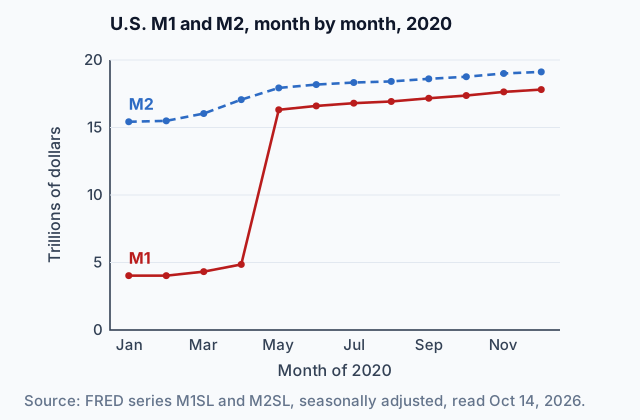
Watch savings deposits. Until 2020 the Fed counted them in M2 but not M1, as many books still do. On April 24, 2020 the Fed dropped its limit of six withdrawals or transfers a month from savings accounts, so savings became about as easy to spend as checking. On December 17, 2020 the Fed announced that savings deposits would move into M1. The change took effect with its February 23, 2021 money supply release, which counted savings in M1 for every month from May 2020 on. (Source: the Federal Reserve's H.6 Technical Q&As.) Questions here that sort savings deposits name their definitions. If a test question gives its own definition of M1 or M2, use that definition.
Quick check · Multiple choice
In late April 2020 the Federal Reserve removed its limit of six withdrawals or transfers a month from savings accounts. FRED series M1SL and M2SL (Federal Reserve data, seasonally adjusted) show U.S. M1 rising from $4,856.4 billion in April 2020 to $16,312.5 billion in May 2020, while M2 rose only from $17,064.0 billion to $17,931.9 billion. What best explains the jump in M1?
2d. The monetary base
The monetary base, often labeled M0 or MB, is currency in circulation plus bank reserves. Reserves are money banks hold for themselves: cash in their vaults and the balances they keep in accounts at the central bank. In the invented economies on this page, the currency row is currency held by the public and cash in bank vaults sits inside reserves, so no dollar is counted twice.
The base and M1 overlap, but they are different measures. Currency held by the public is in both. Bank reserves are in the base but not in M1, because M1 counts what households and firms can spend, and reserves belong to banks. Checking and savings deposits are in M1 but not in the base: they are what banks owe their customers, not currency or reserves.
Today M1 is far larger than the base. In August 2026, M1 was $19,991.1 billion (FRED series M1SL, seasonally adjusted) and the monetary base was $5,411.6 billion (BOGMBASE, not seasonally adjusted). Most of the money people spend is bank deposits, and 4.4 shows where deposits come from.
Quick check · Fill the statement
Tap a blank, then tap a phrase.
The monetary base is currency in circulation plus . Bank reserves are counted in , while checking deposits held by the public are counted in .
Part 3 Watch it done Three measures from one table
Watch each step, then do the last one yourself.
Tarvania's central bank measures M1 and M2 the way the Federal Reserve does today, and it measures the monetary base as currency held by the public plus bank reserves. Its figures, in billions of dollars: currency held by the public, 85; checking (demand) deposits, 240; savings deposits, 410; small-denomination time deposits, 70; retail money market fund balances, 125; bank reserves (vault cash and deposits at the central bank), 160. Find M1, M2 and the monetary base.
Step 1 · M1: what the public can spend now
Add currency held by the public, checking deposits and savings deposits: $85 + $240 + $410 = $735 billion. Bank reserves stay out, because they belong to banks.
Why this step?
Why do savings deposits go in M1 here?
The problem says Tarvania uses the Federal Reserve's current definitions, and since May 2020 those count savings deposits in M1. Under the older definition they would sit in M2 only.
Step 2 · M2: add the less liquid accounts
Start from M1 and add small time deposits and retail money market funds: $735 + $70 + $125 = $930 billion. Reserves stay out of M2 for the same reason they stay out of M1.
Your step · Calculate
Tarvania's central bank measures its monetary base as currency held by the public plus bank reserves, with cash in bank vaults counted in reserves. Its figures, in billions of dollars: currency held by the public, 85; checking deposits, 240; savings deposits, 410; small-denomination time deposits, 70; retail money market fund balances, 125; bank reserves (vault cash and deposits at the central bank), 160. What is Tarvania's monetary base, in billions of dollars?
billion dollars
Part 4 Try it Measure the real money supply
The Federal Reserve reports the pieces of the U.S. money supply every month in its H.6 release, and FRED, run by the Federal Reserve Bank of St. Louis, republishes each one as a series. The table shows August 2026, the latest month posted when this lesson was written (read October 14, 2026).
| Component (source) | August 2026 |
|---|---|
| Currency held by the public (FRED CURRSL) | 2,389.7 |
| Demand deposits (FRED DEMDEPSL) | 7,128.0 |
| Other liquid deposits, including savings deposits (FRED MDLM) | 10,473.5 |
| Small-denomination time deposits (FRED STDSL) | 1,505.6 |
| Retail money market funds (FRED RMFSL) | 3,073.9 |
| Reserve balances at the Federal Reserve (H.6, not seasonally adjusted) | 2,936.0 |
The last row counts only the balances banks keep at the Federal Reserve. Cash in bank vaults is in neither that row nor currency held by the public, so adding those two rows does not give the monetary base. The Fed counts vault cash in currency in circulation instead.
Try it · Calculate
In August 2026, in billions of dollars, U.S. currency held by the public was 2,389.7; demand deposits 7,128.0; other liquid deposits, including savings deposits, 10,473.5; small-denomination time deposits 1,505.6; retail money market funds 3,073.9; and reserve balances at the Federal Reserve 2,936.0 (FRED and the Fed's H.6 release). Using the Federal Reserve's current definitions, what was U.S. M1, in billions of dollars, to one decimal place?
Part 5 Explain it Write it the way the exam asks
Nothing you type leaves this page.
Free response is 33.35% of the exam score. This one is shaped like Question 3, Short.
Free-response practice · Question 3 style
(a) Define money. (b) Nkechi pays a $300 phone bill with her credit card. Is the credit card money? Explain. (c) Nkechi then moves $2,000 from her checking account into a one-year certificate of deposit (a small-denomination time deposit) at the same bank. Using the Federal Reserve's current definitions, what happens to M1 and to M2? Explain.
Model answer
(a) Money is any asset that is accepted as a means of payment. (b) No. The card company pays the phone company and Nkechi now owes the card company, so the card arranged a loan. The debt is settled later when she pays the card bill with money, such as her checking deposit. (c) M1 decreases by $2,000 and M2 does not change. Checking deposits count in both M1 and M2, but a small time deposit counts only in M2, so the $2,000 leaves M1 and stays in M2.
Score your own answer. This is a self-check, not a grade. Tick each point your answer makes.
Part 6 Check yourself Measure money from the data
Read the table first, then answer both questions from it.
Lunessa, a fictional economy, measures money with the Federal Reserve's current definitions. Its central bank reported these year-end figures.
| Item | Amount |
|---|---|
| Currency held by the public | 64 |
| Checking (demand) deposits | 188 |
| Savings deposits | 297 |
| Small-denomination time deposits (under $100,000) | 52 |
| Retail money market fund balances | 91 |
| Bank reserves (vault cash and deposits at the central bank) | 120 |
| Credit card balances owed by households | 45 |
Case question 1 · Calculate
Using the Federal Reserve's current definitions and the table of Lunessa's money and credit, what is Lunessa's M2, in billions of dollars?
Case question 2 · Multiple choice
Using the table of Lunessa's money and credit, suppose households move $30 billion out of savings deposits and into small-denomination time deposits under $100,000. Using the Federal Reserve's current definitions, what is Lunessa's M1 after the move?
The rest stand on their own and do not use the case.
Check yourself · Select all
Which two of these are money? Select two.
Select 2 answers, then check.
Check yourself · Spot the error
During a year when prices rose 30 percent, Maren kept $500 in a drawer to spend on a trip the next summer. A student wrote this analysis. Tap the first line with a mistake.
Part 7 Keep it Keep it
From 4.2 Nominal v. Real Interest Rates · Calculate
A bank wants an expected real interest rate of 2.5% on one-year loans to small businesses, and it expects inflation of 3.5% over the year. What nominal interest rate should it charge?
From 3.8 Fiscal Policy · Multiple choice
Which of these is a reason discretionary fiscal policy acts with a lag?
In three lines
- Money is any asset accepted as a means of payment; a credit card arranges a loan instead.
- Money works as a medium of exchange, a unit of account and a store of value.
- M1 includes savings deposits under the Fed's current definitions, M2 adds less liquid accounts, and the monetary base is currency plus bank reserves.
Exam strategy for this topic
- Section I, Multiple Choice: 60 questions in 70 minutes.
- Section II, Free Response: 3 questions in 60 minutes.
- This lesson's Explain it is shaped like free-response question 3, Short.
- A four-function calculator is allowed on both sections of the exam.
When a question gives a table and asks for M1, M2 or the monetary base, write which rows you are adding before you add them. If the question gives its own definition of M1 or M2, use that definition.
Questions students ask
Is my debit card money?
The card is not, but the checking balance it reaches is. Paying by debit moves dollars from your account to the seller's and settles the purchase on the spot.
Why are savings deposits in M1 now?
In April 2020 the Federal Reserve dropped its limit of six withdrawals or transfers a month from savings accounts, so savings became about as easy to spend as checking. The Fed then moved savings deposits into M1, counting them there from May 2020 on.
What is the difference between M1 and the monetary base?
Currency held by the public is in both. Bank reserves are in the base but not M1, and checking and savings deposits are in M1 but not the base.
If inflation shrinks what money buys, how is it a store of value?
A store of value does not have to be perfect. After a year of 3 percent inflation, a dollar still buys about 97 cents' worth of what it bought before, so it held most of its value.
How do I calculate M2 from a table?
Build M1 first from currency, demand deposits and savings deposits, then add small-denomination time deposits and retail money market funds. Leave out bank reserves and any credit card balances.
Course alignment, for teachers
AP Macroeconomics topic 4.3, Unit 4: Financial Sector.
- Skill 1.B: Identify an economic concept, principle, or model illustrated by an example.
This lesson maps all 4 essential knowledge statements of the topic to the part that teaches each one: 4 are checked by a scored question. The map is in the lesson file.