Unit 4 · Topic 4.4 · about 30 minutes · 7 parts · 14 scored checks, 1 of them multiple choice, plus 2 from earlier lessons
AP Macroeconomics 4.4: Banking and the Expansion of the Money Supply
Unit 4: 18 to 23% of the multiple-choice section
What you'll be able to do
- Define the terms of banking and money creation, explain how banks expand the money supply by lending, and calculate the effects of banking changes using data and balance sheets.
Key vocabulary
| Term | What it means | The exam trap |
|---|---|---|
| Balance sheet | A record, often drawn as a T-account, of what a depository institution owns (assets) on one side and what it owes (liabilities) plus owner's equity on the other. | Both sides of a T-account must total the same, so a cash deposit raises reserves on the asset side and demand deposits on the liability side by the same amount. |
| Fractional reserve banking | A system in which banks hold only a fraction of their deposits as reserves and lend out the rest. | Lending, not depositing, is where new money comes from: a cash deposit only changes the form of money that was already counted. |
| Required reserves | The reserves a bank must hold, equal to the required reserve ratio times its demand deposits. | Apply the ratio to demand deposits, never to total reserves, loans or assets, so 20 percent of Fernhill's $450,000 in deposits is $90,000. |
| Excess reserves | A bank's reserves above its required reserves, the amount it can lend. | One bank can lend only its excess reserves, so after a $5,000 cash deposit at a 20 percent ratio it can lend $4,000, not the $20,000 the whole system might create. |
| Required reserve ratio | The fraction of demand deposits a bank is required to hold as reserves. | Raising the ratio leaves total reserves where they were and cuts excess reserves, so a bank with no cushion can suddenly be short. |
| Money multiplier | The ratio of the money supply to the monetary base; its maximum value is 1 divided by the required reserve ratio. | The maximum is 1 ÷ the required reserve ratio, 5 at 20 percent, not 1 ÷ (1 minus the ratio), and it is a ceiling the real expansion falls short of. |
| Monetary base | Currency in circulation plus bank reserves. | When the central bank buys bonds with new reserves, the monetary base rises by the purchase, while the money supply in a limited-reserves system can rise by up to the multiplier times that amount. |
 Tap to open the picture full size
Part 1 Think first Cash out of the shoebox
Guess before you learn. A wrong guess still makes the answer stick.
Predict first
Nasir has kept $5,000 in cash in a shoebox for years. Today he deposits all of it into his checking account. At the moment the deposit is made, what happens to the amount of money in the economy?
In short. Banks create money when they lend out the reserves they hold beyond what the required reserve ratio demands, and the money multiplier sets the most that lending can add to the money supply.
- A bank's balance sheet lists reserves, loans and bonds as assets, and demand deposits as its main liability.
- Required reserves are the required reserve ratio times demand deposits; reserves above that are excess reserves, which a bank can lend.
- The maximum money multiplier is 1 divided by the required reserve ratio, and real expansion falls short of it when banks keep excess reserves or the public holds more currency.
Part 2 Learn it Four short ideas, each checked as you go
2a. A bank's balance sheet
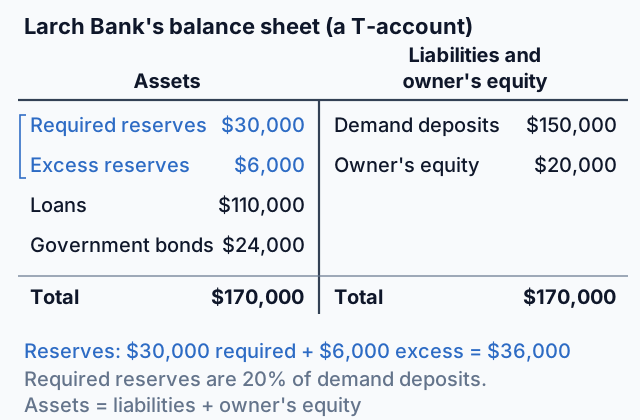
A bank, like any depository institution, records what it owns and what it owes on a balance sheet, usually drawn as a T-account. Assets go on the left: the bank's reserves, the loans it has made and any bonds it holds. Liabilities go on the right. The biggest is demand deposits, the money in customers' checking accounts, which the bank owes back whenever they ask. Owner's equity is what is left over, so the two sides always total the same.
A bank's reserves are the cash in its vault plus its deposits at the central bank. Where there is a reserve requirement, they split in two. Required reserves are the required reserve ratio times demand deposits. Excess reserves are any reserves above that. If the ratio changes, required reserves change with it, and so do excess reserves.
College Board's course framework draws a bank's balance sheet this way:
| Assets | Liabilities and owner's equity |
|---|---|
| Required reserves: $10,000 | Demand deposits: $100,000 |
| Excess reserves: $5,000 | Owner's equity: $0 |
| Loans: $85,000 |
Quick check · Calculate
Bank A's balance sheet shows assets of $10,000 in required reserves, $5,000 in excess reserves and $85,000 in loans, and liabilities of $100,000 in demand deposits with $0 of owner's equity. What required reserve ratio is the bank meeting, in percent?
2b. Lending creates money
Banks run on fractional reserve banking: they keep a fraction of their deposits as reserves and lend out the rest. That is how banks create money.
Take Nasir's $5,000 in Esterra, an invented economy whose banks have limited reserves and a required reserve ratio of 20 percent. Limited reserves means banks hold little beyond what they are required to, so new reserves they receive get lent out. Count the money supply as currency the public holds plus checking deposits. The deposit leaves it unchanged, but his bank's balance sheet changes: reserves and demand deposits each rise by $5,000. Twenty percent of the new reserves is required. The rest is excess.
Excess reserves are what a single bank can lend. Say it lends them to a carpenter by adding them to her checking account. Now there is new money: a deposit that did not exist before, while Nasir still has his $5,000. When she pays a supplier, the money lands in another bank, which keeps its required share and lends its own excess, and the rounds continue.
Moving money from one bank to another changes no total. A cash withdrawal runs a deposit backward: the money supply stays the same, but the bank loses reserves.
Quick check · Fill the statement
Tap a blank, then tap an amount.
In Esterra, an invented economy with limited reserves and a required reserve ratio of 20 percent, Nasir deposits $5,000 of cash. His bank's total reserves rise by , its required reserves rise by , and the most this one bank can now lend is .
2c. The money multiplier
Each round of lending is smaller than the one before, because each bank keeps its required share. In Esterra the first bank lends 80 percent of the new reserves, the next bank lends 80 percent of that, and the rounds shrink toward zero.
The money multiplier is the ratio of the money supply to the monetary base (currency in circulation plus bank reserves). Its maximum value is 1 ÷ the required reserve ratio, so 1 ÷ 0.20 = 5 in Esterra. That maximum assumes every bank lends all its excess reserves and every dollar lent comes back as a deposit.
The size of the expansion depends on the multiplier:
- Most new money from lending = new excess reserves × multiplier.
- Most new demand deposits from a new deposit of reserves = that deposit × multiplier.
When a cash deposit starts it, multiply the excess reserves, not the whole deposit. The cash was money already.
This story describes a banking system with limited reserves, which is why Esterra is invented. The banking system in the United States has ample reserves: banks already hold far more reserves than they need, so the multiplier story does not describe how U.S. money is created today. 4.6 shows how the Federal Reserve works in that system.
Quick check · Calculate
Esterra is an invented economy whose banks have limited reserves and a required reserve ratio of 20 percent. Banks there lend all their excess reserves, and every loan is redeposited. Count the money supply as currency held by the public plus checking deposits. Someone deposits $3,000 of cash into a checking account. What is the maximum increase in the money supply that results, in dollars?
2d. Why real expansion is smaller
The multiplier gives a maximum, not a forecast. Two leaks make the real expansion smaller.
Banks may hold excess reserves instead of lending them, to be ready for withdrawals or because they see few safe borrowers. A dollar that stays in the vault starts no new round.
The public may hold more currency. If the carpenter keeps $500 of her loan as cash, that $500 never reaches a bank, so no bank keeps a share of it and lends the rest.
U.S. data from before 2020 show both. In August 2007, according to FRED (Federal Reserve Bank of St. Louis series TOTRESNS, REQRESNS and BOGMBASE, read October 14, 2026), banks held $44.9 billion of reserves when $40.1 billion was required, so about $4.8 billion sat as excess. The monetary base was $829.6 billion, so most of it was currency rather than bank reserves. The top required reserve ratio on checking deposits was then 10 percent (Federal Reserve Board), which puts the maximum multiplier at 10. The actual multiplier was far smaller.
Quick check · Decide and justify
Esterra is an invented economy whose banks have limited reserves and a required reserve ratio of 20 percent. Its banks receive $10 billion of new excess reserves, and an analyst says the money supply will now grow by exactly $50 billion. Will it?
Which reason supports your choice?
Part 3 Watch it done The central bank buys a bond from a dealer
Watch each step, then do the last one yourself.
Esterra is an invented economy whose banks have limited reserves and a required reserve ratio of 20 percent. Its central bank buys $6,000 of government bonds from a bond dealer and pays with newly created reserves. The dealer deposits the payment in her checking account at Bramwell Bank. Banks lend all their excess reserves, and every loan is redeposited. Find the maximum increase in the money supply.
Step 1 · What the deposit does
The dealer traded a bond, which is not money, for a $6,000 checking deposit, which is. So demand deposits rise by $6,000, and that $6,000 is new money. Bramwell Bank's reserves also rise by $6,000, so the monetary base rises by $6,000.
Why this step?
Why is the dealer's $6,000 new money when Nasir's $5,000 cash deposit was not?
Nasir's cash was already counted in the money supply, so depositing it only changed its form. The dealer's bond was not money, and the central bank paid for it with reserves that did not exist before.
Step 2 · Split the new reserves
Bramwell must hold 20 percent of the new $6,000 deposit: $1,200 required. The other $4,800 is excess reserves.
Your step · Calculate
Esterra is an invented economy whose banks have limited reserves and a required reserve ratio of 20 percent. Count the money supply as currency held by the public plus checking deposits. Its central bank buys $6,000 of bonds from a dealer, who deposits the payment in a checking account. Banks lend all excess reserves, and every loan is redeposited. Counting both the dealer's new deposit and the deposits that lending creates, what is the maximum total increase in the money supply, in dollars?
dollars
Part 4 Try it Work it in new situations
Real numbers. The multiplier is defined as the money supply divided by the monetary base, so you can compute it from data and compare it with the maximum.
Try it · Calculate
FRED, the Federal Reserve Bank of St. Louis data service, reports that in August 2007 U.S. M1 was $1,376.3 billion (series M1SL) and the monetary base was $829.6 billion (series BOGMBASE), both read on October 14, 2026. Taking M1 as the money supply, what was the money multiplier? Give your answer to two decimal places.
A withdrawal. When a customer takes out cash, the bank's reserves fall by the full amount, but its required reserves fall only by the ratio times that amount.
Try it · Calculate
Esterra is an invented economy whose banks have limited reserves and a required reserve ratio of 20 percent. One of its banks holds no excess reserves. A customer withdraws $1,000 in cash from her checking account there. By how many dollars are the bank's reserves now short of what it must hold?
A loan on the T-account. Record a transaction one row at a time: which side it touches, which row, and by how much. When you are done, the two sides must still total the same.
Try it · Fill the statement
Tap a blank, then tap a change.
Hollis Bank is in an invented economy with limited reserves and a required reserve ratio of 20 percent. It lends $3,000 to a carpenter by adding the money to her checking account at Hollis. She pays all $3,000 to a supplier who banks somewhere else, and the payment clears. Compared with before the loan, Hollis Bank's T-account shows, on the assets side, reserves and loans , and on the liabilities side, demand deposits .
Part 5 Explain it Write it the way the exam asks
Nothing you type leaves this page.
Free response is 33.35% of the exam score. This one is shaped like Question 3, Short.
Free-response practice · Question 3 style
Delmar is an invented economy whose banking system has limited reserves. The required reserve ratio is 25 percent. Quarry Bank's balance sheet is:
- Assets: reserves $32,000; loans $88,000.
- Liabilities and owner's equity: demand deposits $100,000; owner's equity $20,000.
A customer deposits $8,000 of cash into her checking account at Quarry Bank.
(a) Calculate Quarry Bank's required reserves after the deposit. Show your work.
(b) Calculate the maximum amount Quarry Bank can lend after the deposit. Show your work.
(c) Calculate the maximum change in the money supply in the banking system that results from the $8,000 deposit. Show your work.
(d) Will the actual change in the money supply be greater than, less than, or equal to your answer to part (c)? Explain.
Model answer
(a) Demand deposits rise to $108,000, so required reserves are 0.25 × $108,000 = $27,000. (b) Reserves rise to $32,000 + $8,000 = $40,000. Excess reserves are $40,000 − $27,000 = $13,000, the most Quarry Bank can lend. (c) The deposit adds $8,000 of reserves, of which 0.25 × $8,000 = $2,000 is required, so excess reserves rise by $6,000. The maximum money multiplier is 1 ÷ 0.25 = 4, so the money supply can rise by at most $6,000 × 4 = $24,000. The $8,000 itself does not count, because it was already money as currency. (d) Less than $24,000. Banks may keep some excess reserves instead of lending them, and a dollar that is not lent never becomes a deposit in the next round.
Score your own answer. This is a self-check, not a grade. Tick each point your answer makes.
Part 6 Check yourself Read a bank's balance sheet
Read the balance sheet first, then answer the questions from it.
Fernhill Bank is in Esterra, an invented economy whose banks have limited reserves. The required reserve ratio is 20 percent.
| Assets | Liabilities and owner's equity |
|---|---|
| Reserves: $100,000 | Demand deposits: $450,000 |
| Loans: $350,000 | Owner's equity: $50,000 |
| Government bonds: $50,000 |
Case question 1 · Calculate
What are Fernhill Bank's excess reserves, in dollars?
Case question 2 · Multiple choice
Esterra's central bank buys $10,000 of government bonds from Fernhill Bank and pays with newly created reserves. Fernhill and every bank after it lend all the excess reserves this purchase creates, and every loan is redeposited. Count the money supply as currency held by the public plus checking deposits. What is the maximum increase in Esterra's money supply that results from the purchase?
Case question 3 · Calculate
Esterra's central bank raises the required reserve ratio from 20 percent to 24 percent, and nothing on Fernhill Bank's balance sheet changes. By how many dollars are Fernhill's reserves now short of what it must hold?
The rest stand on their own and do not use the case.
Check yourself · Spot the error
Count the money supply as currency held by the public plus checking deposits. A student worked out the most that depositing $8,000 of cash could add to the money supply in Esterra, an invented economy whose banks have limited reserves and a required reserve ratio of 20 percent. Tap the first line with a mistake.
Check yourself · Put it in order
A customer deposits $10,000 of cash at a bank in an invented economy whose banks have limited reserves and a required reserve ratio of 20 percent. Every bank lends all its excess reserves, and each loan is spent and deposited at a different bank. Tap the events in the order they happen.
Check yourself · Sort it
Count the money supply as currency held by the public plus checking deposits. Tap each event, then tap its effect on the money supply at the moment it happens.
Creates new money
Leaves the money supply unchanged
Part 7 Keep it Keep it
From 4.3 Definition, Measurement, and Functions of Money · Select all
Which two of these are money? Select two.
Select 2 answers, then check.
From 3.2 Multipliers · Calculate
In Oakhurst the MPC is 0.9. The government raises taxes by $15 billion, and nothing else changes. What is the maximum change in aggregate demand, in billions of dollars? Give a negative number for a decrease.
In three lines
- Required reserves are the ratio times deposits; reserves beyond that are excess, and one bank can lend only its excess.
- Lending creates deposits, so the system can add at most the new excess reserves times 1 ÷ the required reserve ratio.
- Excess reserves banks keep and currency the public holds make the real expansion smaller than that maximum.
Exam strategy for this topic
- Section I, Multiple Choice: 60 questions in 70 minutes.
- Section II, Free Response: 3 questions in 60 minutes.
- This lesson's Explain it is shaped like free-response question 3, Short.
- A four-function calculator is allowed on both sections of the exam.
Write the excess reserves and the multiplier on separate lines before you multiply, for example $6,000 × (1 ÷ 0.25) = $24,000. Then say whether the cash deposit itself was already money, because that decides whether you add it in.
Questions students ask
Why doesn't depositing cash increase the money supply?
Cash held by the public is already counted in the money supply, and so is a checking deposit. Moving $5,000 from a shoebox into checking changes its form, not the total. New money appears only when the bank lends part of it out.
How do I find the maximum money multiplier?
Divide 1 by the required reserve ratio, written as a decimal. At 25 percent it is 1 ÷ 0.25 = 4.
Why is a bond purchase by the central bank different from a cash deposit?
The bond dealer traded something that is not money for a brand-new checking deposit, so her $6,000 is new money. Add the lending it supports, $4,800 × 5 = $24,000, and the money supply can rise by up to $30,000.
Why is the real increase in the money supply smaller than the formula says?
Banks may keep some excess reserves instead of lending them, and people may hold some of their loans as cash. Either way a round of lending stops early.
What happens to a bank's reserves when someone withdraws cash?
Reserves fall by the full amount, but required reserves fall only by the ratio times it. At 20 percent, a $1,000 withdrawal from a bank with no excess reserves leaves it $800 short.
Does the money multiplier describe the U.S. today?
Not well. The U.S. banking system has ample reserves, so banks already hold far more than they need, and the multiplier story fits a system with limited reserves.
Course alignment, for teachers
AP Macroeconomics topic 4.4, Unit 4: Financial Sector.
- Skill 3.C: Determine the effect(s) of a change in an economic situation using quantitative data or calculations.
This lesson maps all 8 essential knowledge statements of the topic to the part that teaches each one: 8 are checked by a scored question. The map is in the lesson file.