Unit 5 · Topic 5.4 · about 30 minutes · 7 parts · 11 scored checks, 1 of them multiple choice, plus 2 from earlier lessons
AP Macroeconomics 5.4: Government Deficits and the National Debt
Unit 5: 20 to 30% of the multiple-choice section
What you'll be able to do
- Define the government budget surplus or deficit and the national debt, and explain the issues involved in the burden of the national debt.
Key vocabulary
| Term | What it means | The exam trap |
|---|---|---|
| Government budget surplus | The amount by which tax revenue exceeds government purchases plus transfer payments in a given year. | Running one does not erase the national debt; a surplus only lets the government pay down part of what it already owes. |
| Government budget deficit | The amount by which government purchases plus transfer payments exceed tax revenue in a given year. | Shrinking deficits still add to the debt: a deficit that falls from $300 billion to $100 billion means the debt rises by less each year, not that it falls. |
| National debt | The total a government owes from its past borrowing, which grows whenever it runs a budget deficit. | Interest is charged on the whole accumulated debt, not only on this year's borrowing, so a debt of $5,000 billion at 3 percent costs $150 billion a year. |
| Transfer payments | Payments from the government to people, such as unemployment benefits, that buy no good or service in return. | Benefits and pensions buy no good or service, yet the government pays them out, so they count as outlays when you calculate the budget balance. |
| Government purchases | Government spending on goods and services, from salaries for public workers to new highways. | Purchases are only part of outlays, so comparing tax revenue with purchases alone, without transfer payments, understates a deficit or invents a surplus. |
 Tap to open the picture full size
Part 1 Think first The gap is shrinking
Guess before you learn. A wrong guess still makes the answer stick.
Predict first
Varno's government spends more than it collects in taxes every year and borrows to cover the gap. Over the next three years the gap shrinks, from $300 billion to $200 billion to $100 billion. What happens to the total amount Varno owes its lenders over those three years?
In short. A government budget deficit is the amount by which purchases plus transfer payments exceed tax revenue in one year, and the national debt is the total the government owes from borrowing to cover its deficits.
- The budget balance is tax revenue minus government purchases and transfer payments, for one year.
- The deficit is a flow, measured over one year; the national debt is a stock, the total owed on one date.
- Interest is charged every year on the whole accumulated debt, and it counts as an outlay that uses funds that could go elsewhere.
Part 2 Learn it Four short ideas, each checked as you go
2a. Surplus or deficit
Every year a government collects tax revenue and pays money out in two ways. Government purchases buy goods and services: teachers' salaries, fighter jets, highway repairs. Transfer payments hand money to people without buying anything in return: unemployment benefits, pensions for retirees, aid to low-income families. Purchases plus transfers are the government's outlays.
The budget for a year compares the two sides:
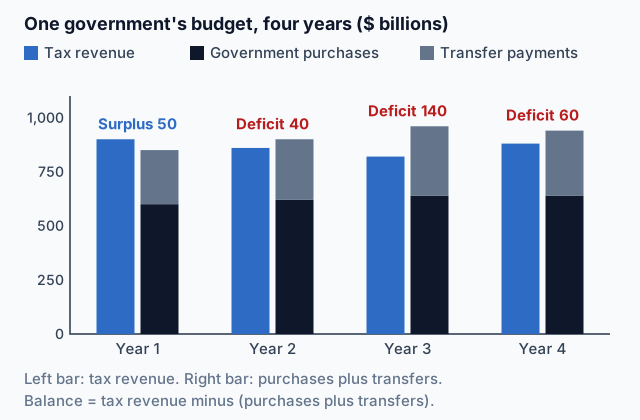
Budget balance = tax revenue − (government purchases + transfer payments)
If tax revenue is bigger, the government runs a budget surplus. If purchases plus transfers are bigger, it runs a budget deficit. If they are equal, the budget is balanced.
Transfers count. A government that buys $500 billion of goods and services and pays $200 billion in benefits has paid out $700 billion, even though the benefits bought nothing. And the balance covers one year. A deficit of $60 billion says that this year, outlays beat tax revenue by $60 billion. It says nothing about earlier years.
Quick check · Calculate
This year Norvell's government buys $820 billion of goods and services and makes $310 billion in transfer payments. It collects $1,050 billion in tax revenue. How large is Norvell's budget deficit this year, in billions of dollars?
2b. A deficit adds to the debt
A government that pays out more than it collects has to find the difference. It borrows, by selling bonds to households, firms, banks and foreign buyers. Each bond is a promise to repay the money later, with interest.
The national debt is the total the government owes from all that borrowing, built up over the years. So the two words measure different kinds of thing:
- The deficit is a flow: how much more went out than came in during one year.
- The debt is a stock: how much is owed on a particular date.
A credit card works the same way. Spending more than you pay off this month is the month's deficit. The balance on the statement is the debt.
When a government runs a deficit, it adds to the national debt. If it owes $2,000 billion at the start of a year and borrows to cover a $70 billion deficit, it owes $2,070 billion at the end.
That is what happened in Varno. Its deficit shrank, but every year was still a deficit, so every year added to what it owed. A smaller deficit slows the growth of the debt. It does not reverse it.
Quick check · Sort it
Tap a quantity, then tap the kind of measure it is.
Flow: measured across a period
Stock: measured on one date
2c. Interest on the debt
Lenders do not lend for free. Every year the government owes interest on its whole accumulated debt, not just on the newest borrowing. A debt of $3,000 billion at an average rate of 4 percent costs $3,000 billion × 0.04 = $120 billion in interest that year.
Interest is money the government pays out, and government budgets count it as an outlay alongside purchases and transfers. In this lesson, any question that includes interest says so.
The debt feeds itself. Interest makes the deficit bigger. A bigger deficit adds more to the debt, and next year's interest is charged on that bigger debt. Even with tax revenue, purchases and transfers frozen, the debt grows a little faster each year.
The money has other uses. Every dollar paid to bondholders as interest is a dollar the government cannot spend on schools or roads, pay out as benefits, or return as a tax cut, unless it borrows still more. The bigger the debt, the bigger the share of the budget that interest takes.
Quick check · Calculate
At the start of this year, Teskar's government owes $5,000 billion on its national debt, at an average interest rate of 3 percent a year. Last year it ran a budget deficit of $80 billion. How much interest does Teskar owe on its debt this year, in billions of dollars?
2d. Which deficit?
The word deficit turns up in two places in macroeconomics, and they are easy to mix up.
A government budget deficit is about one organization's money: the government's tax revenue against its purchases and transfers. A trade deficit is about the whole country's dealings with the rest of the world: it means imports are bigger than exports, so net exports, one of the parts of GDP, are negative.
The two can move separately. A country can import more than it exports while its government collects more in taxes than it pays out, and the reverse can happen too. So a question about the government's budget always has an answer in terms of revenue and outlays. Saying "net exports fell, so there is a deficit" answers a different question.
When a budget moves into deficit, say why in its own terms: government outlays now exceed tax revenue.
Quick check · Decide and justify
Arland's government had a balanced budget last year. This year it cuts income tax rates, so its tax revenue falls, and its purchases and transfer payments do not change. In the same year Arland's imports grow faster than its exports. Does the government's budget move into deficit this year?
Which reason supports your choice?
Part 3 Watch it done Three years of interest in Telmar
Watch each step, then do the last one yourself.
Telmar's national debt is $4,000 billion at the start of Year 1. Every year it collects $1,500 billion in tax revenue, buys $1,150 billion of goods and services and pays $450 billion in transfer payments. It also pays 3 percent interest on whatever it owes at the start of each year. Interest counts as a government outlay, and Telmar borrows exactly enough to cover each year's deficit. What is Telmar's national debt at the end of Year 3?
Step 1 · The gap before interest
Purchases plus transfers are $1,150 billion + $450 billion = $1,600 billion. That is $100 billion more than tax revenue every year, because none of the three numbers changes.
Step 2 · Year 1
Interest is 3 percent of $4,000 billion, which is $120 billion. So the deficit is $100 billion + $120 billion = $220 billion, and the debt ends Year 1 at $4,000 billion + $220 billion = $4,220 billion.
Step 3 · Year 2
Interest is 3 percent of $4,220 billion, which is $126.6 billion. The deficit is $100 billion + $126.6 billion = $226.6 billion, and the debt ends Year 2 at $4,446.6 billion.
Why this step?
Why is Year 2's interest larger than Year 1's?
Interest is charged on everything owed at the start of the year, and Telmar borrowed its whole Year 1 deficit. It now owes $4,220 billion, and 3 percent of that is more than 3 percent of $4,000 billion.
Your step · Calculate
Finish it. Telmar's national debt is $4,446.6 billion at the start of Year 3. That year it collects $1,500 billion in tax revenue, buys $1,150 billion of goods and services, pays $450 billion in transfer payments, and pays 3 percent interest on what it owes at the start of the year. Interest counts as a government outlay, and Telmar borrows exactly enough to cover the deficit. What is Telmar's national debt at the end of Year 3, in billions of dollars, to the nearest tenth?
billion dollars
The deficit grew from $220 billion to $233.4 billion over three years, while tax revenue, purchases and transfers never moved. All of that growth is interest on a debt that each deficit made larger.
Part 4 Try it Real numbers from the U.S. budget
The U.S. Office of Management and Budget (OMB) reports the federal government's receipts and outlays for each fiscal year, which runs from October 1 to September 30. The figures below are OMB's, read on October 14, 2026 from FRED, the Federal Reserve Bank of St. Louis's data site (series FYFR, FYONET and FYOINT, last updated April 3, 2026). Receipts are mostly taxes. Outlays include government purchases, transfer payments and interest on the debt.
| Measure | Fiscal year 2024 | Fiscal year 2025 |
|---|---|---|
| Receipts | 4,919.9 | 5,236.4 |
| Outlays, all | 6,735.3 | 7,011.1 |
| Of which, interest on the debt | 879.9 | 970.1 |
Interest is the line to watch. In fiscal year 2020 it was $345.5 billion, about 5.3 percent of outlays. By 2025 it was $970.1 billion, about 13.8 percent of outlays: money that went to bondholders instead of to anything else the government does.
Try it · Calculate
In fiscal year 2025, U.S. federal receipts were $5,236.4 billion. Federal outlays, including $970.1 billion of interest on the debt, were $7,011.1 billion (OMB figures on FRED, read October 14, 2026). How large was the federal budget deficit that year, in billions of dollars?
Try it · Decide and justify
The U.S. federal deficit was $1,815.4 billion in fiscal year 2024 and $1,774.7 billion in fiscal year 2025 (OMB figures on FRED). The Treasury's Debt to the Penny data, read October 14, 2026, show total public debt outstanding of $35,464.7 billion on September 30, 2024 and $37,637.6 billion on September 30, 2025. Did the smaller deficit in fiscal year 2025 reduce the national debt?
Which reason supports your choice?
Part 5 Explain it Write it the way the exam asks
Nothing you type leaves this page.
Free response is 33.35% of the exam score. This one is shaped like Question 2, Short.
Free-response practice · Question 2 style
Orleth, a fictional country, reports its government budget for two years.
- Year 1: tax revenue $900 billion, government purchases $600 billion, transfer payments $260 billion, interest paid on the national debt $40 billion.
- Year 2: tax revenue $870 billion, government purchases $640 billion, transfer payments $290 billion, interest paid on the national debt $40 billion.
Interest counts as a government outlay, and Orleth borrows to cover any deficit.
(a) Calculate Orleth's government budget balance in each year, and state whether each year has a surplus, a deficit or a balanced budget. Show your work.
(b) Will Orleth's national debt increase, decrease, or stay the same in Year 2? Explain.
(c) Explain how the change in the debt during Year 2 affects the interest Orleth must pay in Year 3, and what that means for the government's other uses of its funds.
Model answer
(a) Year 1: $900 billion − ($600 billion + $260 billion + $40 billion) = $0, so the budget is balanced. Year 2: $870 billion − ($640 billion + $290 billion + $40 billion) = −$100 billion, a deficit of $100 billion. (b) The national debt increases. Government outlays of $970 billion exceed tax revenue of $870 billion, and the government borrows to cover that deficit, which adds to the national debt. (c) Interest is paid on the whole accumulated debt, so a larger debt means larger interest payments in Year 3. Money paid as interest cannot be used for other purposes, such as purchases, transfer payments or tax cuts, unless the government borrows even more.
Score your own answer. This is a self-check, not a grade. Tick each point your answer makes.
Part 6 Check yourself Read a budget record
Read the case first, then answer both questions from it.
Selvia, a fictional country, owed $1,800 billion on its national debt at the start of Year 1. Interest payments count as government outlays, and Selvia borrows exactly enough to cover each year's deficit, so its debt grows by the amount of each deficit. Its finance ministry reported:
| Measure | Year 1 | Year 2 | Year 3 |
|---|---|---|---|
| Tax revenue | 700 | 720 | 760 |
| Government purchases | 520 | 530 | 540 |
| Transfer payments | 190 | 200 | 205 |
| Interest paid on the debt | 36 | 38 | 40 |
Case question 1 · Calculate
Selvia owed $1,800 billion at the start of Year 1. Its tax revenue was $700 billion, $720 billion and $760 billion in Years 1, 2 and 3; its government purchases were $520 billion, $530 billion and $540 billion; its transfer payments were $190 billion, $200 billion and $205 billion; and its interest payments, which count as outlays, were $36 billion, $38 billion and $40 billion. Selvia borrows exactly each year's deficit. What is Selvia's national debt at the end of Year 3, in billions of dollars?
Case question 2 · Multiple choice
Selvia's interest payments on its national debt rose from $36 billion in Year 1 to $40 billion in Year 3, and interest counts as a government outlay. Which statement about that rise is correct?
The rest stand on their own and do not use the case.
Check yourself · Decide and justify
Some lawmakers propose a rule that the government's budget must balance every year. Suppose the rule is in force and the budget is balanced when a recession begins. As incomes fall, income tax revenue falls automatically, and more people qualify for unemployment benefits under laws already in place. To obey the rule, would the government have to change tax rates or spending during the recession?
Which reason supports your choice?
Check yourself · Put it in order
A government with a large national debt runs a budget deficit this year. Interest counts as an outlay, and its tax revenue, purchases and transfer payments stay the same next year. Tap the steps in the order they happen.
Part 7 Keep it Keep it
From 5.3 Money Growth and Inflation · Calculate
In an economy, the money supply grows 9% a year, velocity stays constant, and real output grows 3% a year. Approximately what is the long-run inflation rate, in percent?
Northland and Southland are neighboring economies of the same size, and both start at full employment. Northland charges an income tax and runs an unemployment insurance program. Southland pays for its government with a fixed yearly fee, the same for every household, and has no unemployment insurance. Then both are hit by the same sharp drop in construction of new office buildings.
From 3.9 Automatic Stabilizers · Select all
During a recession, payments from a country's unemployment insurance program rise by $40 billion under rules already in law. Which two of these follow in the short run? Select two.
Select 2 answers, then check.
In three lines
- Budget balance = tax revenue − (government purchases + transfer payments), for one year.
- Every deficit is borrowed and adds to the national debt; a smaller deficit still adds.
- Interest on the whole debt is an outlay that adds to the debt and uses funds that could go elsewhere.
Exam strategy for this topic
- Section I, Multiple Choice: 60 questions in 70 minutes.
- Section II, Free Response: 3 questions in 60 minutes.
- This lesson's Explain it is shaped like free-response question 2, Short.
- A four-function calculator is allowed on both sections of the exam.
Write the budget balance as tax revenue minus government purchases and transfer payments, and add interest to outlays whenever the question says it counts. When asked about the debt, state whether it rises, falls or stays the same and tie that to whether the year's budget is in deficit.
Questions students ask
What is the difference between the deficit and the debt?
The deficit is a flow: how much outlays exceed tax revenue in one year. The debt is a stock: the total owed on one date, built up from past borrowing.
If the deficit gets smaller, does the national debt go down?
No. A smaller deficit is still a deficit, so the government still borrows and the debt still rises, only by less. The debt stops growing only when the budget is balanced or in surplus.
Do transfer payments count in the budget?
Yes. A government that buys $500 billion of goods and services and pays $200 billion in benefits has paid out $700 billion, even though the benefits bought nothing.
Why is interest on the debt a problem?
Interest is owed every year on the whole debt and counts as an outlay, so it makes each deficit bigger and the debt grows faster. Every dollar paid to bondholders is a dollar the government cannot spend on schools, roads or benefits, or give back as a tax cut, unless it borrows more.
Is a budget deficit the same as a trade deficit?
No. A budget deficit compares the government's outlays with its tax revenue, and a trade deficit compares a country's imports with its exports. The two can move separately.
How large were the recent U.S. deficit and interest bill?
OMB figures on FRED put fiscal year 2025 receipts at $5,236.4 billion and outlays at $7,011.1 billion, a deficit of $1,774.7 billion. Interest on the debt, $970.1 billion, was part of those outlays.
Course alignment, for teachers
AP Macroeconomics topic 5.4, Unit 5: Long-Run Consequences of Stabilization Policies.
- Skill 3.A: Determine the outcome of an economic situation using economic concepts, principles, or models.
This lesson maps all 3 essential knowledge statements of the topic to the part that teaches each one: 3 are checked by a scored question. The map is in the lesson file.