Unit 6 · Topic 6.1 · about 30 minutes · 7 parts · 12 scored checks, 1 of them multiple choice, plus 2 from earlier lessons
AP Macroeconomics 6.1: Balance of Payments Accounts
Unit 6: 10 to 13% of the multiple-choice section
What you'll be able to do
- Define the current account, the capital and financial account and the balance of payments, explain how a change in any of their parts changes a country's balance of payments, and calculate the CA, the CFA and the BOP.
Key vocabulary
| Term | What it means | The exam trap |
|---|---|---|
| Balance of payments (BOP) | The accounting system that records a country's international transactions for a period of time, made up of the current account and the capital and financial account. | When a question asks for the balance of payments, the answer is CA + CFA, which is zero, so a figure that is not zero is usually the current account reported by mistake. |
| Current account (CA) | The account that records a country's net exports, net income from abroad and net unilateral transfers. | Students often stop at net exports, but the current account also adds net income from abroad and net unilateral transfers, so a trade surplus can sit inside a current account deficit. |
| Balance of trade | A country's net exports, exports minus imports of goods and services, which is one part of the current account. | A trade surplus does not make the current account a surplus: Orvane's net exports were +25 while its current account was -15, because it paid out more in interest and dividends than it earned. |
| Net income from abroad | Income such as interest, dividends and wages that residents earn abroad, minus the same kinds of income foreigners earn in the country. | Interest and dividends earned on assets abroad go here in the current account, not in the CFA, because only the income crosses the border while the asset stays put. |
| Net unilateral transfers | Money received from abroad minus money sent abroad with nothing bought in return, such as gifts, aid and money workers send home. | Money a worker sends home is a transfer even though nothing is bought, so it is a current account debit for the country it leaves and a credit for the one it reaches. |
| Capital and financial account (CFA) | The single account that records financial capital transfers and purchases and sales of assets between countries. | Never split this into a capital account and a financial account moving in opposite directions; it is one account with one balance, and the whole offset to the current account shows up there. |
| Financial capital inflow and outflow | A CFA surplus is a net financial capital inflow, money coming in for the country's assets, and a CFA deficit is a net outflow. | Reading a CFA surplus as money leaving gets it backward: a surplus is a net inflow, foreigners buying more of the country's assets than its residents buy abroad. |
| Credit and debit | A credit is any transaction that makes money flow into a country, and a debit is any transaction that makes money flow out. | Ask only which way the money flows, so a Mirovian firm buying a factory abroad is a debit even though Mirovia gains an asset, and a foreigner buying a Mirovian bond is a credit. |
 Tap to open the picture full size
Part 1 Think first Spending more than you earn
Guess before you learn. A wrong guess still makes the answer stick.
Predict first
Ilse runs a small glassblowing studio, and it is her only source of income. This year she spent $8,000 more on rent, gas for the furnace and wages than the studio took in from selling glass. Nobody gave her any money, and every bill was paid in full and on time. Which of these must be true?
In short. The balance of payments is a country's record of every transaction with the rest of the world over a period of time, kept in two accounts: the current account (CA) and the capital and financial account (CFA).
- The current account records net exports, net income from abroad and net unilateral transfers, and it can show a surplus or a deficit.
- The capital and financial account is a single account that records purchases and sales of assets between countries and other financial capital transfers.
- Money flowing in is a credit and money flowing out is a debit, and the two accounts always sum to zero: CA + CFA = 0.
Part 2 Learn it Three short ideas, each checked as you go
2a. The current account
The balance of payments (BOP) is a country's record of its transactions with the rest of the world over a period of time, such as a year. It has two accounts. Start with the current account (CA), which records three things:
- Net exports: exports of goods and services minus imports. This is the balance of trade.
- Net income from abroad: interest, dividends and wages residents earn abroad, minus what foreigners earn here.
- Net unilateral transfers: money sent with nothing bought in return, such as gifts, government aid, and money a worker sends home to family.
Every entry is a credit if money flows into the country and a debit if money flows out. When a sports club in Kiravo pays a Mirovian architecture firm to design its stadium, money flows into Mirovia: a credit. When a Mirovian sends money to a cousin in Kiravo, money flows out: a debit, even though nothing was bought.
Credits minus debits gives the CA balance: positive is a surplus, negative a deficit. The balance of trade can point the other way from the whole CA, because income and transfers count too.
Quick check · Match
Each transaction is recorded in Mirovia's current account. Tap a part of the current account, then tap the transaction that belongs in it.
2b. The capital and financial account
The second account is the capital and financial account (CFA). It records financial capital transfers and purchases and sales of assets between countries: bonds, shares, bank deposits, buildings, whole companies.
The money rule is the same. When an investor in Kiravo buys a Mirovian government bond, money flows into Mirovia, so it is a CFA credit. When a Mirovian firm buys a factory in Kiravo, money flows out: a CFA debit.
A positive CFA balance is a CFA surplus, a net financial capital inflow: foreigners bought more Mirovian assets than Mirovians bought abroad. A negative balance is a CFA deficit, a net financial capital outflow.
Two traps sit here. The first is the name. "Capital and financial account" is one account with one balance. Never split it into a capital account and a financial account that move separately. The second is goods versus assets. A machine shipped in from abroad is an import, a current account debit, even if a firm uses it for twenty years. A factory bought abroad stays abroad and is owned as an asset, so it goes in the CFA.
Quick check · Sort it
Each transaction is recorded in Mirovia's balance of payments. Tap a transaction, then tap where Mirovia records it.
Current account credit
Current account debit
Capital and financial account credit
Capital and financial account debit
2c. Why the two accounts cancel
Every payment across a border has two sides. Suppose Mirovia imports $90 million more in goods and services than it exports, and its income and transfers are zero. Its CA is -90 (in millions).
Foreigners now hold $90 million of Mirovian money they did not spend on Mirovian goods, services, income or gifts. They buy Mirovian bonds, shares or buildings with it, or lend it back, and even leaving it in a Mirovian bank counts, because a deposit is an asset. Every one of those is money flowing back into Mirovia, a CFA credit. So the CFA is +90.
That is the rule. The sum of all credits matches the sum of all debits, so
CA + CFA = 0
A current account deficit comes with a CFA surplus of the same size, and a current account surplus comes with a CFA deficit. The two balances move in opposite directions.
Quick check · Calculate
Last year Kiravo's current account showed a surplus of $65 million. Using only that fact, what was Kiravo's capital and financial account balance, in millions of dollars? Enter a deficit as a negative number.
Part 3 Watch it done Orvane's year, account by account
Watch each step, then do the last one yourself.
Orvane, a fictional country, recorded these transactions with the rest of the world last year, in millions of dollars:
- Exports of goods: 640
- Imports of goods: 700
- Exports of services: 180
- Imports of services: 95
- Interest and dividends received from abroad: 40
- Interest and dividends paid abroad: 110
- Money sent home by Orvanians working abroad: 30
- Foreign investors buy bonds issued by Orvane companies: 260
- Orvane residents buy foreign shares and a hotel abroad: 245
Find Orvane's current account balance and its capital and financial account balance, and check the balance of payments.
Step 1 · Sort the lines
Seven of the nine lines belong in the current account: the trade in goods and services, the interest and dividends, and the money sent home. Ask whether money flows into Orvane or out. In: the exports, the income received and the money sent home. Those are credits. Out: the imports and the income paid. Those are debits. The last two lines are assets changing hands, so they belong in the capital and financial account. Leave them for the last step.
Why this step?
Why does the money sent home go in the current account when Orvane sold nothing for it?
It is a unilateral transfer, money sent with nothing bought in return, and the current account records net unilateral transfers. It flows into Orvane, so it is a credit.
Step 2 · Net exports
Exports minus imports of goods and services: (640 + 180) - (700 + 95) = 820 - 795 = 25. Orvane has a trade surplus.
Step 3 · Income and transfers
Net income from abroad: 40 - 110 = -70, so Orvane pays out more in interest and dividends than it earns. Net unilateral transfers: +30. Together with net exports, these are the three parts of the current account.
Your step · Calculate
Last year foreign investors bought $260 million of bonds issued by companies in Orvane, a fictional country, and Orvane residents bought $245 million of foreign shares and a hotel abroad. These were Orvane's only purchases and sales of assets with the rest of the world. What was Orvane's capital and financial account balance, in millions of dollars? Enter a deficit as a negative number.
Check it. The current account is 25 - 70 + 30 = -15, a deficit even though Orvane sells more goods and services than it buys, because it pays out 70 more in interest and dividends than it earns. CA + CFA = -15 + 15 = 0. The balance of payments balances, as it must. If your two balances ever fail to add to zero, a line is in the wrong account or carries the wrong sign, and that is worth finding before you go on.
Part 4 Try it The real thing, then a change
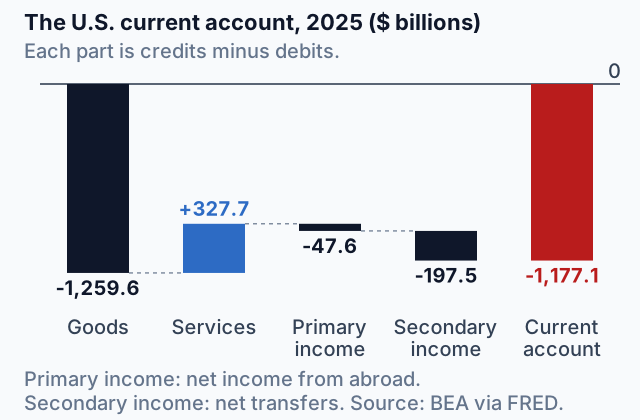
These are real balances for the United States in 2024, from the Bureau of Economic Analysis (BEA) international transactions accounts, read through the St. Louis Fed's FRED database on October 14, 2026. Each is a full year, summed from seasonally adjusted quarters, and each is already credits minus debits. BEA calls net income from abroad primary income and net unilateral transfers secondary income.
| Balance | 2024 |
|---|---|
| Goods | -1,212.8 |
| Services | +327.3 |
| Primary income (net income from abroad) | -68.7 |
| Secondary income (net unilateral transfers) | -244.5 |
Try it · Calculate
In 2024 the U.S. balances, in billions of dollars, were: goods -1,212.8, services +327.3, primary income (net income from abroad) -68.7, and secondary income (net unilateral transfers) -244.5. What was the U.S. current account balance, in billions of dollars, to one decimal place?
BEA publishes a small capital account separately from its financial account, and this course adds the two together as the one capital and financial account. BEA's financial account also runs its sign the opposite way from the one this course uses, and its published accounts carry a statistical discrepancy, so they do not add to exactly zero. That is why the identity in this lesson is always worked on made-up tables, where every transaction is counted.
Try it · Decide and justify
Islen's current account is balanced at zero. Then Islen's households buy $40 million more in imports, and nothing else in its current account changes. What happens to Islen's capital and financial account?
Which reason supports your choice?
Now a made-up country where every transaction is counted. Dunmere recorded these transactions with the rest of the world last year.
| Transaction | Amount |
|---|---|
| Exports of goods and services | 450 |
| Imports of goods and services | 520 |
| Interest and dividends received from abroad | 60 |
| Interest and dividends paid abroad | 45 |
| Gifts received from relatives abroad | 25 |
| Foreigners buy Dunmere government bonds | 210 |
| Dunmere residents buy foreign shares | 180 |
Try it · Calculate
Last year Dunmere, a fictional country, exported $450 million and imported $520 million of goods and services. It received $60 million and paid $45 million in interest and dividends, and received $25 million in gifts from relatives abroad. Foreigners bought $210 million of Dunmere government bonds, and Dunmere residents bought $180 million of foreign shares. What was Dunmere's balance of payments, its current account balance plus its capital and financial account balance, in millions of dollars?
Part 5 Explain it Write it the way the exam asks
Nothing you type leaves this page.
Free response is 33.35% of the exam score. This one is shaped like Question 2, Short.
Free-response practice · Question 2 style
Zaveria and Velaro are trading partners, and Velaro sells many of its goods to Zaveria. Zaveria's current account is balanced.
(a) Real income in Zaveria increases. Will Zaveria's net exports increase, decrease, or stay the same?
(b) Based on your answer to part (a), will Zaveria's capital and financial account move into a surplus, move into a deficit, or stay balanced? Explain.
(c) Will the unemployment rate in Velaro increase, decrease, or stay the same in the short run? Explain.
Model answer
(a) Zaveria's net exports decrease. Higher real income means Zaveria's households buy more goods and services, including more imports from Velaro, while nothing has raised Zaveria's exports. (b) Zaveria's capital and financial account moves into a surplus. The fall in net exports moves the current account into deficit, and the balance of payments must balance (CA + CFA = 0), so the CFA rises by the same amount, a net inflow of financial capital. (c) Velaro's unemployment rate decreases. Velaro's exports to Zaveria rise, so its aggregate demand increases, real output rises, and firms hire more workers.
Score your own answer. This is a self-check, not a grade. Tick each point your answer makes.
Part 6 Check yourself Read a country's accounts
Read the table first, then answer the three questions from it.
Ebbland, a fictional country, recorded these transactions with the rest of the world last year.
| Transaction | Amount |
|---|---|
| Exports of goods | 900 |
| Imports of goods | 1,100 |
| Exports of services | 250 |
| Imports of services | 150 |
| Interest and dividends received from abroad | 80 |
| Interest and dividends paid abroad | 60 |
| Money sent abroad by Ebbland residents to relatives | 40 |
| Foreigners buy Ebbland government bonds and factories | 520 |
| Ebbland residents buy shares in foreign companies | 400 |
Case question 1 · Calculate
Using the table of Ebbland's international transactions, what was Ebbland's current account balance, in millions of dollars? Enter a deficit as a negative number.
Case question 2 · Calculate
Using the table of Ebbland's international transactions, what was Ebbland's capital and financial account balance, in millions of dollars? Enter a deficit as a negative number.
Case question 3 · Multiple choice
Using the table of Ebbland's international transactions, which statement about Ebbland's capital and financial account last year is correct?
The rest stand on their own and do not use the case.
Check yourself · Fill the statement
Tap a blank, then tap a phrase.
The balance of payments records a country's with the rest of the world over a period of time. It is made of two accounts, the current account and the . A country's balance of trade, its net exports, belongs to the .
Check yourself · Spot the error
Tellmark's current account moved from a balance of zero to a deficit of $50 million last year. A student explained what happened to Tellmark's capital and financial account. Tap the first line with a mistake.
Part 7 Keep it Keep it
From 5.7 Public Policy and Economic Growth · Multiple choice
A government gives firms a permanent tax credit for money they spend on research and development. Which describes the most likely effects?
The expenditures formula runs in both directions. If you know GDP and all but one of its parts, the missing part is whatever makes the total come out. Watch the sign of net exports when imports are bigger than exports.
From 2.1 The Circular Flow and GDP · Calculate
In 2026 the country of Ulvik had a GDP of $2,400 billion. Consumption was $1,620 billion, government purchases were $480 billion, exports were $210 billion and imports were $290 billion. Using the expenditures approach, how much was investment in 2026, in billions of dollars?
In three lines
- The current account holds net exports, net income from abroad and net unilateral transfers.
- The capital and financial account is one account: foreign purchases of your assets are credits, your purchases abroad are debits.
- CA + CFA = 0, so a current account deficit comes with a CFA surplus of the same size.
Exam strategy for this topic
- Section I, Multiple Choice: 60 questions in 70 minutes.
- Section II, Free Response: 3 questions in 60 minutes.
- This lesson's Explain it is shaped like free-response question 2, Short.
- A four-function calculator is allowed on both sections of the exam.
Before you calculate anything, sort every line into the current account or the CFA and mark it credit or debit by which way the money flows. Then check that your two balances add to zero; if they do not, a line is in the wrong account or has the wrong sign.
Questions students ask
Why does a current account deficit have to come with a CFA surplus?
The money a country pays out for its extra imports ends up with foreigners. Whatever they do with it, buy bonds, buy property or leave it in a bank there, is a purchase of that country's assets, which is a CFA credit. So CA + CFA = 0.
Is a current account deficit the same thing as a government budget deficit?
No. The current account records a country's transactions with the rest of the world, while a budget deficit is government spending above tax revenue. Nothing in the balance of payments is about taxes.
Where do dividends from shares owned abroad go?
In the current account, as part of net income from abroad, and they are a credit because money flows in. The shares themselves went in the CFA when they were bought.
If a firm imports a machine it will use for twenty years, is that an asset in the CFA?
No. A machine shipped into the country is an import of a good, so it is a current account debit. The CFA is for assets changing owners across borders, such as bonds, shares, deposits or a factory that stays abroad.
How do I find the current account from a table of transactions?
Add net exports, net income from abroad and net unilateral transfers, keeping each sign. For Ebbland that was -100 + 20 - 40 = -120, a deficit. Leave the asset purchases out, since they belong in the CFA.
Course alignment, for teachers
AP Macroeconomics topic 6.1, Unit 6: Open Economy—International Trade and Finance.
- Skill 1.A: Describe economic concepts, principles, or models.
This lesson maps all 6 essential knowledge statements of the topic to the part that teaches each one: 6 are checked by a scored question. The map is in the lesson file.