Unit 6 · Topic 6.2 · about 30 minutes · 7 parts · 11 scored checks, 2 of them multiple choice, plus 2 from earlier lessons
AP Macroeconomics 6.2: Exchange Rates
Unit 6: 10 to 13% of the multiple-choice section
What you'll be able to do
- Define the exchange rate, currency appreciation and currency depreciation, explain how one currency is valued in terms of another, and calculate the value of one currency in terms of another.
Key vocabulary
| Term | What it means | The exam trap |
|---|---|---|
| Foreign exchange market | The market in which one currency is exchanged for another. | This is a market for currencies, so its price is an exchange rate, not the price level of goods and not an interest rate. |
| Exchange rate | The price of one currency in terms of another currency, such as 1.10 U.S. dollars per euro. | Read the currency after "per" as the one being priced: 1.25 dollars per euro is the price of a euro, so one dollar buys only 1 ÷ 1.25 = 0.8 euros. |
| Currency appreciation | A currency becoming more valuable in terms of another currency, so one unit of it buys more of the other. | A rising number does not prove the dollar appreciated: when dollars per euro rises from 1.10 to 1.20, the euro appreciated and the dollar depreciated. |
| Currency depreciation | A currency becoming less valuable in terms of another currency, so one unit of it buys less of the other. | Depreciation of one currency is appreciation of the other, so if a dollar buys fewer pesos, each peso buys more dollars, and the two can never both lose value against each other. |
 Tap to open the picture full size
Part 1 Think first A room in Oaxaca
Guess before you learn. A wrong guess still makes the answer stick.
Predict first
A guesthouse in Oaxaca, Mexico, charges 1,800 pesos a night, and it keeps that price all year. In March the exchange rate is 18 pesos per U.S. dollar. By July it is 20 pesos per U.S. dollar. For a traveler from Ohio paying in dollars, how does the July price of a night compare with the March price?
In short. An exchange rate is the price of one currency in terms of another, and a currency appreciates when it buys more of the other currency and depreciates when it buys less.
- A quote is a price: in 1.25 dollars per euro, the thing being bought is one euro, and it costs $1.25.
- When one currency appreciates against another, the other depreciates against it.
- A rising number can mean either currency gained, so read which currency the rate prices before you decide.
Part 2 Learn it Four short ideas, each checked as you go
2a. An exchange rate is a price
In the foreign exchange market, people trade one currency for another. A traveler swaps dollars for pesos; a U.S. company pays a supplier in Germany in euros. The exchange rate is the price of one currency in terms of the other.
Read a quote the way you read any price. A sign at an airport currency counter that says 1.25 dollars per euro means one euro costs $1.25, the same way 4 dollars per gallon means a gallon of milk costs $4. The currency after "per" is the thing being bought, one unit of it. The other currency is what you pay with.
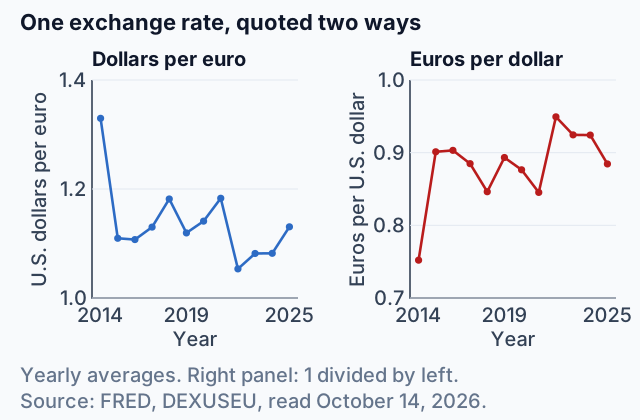
Every rate can be written the other way round. If a dollar costs 150 yen, then a yen costs 1 ÷ 150 of a dollar, about 0.0067 dollars, a bit under one cent. Both quotes describe the same trade, 150 yen for 1 dollar. To flip a quote, divide 1 by it and swap the units.
Quick check · Calculate
A currency counter quotes the exchange rate as 1.25 U.S. dollars per euro. At that rate, how many euros does one U.S. dollar buy?
2b. Changing a price into another currency
Prices abroad are set in the local currency. To find what something costs you, convert with the rate, and let the units tell you whether to multiply or divide.
Hiking boots in Sapporo cost 12,000 yen, and the rate is 150 yen per dollar. You want dollars, so the yen must cancel: 12,000 yen ÷ 150 yen per dollar = $80. Dividing makes sense. Each dollar buys 150 yen, so the price takes far fewer dollars than yen.
Now a quote the other way up. A bookshop in Lyon sells a map for 20 euros, and the rate is 1.10 dollars per euro. This time 20 euros × 1.10 dollars per euro = $22. Multiplying makes sense too: a euro costs more than a dollar, so the dollar price is the bigger number.
Two checks catch most slips. Write the units and make sure the currency you start with cancels. Then ask which currency is worth more, and so which price should be the larger number.
Quick check · Calculate
A ceramics studio in Portugal prices a hand-painted serving bowl at 40 euros. The exchange rate is 1.25 U.S. dollars per euro. What does the bowl cost a buyer in the United States, in dollars?
2c. Appreciation and depreciation
Exchange rates move every day. When a currency becomes more valuable in terms of another, it appreciates: one unit of it buys more of the other currency. When it becomes less valuable, it depreciates: one unit buys less.
The two always come together. If a dollar now buys more yen, then each yen buys fewer dollars, so the dollar appreciated against the yen and the yen depreciated against the dollar. Two currencies cannot both gain against each other.
It shows up in what things cost. After the dollar appreciates against the yen, a train ticket priced at 1,000 yen costs fewer dollars than before, because each dollar now buys more yen, so it takes fewer dollars to make up 1,000 yen. For a buyer in Japan, a U.S. book priced at $20 now costs more yen.
An exchange rate is the price of one money in another money. It is not the price level of goods in either country, and it is not an interest rate, though later lessons show how both can move it.
Quick check · Multiple choice
The U.S. dollar appreciates against the Japanese yen. Which of these must be true?
2d. Which way is the quote written?
A headline says the exchange rate rose. Did the dollar get stronger? You cannot tell until you read the units.
Find the currency after "per". The quote is its price. If the number rises, that currency got more expensive, so it appreciated and the other one depreciated.
- Yen per dollar rises: a dollar costs more yen. The dollar appreciated.
- Dollars per euro rises: a euro costs more dollars. The euro appreciated, and the dollar depreciated.
Both are "the number went up", and they say opposite things about the dollar. This is the slip to watch for, and the reason to name which currency a rate prices every time you use one.
A caution if you go further. Percent changes are not the same in both directions. If the rate goes from 8 to 10 Swedish kronor per dollar, a dollar's price in kronor rose 25 percent, but a krona's price in dollars fell from 0.125 to 0.10, which is 20 percent. Do not assume the two currencies move by the same percent.
Quick check · Sort it
Each line is a change in an exchange rate. Read which currency the quote prices, then tap the line and tap what happened to the U.S. dollar against the other currency.
The U.S. dollar appreciated
The U.S. dollar depreciated
Part 3 Watch it done A cello from Germany
Watch each step, then do the last one yourself.
A youth orchestra in Denver orders a cello from a workshop in Germany. The workshop's price is 3,000 euros. When the orchestra places the order, the rate is 1.10 U.S. dollars per euro. When the bill comes due, the rate is 1.20 U.S. dollars per euro. Find the cello's dollar price at each rate and say which currency appreciated.
Step 1 · Read the quote
1.10 dollars per euro is the price of one euro: $1.10. The workshop wants 3,000 euros, so the orchestra has to buy 3,000 of them.
Step 2 · Price at the first rate
3,000 euros × 1.10 dollars per euro = $3,300. The euros cancel and dollars are left.
Why this step?
Why multiply here, when the boots priced in yen were divided?
This quote prices the euro in dollars, so each of the 3,000 euros adds $1.10. The yen quote priced the dollar in yen, so dividing counted how many dollars it took. Either way, the currency you start with has to cancel.
Step 3 · Price at the second rate
3,000 euros × 1.20 dollars per euro = $3,600. The cello's price in euros never moved, but its dollar price rose by $300.
Your step · Multiple choice
A workshop in Germany prices a cello at 3,000 euros. Between the day a U.S. orchestra orders it and the day the bill is paid, the exchange rate moves from 1.10 to 1.20 U.S. dollars per euro. Which statement about that change is true?
Nothing about the cello changed in Germany. The orchestra pays $300 more only because the euro appreciated against the dollar between the order and the bill.
Part 4 Try it Two you have not seen
One conversion runs the other way from the cello, and one asks which currency rose. Write the units before you calculate.
Try it · Calculate
A weaver in Vermont sells a wool blanket for $60 and ships one to a buyer in Italy. The exchange rate is 1.25 U.S. dollars per euro. What is the blanket's price in euros?
Try it · Decide and justify
Over one year the exchange rate moves from 1.20 U.S. dollars per Swiss franc to 1.10 U.S. dollars per Swiss franc. Which currency appreciated?
Which reason supports your choice?
Part 5 Explain it Write it the way the exam asks
Nothing you type leaves this page.
Free response is 33.35% of the exam score. This one is shaped like Question 3, Short.
Free-response practice · Question 3 style
Quellan, a fictional country, uses a currency called the quell, and the exchange rate between the quell and the U.S. dollar is flexible. In January the exchange rate is 4 quells per U.S. dollar. In July it is 5 quells per U.S. dollar. A U.S. company sells a water pump for $300, and a farm in Quellan sells a sack of coffee beans for 60 quells. Neither seller changes its price.
(a) Calculate the pump's price in quells in July. Show your work.
(b) From January to July, which currency appreciated and which depreciated, the U.S. dollar or the quell? Explain.
(c) Calculate the sack of coffee's price in U.S. dollars in July, and state whether the coffee became more expensive or less expensive for buyers in the United States from January to July. Show your work.
Model answer
(a) $300 × 5 quells per dollar = 1,500 quells. (b) The dollar appreciated against the quell and the quell depreciated against the dollar, because one dollar buys 5 quells in July instead of 4. (c) 60 quells ÷ 5 quells per dollar = $12 in July, against 60 ÷ 4 = $15 in January, so the coffee became less expensive for buyers in the United States.
Score your own answer. This is a self-check, not a grade. Tick each point your answer makes.
Part 6 Check yourself Read real exchange rates
Read the table first, and check how each rate is quoted before you answer.
The Federal Reserve Board publishes daily exchange rates, and FRED, the data service of the Federal Reserve Bank of St. Louis, averages them by year. The table shows three of those series as annual averages for 2024 and 2025, read from FRED on October 14, 2026: U.S. dollars per euro, Japanese yen per U.S. dollar, and Mexican pesos per U.S. dollar. They are not all quoted the same way round.
| Rate | 2024 | 2025 |
|---|---|---|
| Dollars per euro | 1.0820 | 1.1306 |
| Yen per dollar | 151.46 | 149.57 |
| Pesos per dollar | 18.3062 | 19.2052 |
Case question 1 · Select all
Based on the FRED annual averages for 2024 and 2025, which two statements are true of the change from 2024 to 2025? Select two.
Select 2 answers, then check.
Case question 2 · Calculate
At the 2025 annual average rate for the yen in the FRED table, 149.57 Japanese yen per U.S. dollar, how many U.S. dollars did 10,000 yen buy? Round to the nearest dollar.
The rest stand on their own and do not use the case.
Check yourself · Match
Each quote is a possible exchange rate between the Japanese yen and the U.S. dollar. Tap a quote, then tap the same rate written the other way round.
Check yourself · Spot the error
A news report says the exchange rate moved from 0.92 euros per U.S. dollar to 0.86 euros per U.S. dollar. A student wrote this analysis. Tap the first line that goes wrong.
Part 7 Keep it Keep it
From 6.1 Balance of Payments Accounts · Sort it
Each transaction is recorded in Mirovia's balance of payments. Tap a transaction, then tap where Mirovia records it.
Current account credit
Current account debit
Capital and financial account credit
Capital and financial account debit
Before you calculate, find one word in the question: expected or actual. A rate set when a loan is made can only use expected inflation. A real rate in hindsight uses actual inflation.
From 4.2 Nominal v. Real Interest Rates · Calculate
A school district sold two-year bonds paying a nominal interest rate of 4.6% a year. When investors bought them, they expected inflation to average 2.1% a year. Over the two years, inflation actually averaged 3.0% a year. What real interest rate a year did investors expect to earn when they bought the bonds?
In three lines
- An exchange rate is the price of one currency in another; divide 1 by it to flip the quote.
- Convert a price so the currency you start with cancels.
- A currency appreciates when it buys more of the other, which then depreciates.
Exam strategy for this topic
- Section I, Multiple Choice: 60 questions in 70 minutes.
- Section II, Free Response: 3 questions in 60 minutes.
- This lesson's Explain it is shaped like free-response question 3, Short.
- A four-function calculator is allowed on both sections of the exam.
Write the units beside every exchange rate you use and say which currency it prices before you calculate or decide anything. On a conversion, ask which currency is worth more, so you know which price should be the bigger number.
Questions students ask
How do I flip an exchange rate into the other quote?
Divide 1 by the rate and swap the units. 150 yen per dollar becomes 1 ÷ 150, about 0.0067 dollars per yen.
If the exchange rate goes up, did the dollar get stronger?
Only if the quote prices the dollar, as yen per dollar does. If the quote is dollars per euro, a rise means a euro costs more dollars, so the euro appreciated and the dollar depreciated.
What does a 3,000 euro cello cost in dollars at 1.20 dollars per euro?
3,000 euros × 1.20 dollars per euro = $3,600. The euros cancel and dollars are left.
Why did a room in Mexico get cheaper for me when its peso price never changed?
The dollar appreciated against the peso. At 18 pesos per dollar a 1,800 peso room costs $100, and at 20 pesos per dollar it costs $90. Each dollar buys more pesos, so you need fewer of them.
Do two currencies always change by the same percent against each other?
No. If the rate goes from 8 to 10 kronor per dollar, a dollar's price in kronor rises 25 percent, but a krona's price in dollars falls from 0.125 to 0.10, which is 20 percent.
Course alignment, for teachers
AP Macroeconomics topic 6.2, Unit 6: Open Economy—International Trade and Finance.
- Skill 1.C: Identify an economic concept, principle, or model using quantitative data or calculations.
This lesson maps all 2 essential knowledge statements of the topic to the part that teaches each one: 2 are checked by a scored question. The map is in the lesson file.