Unit 6 · Topic 6.5 · about 30 minutes · 7 parts · 9 scored checks, 1 of them multiple choice, plus 2 from earlier lessons
AP Macroeconomics 6.5: Changes in the Foreign Exchange Market and Net Exports
Unit 6: 10 to 13% of the multiple-choice section
What you'll be able to do
- Explain, using graphs, how a change in the value of a country's currency changes its net exports and its aggregate demand.
Key vocabulary
| Term | What it means | The exam trap |
|---|---|---|
| Exports | Goods and services produced in a country and sold to buyers in other countries. | An appreciation makes exports fall, not rise: the seller's price in its own currency has not moved, but each unit of that currency now costs foreign buyers more. |
| Imports | Goods and services produced in other countries and bought by buyers in this country. | After an appreciation imports rise, because foreign goods cost fewer units of the home currency, and those cheaper imports lower net exports rather than raising them. |
| Net exports | The value of a country's exports minus the value of its imports, one of the four components of aggregate demand. | Changes here shift AD, not SRAS or LRAS, because net exports are spending on the country's output. |
| Currency appreciation | A currency becoming more valuable in terms of another currency, so one unit of it buys more of the other. | Calling a currency "strong" does not make it good news for exporters: when the krone appreciates, Osterby's goods cost foreign buyers more and its exports fall. |
| Currency depreciation | A currency becoming less valuable in terms of another currency, so one unit of it buys less of the other. | Depreciation raises net exports through both sides at once, more exports and fewer imports, so AD shifts right and short-run output and the price level rise. |
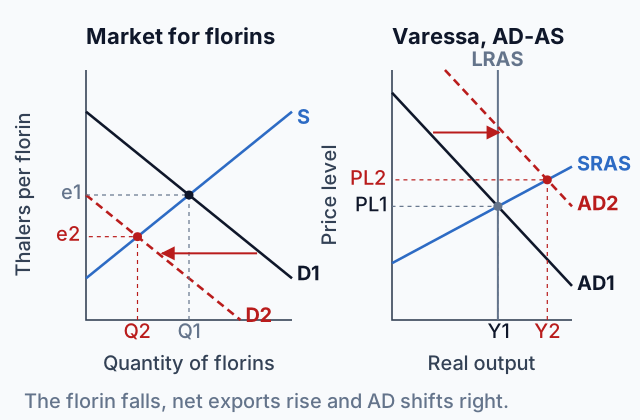 Tap to open the picture full size
Part 1 Think first Kayaks for Japan
Guess before you learn. A wrong guess still makes the answer stick.
Predict first
Teodora builds sea kayaks in New Zealand and sells most of them to paddlers in Japan. She charges NZ$2,000 a kayak and keeps that price all year. Suppose that over one year the exchange rate goes from 85 to 100 yen per New Zealand dollar. What most likely happens to the number of kayaks she sells in Japan?
In short. When a country's currency changes value, the prices its goods carry abroad and the prices foreign goods carry at home change with it, so its net exports and its aggregate demand move.
- A depreciation makes a country's goods relatively less expensive abroad and foreign goods relatively more expensive at home, so exports rise, imports fall and net exports increase.
- An appreciation does the reverse: exports fall, imports rise and net exports decrease.
- Net exports are part of aggregate demand, so in the short run a depreciation raises real output, employment and the price level, and an appreciation lowers them.
Part 2 Learn it Three short ideas, each checked as you go
2a. When a currency appreciates
Varessa and Tolvia trade with each other, and the exchange rate between Varessa's florin and Tolvia's thaler is flexible. Say it rises from 2 to 2.5 thalers per florin. Each florin now buys more thalers, so the florin has appreciated.
Nothing about Varessan goods has changed, but their price abroad has. An espresso machine made in Varessa sells for 400 florins. A Tolvian buyer used to pay 800 thalers for it (400 × 2) and now pays 1,000 (400 × 2.5). Varessan goods are relatively more expensive for Tolvians, so Tolvians buy fewer of them: Varessa's exports decrease.
The other side moves too. A Tolvian wool coat sells for 300 thalers. It used to cost a Varessan 150 florins (300 ÷ 2) and now costs 120 (300 ÷ 2.5). Tolvian goods are relatively less expensive in Varessa, so Varessans buy more of them: Varessa's imports increase.
Net exports are exports minus imports. Exports fell and imports rose, and both changes push the same way: Varessa's net exports decrease.
Quick check · Calculate
Varessa's florin and Tolvia's thaler trade at a flexible exchange rate. A furniture maker in Varessa sells a dining table for 1,200 florins and keeps that price. The exchange rate rises from 1.5 to 1.8 thalers per florin. By how many thalers does the table's price rise for a buyer in Tolvia?
2b. When a currency depreciates
Run it backward. If the rate falls from 2.5 to 2 thalers per florin, each florin buys fewer thalers, so the florin has depreciated.
The 400-florin espresso machine now costs a Tolvian 800 thalers instead of 1,000. Varessan goods are relatively less expensive abroad, so Varessa's exports increase.
The import side is the one students skip. The Tolvian coat still sells for 300 thalers, but each florin buys fewer thalers, so a Varessan now pays 150 florins for it instead of 120. Tolvian goods are relatively more expensive in Varessa, and Varessan shoppers buy fewer of them and more coats made at home: Varessa's imports decrease.
More exports and fewer imports both raise exports minus imports, so Varessa's net exports increase.
A depreciation does not change the price either seller charges in its own currency. It changes what that price costs a buyer who pays in the other currency, and buyers respond to that.
Quick check · Fill the statement
Tap a blank, then tap a word.
Under a flexible exchange rate, Varessa's florin depreciates against Tolvia's thaler. A Tolvian phone priced in thalers now costs a Varessan buyer florins, so Varessa's imports . A Varessan hiking tent priced in florins now costs a Tolvian buyer thalers, so Varessa's net exports .
2c. From net exports to aggregate demand
Net exports are one of the four parts of aggregate demand, alongside consumption, investment and government spending. So a change in a currency's value does not stop at trade.
When the florin depreciates and Varessa's net exports increase, buyers at home and abroad together want more Varessan output at every price level. Aggregate demand in Varessa shifts right. In the short run real output rises, firms hire more workers so employment rises, and the price level rises.
When the florin appreciates, the chain runs the other way: net exports decrease, AD shifts left, and in the short run real output, employment and the price level all fall.
This is a shift of AD, not of SRAS or LRAS, because the story runs through spending on the country's goods. And when a question says "based solely on" the change in net exports, follow that one link, even if you can think of other effects. Each step causes the next, so write every step: the currency, the relative prices, exports and imports, net exports, AD, then output and the price level.
Quick check · Put it in order
Varessa has a flexible exchange rate. A graph of the market for florins shows the demand for florins shifting to the right. Based solely on the resulting change in Varessa's net exports, tap the steps in the order they happen.
Part 3 Watch it done A weaker guilder in Ardmoor
Watch each step, then do the last one yourself.
Ardmoor and Brask trade under a flexible exchange rate. The demand for Ardmoor's currency, the guilder, falls, and the exchange rate drops from 4 levs per guilder to 3.2 levs per guilder. An Ardmoorian wool sweater sells for 50 guilders and a Braskan laptop sells for 2,400 levs, and neither seller changes its price. Trace the effect on Ardmoor's net exports and aggregate demand.
Step 1 · Read the change
Each guilder now buys 3.2 levs instead of 4, so the guilder depreciated against the lev.
Step 2 · Price the export abroad
The sweater costs a Braskan buyer 50 × 4 = 200 levs before and 50 × 3.2 = 160 levs after. Ardmoorian goods are relatively less expensive in Brask, so Ardmoor's exports increase.
Step 3 · Price the import at home
The laptop costs an Ardmoorian buyer 2,400 ÷ 4 = 600 guilders before and 2,400 ÷ 3.2 = 750 guilders after. Braskan goods are relatively more expensive in Ardmoor, so Ardmoor's imports decrease.
Why this step?
Why do Ardmoor's imports fall when nothing about the laptop or its price in levs changed?
Ardmoorians pay in guilders. Each guilder now buys fewer levs, so the same 2,400 levs take 750 guilders instead of 600, and buyers turn to goods made at home.
Step 4 · Net exports
Exports rose and imports fell, so exports minus imports rose: Ardmoor's net exports increase.
Your step · Decide and justify
Finish the analysis. Based solely on the change in Ardmoor's net exports, which way does aggregate demand in Ardmoor shift?
Which reason supports your choice?
Ardmoor's net exports on the AD-AS graph
Higher net exports shift AD right from AD1 to AD2 along SRAS. Real output rises from Y1 to Y2 and the price level from PL1 to PL2 in the short run.
Part 4 Try it Draw it, then follow it to net exports
One step further. People often hear a rising currency called "strong" and assume that is good news for everyone in the country. Decide whether it is good news for the people who sell abroad.
Try it · Decide and justify
Osterby has a flexible exchange rate, and its currency, the krone, appreciates sharply against the currencies of the countries that buy Osterby's goods. Osterby's exporters keep their prices in kroner. A business columnist writes that a stronger krone is good news for Osterby's exporters. Based solely on the change in the exchange rate, is the columnist right?
Which reason supports your choice?
Part 5 Explain it Write it the way the exam asks
Nothing you type leaves this page.
Free response is 33.35% of the exam score. This one is shaped like Question 2, Short.
Free-response practice · Question 2 style
Ruvia and Lissard trade with each other, and the exchange rate between Ruvia's currency, the tolar, and Lissard's currency, the dinar, is flexible. Ruvia's economy is in long-run equilibrium when the tolar appreciates against the dinar.
(a) Will Ruvia's net exports increase, decrease, or stay the same? Explain.
(b) Draw a correctly labeled graph of aggregate demand and aggregate supply for Ruvia showing LRAS at full-employment output labeled YF, the equilibrium price level labeled PL1 and real output labeled Y1. On your graph, show the short-run effect of the change in net exports you identified in part (a), labeling the new price level PL2 and real output Y2.
(c) Based on your graph, will the unemployment rate in Ruvia increase, decrease, or stay the same in the short run?
Model answer
(a) Ruvia's net exports decrease. Each tolar now buys more dinars, so Ruvian goods become relatively more expensive for buyers in Lissard and Ruvia's exports fall, while Lissardian goods become relatively less expensive in Ruvia and Ruvia's imports rise. (b) Price level on the vertical axis and real output on the horizontal, with a downward-sloping AD1, an upward-sloping SRAS and a vertical LRAS at YF. AD1 and SRAS cross on LRAS at PL1 and Y1. AD shifts left to AD2, shown by an arrow from AD1. Where AD2 crosses SRAS, PL2 is below PL1 and Y2 is to the left of Y1, both marked on the axes with dashed lines. (c) The unemployment rate increases.
Score your own answer. This is a self-check, not a grade. Tick each point your answer makes.
Part 6 Check yourself Read a currency change from the data
Read the table first, and check how the exchange rate is quoted before you answer.
Mendra, a fictional country, trades with the United States under a flexible exchange rate. Mendra's statistics office reported these figures for two years. Each price is what the seller charges in its own currency.
| Measure | Year 1 | Year 2 |
|---|---|---|
| Exchange rate (Mendran rials per U.S. dollar) | 40 | 50 |
| Price of a Mendran wool rug (rials) | 20,000 | 20,000 |
| Price of a U.S.-made farm drone (dollars) | 1,500 | 1,500 |
Case question 1 · Multiple choice
Based on Mendra's table, what happens to Mendra's imports from the United States from Year 1 to Year 2?
Case question 2 · Calculate
Using Mendra's table, by how many U.S. dollars does the price of a Mendran wool rug fall for a buyer in the United States from Year 1 to Year 2?
The rest stand on their own and do not use the case.
Check yourself · Select all
Esker's economy is in long-run equilibrium, and its exchange rate is flexible. Esker's currency depreciates against the currencies of all its trading partners. Based solely on the resulting change in Esker's net exports, which two of these rise in Esker in the short run? Select two.
Select 2 answers, then check.
Check yourself · Spot the error
Cardova trades with the United States under a flexible exchange rate, and the Cardovan peso appreciates against the U.S. dollar. A student wrote this analysis of Cardova's trade. Tap the first line that goes wrong.
Part 7 Keep it Keep it
From 6.4 Effect of Changes in Policies and Economic Conditions on the Foreign Exchange Market · Fill the statement
Tap a blank, then tap a word.
Solvany, whose currency is the escudo, trades with Kavros under flexible exchange rates. Solvany raises its income taxes, and real income in Solvany falls. Based solely on the change in real income, Solvanians buy goods from Kavros, the supply of escudos shifts to the , and the escudo .
From 3.1 Aggregate Demand (AD) · Spot the error
A student described how they showed restaurants across the country buying new ovens and dishwashers on a graph of aggregate demand. Tap the first line with a mistake.
In three lines
- An appreciation makes exports more expensive abroad and imports cheaper at home, so net exports fall.
- A depreciation does the reverse: exports rise, imports fall and net exports rise.
- Net exports are part of AD, so the currency's change moves AD, output and prices.
Exam strategy for this topic
- Section I, Multiple Choice: 60 questions in 70 minutes.
- Section II, Free Response: 3 questions in 60 minutes.
- This lesson's Explain it is shaped like free-response question 2, Short.
- A four-function calculator is allowed on both sections of the exam.
Write each link with its reason: the change in the currency, the prices buyers face, exports and imports, net exports, then AD and short-run output and the price level. On the AD-AS graph, draw LRAS at YF and label AD1, AD2, PL2 and Y2.
Questions students ask
Why does a depreciation lower imports when the foreign seller never changed its price?
The buyer pays in the home currency, and each unit now buys less of the foreign one. In Ardmoor a 2,400 lev laptop went from 600 to 750 guilders when the rate fell from 4 to 3.2 levs per guilder, so Ardmoorians bought fewer.
Is a stronger currency good news for a country's exporters?
No. Their prices in their own currency stay the same, but foreign buyers have to pay more of their own money for each unit, so they buy less and exports fall.
Which curve shifts on the AD-AS graph when net exports change?
AD. Net exports are one of the four components of aggregate demand, so a rise shifts AD right and a fall shifts it left, while SRAS and LRAS stay put.
What happens to unemployment when a currency depreciates?
Based on net exports alone, it falls in the short run. Net exports rise, AD shifts right, real output rises and firms hire more workers.
Could net exports go either way after an appreciation?
No. Exports fall and imports rise, and both of those lower exports minus imports, so net exports decrease.
Course alignment, for teachers
AP Macroeconomics topic 6.5, Unit 6: Open Economy—International Trade and Finance.
- Skill 3.A: Determine the outcome of an economic situation using economic concepts, principles, or models.
This lesson maps all 2 essential knowledge statements of the topic to the part that teaches each one: 2 are checked by a scored question. The map is in the lesson file.