Unit 6 · Topic 6.6 · about 30 minutes · 7 parts · 10 scored checks, 1 of them multiple choice, plus 2 from earlier lessons
AP Macroeconomics 6.6: Real Interest Rates and International Capital Flows
Unit 6: 10 to 13% of the multiple-choice section
What you'll be able to do
- Explain, using graphs, how differences in real interest rates between countries move financial capital and change the foreign exchange market and the loanable funds market.
Key vocabulary
| Term | What it means | The exam trap |
|---|---|---|
| Real interest rate | The nominal interest rate minus the inflation rate, which measures how much more a sum of money will buy after the interest is paid. | Compare real rates, not nominal ones: an 8% bond with 6% inflation pays 2% real, which loses to a 5% bond with 1% inflation paying 4% real. |
| Financial capital flows | Money moving between countries to buy financial assets such as bonds, shares and bank deposits. | These flows chase the relatively higher real return on bonds, shares and deposits, not cheaper goods, so explain them with real interest rates rather than with prices of goods. |
| Net capital inflows | Financial capital coming into a country minus financial capital leaving it; a negative value is a net outflow. | Higher net capital inflows mean foreigners are buying the country's assets, which are CFA credits, so the capital and financial account moves toward surplus, not deficit. |
| Foreign exchange market | The market where one country's currency is traded for another's, with the exchange rate as its price. | An inflow raises the demand for the receiving country's currency so it appreciates; a leftward shift of its supply shows the same appreciation, but nothing about an inflow makes it depreciate. |
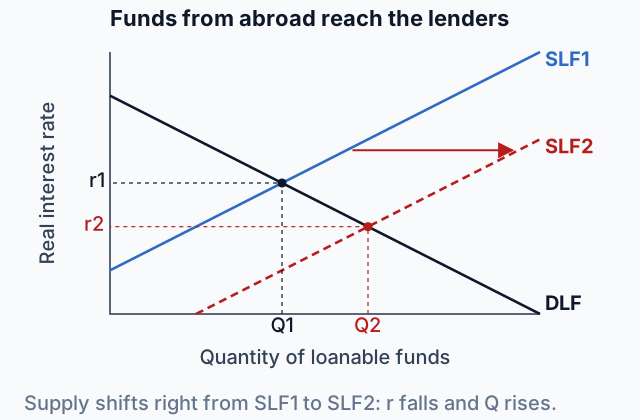
| Loanable funds market | The market in which savers, at home and abroad, supply funds and borrowers demand them, with the real interest rate as its price. | Foreign investors are lenders, so an inflow shifts the supply of loanable funds right and lowers the real interest rate, not the demand for loanable funds. |
 Tap to open the picture full size
Part 1 Think first A rate rise in Gavrona
Guess before you learn. A wrong guess still makes the answer stick.
Predict first
Gavrona's banking system has ample reserves. Its central bank raises the interest rate it pays on reserves, and inflation in Gavrona does not change. Interest rates in other countries stay where they were. Over the next few months, what most likely happens to investors' money and to the value of Gavrona's currency?
In short. Financial capital moves between countries in search of the best real return, and each flow shows up in the loanable funds market, the foreign exchange market and the balance of payments.
- Investors compare real interest rates across borders, the nominal rate minus inflation, never nominal rates on their own.
- A central bank that changes its interest rate in the short run changes what its country's assets pay compared with assets abroad.
- A flow of financial capital moves the supply of loanable funds, the market for the currency and the capital and financial account.
Part 2 Learn it Three short ideas, each checked as you go
2a. Money goes where the real return is higher
Pension funds, banks and ordinary savers can buy bonds, shares and bank deposits in many countries, not only their own. When they choose where to put money, they compare returns, and the return that counts is the real interest rate: the nominal interest rate minus the inflation rate, as in lesson 4.2. A bond paying 10% where prices rise 9% a year adds only 1% to what the money can buy. One paying 5% where prices rise 2% adds 3%.
So a difference in real interest rates changes the relative value of assets. The bonds and deposits of the country with the higher real rate become more worth holding than the same kinds of assets abroad, and financial capital flows toward the country with the relatively higher real interest rate.
Relatively is the word to hold on to. What pulls money across a border is the gap between countries. If every country's real rate rose by the same amount, nothing would pull funds from one to another.
Notice what the investors are after: a higher return on financial assets. They are not shopping for cheaper goods.
Quick check · Calculate
Arvana's one-year government bonds pay a nominal interest rate of 8%, and Arvana's inflation rate is 6%. Dessaly's one-year government bonds pay 5%, and Dessaly's inflation rate is 1%. The two countries' bonds are equally safe. What is the real interest rate, in percent, in the country toward which financial capital flows?
2b. One inflow, three places
Say real interest rates in Sarrona rise relative to rates abroad, and foreign investors move funds in. That one flow shows up in three places.
Foreign exchange market. Foreigners need Sarrona's currency to buy its bonds. The demand for the currency shifts right, and the currency appreciates. Showing the supply of the currency shifting left, because Sarronans keep more of their own money at home, gives the same appreciation.
Balance of payments. Foreigners buying Sarronan assets is money flowing into Sarrona, a credit in the capital and financial account. The CFA moves toward surplus.
Loanable funds market. The arriving funds join what savers at home already lend, so the supply of loanable funds shifts right. It is supply, not demand: the foreigners are lending, not borrowing. More supply lowers Sarrona's real interest rate and raises the quantity of loanable funds, narrowing the gap that drew the money in.
The country the money leaves sees each of these the other way round. Its currency depreciates, its CFA moves toward deficit, its supply of loanable funds shifts left and its real interest rate rises. And a stronger currency makes Sarrona's goods more expensive to buyers abroad, so its net exports fall.
Quick check · Match
Real interest rates in a country rise relative to rates abroad, and financial capital flows in. Tap a market or account, then tap what the inflow does there.
2c. Central banks tip the balance
A central bank can move its country's interest rate in the short run. How it does that depends on the banking system, as in lesson 4.6.
- With ample reserves, it changes its administered rates. Raising the interest it pays on reserves lifts the policy rate and other short-term rates; lowering it pulls them down.
- With limited reserves, it uses open-market operations. Selling government bonds takes reserves out, the money supply falls and the nominal interest rate rises. Buying bonds does the reverse.
Prices and expected inflation adjust slowly, so in the short run a higher nominal rate is a higher real rate too. If rates abroad stay where they were, the country's assets now pay a relatively higher return, and net capital inflows rise. A rate cut does the opposite: investors seek higher returns elsewhere, and net inflows fall.
Quick check · Decide and justify
Estavia's banking system has ample reserves, and its inflation rate is above the central bank's target. The central bank takes the policy action that lowers inflation, and real interest rates abroad do not change. What happens to net financial capital inflows to Estavia in the short run?
Which reason supports your choice?
Part 3 Watch it done Where the pension fund goes
Watch each step, then do the last one yourself.
A pension fund in Halvorsk will buy one-year government bonds from one of two countries, and the two countries' bonds are equally safe. Veldra's bonds pay a nominal interest rate of 6%, and Veldra's price index rose from 200 to 210 over the past year. Pirella's bonds pay 4%, and Pirella's price index rose from 120 to 121.2 over the past year. Expect each country's inflation to stay at last year's rate. Decide which country the fund's money flows toward.
Step 1 · Pick the number to compare
The fund cares about what its interest will buy when the bonds pay out, so the number to compare is each country's real interest rate, not the 6% and the 4% printed on the bonds.
Why this step?
Why not simply take the bonds that pay 6%?
Prices in Veldra are rising fast, so most of that 6% only keeps up with prices. A nominal rate bundles the real return with payment for inflation, and only the real part adds to what the money can buy.
Step 2 · Turn the index into an inflation rate
Inflation is the percent change in the price index, as in lesson 2.4. For Veldra: (210 - 200) ÷ 200 × 100 = 5%.
Step 3 · Veldra's real rate
Nominal minus inflation: 6% - 5% = 1%. Now do the same for Pirella, from its index, and compare.
Your step · Decide and justify
Finish the analysis. Toward which country does the pension fund's money flow?
Which reason supports your choice?
What happens next. To pay for Pirella's bonds, the fund first buys Pirella's currency, so the demand for that currency rises. The purchase is money flowing into Pirella, a credit in its capital and financial account, and the funds add to what Pirella's lenders can offer. It is the three places of Learn it, one fund at a time.
Part 4 Try it Draw it yourself
Follow money across a border on two graphs. Draw the loanable funds market first, then the markets for currencies.
Try it · Put it in order
Zorvia's government raises its spending without raising taxes and borrows to cover the deficit. Real interest rates in other countries do not change. Tap the steps in the order they happen.
Part 5 Explain it Write it the way the exam asks
Nothing you type leaves this page.
Free response is 33.35% of the exam score. This one is shaped like Question 3, Short.
Free-response practice · Question 3 style
Montreve, a fictional country, has a banking system with limited reserves and a flexible exchange rate. Its currency is the mont. Montreve's central bank sells government bonds on the open market. Assume that expected inflation in Montreve and interest rates in other countries do not change.
(a) Will the real interest rate in Montreve increase, decrease, or stay the same in the short run?
(b) Will net financial capital inflows to Montreve increase, decrease, or stay the same? Explain.
(c) Draw a correctly labeled graph of the foreign exchange market for the mont, with the U.S. dollar as the other currency. Show the effect of the change you identified in part (b) on the exchange rate, labeling the original values e1 and Q1 and the new values e2 and Q2.
Model answer
(a) Montreve's real interest rate increases. Selling bonds takes reserves out of the banking system, so the money supply falls and the nominal rate rises, and with expected inflation unchanged the real rate rises with it. (b) Net financial capital inflows increase. Montreve's real interest rate is now relatively higher than rates abroad, so foreign investors seek the higher return on financial assets in Montreve. (c) Dollars per mont on the vertical axis and quantity of monts on the horizontal axis, with a downward-sloping demand for monts, D1, and an upward-sloping supply of monts, S1, crossing at e1 and Q1. To buy Montrevan assets, foreigners demand more monts, so demand shifts right to D2, shown with an arrow, and crosses S1 at e2, above e1, and Q2, to the right of Q1, each marked on its axis with a dashed line. The mont appreciates. (Showing supply shifting left to S2 instead, with e2 above e1 and Q2 to the left of Q1, is also correct.)
Score your own answer. This is a self-check, not a grade. Tick each point your answer makes.
Part 6 Check yourself Read a policy change from the data
Read the table first, then answer the questions from it.
Quarnby, a fictional country, has a banking system with ample reserves and a flexible exchange rate. Between Year 1 and Year 2 its central bank raised the interest rate it pays on reserves. Real interest rates in the countries Quarnby trades with did not change. Quarnby's statistics office reported:
| Measure | Year 1 | Year 2 |
|---|---|---|
| Nominal interest rate on one-year government bonds | 3.0% | 4.5% |
| Inflation rate | 2.5% | 2.0% |
| Quarnby government bonds bought by foreign investors (billions of U.S. dollars) | 40 | 65 |
Case question 1 · Calculate
Using the table of Quarnby's interest rates and bond purchases, by how many percentage points did Quarnby's real interest rate change from Year 1 to Year 2? Enter a decrease as a negative number.
Case question 2 · Multiple choice
Using the table of Quarnby's interest rates and bond purchases, which best explains why foreign investors bought more Quarnby government bonds in Year 2?
Case question 3 · Select all
Using the table of Quarnby's interest rates and bond purchases, which two of these most likely happened in Quarnby in Year 2 as foreign investors bought more of its bonds? Select two.
Select 2 answers, then check.
The rest stand on their own and do not use the case.
Check yourself · Spot the error
Real interest rates in Torvald rise while real rates in other countries do not change. A student explained what follows. Tap the first line with a mistake.
Check yourself · Sort it
Each central bank action happens on its own, expected inflation does not change, and real interest rates abroad stay where they were. Tap an action, then tap what happens to net financial capital inflows to that country in the short run.
Net inflows increase
Net inflows decrease
Part 7 Keep it Keep it
From 6.5 Changes in the Foreign Exchange Market and Net Exports · Calculate
Varessa's florin and Tolvia's thaler trade at a flexible exchange rate. A furniture maker in Varessa sells a dining table for 1,200 florins and keeps that price. The exchange rate rises from 1.5 to 1.8 thalers per florin. By how many thalers does the table's price rise for a buyer in Tolvia?
From 4.2 Nominal v. Real Interest Rates · Decide and justify
In the country of Corvia, banks and borrowers have long expected inflation of about 2% a year and have settled on an expected real interest rate of 3%. A new forecast convinces everyone that prices will rise about 6% a year from now on, and the expected real rate both sides want stays at 3%. What happens to the nominal interest rate on new one-year loans?
Which reason supports your choice?
In three lines
- Financial capital flows toward the relatively higher real interest rate, nominal minus inflation.
- An inflow shifts SLF right, raises demand for the currency and moves the CFA toward surplus.
- A central bank's short-run rate change moves net capital inflows the same way.
Exam strategy for this topic
- Section I, Multiple Choice: 60 questions in 70 minutes.
- Section II, Free Response: 3 questions in 60 minutes.
- This lesson's Explain it is shaped like free-response question 3, Short.
- A four-function calculator is allowed on both sections of the exam.
Give every link its reason: the real interest rate rose relative to rates abroad, so foreign investors seek higher returns and financial capital flows in. Then name the curve that moves in each market, the supply of loanable funds or the demand for the currency, and its direction.
Questions students ask
Why do investors compare real interest rates instead of nominal ones?
Part of a nominal rate only keeps up with rising prices. The real rate, nominal minus inflation, is what adds to what the money can buy, so it decides where funds go.
How do I find the real interest rate when I'm given a price index?
Turn the index into an inflation rate, then subtract it. Veldra's index rose from 200 to 210, which is 5% inflation, so its 6% bond pays 1% real.
Does a capital inflow raise or lower the real interest rate in the country receiving it?
It lowers it. The arriving funds add to the supply of loanable funds, so the real interest rate falls and the quantity of loanable funds rises, which narrows the gap that drew the money in.
How can a central bank change net capital inflows?
By moving its interest rate in the short run. With ample reserves it raises or lowers the interest it pays on reserves, and with limited reserves it sells or buys government bonds. Higher rates draw funds in; lower rates send them elsewhere.
What happens to net exports when financial capital flows in?
They fall. Investors buying the country's assets demand its currency, so it appreciates, and the country's goods become relatively more expensive for buyers abroad.
Course alignment, for teachers
AP Macroeconomics topic 6.6, Unit 6: Open Economy—International Trade and Finance.
- Skill 3.B: Determine the effect(s) of one or more changes on other economic markets.
This lesson maps all 2 essential knowledge statements of the topic to the part that teaches each one: 2 are checked by a scored question. The map is in the lesson file.