Unit 6 · Topic 6.4 · about 30 minutes · 7 parts · 11 scored checks, 2 of them multiple choice, plus 2 from earlier lessons
AP Macroeconomics 6.4: Effect of Changes in Policies and Economic Conditions on the Foreign Exchange Market
Unit 6: 10 to 13% of the multiple-choice section
What you'll be able to do
- Explain, using graphs, what shifts the demand for and the supply of a currency, and how those shifts change the equilibrium exchange rate.
Key vocabulary
| Term | What it means | The exam trap |
|---|---|---|
| Demand for a currency | The quantities of a currency people want to buy at each exchange rate, arising from the demand for the country's goods, services and financial assets. | Buyers abroad move this curve, so a quota the other country puts on this country's goods shifts the demand for this currency left, while a change in the country's own imports does not touch it. |
| Supply of a currency | The quantities of a currency its holders offer at each exchange rate, arising from their need to make payments in other currencies. | Residents paying for imports move this curve, so higher real income at home shifts the supply of the home currency right and the currency depreciates. |
| Equilibrium exchange rate | The exchange rate at which the quantity of a currency demanded equals the quantity supplied. | It rises when demand shifts right or supply shifts left, so a leftward shift of supply means the currency appreciates, not depreciates. |
| Tariff | A tax on imported goods, which cuts a country's imports and so the supply of its own currency. | Students often shift the demand for the home currency right after a home tariff, but the tariff cuts the country's imports and so shifts the supply of its own currency left. |
| Quota | A limit on the quantity of a good that may be imported. | Whose quota it is decides the curve: Branmor's quota on Velland's cars shifts the demand for drams left, while a quota Velland puts on Branmor's goods would shift the supply of drams left. |
| Fiscal policy | Changes in government spending and taxes, which influence aggregate demand, real output, the price level and, through them, exchange rates. | Expansionary fiscal policy has no single effect on the currency: through real income or the price level it depreciates, and through the real interest rate it appreciates, so follow the road the question names. |
| Monetary policy | A central bank's use of its tools to change interest rates, which influences aggregate demand, real output, the price level and exchange rates. | Under ample reserves a bond sale leaves the policy rate and the currency where they were; raising interest on reserves is what lifts rates and makes the currency appreciate. |
 Tap to open the picture full size
Part 1 Think first Two economists, one spending program
Guess before you learn. A wrong guess still makes the answer stick.
Predict first
A country with a flexible exchange rate announces a large road-building program, paid for by government borrowing. On the evening news, one economist says the program will make the country's currency worth more against other currencies. A second economist says it will make the currency worth less. What do you make of the two forecasts?
In short. The equilibrium exchange rate changes whenever something shifts the demand for a currency or its supply, and trade barriers, fiscal policy and monetary policy all do.
- Demand for a currency comes from wanting the country's goods, services and assets, mostly from abroad; supply comes from holders paying for things priced in other currencies, mostly the country's own residents.
- Fiscal policy reaches the exchange rate through its effects on real output, the price level and the real interest rate.
- Monetary policy reaches it through interest rates, and the tool that moves them depends on whether reserves are ample or limited.
Part 2 Learn it Four short ideas, each checked as you go
2a. Who moves demand, and who moves supply
Take the market for escudos, Solvany's currency, priced in shillings, the currency of Kavros.
The demand for escudos comes from anyone who wants something priced in escudos: Solvanian goods, services such as a hotel room in Solvany, or assets such as Solvanian bonds and shares. Most of those buyers are abroad. When they want more at every exchange rate, demand shifts right; when they want less, it shifts left.
The supply of escudos comes from holders of escudos paying for things priced in other currencies, mostly Solvanians, who offer escudos to get shillings. When Solvanians buy more from abroad, supply shifts right; when they buy less, it shifts left.
So ask who changed their plans. Usually buyers in Kavros move the demand for escudos, and buyers in Solvany move the supply.
Trade barriers follow the same rule. A tariff or quota that Solvany puts on goods from Kavros cuts what Solvanians import, so they offer fewer escudos: the supply of escudos shifts left. A quota that Kavros puts on Solvanian goods cuts the demand for escudos.
Either shift moves the equilibrium exchange rate. Demand right or supply left raises it, and the escudo appreciates. Demand left or supply right lowers it, and the escudo depreciates.
Quick check · Sort it
Solvany and Kavros trade under flexible exchange rates. Solvany's currency is the escudo. Tap an event, then tap what it does in the market for escudos.
Demand for escudos shifts right
Demand for escudos shifts left
Supply of escudos shifts right
Supply of escudos shifts left
2b. Fiscal policy: three roads to one exchange rate
Expansionary fiscal policy, higher government spending or lower taxes, shifts aggregate demand right. In the short run real output and the price level rise, and when the government borrows to pay for it, the real interest rate rises too, as in 5.5 Crowding Out. Each reaches the foreign exchange market by its own road, and the roads do not agree.
- Real income. Higher income at home means more spending on imports. To pay for them, residents offer more of their own currency, so its supply shifts right and it depreciates.
- The price level. Home goods now cost more than goods from abroad, so buyers abroad want fewer of them and fewer units of the home currency. Demand shifts left (or supply shifts right, as home buyers switch to imports), and it depreciates.
- The real interest rate. Home bonds now pay more, so savers abroad want them and the currency they are priced in. Demand shifts right (or supply shifts left), and it appreciates.
When a question names the road, with words like "based solely on the change in the price level", follow that one. When a question about government borrowing or a larger budget deficit names no road, follow the real interest rate: the borrowing pushes it up and the currency appreciates. A contractionary policy runs each road backward.
Quick check · Fill the statement
Tap a blank, then tap a word.
Solvany, whose currency is the escudo, trades with Kavros under flexible exchange rates. Solvany raises its income taxes, and real income in Solvany falls. Based solely on the change in real income, Solvanians buy goods from Kavros, the supply of escudos shifts to the , and the escudo .
2c. Monetary policy: name the regime, then follow the rate
Monetary policy moves interest rates first, and the currency follows. Which tool moves the rate depends on the banks, as in 4.6 Monetary Policy.
- With ample reserves, the central bank raises or lowers interest on reserves, and the policy rate moves with it.
- With limited reserves, it sells government bonds to shrink the money supply and push interest rates up, or buys them to push rates down.
When interest rates rise, the country's bonds and bank deposits pay more, so savers abroad want them and the demand for the currency shifts right (or its supply shifts left, as savers at home keep their funds at home). The currency appreciates. When rates fall, it runs the other way and the currency depreciates.
Expansionary monetary policy also raises real output and the price level, and both of those push the currency down too, so here the roads agree. Compare fiscal policy: an expansion there raises the real interest rate, while an expansionary monetary policy lowers interest rates. Through interest rates, the two push the currency in opposite directions.
Quick check · Sort it
Each card describes a central bank in a country with a flexible exchange rate, where nothing else changes at home or abroad. Tap a card, then tap what follows for that country's currency.
The currency appreciates
The currency depreciates
The policy rate stays put, and so does the currency
2d. Trading the currency itself
Anything that changes how much of a currency people offer or want at each exchange rate shifts its supply or demand, and that includes a central bank trading its own currency in the foreign exchange market. Interest rates do not have to move at all:
- Selling its own currency, for foreign currency, adds to the supply of the currency, so it depreciates.
- Buying its own currency, paying with foreign currency it holds, adds to the demand for it, so it appreciates.
Name the action and the curve it moves. "Sell escudos" is half an answer; "selling escudos increases the supply of escudos" is the whole one. And a bond sale is a different move. It is a monetary policy tool, not a trade in the currency: with limited reserves it pushes interest rates up and raises the currency, and with ample reserves it leaves the policy rate where it was.
Quick check · Decide and justify
Solvany has a flexible exchange rate. The escudo, Solvany's currency, trades against the shilling of its main trading partner and has appreciated sharply, and Solvany's central bank wants to push its value back down by trading in the foreign exchange market. Should it buy escudos or sell escudos?
Which reason supports your choice?
Part 3 Watch it done A car quota, drawn in both markets
Watch each step, then do the last one yourself.
Velland and Branmor trade under flexible exchange rates. Velland's currency is the dram, and Branmor's is the crona. Branmor sets a quota that cuts the number of cars it imports from Velland. Show the effect in the foreign exchange market for drams, then decide what happens in the market for cronas.
Step 1 · Set up the graph
The market for drams has Cronas per dram on the vertical axis, the price of one dram in the other currency, and Quantity of drams on the horizontal axis. The demand for drams, D drams, slopes down; the supply of drams, S drams, slopes up. They cross at e1 and Q1, marked on both axes with dashed lines.
Step 2 · Find who changed their plans
Buyers in Branmor pay for Velland's cars with drams, and the quota lets them buy fewer cars. They want fewer drams at every exchange rate, so the demand for drams shifts left, from D1 to D2, with an arrow showing the move. Once the axes name the currency, D1 and D2 are labels enough.
Why this step?
Why does the quota move the demand for drams and not their supply?
Drams are supplied by people holding drams, mostly Velland's residents, who pay for things priced in cronas, and nothing in the story changes what they buy from Branmor. The quota changes what Branmor's buyers can buy from Velland, and they are the ones who demand drams.
Step 3 · Read the new equilibrium
D2 crosses the unchanged supply curve at e2, below e1, and Q2, left of Q1. Each dram now buys fewer cronas, so the dram depreciates.
Your step · Multiple choice
Velland and Branmor trade under flexible exchange rates. Velland's currency is the dram and Branmor's is the crona. Branmor sets a quota that cuts the number of cars it imports from Velland. In the foreign exchange market for cronas, what does the quota do?
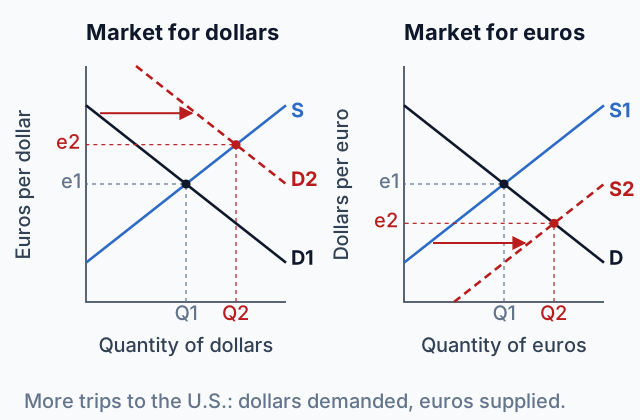
Put the two graphs side by side. In the market for drams, demand shifted left and the dram depreciated. In the market for cronas, supply shifted left and the crona appreciated. One trade demands one currency and supplies the other, so the curve swaps between the two graphs while the direction stays the same, and the two currencies always move in opposite directions.
Part 4 Try it Draw it yourself
What to watch for. In the two-market situation, the lab opens the second graph only after the first is right. Before you move anything there, say which curve the trade moves in that market. It is never the same curve as in the first market, and the direction is the same.
Part 5 Explain it Write it the way the exam asks
Nothing you type leaves this page.
Free response is 33.35% of the exam score. This one is shaped like Question 2, Short.
Free-response practice · Question 2 style
Rovenna and Quintar trade with each other under flexible exchange rates. Rovenna's currency is the rova, and Quintar's currency is the quint. (a) Draw a correctly labeled graph of the foreign exchange market for the rova, showing the equilibrium exchange rate labeled e1 and the equilibrium quantity labeled Q1. (b) Rovenna places new tariffs on goods imported from Quintar. On your graph in part (a), show the effect of the tariffs on the supply of rovas, labeling the new exchange rate e2, and identify whether the rova appreciates or depreciates. (c) The tariffs also change the foreign exchange market for quints. Identify which curve in the market for quints shifts and in which direction, and explain why.
Model answer
(a) The vertical axis is Quints per rova and the horizontal axis is Quantity of rovas. The demand for rovas, D1, slopes down and the supply of rovas, S1, slopes up. They cross at e1 and Q1, marked on the axes with dashed lines. (b) Rovennans import less from Quintar, so they offer fewer rovas for quints: the supply of rovas shifts left from S1 to S2, shown with an arrow. Where S2 crosses D1, e2 is above e1, so the rova appreciates. (c) The demand for quints shifts left. Rovennans buy fewer goods from Quintar, so at every exchange rate they need fewer quints to pay for them, and the quint depreciates.
Score your own answer. This is a self-check, not a grade. Tick each point your answer makes.
Part 6 Check yourself One policy, three roads
Read the case first. Each case question names the one change to follow.
Duvessa, a fictional country with a flexible exchange rate, sharply raised government spending in Year 2 and borrowed to pay for it. Its currency is the pound. In the countries Duvessa trades with, price levels, incomes and real interest rates did not change. Duvessa's statistics agency reported:
| Measure | Year 1 | Year 2 |
|---|---|---|
| Real GDP (billions of base-year pounds) | 640 | 662 |
| Price level (Year 1 = 100) | 100 | 104 |
| Real interest rate | 2.0% | 3.4% |
Case question 1 · Decide and justify
Based solely on the change in Duvessa's real interest rate from Year 1 to Year 2, what happens to the value of the pound in the foreign exchange market?
Which reason supports your choice?
Case question 2 · Decide and justify
Based solely on the change in Duvessa's real GDP (its real income) from Year 1 to Year 2, what happens to the value of the pound in the foreign exchange market?
Which reason supports your choice?
Case question 3 · Decide and justify
Based solely on the change in Duvessa's price level from Year 1 to Year 2, what happens to the value of the pound in the foreign exchange market?
Which reason supports your choice?
The rest stand on their own and do not use the case.
Check yourself · Spot the error
Lurenza has a flexible exchange rate and a banking system with ample reserves. Inflation is higher than its target. A student explained what Lurenza's central bank should do and what happens to the lur, Lurenza's currency. Tap the first line with a mistake.
Check yourself · Put it in order
Norvik has a flexible exchange rate, and its currency is the norv. Its government sharply cuts spending, while prices abroad do not change. Based solely on the change in Norvik's price level, tap the steps in the order they happen.
Check yourself · Multiple choice
Calvera has a flexible exchange rate, and its currency is the calo. This year Calvera's government runs a much larger budget deficit than last year and borrows to cover it. Price levels, incomes and real interest rates in the countries Calvera trades with do not change. What happens to the value of the calo in the foreign exchange market?
Part 7 Keep it Keep it
From 6.3 The Foreign Exchange Market · Calculate
Ostavia, a fictional country, uses a currency called the ducat, and its exchange rate with the U.S. dollar is flexible. In the market for ducats, quantity demanded is Qd = 1,500 - 250e and quantity supplied is Qs = 250e - 500, where e is the exchange rate in dollars per ducat and both quantities are in millions of ducats a day. The equilibrium rate is 4 dollars per ducat. Suppose the rate is 4.80 dollars per ducat for a moment. How large is the surplus of ducats, in millions?
From 4.6 Monetary Policy · Sort it
Each card is an action a government or central bank might take. Tap a card, then tap where it belongs.
Policy action with ample reserves
Policy action with limited reserves
Not monetary policy
In three lines
- Wanting a country's goods, services and assets moves the demand for its currency; paying in other currencies moves its supply, and the country's own tariffs or quotas cut it.
- Fiscal expansion depreciates the currency through real income or the price level and appreciates it through the real interest rate, the road to take when none is named.
- Higher interest rates appreciate a currency, and a central bank that sells its own currency depreciates it.
Exam strategy for this topic
- Section I, Multiple Choice: 60 questions in 70 minutes.
- Section II, Free Response: 3 questions in 60 minutes.
- This lesson's Explain it is shaped like free-response question 2, Short.
- A four-function calculator is allowed on both sections of the exam.
Before you draw, say who changed their plans: buyers abroad move the demand for a currency, and holders of it paying for things abroad move its supply. When a question says "based solely on" one change, follow only that road and name the currency that appreciates or depreciates.
Questions students ask
Why does a country's own tariff shift the supply of its currency and not the demand?
The tariff changes what the country's residents buy from abroad. They are the ones selling their currency to pay for imports, so fewer imports means less of the currency offered. Buyers abroad, who make up the demand, have not changed their plans.
Does expansionary fiscal policy make the currency appreciate or depreciate?
It depends on the road. Through the higher real interest rate that government borrowing brings, it appreciates. Through higher real income or a higher price level, it depreciates. Follow the road the question names, and the real interest rate road when a borrowing question names none.
How does monetary policy change the exchange rate?
Through interest rates. Higher rates make the country's bonds and deposits pay more, so the demand for its currency rises and it appreciates; lower rates do the reverse.
How can a central bank push its currency down without changing interest rates?
It sells its own currency for foreign currency in the foreign exchange market. That adds to the supply of the currency, so it depreciates.
If the demand for drams shifts left, what happens in the market for cronas?
The supply of cronas shifts left. One trade demands one currency and supplies the other, so the curve swaps between the two graphs while the direction stays the same. The dram depreciates and the crona appreciates.
Course alignment, for teachers
AP Macroeconomics topic 6.4, Unit 6: Open Economy—International Trade and Finance.
- Skill 4.C: Demonstrate the effect of a change in an economic situation on an accurately labeled graph or visual.
This lesson maps all 3 essential knowledge statements of the topic to the part that teaches each one: 3 are checked by a scored question. The map is in the lesson file.