Unit 1 · Topic 1.1 · about 25 minutes · 7 parts · 9 scored checks, 2 of them multiple choice
AP Microeconomics 1.1: Scarcity
Unit 1: 12 to 15% of the multiple-choice section
What you'll be able to do
- Define resources as the factors of production, and explain what makes most of them scarce and why some, such as established knowledge, are not.
Key vocabulary
| Term | What it means | The exam trap |
|---|---|---|
| Scarcity | The condition in which there are not enough resources to meet everything a society wants and needs. | Before you call a resource scarce or not scarce, check what you are comparing it with. |
| Trade-off | Giving up one use of a resource to have another, which scarcity forces on every choice. | Name the specific use that is given up; that use is the trade-off, so look for it before looking at any bill. |
| Factors of production | Inputs that firms combine to make goods and services, such as land, labor and capital. | A list of factors names things that do the producing, so check each item on a list for whether it produces anything. |
| Land | Anything nature provides that is used in production, from soil and rivers to timber and ore. | Land is broader than it sounds; check what counts as a natural resource before ruling something out. |
| Labor | Human work, measured in hours and effort, used to make goods and services. | Labor is the work itself, the hours and effort, not the wages paid for it. |
| Capital | Equipment and structures people have built to help make other goods and services. | In everyday speech capital means money; in this course it means something people made to produce other goods. |
| Non-rival | Describes a resource that one person can use without leaving any less of it for others. | Rivalry is a question about what one use leaves for other users, so settle it by that question and nothing else. |
 Tap to open the picture full size
Part 1 Think first A year of free dinners
Make a guess first. Even a wrong guess helps the answer stick.
Predict first
Diego wins a contest prize: every dinner at every restaurant in his city is free for him for a full year. He loves eating out, and he also has a part-time job, homework and a soccer team. Which statement describes Diego's dinners next year?
In short. Scarcity means there are not enough resources to meet everything a society wants and needs, so every use of a scarce resource is a trade-off against some other use.
- Scarcity compares the resources that exist with what people want from them; price and wealth do not change that comparison.
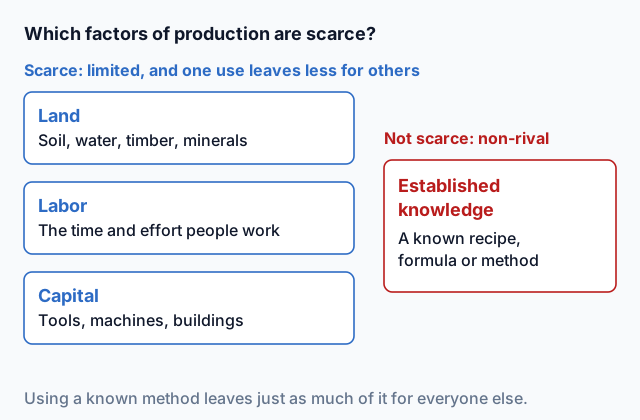
- The factors of production are land, labor and capital, and most of them are scarce.
- Established knowledge is often not scarce, because one person using it leaves no less of it for anyone else.
Part 2 Learn it Three ideas, with a check after each
2a. Scarcity creates trade-offs
A society wants more than it can make. People want housing, clinics, roads, phones, concerts and free time, all at once. The resources used to make those things are limited. Scarcity is that mismatch: there are not enough resources to meet every want and need.
Because of scarcity, every use of a resource rules out another use. That is a trade-off. A hospital that turns a ward into an emergency room has one fewer ward. A farmer who plants corn on a field cannot also graze cattle on it this season.
Scarcity is a comparison, so a low price or a big bank account cannot settle it. A price of zero does not end it: Diego's free dinners still use up his scarce evenings. Wealth does not end it either: a rich family still has 24 hours in a day, and a rich country still has only so many workers this year. The test is always the same: set the uses people want against the amount that exists. If the wants are larger, the resource is scarce, and using it means a trade-off.
Quick check · Decide and justify
A state park's most popular hiking trail is free to use. On summer weekends about 3,000 hikers a day want to start on it, but its parking lot and trailhead can handle about 800. Is the trail scarce on summer weekends?
Which reason supports your choice?
2b. The factors of production
The resources used to produce goods and services are called factors of production. The course gives three examples: land, labor and capital.
- Land: natural resources, such as soil, rivers, timber, oil in the ground and the site a building stands on.
- Labor: the time and effort people put into producing.
- Capital: things people have made that are used to produce other goods and services, such as a pizza oven, a tractor or a warehouse.
Most factors of production are scarce. A field can grow one crop at a time. A welder's hour spent on one job is not spent on another. A delivery van can be on one route at a time. Each is rival: when one producer uses it, there is less of it for everyone else. That is why it can run short. When people want more uses of it than it can serve, it is scarce.
Capital in this course means the oven, not the money that bought it. A loan can pay for an oven, but only the oven bakes.
Quick check · Sort it
Tap a resource, then tap the factor of production it is.
Land
Labor
Capital
2c. Knowledge that is not scarce
Not every factor of production is scarce. Think about the method for making bread rise with yeast. A baker in Ohio uses it every morning. A baker in Lagos uses it the same morning. Neither one has any less of the method because the other is using it.
That is what economists mean by non-rival: one person's use of the resource leaves just as much for everyone else. Established knowledge is the clearest example: a widely known recipe, a math formula, a standard way to treat a burn, the rules of grammar. Using it does not use it up, so there is no shortage of it to divide. Because it is non-rival, established knowledge may not be scarce at all.
Compare that with the yeast, the flour and the oven. Every bag of flour one baker uses is a bag no other baker can use. Those are rival, and bakers want more flour and oven time than there is, so they are scarce.
So when you classify a resource, ask two things. What kind of factor is it? And does one use leave less for others?
Quick check · Fill the statement
Tap a blank, then tap a word or phrase.
A school's chemistry teachers all use the same well-known method for balancing equations. When one teacher uses it, the others have of it, so the method is . The school's lab benches are different: a bench one class uses is not free for another, and more classes want lab time than the benches can hold, so the benches are .
Part 3 Watch it done Which of a studio's resources are scarce?
Follow each step, then finish the last one yourself.
Amara runs a small game studio. Its three programmers each work 40 hours a week, and the team has more bug fixes and features planned than they can finish. The studio has two high-end computers for testing, and testers wait in line for them every afternoon. It rents an office downtown that has no room for another desk, and it builds its games with a well-known pathfinding method that is taught in most computer science textbooks. Which of these resources are scarce for the studio?
Step 1 · Labor
The programmers' hours are labor. The team wants more work done than 120 hours a week can cover, and an hour spent on one game is not spent on another, so the hours are scarce.
Step 2 · Capital
The test computers are capital. Testers queue for them, so the studio wants more testing time than two machines give, and a machine running one test cannot run another. They are scarce.
Why this step?
Why is it not enough to say the computers are limited?
Every resource is limited in some sense. It is scarce when people want more uses of it than it can serve, which the queue for the computers shows.
Your step · Multiple choice
Amara's game studio has three programmers, two test computers, a rented office and a well-known pathfinding method from computer science textbooks. Which of these is NOT scarce for the studio?
Part 4 Try it A farm cooperative plans its season
A new situation. This time there is land, a known method and a decision to make. Decide which statements hold up.
Try it · Select all
A farm cooperative owns 200 acres. Its members want to plant 150 acres of strawberries and 120 acres of pumpkins this season. To test their soil, they use a well-known method published by the state's agriculture office, which any farmer may use. Which two statements are correct? Select two.
Select 2 answers, then check.
Part 5 Explain it Answer a short free-response question
Nothing you type leaves this page.
Free response is 33.35% of the exam score. This one is shaped like Question 3, Short.
Free-response practice · Question 3 style
The country of Westvale has large coal deposits, three million workers and many steel mills. (a) Identify the economic problem that forces Westvale to make trade-offs. (b) Identify the factor of production that each of the following is: (i) Westvale's coal deposits, (ii) Westvale's steel mills. (c) Westvale's engineers design bridges using a widely published method, and Westvale wants more steel than its mills can make. Explain why the method is not scarce for Westvale, while its steel is.
Model answer
(a) Scarcity: Westvale does not have enough resources to meet everything its people want and need. (b) (i) Land, since coal in the ground is something nature provides. (ii) Capital, since people built the mills to make steel. (c) The bridge method is established knowledge and is non-rival: one engineer using it leaves the full method for every other engineer, so there is never too little of it. Steel is different. A ton used in one bridge cannot go into another, and Westvale wants more steel than its mills make, so steel is scarce.
Score your own answer. This is a self-check, not a grade. Tick each point your answer makes.
Part 6 Check yourself Read a clinic's monthly records
Read the table first, then answer the questions from it.
Lakeview Community Clinic gives free checkups. Every patient visit takes half an hour of a nurse's time, and at every visit the nurse follows a blood pressure screening guideline that a national health agency publishes for anyone to use. The clinic kept these records for March:
| Item | March |
|---|---|
| Nurse hours available | 400 hours |
| Nurse time needed per visit | 0.5 hours |
| Exam rooms | 6 |
| Visits delayed because every exam room was in use | 120 |
| Blood pressure cuffs | 6 |
| Visits delayed because every cuff was in use | 45 |
| Screening guideline, published free | Used at every visit |
| Patient visits requested | 950 |
Case question 1 · Multiple choice
Which resource in Lakeview Community Clinic's March records is NOT scarce for the clinic?
Case question 2 · Calculate
Using the nurse hours available and the nurse time each visit needs, how many of the patient visits requested in March could the clinic NOT provide?
The rest stand on their own and do not use the case.
Check yourself · Spot the error
A student listed the resources a farm-to-table restaurant uses and said whether each is scarce. Tap the first line with a mistake.
Check yourself · Match
Tap each resource, then tap how an economist classifies it.
Part 7 Keep it Keep it
In three lines
- Scarcity: not enough resources to meet every want and need, so every use is a trade-off.
- The factors of production are land, labor and capital, and most are scarce.
- Established knowledge is non-rival, so it may not be scarce.
Exam strategy for this topic
- Section I, Multiple Choice: 60 questions in 70 minutes.
- Section II, Free Response: 3 questions in 60 minutes.
- This lesson's Explain it is shaped like free-response question 3, Short.
- A four-function calculator is allowed on both sections of the exam.
When a question asks whether a resource is scarce, compare what exists with what people want, and say so in one sentence. When it asks about a known method or formula, ask whether one user's use leaves less for anyone else.
Questions students ask
If something is free, can it still be scarce?
Yes. The free state-park trail in this lesson draws about 3,000 hikers a day for about 800 spots. Charging nothing does not add a single parking space.
Why isn't knowledge scarce when it is so valuable?
Value is not the test. Established knowledge, such as a known recipe or formula, is non-rival: one person using it leaves just as much for everyone else. Because using it does not use it up, it may not be scarce.
Can money count as capital?
Not in this course. Money pays for factors, but a dollar cannot cut hair or move pallets. The forklift the money buys is the capital.
Does a rich country escape scarcity?
No. Even the richest country can staff only so many hospitals and farm only so many acres this year, so making more of one thing still means less of another.
My textbook lists entrepreneurship as a fourth factor. Is that wrong?
No. Many textbooks add entrepreneurship, the work of organizing the other factors and taking the risk of a business. The course gives land, labor and capital as examples of factors, and this lesson uses those three.
Course alignment, for teachers
AP Microeconomics topic 1.1, Unit 1: Basic Economic Concepts.
- Skill 1.A: Describe economic concepts, principles, or models.
This lesson maps all 2 essential knowledge statements of the topic to the part that teaches each one: 2 are checked by a scored question. The map is in the lesson file.