Unit 1 · Topic 1.2 · about 25 minutes · 7 parts · 9 scored checks, 2 of them multiple choice, plus 2 from earlier lessons
AP Microeconomics 1.2: Resource Allocation and Economic Systems
Unit 1: 12 to 15% of the multiple-choice section
What you'll be able to do
- Explain how the economic system a society adopts (command, market or mixed) shapes how it answers what to produce, how to produce it and who consumes it.
Key vocabulary
| Term | What it means | The exam trap |
|---|---|---|
| Resource allocation | How a society decides to use its scarce resources, by answering what to produce, how to produce it and who consumes it. | Resource allocation is about using real resources, so do not confuse it with how money is shared out. |
| Economic system | A society's institutions, such as who owns resources, together with the coordinating mechanism it uses to allocate scarce resources and distribute output. | An economic system is more than a form of government; describe it by who owns resources and what mechanism answers the three questions. |
| Coordinating mechanism | The means a system uses to answer the three questions, such as central plans and orders or prices and voluntary exchange. | Name the mechanism itself, the plan or the prices, rather than naming who benefits from the result. |
| Command economy | An economic system in which the government owns most resources and a central authority answers the three questions by plan and order. | Government ownership is one feature to check; also check who gives the orders about what is made and how. |
| Market economy | An economic system in which private individuals and firms own most resources and prices with voluntary exchange answer the three questions. | Describe a market economy by who owns resources and by its mechanism, not by who is missing from it. |
| Mixed economy | An economic system that uses both markets and government decisions to allocate resources. | Check every part of the economy you are told about before naming its system. |
 Tap to open the picture full size
Part 1 Think first The last fans in town
Make a guess first. Even a wrong guess helps the answer stick.
Predict first
A heat wave hits a large city, and stores sell out of electric fans in two days. A few hundred fans are left across the whole city, and thousands of households want one. In most cities like this one, what decides which households end up with the remaining fans?
In short. Resource allocation is how a society answers three questions about its scarce resources, and the economic system it adopts decides who answers them and how.
- Every society must decide what goods and services to produce, how to produce them and who consumes them.
- In a command economy a central authority answers the three questions through plans and orders; in a market economy prices and the voluntary choices of buyers and sellers answer them.
- Most real economies are mixed: markets answer most of the questions, and the government answers some of them through laws, taxes and public services.
Part 2 Learn it Three ideas, with a check after each
2a. Three questions about scarce resources
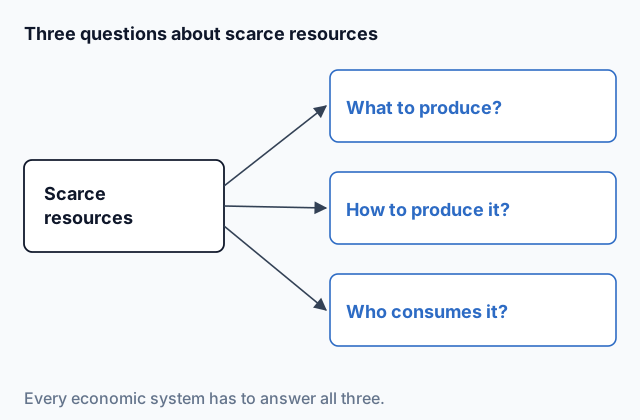
Because resources are scarce, someone has to decide how to use them. Deciding that is resource allocation, and it always comes down to three questions.
- What to produce? Which goods and services, and how much of each. More apartments or more office towers? More buses or more cars?
- How to produce it? Which mix of resources and methods. A farm can harvest lettuce with forty workers or with four workers and a machine.
- Who consumes it? Which people get the goods and services once they exist. The fans in Think first are this question.
Every society answers all three, every day, whether anyone sits down to answer them or not. A small village and a country of 300 million face the same questions. What differs is who does the answering and by what means.
Quick check · Match
Tap each decision, then tap the basic question it answers.
2b. Command economies and market economies
An economic system is a society's set of institutions, such as who owns resources and what the laws allow, together with a coordinating mechanism that turns those into answers to the three questions.
In a command economy, the government owns most of the land and capital, and a central authority answers the questions. Planners decide that farms will grow so much wheat, assign factories their machines and workers, and set rules for who receives housing or cars. The coordinating mechanism is the plan and the orders that carry it out.
In a market economy, private individuals and firms own most resources, and no one person is in charge of the whole. Firms produce what buyers are willing to pay for, choose the methods that keep their costs down, and sell to buyers who choose to pay the price. The coordinating mechanism is prices together with the voluntary choices of buyers and sellers. When more people want a good, its price rises, and firms find it worth making more. The fans in Think first went this way in most cities: stores set prices, and the households that chose to pay them got the fans.
Quick check · Sort it
Tap a feature, then tap the economic system it belongs to.
Command economy
Market economy
2c. Mixed economies
Almost no country today runs on pure command or a pure market. Almost every economy is a mixed economy: it uses both coordinating mechanisms, in different proportions.
In the United States, Canada or South Korea, private firms and prices answer most of the three questions. The government still answers some. It decides that public schools and highways are produced, sets safety and pollution rules that shape how goods are made, and uses taxes and benefits that change who consumes what.
Other mixed economies lean further toward command. A government might own the railways, the power company and the banks, and leave restaurants, shops and farms to the market.
So classifying a system is a matter of balance. Ask who answers most of the three questions, and by what means. If prices and private choices answer nearly all of them, the economy is close to a market economy. If plans and orders do, it is close to a command economy. If both play real parts, it is mixed.
Quick check · Decide and justify
In the country of Halvard, private firms own most factories and stores, and prices set by buyers and sellers decide what most firms make. The government runs the public schools, owns the national railway and sets safety rules for food. What kind of economic system does Halvard have?
Which reason supports your choice?
Part 3 Watch it done How a planned economy answers the three questions
Follow each step, then finish the last one yourself.
In the country of Eastmark, the state owns all farms and factories. A national planning office writes a five-year plan: 2 million tons of steel a year, 50,000 new apartments and 300,000 tractors. It assigns each factory its workers and machines and tells it which methods to use. Describe how Eastmark answers the three basic questions.
Step 1 · What to produce
The planning office decides: the plan names the goods, steel, apartments and tractors, and how much of each.
Step 2 · How to produce it
The planning office decides again, by assigning workers, machines and methods to each factory.
Why this step?
Why is Eastmark a command economy and not a mixed one?
Its government owns the resources, and a central authority answers the questions by plan and order. No part of the allocation is left to prices and private choices.
Your step · Multiple choice
In Eastmark, the state owns all farms and factories and a planning office sets every factory's output and methods. How does Eastmark answer the question of who consumes the 50,000 new apartments?
Part 4 Try it When buyers change their minds
A new situation. In a market economy no planner orders a change, yet production still follows what buyers want. Put the chain of events in order.
Try it · Put it in order
In a market economy, many more families suddenly want electric bikes. Tap the events in the order they happen.
Part 5 Explain it Answer a short free-response question
Nothing you type leaves this page.
Free response is 33.35% of the exam score. This one is shaped like Question 2, Short.
Free-response practice · Question 2 style
Every society must allocate its scarce resources. (a) Identify the three basic questions of resource allocation. (b) In a command economy, identify who answers the question of what to produce. (c) A new phone becomes very popular in a market economy, and stores cannot keep it in stock. Explain how the market economy decides which buyers get the phones that are available. (d) Identify one way the government of a mixed economy could change who gets the phones.
Model answer
(a) What goods and services to produce, how to produce them, and who consumes them. (b) A central authority, such as a government planning office, decides what to produce. (c) No central authority assigns the phones. Stores post a price, and the phones go to the buyers who choose to pay it, so prices and voluntary exchange decide who gets them. (d) It could use a tax or a benefit, for example paying part of the price for students, which changes who buys the phones.
Score your own answer. This is a self-check, not a grade. Tick each point your answer makes.
Part 6 Check yourself Compare three countries
Read the table first, then answer the questions from it.
An economics class compared how three countries make the same kinds of decisions. Its notes are below.
| Country | Who owns most factories | What sets most prices | Who decides what farms grow |
|---|---|---|---|
| Arland | Private owners | Buyers and sellers | Each farm's owner |
| Bexia | The state | A planning agency | The planning agency |
| Corvia | Private owners, except the state's railways and power plants | Buyers and sellers, with some limits set by law | Each farm's owner, with state payments to grow wheat |
Case question 1 · Fill the statement
Tap a blank, then tap a word.
From the class's notes, Arland is closest to a economy, Bexia is a economy, and Corvia is a economy.
Case question 2 · Multiple choice
According to the class's notes, what is the coordinating mechanism that decides how much wheat Bexia's farms grow?
The rest stand on their own and do not use the case.
Check yourself · Spot the error
A student wrote these notes on resource allocation. Tap the first line with a mistake.
Check yourself · Select all
Which two of these are part of how a market economy allocates resources? Select two.
Select 2 answers, then check.
Part 7 Keep it Keep it
From 1.1 Scarcity · Sort it
Tap a resource, then tap the factor of production it is.
Land
Labor
Capital
Lakeview Community Clinic gives free checkups. Every patient visit takes half an hour of a nurse's time, and at every visit the nurse follows a blood pressure screening guideline that a national health agency publishes for anyone to use. The clinic kept these records for March:
| Item | March |
|---|---|
| Nurse hours available | 400 hours |
| Nurse time needed per visit | 0.5 hours |
| Exam rooms | 6 |
| Visits delayed because every exam room was in use | 120 |
| Blood pressure cuffs | 6 |
| Visits delayed because every cuff was in use | 45 |
| Screening guideline, published free | Used at every visit |
| Patient visits requested | 950 |
From 1.1 Scarcity · Calculate
Using the nurse hours available and the nurse time each visit needs, how many of the patient visits requested in March could the clinic NOT provide?
In three lines
- Resource allocation answers three questions: what to produce, how, and who consumes it.
- Command economies answer them by plan and order; market economies by prices and voluntary exchange.
- Most real economies are mixed, with both mechanisms playing a part.
Exam strategy for this topic
- Section I, Multiple Choice: 60 questions in 70 minutes.
- Section II, Free Response: 3 questions in 60 minutes.
- This lesson's Explain it is shaped like free-response question 2, Short.
- A four-function calculator is allowed on both sections of the exam.
When a question asks how an economic system allocates resources, name the coordinating mechanism (a central authority's plan, or prices and voluntary exchange) and tie it to the specific question: what, how or who consumes.
Questions students ask
What are the three basic economic questions?
What goods and services to produce, how to produce them, and who consumes them. Every society answers all three because its resources are scarce.
Is the United States a market economy or a mixed economy?
A mixed economy. Prices and private firms answer most of the three questions, but the government also decides some, for example by providing public schools and highways, setting safety rules and taxing and paying benefits.
Who decides what gets produced in a market economy?
No single person does. Firms produce what buyers are willing to pay for, so prices and the voluntary choices of buyers and sellers decide together.
What is a coordinating mechanism?
It is how an economic system turns its institutions into answers to the three questions. In a command economy it is central planning and orders; in a market economy it is prices and voluntary exchange.
Do any countries have a pure command or pure market economy?
Almost none. Real economies sit somewhere between the two, which is why most are called mixed, though some lean much further toward planning than others.
Course alignment, for teachers
AP Microeconomics topic 1.2, Unit 1: Basic Economic Concepts.
- Skill 1.D: Describe the similarities, differences, and limitations of economic concepts, principles, or models.
This lesson maps all 2 essential knowledge statements of the topic to the part that teaches each one: 2 are checked by a scored question. The map is in the lesson file.