Unit 10 · Topic 10.1 · about 30 minutes · 7 parts · 14 scored checks, 3 of them multiple choice
AP Physics 2: Algebra-Based 10.1: Electric Charge and Electric Force
Unit 10: 15 to 18% of the multiple-choice section
What you'll be able to do
- Describe the electric force between charged objects: its size from Coulomb's law, and its direction along the line between them.
- Compare the electric and gravitational forces between objects that have both charge and mass, and explain why gravity dominates at large scales.
- Describe electric permittivity, and how a material polarizes near charge depending on how easily its electrons rearrange.
Key vocabulary
| Term | What it means | The exam trap |
|---|---|---|
| Elementary charge | The size of the charge on one proton or one electron, C. | Charges are often given with a prefix, such as 2.0 C for C, so convert with the prefix before you calculate. |
| Net charge | The total of all the positive and negative charges in an object. | A neutral object still contains charges, in equal positive and negative amounts, so neutral does not mean the object has no charges in it. |
| Coulomb | The SI unit of electric charge, written C. | Later in this unit a capital C also stands for capacitance, so check whether a C in a problem is a unit or a quantity. |
| Vacuum | A region of space with no matter in it, also called free space. | Air is not a vacuum, but electric forces in air are almost the same as in a vacuum, so problems set in air are usually worked as if in a vacuum. |
 Tap to open the picture full size
Part 1 Think first Two balloons, one push
Commit to a guess first. Being wrong now makes the right idea stick better.
Predict first
Mia rubs two small balloons on her hair. Balloon A picks up three times as much charge as balloon B, and both charges have the same sign. She hangs the balloons from threads a few centimeters apart, and they push each other away. Which balloon pushes harder on the other?
In short. Electric charge comes in whole numbers of the elementary charge , and Coulomb's law gives the size of the force between two point charges, , directed along the line joining them.
- Like charges repel and opposite charges attract, and the two charges exert forces of equal size on each other, however different the charges are.
- Between charged particles the electric force is far stronger than gravity, but large objects are nearly neutral, so gravity dominates at large scales.
- A material's permittivity measures how much it polarizes near charge, which depends on how easily its electrons rearrange.
Part 2 Learn it Charge and the force between charges
2a. Charge comes in whole units
Electric charge is a fundamental property of matter, in the way mass is. It comes in two kinds, described as positive and negative. A proton carries a charge of and an electron a charge of , where C is the elementary charge. A neutron has no charge. The SI unit of charge is the coulomb, C.
An object's net charge is the total of all the charges in it. A neutral object has as many electrons as protons. One with 5 more electrons than protons has a net charge of , and one with 5 fewer has . Since every proton and electron carries exactly , the elementary charge can be treated as the smallest indivisible amount of charge, and any net charge is a whole number of elementary charges: or , never .
Real charged objects have a size. When that size is negligible next to the distances in a situation, we model each one as a point charge, with all its charge at a single point. A bead 1 mm across, 30 cm from another bead, is a point charge.
Quick check · Calculate
A speck of dust has a net charge of C. Take C. How many more electrons than protons does the speck carry? Give a whole number.
2b. Coulomb's law
Two point charges exert electric forces on each other. Coulomb's law gives the size of each force:
Here is the distance between the charges and . This lesson uses that value of , and every charge in it is in a vacuum.
The force is proportional to each charge, so doubling one charge doubles it. It is inversely proportional to the square of the distance, so doubling the distance makes it a quarter as large, not half.
There is one force size for the pair, and the formula shows why: swap and and nothing changes. Each charge pushes or pulls on the other, and by Newton's third law those two forces are equal in size and opposite in direction, however different the charges are.
Each force points along the line joining the two charges. Charges of the same sign repel, so each force points away from the other charge. Charges of opposite sign attract, so each points toward the other.
 Tap to open the picture full size
Quick check · Rank it
Four pairs of point charges are each alone in a vacuum. In pair 1, charges and are a distance apart. In pair 2, and are apart. In pair 3, and are apart. In pair 4, and are apart. Rank the pairs by the size of the force each charge exerts on the other.
Largest force first
Give each one a place, 1 for first. Give two the same place if they are equal.
Your ranking: none yet
2c. Electric force and gravity
Any two objects with mass also attract each other by gravity, , with . Coulomb's law has the same inverse square form, but the two forces differ in two ways.
Gravitational forces are always attractive. Electric forces can attract or repel.
And between charged particles, the electric force is usually far larger. Two protons m apart, as in an atomic nucleus, repel with an electric force of about 230 N, while their gravitational attraction is about N.
So why does gravity, not the electric force, hold the Moon in orbit around Earth? Large objects are very nearly neutral. Earth and the Moon each hold enormous amounts of positive and negative charge in almost equal measure, so their electric forces on each other nearly cancel. Mass has no negative kind, so gravity never cancels, and at large scales it dominates.
At everyday scales, electric forces are everywhere. The normal force of a floor, friction and the tension in a rope all come from electric forces among huge numbers of atoms. There are so many that we treat them instead as contact forces.
Quick check · Multiple choice
Between two protons, the electric force is far larger than the gravitational force. Yet the force that keeps Earth in orbit around the Sun is gravitational. Which explains this?
2d. Polarization and permittivity
Materials differ in how their electrons behave. In a conductor, such as a metal, some electrons are free to move through the whole object, so charge carriers move easily. In an insulator, such as glass, plastic or dry wood, charge carriers cannot move easily, and each electron stays with its own atom or molecule.
Bring a charged object near either kind and its electric force pushes on the material's electrons. In a conductor, free electrons shift across the whole object. In an insulator, the electrons of each molecule shift a little toward one side. Either way, the result is an induced rearrangement of electrons that leaves positive and negative charge separated within the material: polarization.
Electric permittivity measures how much a material or medium polarizes near charge. It depends on what the material is made of and how it is arranged: the more easily its electrons change configuration, the greater its permittivity. Free space has a constant permittivity, , the constant in . Matter has a different value.
Quick check · Match
Tap a term, then the statement that describes it.
Part 3 Watch it done The net force from two charges
Predict first, then watch each step, then finish the problem yourself.
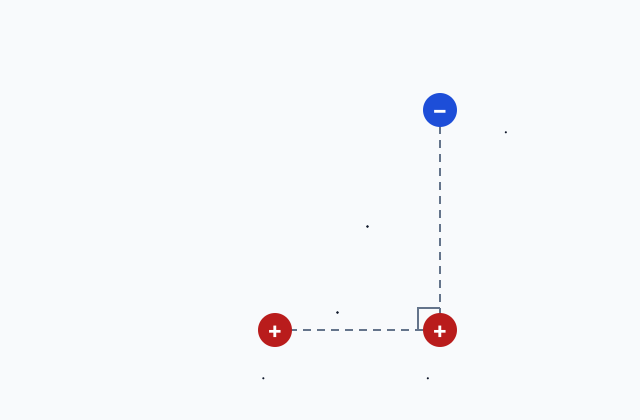
In the picture at the top of this lesson, point charges sit in a vacuum at the corners of a right triangle. Charge P, C, is at the right angle. Charge A, C, is 0.30 m to the left of P, and charge B, C, is 0.40 m directly above P. Take . What is the size of the net electric force on P?
Predict first
Before you open the first step, predict: which way does the net force on P point?
Step 1 · Define the system and choose axes
The system is charge P. Take to the right and up. Two forces act on P, one exerted by A and one exerted by B, and each points along the line joining P to the charge exerting it.
Step 2 · The force exerted by A
A and P are both positive, so they repel: the force on P points away from A, to the right, along . Its size is
Step 3 · The force exerted by B, and the plan
B is negative and P is positive, so they attract: the force on P points toward B, straight up, along . Its size uses the same law with B's charge and the 0.40 m distance. The two forces are at right angles, so the net force has components and , and its size is .
Why this step?
Why not just add the sizes of the two forces?
The forces point in different directions, one along and one along . Adding their sizes would treat them as pointing the same way. Each component of the net force is the sum of the forces' components along that axis.
Your step · Calculate
Finish it. Point charges sit in a vacuum at the corners of a right triangle. Charge P, C, is at the right angle. Charge A, C, is 0.30 m to the left of P, and charge B, C, is 0.40 m directly above P. Take . What is the size of the net electric force on P? Give your answer to the nearest 0.01 N.
N
Part 4 Try it Draw the forces, then weigh them against gravity
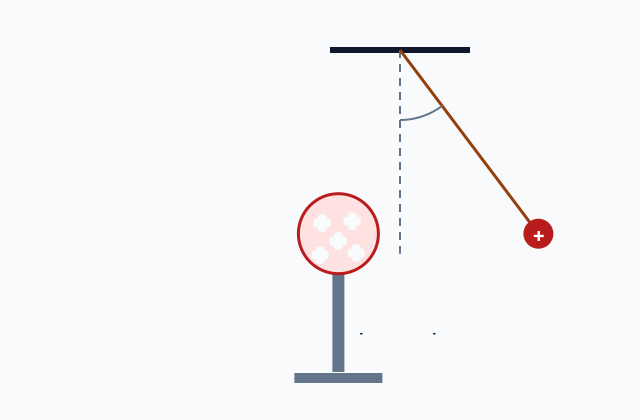
The ball in the picture below hangs at rest. Before you build its force diagram, say which way you expect each force to point, then check each one against what exerts it.
 Tap to open the picture full size
Try it · Draw the forces
A small ball with a positive charge hangs at rest from an insulating thread. A sphere with a positive charge, on an insulating stand, is level with the ball and to its left, and the thread hangs 37 degrees from vertical, tilted away from the sphere. Build the force diagram for the ball: pick each force on it, give its direction, and give its length compared with the gravitational force.
The dot is the ball. One diagram that fits
Pick each force exerted on the ball, then choose the way it points and how long its arrow is compared with the others. The arrows are drawn for you.
Now compare the electric force with gravity for two objects you could hold in your hand. Predict first: is one of them larger than the other by a factor of about ten, about a thousand, or more than a million?
Try it · Decide and justify
Two small spheres, each of mass 2.0 g and charge nC, are 0.10 m apart in a vacuum. Take and . Is the gravitational force between the spheres smaller than the electric force between them?
Which reason supports your answer?
Part 5 Explain it Does distance change the winner?
On the exam this is handwritten, so answer on paper first. Nothing you type here leaves this page. Then check your answer against the model and each scoring point.
Free response is 50% of the exam score. This one is shaped like Question 1, Mathematical Routines.
Free-response practice · Question 1 style
Two identical small particles, each of mass and charge , are a distance apart in a vacuum, far from anything else.
(a) Derive an expression for the ratio of the electric force to the gravitational force between them, , in terms of , , and .
(b) Calculate the ratio for two electrons, each with C and kg. Use and .
(c) A student claims that if the two electrons were moved far enough apart, gravity would become the larger force, because the electric force weakens faster with distance. Use your expression from (a) to justify whether the claim is correct.
Model answer
(a) Coulomb's law gives and Newton's law of gravitation gives , so dividing one by the other, . The in each cancels.
(b) . The electric force is more than times the gravitational force.
(c) Incorrect. Both forces are proportional to , so the ratio in (a) does not contain at all. Moving the electrons twice as far apart makes each force a quarter as large, and the electric force stays about times the gravitational force at every distance. The electric force does not weaken faster than gravity; it weakens at exactly the same rate, so it is the larger force at any separation.
Score your own answer. This is a self-check, not a grade. Tick each point your answer makes.
Part 6 Check yourself Three charges on a line
Both case questions use the figure.
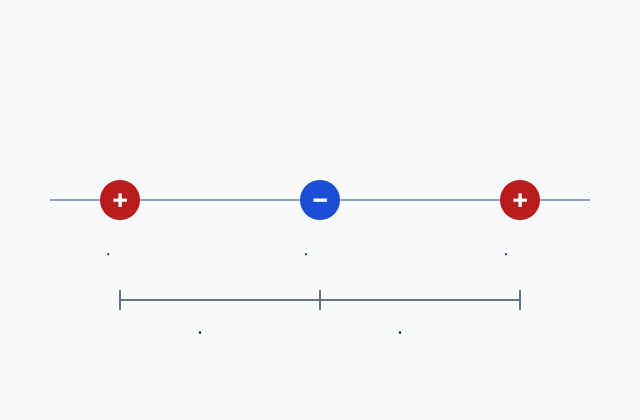
Three point charges sit on a straight line in a vacuum. Take .
 Tap to open the picture full size
Case question 1 · Calculate
Using the figure of three charges on a line: X, C, Y, C, and Z, C, sit in that order, 0.30 m apart, so X and Z are 0.60 m apart. What is the size of the net electric force on Z? Give your answer to the nearest 0.01 N.
Case question 2 · Multiple choice
Using the figure of three charges on a line: X carries C and Y carries C, 0.30 m apart. How does the force exerted by X on Y compare with the force exerted by Y on X?
The rest stand on their own and do not use the case.
Check yourself · Fill the statement
Tap a blank, then an answer.
Two charged beads, each 2 mm across, are 40 cm apart in a vacuum, so each can be modeled as a . Moving them to 80 cm apart makes the force between them as large. Swapping one bead for a bead with three times the charge, at the same distance, makes the force as large.
Check yourself · Sort it
Each card names a force between two objects. Tap a card, then whether that force attracts, repels, could do either, or is not there at all.
Attracts
Repels
Could do either
No force at all
Check yourself · Decide and justify
Blocks of two kinds of plastic, P and Q, sit near the same charged rod. In plastic P, the electrons of each molecule shift easily toward or away from the rod. In plastic Q, they barely shift at all. Does P have the greater electric permittivity?
Which reason supports your answer?
Part 7 Keep it Bring back earlier ideas
Gas pressure and entropy come from the unit before this one, and the pushes of gas atoms on their container are electric forces at the scale of atoms. Pulling those ideas back up is what makes them last.
Bring it back · Calculate
A gas in a cylinder pushes on a piston whose face has an area of . The perpendicular components of the forces the gas's atoms exert on the piston add to N on average. What is the pressure of the gas on the piston? Give your answer in kilopascals, to the nearest 1 kPa.
Bring it back · Multiple choice
A sealed, insulated box is split into two halves by a thin metal wall. One half holds hot gas and the other cold gas, and nothing enters or leaves the box. What happens to the total entropy of the gas in the box?
In three lines
- Charge comes in whole numbers of C: a proton carries , an electron , and a neutron none.
- Coulomb's law, , gives one force size for the pair, along the line between the charges: like charges repel, opposite charges attract.
- Electric forces dwarf gravity between particles, but large objects are nearly neutral, so gravity rules at large scales; permittivity measures how much a medium polarizes.
Exam strategy for this topic
- Section I, Multiple Choice: 42 questions in 85 minutes.
- Section II, Free Response: 4 questions in 95 minutes.
- This lesson's Explain it is shaped like free-response question 1, Mathematical Routines.
- A four-function, scientific, or graphing calculator is allowed on both sections of the exam.
When two or more charges act on one, find each force's size from Coulomb's law with the sizes of the charges, give it a direction from their signs, then add the forces by components. Add the sizes directly only when the forces point the same way.
Questions students ask
What is Coulomb's law?
It gives the size of the electric force between two point charges, , with . The force points along the line between the charges.
Does the larger charge exert the larger force?
No. Each charge exerts a force of the same size on the other, a Newton's third law pair, however different the two charges are.
What is the elementary charge?
The size of the charge on a proton or an electron, C. Every net charge is a whole number of elementary charges.
Why does gravity matter more than electric force for planets?
Planets and stars are almost exactly neutral, so their electric forces on each other nearly cancel, while gravity always attracts and adds up.
What is electric permittivity?
A measure of how much a material or medium polarizes near charge. It depends on how easily the material's electrons rearrange, and free space has the constant value .
Beyond the AP Exam
College Board sets this limit on what the AP Exam asks about this topic. Anything past it is not on the exam.
AP Physics 2 only expects students to make calculations of the electric force between four or fewer interacting charged objects or systems. The analysis of the resulting electric force from more charges is allowed in situations of high symmetry.
Course alignment, for teachers
AP Physics 2: Algebra-Based topic 10.1, Unit 10: Electric Force, Field, and Potential.
- Skill 1.A: Create diagrams, tables, charts, or schematics to represent physical situations.
- Skill 2.A: Derive a symbolic expression from known quantities by selecting and following a logical mathematical pathway.
- Skill 2.D: Predict new values or factors of change of physical quantities using functional dependence between variables.
- Skill 3.B: Apply an appropriate law, definition, theoretical relationship, or model to make a claim.
This lesson maps all 19 essential knowledge statements of the topic to the part that teaches each one: 19 are checked by a scored question. The map is in the lesson file.