Unit 10 · Topic 10.2 · about 30 minutes · 7 parts · 11 scored checks, 2 of them multiple choice, plus 2 from earlier lessons
AP Physics 2: Algebra-Based 10.2: Conservation of Electric Charge and the Process of Charging
Unit 10: 15 to 18% of the multiple-choice section
What you'll be able to do
- Describe how a system's net charge or the way its charge is arranged changes when it is rubbed, touched, brought near another charged object or grounded.
Key vocabulary
| Term | What it means | The exam trap |
|---|---|---|
| Grounding | Electrically connecting a charged system to a much larger, approximately neutral system, such as Earth. | A person standing on the floor is connected to Earth, so a question that has someone touch a metal object may be describing a ground connection. |
| System | The object or group of objects chosen for analysis; everything else is its surroundings. | Before you add up charges, say which objects are in the system and list everything that touches them, such as a hand, a wire or a stand. |
| Nanocoulomb | One billionth of a coulomb, written nC: C. | Charges given to everyday objects by rubbing are nanocoulombs or microcoulombs, so an answer of several whole coulombs on a balloon points to a slip with a prefix. |
 Tap to open the picture full size
Part 1 Think first A balloon and a head of hair
Commit to a guess first. Being wrong now makes the right idea stick better.
Predict first
Leo rubs a balloon on his dry hair. Before the rubbing, the balloon and his hair were both neutral. Afterward the balloon carries a negative charge. What is true of his hair now?
In short. Electric charge is conserved: a system's net charge changes only when charge moves into or out of it, and in solids the charge that moves is almost always electrons.
- Rubbing and touching charge objects by moving electrons from one to the other; identical metal spheres that touch end with equal shares of their total charge.
- A charged object nearby can polarize a neutral one, separating its charge without changing its net charge, which is why charged objects attract neutral ones.
- Grounding connects a system to Earth, which can supply or take in electrons; done with a charged object nearby, it can leave the system charged.
Part 2 Learn it Moving charge, never making it
2a. Charging moves electrons
Matter is made of protons, neutrons and electrons, and a neutral object holds equal amounts of positive and negative charge. Charge is never created or destroyed. So any change in a system's net charge is due to a transfer of charge between the system and its surroundings, and if no charge crosses the system's boundary, its net charge stays constant. That is conservation of electric charge.
In solids, the charge that moves is almost always electrons. Protons are bound in the nuclei of atoms and stay put. So a solid becomes negative by gaining electrons and positive by losing them.
Friction is one way to move them. When two different materials rub, electrons cross from one to the other. Rub a plastic rod with a wool cloth and the rod might end at nC, holding electrons that came from the wool, which ends at nC. Take the rod and the cloth together as one system: its net charge was zero before the rubbing, and it is still zero.
Quick check · Multiple choice
A glass rod is rubbed with a silk cloth. Both were neutral before, and afterward the rod carries nC. What is true of the silk?
2b. Sharing charge by touching
Touch a charged metal object to another metal object and charge flows between them, so the net charge of each can change by contact. Electrons move from one to the other, and the total of the two stays the same.
Two identical metal spheres end with equal charges, since nothing favors one over the other: each takes half the total. A sphere at nC touched to an identical one at nC makes a total of nC, so each ends at nC. Electrons moved from the negative sphere to the positive one: the negative sphere's charge rose by 7 nC, and the positive sphere's fell by 7 nC.
Spheres of different sizes need not split the total equally, but their total still does not change.
Notice what did not happen. The nC and the nC did not cancel away to nothing. Charge only moved: the pair held nC before the touch and holds nC after it.
Quick check · Decide and justify
Two identical metal spheres on insulating stands carry nC and nC. They touch and are pulled apart, and now each is neutral. A classmate says the touch destroyed 10 nC of charge. Is the classmate right?
Which reason supports your answer?
2c. Polarization: charge separated, not added
A charged object can change how charge is arranged in a nearby system without touching it. Hold a negatively charged rod near a neutral aluminum can. The rod repels the can's free electrons, which crowd toward the far side, and the near side is left positive. That induced charge separation, or polarization, rearranges charge within the can, and its net charge stays zero. So it happens in neutral systems too.
An insulator polarizes as well, on a smaller scale. Its electrons cannot travel across it, but within each molecule they shift a little away from the rod.
Either way, the polarized object is attracted to the rod. Its near side, charged opposite to the rod, is closer than its far side, and the electric force is stronger at smaller distances, so the near side's pull beats the far side's push. A rod of either sign attracts a neutral object. A charged object attracts neutral objects, not just objects with charge of the opposite sign.
Quick check · Sort it
A positively charged rod is held a few centimeters from each small object below, without touching it. Any object described as charged carries about as much charge as the rod. Tap a card, then what the rod does to that object.
Attracts it
Repels it
2d. Grounding, and charging without contact
Grounding means connecting a charged system, through a wire or a person's body, to a much larger and approximately neutral system, usually Earth. Earth is so large that it can take in or give up a great deal of charge with no noticeable change in its own.
Ground an isolated charged metal sphere and electrons move until the sphere is, for practical purposes, neutral. If it was negative, its extra electrons flow into Earth. If it was positive, electrons flow up from Earth to make up the shortage. Protons do not travel along the wire.
Grounding does not always leave a system neutral, though. It lets electrons move in response to any charge nearby. Hold a negatively charged rod near a metal sphere and ground the sphere: the rod pushes electrons out of the sphere into Earth. Break the ground connection while the rod is still there, and those electrons cannot come back. Take the rod away, and the sphere is left positive. Charging a system this way, with no contact with the charged object, is called charging by induction.
Quick check · Put it in order
A student gives a neutral metal sphere on an insulating stand a negative charge, using a positively charged rod and a wire connected to Earth. Tap her steps in order.
Part 3 Watch it done Three spheres, two touches
Predict first, then watch each step, then finish the problem yourself.
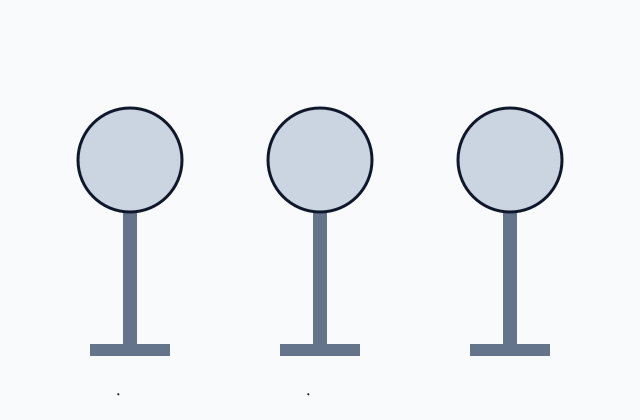
In the picture at the top of this lesson, three identical metal spheres sit on insulating stands. Sphere A carries nC, sphere B carries nC, and sphere C is neutral. A is touched to B, and they are pulled apart. Then B is touched to C, and they are pulled apart. What is the charge on C at the end?
Predict first
Before you open the first step, predict: what charge does C end with?
Step 1 · Define the system for the first touch
The system is A and B together. They touch only each other, and the stands are insulators, so no charge enters or leaves the system. Its net charge stays nC.
Step 2 · Share the total between identical spheres
Identical spheres end with equal charges, half the total each:
The same rule holds for every touch between two identical spheres, using the charges they carry at the moment they touch. Whichever sphere's charge rises gained electrons, and the other lost exactly as many.
Step 3 · Check a limiting case
If A and B had started with equal and opposite charges, their total would be zero and each would end neutral, as it should: the extra electrons on one would exactly make up the shortage on the other.
Why this step?
Why must the pair's total stay the same while electrons move between the spheres?
Charge moves only between A and B; none crosses into the insulating stands or the air. A system's net charge changes only by a transfer to or from its surroundings, so the total stays nC.
Your step · Calculate
Finish it. Three identical metal spheres sit on insulating stands. Sphere A carries nC, sphere B carries nC, and sphere C is neutral. A is touched to B, and they are pulled apart. Then B is touched to C, and they are pulled apart. What is the charge on C at the end? Give your answer to the nearest 0.1 nC.
nC
Part 4 Try it Ground it, then follow the charge
Each question below turns on where electrons can go. Before you answer, say which way you expect them to move.
Try it · Decide and justify
A metal sphere on an insulating stand carries nC, and no other charged object is nearby. A wire connected to Earth touches the sphere for a moment. Afterward, is the sphere's net charge close to zero?
Which reason supports your answer?
Now follow one total through several touches. Predict first: which sphere ends with the most negative charge?
Try it · Rank it
Four identical metal spheres sit on insulating stands. Sphere P carries nC, sphere Q carries nC, and spheres R and S are neutral. P is touched to Q, and they are separated. Then Q is touched to R, and they are separated. Then R is touched to S, and they are separated. Rank the spheres by their final charge.
Most positive (least negative) first
Give each one a place, 1 for first. Give two the same place if they are equal.
Your ranking: none yet
Part 5 Explain it Touch them, then compare the force
On the exam this is handwritten, so answer on paper first. Nothing you type here leaves this page. Then check your answer against the model and each scoring point.
Free response is 50% of the exam score. This one is shaped like Question 4, Qualitative/Quantitative Translation.
Free-response practice · Question 4 style
Identical small metal spheres A and B sit on insulating stands. A carries charge and B carries . They are touched together, then separated again to a distance that is much larger than their size, so each can be treated as a point charge. Treat the air around them as a vacuum.
(a) Without using equations, explain whether the spheres attract or repel after they are separated, and whether the force between them is larger or smaller than it was at the same distance before they touched.
(b) Derive expressions for the size of the electric force between the spheres at distance before the touch and after it, in terms of , and .
(c) Explain how your expressions in (b) support your reasoning in (a).
Model answer
(a) They repel. The touch conserves the pair's total, , and identical spheres share it equally, so each ends with : charges of the same sign. Each charge is also smaller in size than either one was before, so the force between them is smaller.
(b) Before: , attractive. After: , repulsive.
(c) After the touch both charges are , the same sign, which gives the repulsion argued in (a). The product of the charges falls from to in size, so is one eighth of : smaller, as argued.
Score your own answer. This is a self-check, not a grade. Tick each point your answer makes.
Part 6 Check yourself An electroscope, step by step
Both case questions use the figure.
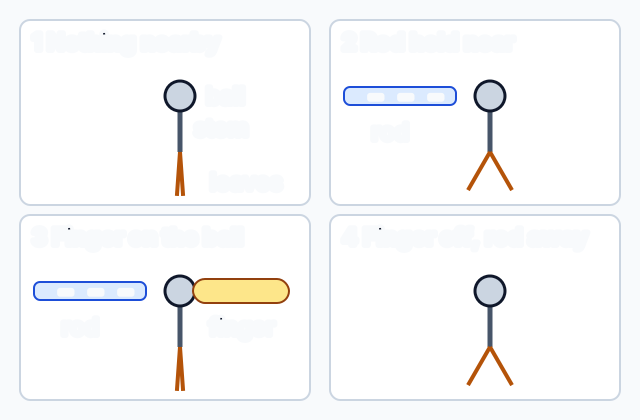
An electroscope is a metal ball on a metal stem, with two thin metal leaves hanging from the bottom of the stem. When the leaves carry charge of the same sign, they repel each other and spread apart. A student starts with a neutral electroscope and does the four steps shown, using a negatively charged rod. She is standing on the floor, which connects her to Earth, so her finger on the ball grounds the electroscope.
 Tap to open the picture full size
Case question 1 · Multiple choice
Using the figure of the electroscope: in step 2 the negatively charged rod is held near the ball without touching it, and the leaves spread apart. What is the electroscope's charge at that step?
Case question 2 · Fill the statement
Using the figure of the electroscope: tap a blank, then an answer.
In step 3 the leaves fall together because electrons flow from the into through her finger. After step 4, with no charged object nearby, the electroscope's net charge is .
The rest stand on their own and do not use the case.
Check yourself · Spot the error
A student explains why a balloon sticks to a wall after being rubbed on a wool sweater. Tap the first line that goes wrong.
Check yourself · Calculate
A small neutral metal sphere sits on an insulating stand. A larger metal sphere carrying nC is touched to it and pulled away, and now carries nC. What is the charge on the small sphere? Give your answer to the nearest 0.1 nC.
Part 7 Keep it Bring back earlier ideas
Charging changes the charges in Coulomb's law, so the forces between objects change with them. Pulling those ideas back up is what makes them last.
From 10.1 Electric Charge and Electric Force · Rank it
Four pairs of point charges are each alone in a vacuum. In pair 1, charges and are a distance apart. In pair 2, and are apart. In pair 3, and are apart. In pair 4, and are apart. Rank the pairs by the size of the force each charge exerts on the other.
Largest force first
Give each one a place, 1 for first. Give two the same place if they are equal.
Your ranking: none yet
The ball in the picture below hangs at rest. Before you build its force diagram, say which way you expect each force to point, then check each one against what exerts it.
Now compare the electric force with gravity for two objects you could hold in your hand. Predict first: is one of them larger than the other by a factor of about ten, about a thousand, or more than a million?
From 10.1 Electric Charge and Electric Force · Decide and justify
Two small spheres, each of mass 2.0 g and charge nC, are 0.10 m apart in a vacuum. Take and . Is the gravitational force between the spheres smaller than the electric force between them?
Which reason supports your answer?
In three lines
- Charge is conserved: a system's net charge changes only by a transfer to or from its surroundings, and in solids electrons are what move.
- Identical metal spheres that touch share their total equally; a charged object polarizes a neutral one and attracts it.
- Grounding connects a system to Earth; done with a charged object nearby and removed first, it leaves the system charged opposite to that object.
Exam strategy for this topic
- Section I, Multiple Choice: 42 questions in 85 minutes.
- Section II, Free Response: 4 questions in 95 minutes.
- This lesson's Explain it is shaped like free-response question 4, Qualitative/Quantitative Translation.
- A four-function, scientific, or graphing calculator is allowed on both sections of the exam.
In any charging question, name the system and ask whether charge can enter or leave it. Describe every step as electrons moving, from where to where, and check that the total charge at the end equals the total at the start.
Questions students ask
Is charge created when you rub two objects together?
No. Rubbing moves electrons from one material to the other, so one ends negative and the other positive by the same amount. The total charge does not change.
Why are neutral objects attracted to charged objects?
A charged object polarizes a neutral one, separating its charge. The side with charge opposite to the charged object is closer, so its attraction is stronger than the repulsion of the far side.
What happens when two identical metal spheres touch?
Charge moves between them until they carry equal charges, each half of their total. The total is the same before and after.
What does grounding do?
It connects a system to Earth, which can supply or take in electrons. An isolated charged conductor ends up neutral, but with a charged object nearby, grounding and then removing the ground first leaves it with a charge opposite to that object's.
Do protons move when an object is charged?
Not in solids. Protons are bound in the nuclei of atoms, so charging a solid moves electrons: it gains them to become negative and loses them to become positive.
Course alignment, for teachers
AP Physics 2: Algebra-Based topic 10.2, Unit 10: Electric Force, Field, and Potential.
- Skill 1.A: Create diagrams, tables, charts, or schematics to represent physical situations.
- Skill 2.C: Compare physical quantities between two or more scenarios or at different times and locations in a single scenario.
- Skill 3.B: Apply an appropriate law, definition, theoretical relationship, or model to make a claim.
- Skill 3.C: Justify or support a claim using evidence from experimental data, physical representations, or physical principles or laws.
This lesson maps all 8 essential knowledge statements of the topic to the part that teaches each one: 8 are checked by a scored question. The map is in the lesson file.