Unit 9 · Topic 9.6 · about 30 minutes · 7 parts · 11 scored checks, 3 of them multiple choice, plus 2 from earlier lessons
AP Physics 2: Algebra-Based 9.6: Entropy and the Second Law of Thermodynamics
Unit 9: 15 to 18% of the multiple-choice section
What you'll be able to do
- Describe how the entropy of a system changes over time: energy spreads out, entropy is a state function greatest at equilibrium, an isolated system never loses entropy, and a closed system can.
Key vocabulary
| Term | What it means | The exam trap |
|---|---|---|
| Entropy | A description of how spread out a system's energy is. | Entropy is not a temperature: two objects at the same temperature can have very different entropies, as a lake and a cup of water do. |
| Isolated system | A system that exchanges neither energy nor matter with anything outside it. | A room counts as isolated only if nothing crosses its walls, including electricity through a wire. |
| Closed system | A system that no matter enters or leaves, though energy can cross its boundary. | A closed system can still gain or lose energy by heating, cooling or work, so it is not the same as an isolated one. |
 Tap to open the picture full size
Part 1 Think first Could the coffee warm up again?
Commit to a guess first. Being wrong now makes the right idea stick better.
Predict first
A mug of coffee on a desk cools from 80 °C to the room's temperature, 20 °C, and warms the air of the room very slightly. Could the room's air, on its own, ever send that energy back into the mug and reheat the coffee to 80 °C?
In short. Entropy describes how spread out a system's energy is, and the second law of thermodynamics says the total entropy of an isolated system never decreases.
- Localized energy tends to spread out, and energy that has spread out is less available to do work.
- Entropy is a state function and is greatest at thermodynamic equilibrium, so an isolated system moves on its own toward equilibrium and stays there.
- A system that exchanges energy with its surroundings can lose entropy, as long as the surroundings gain at least as much.
Part 2 Learn it The direction of spreading
2a. Energy spreads out
Localized energy tends to spread out. The energy of a hot mug spreads into the room. The kinetic energy of a ball rolling to a stop spreads into the random motion of the atoms in the ball, the floor and the air. The total energy stays the same, but it ends up split among far more particles, each with a little.
Entropy describes that spreading. It can be put two ways that come to the same thing:
- the tendency of energy to spread out, so that spread-out energy means high entropy;
- the unavailability of some of a system's energy to do work. Concentrated energy, such as a hot object beside a cold one, can run an engine. The same energy spread evenly at one temperature cannot.
This course treats entropy in words only. You will compare entropies and say which way they change, but you will not calculate a value of entropy.
Quick check · Multiple choice
A rubber ball is dropped onto a floor, bounces lower and lower, and finally lies still. Where is the energy it had at the start, and why can that energy not lift the ball again?
2b. Entropy belongs to the state
Entropy is a state function: it depends only on the current state of a system, not on how the system got there. Two samples of gas in the same state have the same entropy, whether one was heated quickly and the other slowly. In that, entropy is like internal energy and temperature, and unlike work and heat, which depend on the path.
For an isolated system, the state with the most entropy is thermodynamic equilibrium: one temperature throughout, no net flows of energy inside, and nothing left to spread. A hot brick and a cold brick in contact have less entropy than the same two bricks once both are lukewarm, and the closer they get to one temperature, the more entropy the pair has. Once a system reaches equilibrium, nothing about its state changes, so neither does its entropy.
Quick check · Rank it
Two identical bricks sit inside an insulated box, which is otherwise empty. Rank these states of the pair of bricks by total entropy. State 1: one brick at 80 °C and the other at 20 °C, just placed in contact. State 2: the same pair an hour later, both at 50 °C. State 3: one brick at 80 °C and the other at 20 °C, set a few centimeters apart. State 4: the pair partway, one brick at 65 °C and the other at 35 °C.
Most entropy first
Give each one a place, 1 for first. Give two the same place if they are equal.
Your ranking: none yet
2c. The second law
The second law of thermodynamics says that the total entropy of an isolated system can never decrease. It stays constant only if every process in the system is reversible, an ideal limit that real processes only approach. Every real process, such as a hot object cooling or a gas rushing into an empty space, makes it increase.
So an isolated system left alone moves on its own toward thermodynamic equilibrium, where its entropy is greatest, and then stays there. Hot and cold even out, and a gas spreads to fill its container. The reverse would lower the entropy of an isolated system, and it does not happen on its own.
The second law is not the first. Energy is conserved either way: a room sending its energy back into a cold mug of coffee would conserve energy perfectly. It is the second law that rules it out.
Quick check · Decide and justify
A sealed, insulated box holds a gas that has not yet settled: one side is hotter than the other. A student says that as the gas settles, the total entropy of the gas will increase, and that it could only stay the same if every process inside were reversible. Is the student right?
Which reason supports your answer?
2d. When entropy can go down
A change in a system's entropy is decided by how the system interacts with its surroundings, and the "never decreases" of the second law is about isolated systems only.
A closed system, which can exchange energy with its surroundings, can lose entropy when energy leaves it. Water in an ice tray inside a freezer loses energy by cooling, and its entropy decreases as it freezes. A pan cooling on a stove and the air inside a running refrigerator lose entropy the same way.
The second law still holds, because the surroundings gain at least as much. The freezer pushes energy out into the kitchen, and the total entropy of the water and its surroundings (the freezer, the kitchen, and whatever supplies the electricity) increases.
So before you call something a break of the second law, ask whether the system is isolated.
Quick check · Select all
In which two of these situations can the entropy of the named system decrease? Pick two.
Select 2 answers, then check.
Part 3 Watch it done Two blocks, two kinds of system
Predict first, then watch each step, then finish the problem yourself.
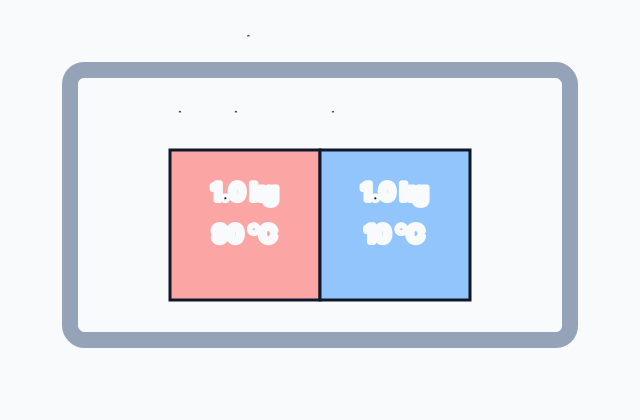
In the picture at the top of this lesson, two identical aluminum blocks, one at 90 °C and one at 10 °C, are placed in contact inside an insulated box that takes in no energy. What happens to the energy and the entropy of each block, and of the pair, from the moment they touch until long after?
Predict first
Before you open the first step, predict: what happens to the total entropy of the two blocks?
Step 1 · Follow the energy
Net energy flows from the 90 °C block to the 10 °C block. The box is insulated, so the energy one block loses the other gains, and the total energy of the pair stays the same. The blocks are identical, so their temperatures change by equal amounts and meet at 50 °C, where they stay.
Step 2 · Decide what kind of system each one is
The pair, inside the insulated box, is an isolated system: no energy crosses its boundary. Each block on its own is not isolated, because energy crosses the face between them, out of the hot block and into the cold one.
Why this step?
Why does it matter that each block on its own is not isolated?
The second law forbids a decrease in entropy only for an isolated system. So for any one part, first ask whether energy crosses its boundary; only a system that nothing crosses is held to never decreasing.
Your step · Sort it
Finish it. Two identical aluminum blocks, at 90 °C and 10 °C, are placed in contact inside an insulated box that takes in no energy, and both reach 50 °C. Tap a card, then what happens to that quantity from the moment they touch until they reach 50 °C.
Increases
Decreases
Stays the same
Part 4 Try it Spread out and used up
Entropy also explains why some energy stops being useful. Predict first: after a battery-powered fan runs down in a sealed room, where has the battery's energy gone?
Try it · Multiple choice
A battery-powered fan runs inside a sealed, insulated room until its battery is flat, then stops. Nothing enters or leaves the room. How does the room afterward compare with the room before?
Now watch a gas spread out on its own.
Try it · Put it in order
A sealed, insulated box holds a gas squeezed into one corner by a partition, and the partition is then removed. Tap these states of the gas in order of entropy, lowest first.
Part 5 Explain it Copper in water, in words and numbers
On the exam this is handwritten, so answer on paper first. Nothing you type here leaves this page. Then check your answer against the model and each scoring point.
Free response is 50% of the exam score. This one is shaped like Question 4, Qualitative/Quantitative Translation.
Free-response practice · Question 4 style
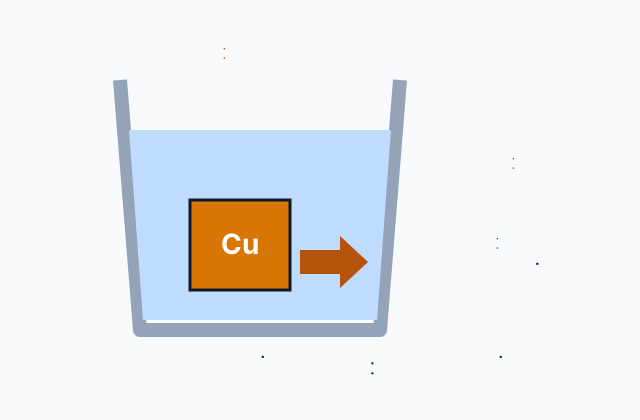
A 0.50 kg block of copper at 90 °C is dropped into 0.50 kg of water at 10 °C in an insulated cup that takes in no energy. Take the specific heat of copper as 385 J/(kg·K) and of water as 4190 J/(kg·K).
(a) Without using equations, explain what happens to the entropy of the copper, the entropy of the water, and the total entropy of the copper and water together, from the moment the block is dropped in until long after. On paper, draw the cup with an arrow for the direction of net energy transfer, and label each part with whether its entropy rises or falls. Do this by hand before you open the model.
(b) Derive an expression for the final temperature of the copper and water, in terms of their masses, specific heats and starting temperatures, and calculate its value.
(c) Explain how your answer to (b) is consistent with your reasoning in (a).
Model answer
(a) Compare your drawing with the model below. Net energy flows from the copper, at the higher temperature, to the water. The copper loses energy, so its entropy falls; it is not isolated, so that is allowed. The water gains energy, and its entropy rises. The copper and water together form an isolated system, so their total entropy cannot decrease. Cooling the copper is a real, irreversible process, so the total rises until both reach one temperature, equilibrium, where it is greatest and stops changing.
(b) The energy the copper loses equals the energy the water gains: , so °C.
(c) The final state in (b) has one temperature for both, which is thermodynamic equilibrium, the state of greatest total entropy from (a). The final temperature lies between 10 °C and 90 °C, so energy went from the copper to the water, the direction of the arrow in (a); the reverse, the copper warming while the water cooled, would push the temperatures apart and lower the total entropy. The copper gives up , about 14,100 J, and the water takes in the same 14,100 J, so the total energy is unchanged while the total entropy rises: energy conservation and the second law describe the same flow. And 16.7 °C sits close to the water's start because the water needs about 11 times the energy per degree that the copper does.
 Tap to open the picture full size
Score your own answer. This is a self-check, not a grade. Tick each point your answer makes.
Part 6 Check yourself An inventor's box
Both case questions use the table.
An inventor describes a new box. It is sealed and insulated, so no energy or matter crosses its walls, and a thin metal plate splits it into two halves holding equal amounts of the same gas. She reports these readings.
| Time (min) | Left half (°C) | Right half (°C) |
|---|---|---|
| 0 | 40 | 40 |
| 10 | 44 | 36 |
| 20 | 48 | 32 |
Case question 1 · Decide and justify
Using the inventor's readings: she says they break no law of physics, because the energy the left half gained equals the energy the right half lost. Is she right?
Which reason supports your answer?
Case question 2 · Multiple choice
Using the inventor's readings: suppose the box really were at 48 °C and 32 °C after 20 minutes, and were then left alone. What would its readings do from then on?
The rest stand on their own and do not use the case.
Check yourself · Spot the error
A student explains what happens to the entropy of water that freezes in an ice tray in a freezer. Tap the first line that goes wrong.
Check yourself · Fill the statement
Tap a blank, then an answer.
The total entropy of an isolated system decreases. It stays constant only if every process in the system is . Because entropy is a state function, two different paths between the same two states give change in entropy.
Part 7 Keep it Bring back earlier ideas
Specific heat and the flow of energy from hot to cold come back here: the second law is why that flow only ever goes one way. Pulling them back up is what makes them last.
From 9.5 Specific Heat and Thermal Conductivity · Calculate
A 0.25 kg block of aluminum, whose specific heat is 900 J/(kg·K), cools from 150 °C to 30 °C. How much energy leaves the block by cooling? Give your answer in kilojoules, to the nearest 1 kJ.
From 9.3 Thermal Energy Transfer and Equilibrium · Select all
A hot metal block is placed against a cold one inside an insulated box and left for a long time. Which two statements are true once the blocks reach thermal equilibrium? Pick two.
Select 2 answers, then check.
In three lines
- Localized energy tends to spread out, and entropy describes that spreading, or how much of a system's energy is unavailable to do work.
- Entropy is a state function, greatest at thermodynamic equilibrium; the total entropy of an isolated system never decreases, and stays constant only for reversible processes.
- A system that exchanges energy with its surroundings can lose entropy, as long as the surroundings gain at least as much.
Exam strategy for this topic
- Section I, Multiple Choice: 42 questions in 85 minutes.
- Section II, Free Response: 4 questions in 95 minutes.
- This lesson's Explain it is shaped like free-response question 4, Qualitative/Quantitative Translation.
- A four-function, scientific, or graphing calculator is allowed on both sections of the exam.
Before you apply the second law, name the system and ask whether it is isolated. Only an isolated system's entropy can never decrease; a system that energy can leave can lose entropy.
Questions students ask
What is entropy?
A description of how spread out a system's energy is. Energy that has spread out evenly has high entropy and is unavailable to do work.
What does the second law of thermodynamics say?
The total entropy of an isolated system never decreases. It stays constant only if every process is reversible, and in every real process it increases.
Can entropy ever decrease?
Yes, for a system that exchanges energy with its surroundings, such as water freezing in a freezer. The surroundings gain at least as much, so the total entropy does not decrease.
Is entropy a state function?
Yes. It depends only on the current state of a system, not on how the system got there, like temperature and internal energy and unlike work and heat.
Course alignment, for teachers
AP Physics 2: Algebra-Based topic 9.6, Unit 9: Thermodynamics.
- Skill 1.A: Create diagrams, tables, charts, or schematics to represent physical situations.
- Skill 2.C: Compare physical quantities between two or more scenarios or at different times and locations in a single scenario.
- Skill 3.B: Apply an appropriate law, definition, theoretical relationship, or model to make a claim.
- Skill 3.C: Justify or support a claim using evidence from experimental data, physical representations, or physical principles or laws.
This lesson maps all 8 essential knowledge statements of the topic to the part that teaches each one: 8 are checked by a scored question. The map is in the lesson file.