Unit 10 · Topic 10.3 · about 30 minutes · 7 parts · 11 scored checks, 2 of them multiple choice, plus 2 from earlier lessons
AP Physics 2: Algebra-Based 10.3: Electric Fields
Unit 10: 15 to 18% of the multiple-choice section
What you'll be able to do
- Describe the electric field of a charged object or a group of point charges: its size and direction at a point, and how field maps and field lines show it.
- Describe the electric field inside and around a charged conductor or insulator at rest.
Key vocabulary
| Term | What it means | The exam trap |
|---|---|---|
| Source charge | A charge that creates the electric field being studied. | A problem may treat a charge as a source in one part and as the charge being pushed in another, so decide in each part which charges create the field. |
| Electrostatic equilibrium | The state of a conductor in which none of its charge is moving. | A question that says a charged conductor is at rest is telling you it is in electrostatic equilibrium, even when it never uses those words. |
| Vector | A quantity with both a size and a direction, such as a force or an electric field. | A vector's size is never negative; a negative component says only which way that component points along its axis. |
 Tap to open the picture full size
Part 1 Think first One number for one spot
Commit to a guess first. Being wrong now makes the right idea stick better.
Predict first
Ana wants one number that says how strongly a charged dome acts at a spot P near it, whatever she puts there. With a tiny bead of charge at P, the electric force on the bead is N. With a tiny bead of charge at P, it is N. What should her number be?
In short. The electric field at a point is the electric force on a small test charge there divided by its charge, , a vector measured in newtons per coulomb that does not depend on the test charge.
- A point charge's field has size and points away from a positive charge and toward a negative one; with several charges, the fields add as vectors.
- A field map draws arrows for the field's size and direction; a field line diagram shows direction along the lines and a stronger field where they crowd together.
- In a conductor at rest the field inside is zero and excess charge sits on the surface; in an insulator, charge and field can both be inside.
Part 2 Learn it Describing the space around charges
2a. Force per unit charge
Charged objects create electric fields: a charge changes the space around it, so any other charge placed nearby feels a force. The electric field at a point is the electric force exerted on a test charge at that point divided by the test charge's charge:
Its unit is the newton per coulomb, N/C. A test charge is a point charge small enough that its presence does not significantly change the field it is measuring.
Double the test charge and the force doubles, so their ratio stays the same. The field belongs to the point and to the charges that create it, called the source charges, not to whatever is put there.
The field is a vector. Rearranged, : the force on a positive charge points the same way as the field, and the force on a negative charge points the opposite way. A field of 500 N/C pointing north pushes a nC charge north with N, and pushes a nC charge south with a force of the same size.
Quick check · Decide and justify
At point P near a charged object, a test charge of nC feels an electric force of N pointing east. A student says the electric field at P is N/C, pointing east. Is the student right?
Which reason supports your answer?
2b. The field of a point charge, and adding fields
Put a test charge a distance from a point charge . By Coulomb's law the force on it has size , so the field there has size
The test charge cancels out, as it should. The field points along the line through : away from if is positive, and toward if is negative. Like the force, it falls off with the square of the distance: twice as far, a quarter of the field.
With several source charges, each one creates its own field at a point, and the net electric field there is the vector sum of them. Add fields the way you add forces, by components. Two fields of 300 N/C at right angles to each other make a net field of N/C, not 600 N/C. Fields add their sizes directly only when they point the same way.
Quick check · Calculate
An isolated point charge of nC sits in a vacuum. At a certain distance from it, its electric field has a size of 500 N/C. Take . What is that distance? Give your answer to the nearest 0.01 m.
2c. Field maps and field lines
The field has a size and a direction at every point, which is a lot to draw. Two representations handle it.
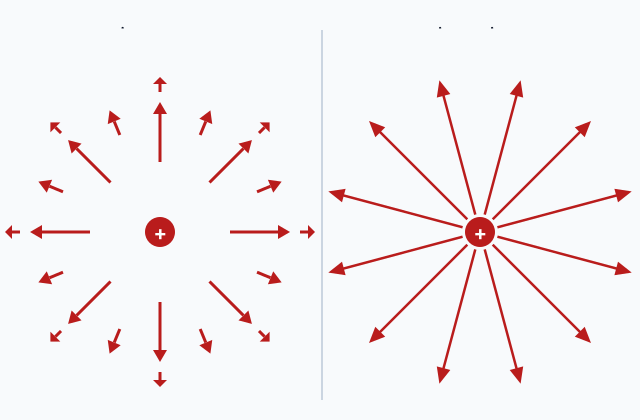
An electric field map puts a vector at many points: each arrow points the way the field points there, and its length shows the field's size. In the map below, the arrows point away from the positive charge and shrink fast with distance.
An electric field line diagram is a simplified model of a map. At any point, the field points along the line through it, the way its arrow shows. Lines start on positive charges and end on negative charges, or run off the page, and they never cross, since the field has one direction at each point. Where lines crowd together the field is strong; where they spread apart it is weak. The field exists between the lines too: a diagram shows only a sample of them.
Field lines are not paths. A charge released on a line is pushed along it only at first; once it is moving, it can leave a curved line.
 Tap to open the picture full size
Quick check · Match
Tap a feature of a field map or a field line diagram, then what it tells you.
2d. Conductors and insulators
In a conductor, free electrons move in response to any field inside it. They keep moving until they stop, and then the conductor is in electrostatic equilibrium. Three things follow.
- The field inside the conductor's material is zero. If it were not, it would still be pushing the free electrons.
- Any excess charge sits on the outer surface. None stays inside the material.
- Just outside, the field is perpendicular to the surface. A part of the field along the surface would push charge along it.
For a sphere whose charge is spread evenly, with spherical symmetry, the field outside is the same as that of a point charge with the sphere's net charge at its center: , with measured from the center.
An insulator is different. Its charge cannot move freely, so in equilibrium excess charge can sit in its interior as well as on its surface, and the field inside an insulator can be nonzero. Fields inside insulators are described only qualitatively in this course.
Quick check · Sort it
Each card states something that must be true of one kind of solid sphere with excess charge, at rest, however the charge was put on it, and need not be true of the other kind. Tap a card, then the kind of sphere it must describe.
A metal sphere
A plastic sphere
Part 3 Watch it done The field of two charges, by components
Predict first, then watch each step, then finish the problem yourself.
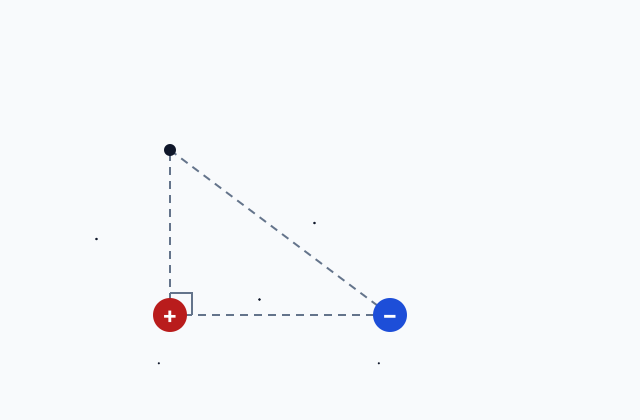
In the picture at the top of this lesson, point charge nC is fixed in a vacuum, and nC is fixed 0.40 m to its right. Point P is 0.30 m directly above , so it is 0.50 m from . Take . What is the size of the net electric field at P?
Predict first
Before you open the first step, predict: which way does the net field at P point?
Step 1 · Choose axes and list the sources
Take to the right and up, with at the origin. Each charge creates its own field at P, and the net field there is their vector sum.
Step 2 · The field of q1
is positive, so its field at P points away from it, straight up. Its size is
So and N/C.
Step 3 · The field of q2
is negative, so its field at P points toward : from P, 0.40 m to the right and 0.30 m down, along a line 0.50 m long. Its size is
Its components are its size times the fraction of that line along each axis: of it to the right and of it down.
Why this step?
Why can't you add 400 N/C and 144 N/C to get the net field?
The two fields point in different directions, one straight up and one down and to the right. Sizes add directly only for fields that point the same way, so each component of the net field is the sum of the fields' components along that axis.
Your step · Calculate
Finish it. Point charge nC is fixed in a vacuum, and nC is fixed 0.40 m to its right. Point P is 0.30 m directly above , and 0.50 m from . Take . What is the size of the net electric field at P? Give your answer to the nearest 1 N/C.
N/C
Part 4 Try it Spheres and surfaces
A charged metal sphere at rest is a source you will meet often. Predict first: if the same charge were put on a metal sphere half as wide, would the field at the same distance from the center be larger, smaller or the same?
Try it · Calculate
A solid metal sphere of radius 0.10 m carries an excess charge of nC and is in electrostatic equilibrium in a vacuum, far from other charges. Take . What is the size of the electric field at a point 0.30 m from the sphere's center? Give your answer to the nearest 10 N/C.
Now look just outside the surface of a charged metal object that is not a sphere.
Try it · Multiple choice
A metal object shaped like a teardrop, rounded at one end and pointed at the other, carries excess charge and is at rest. Which describes the electric field just outside its surface?
Part 5 Explain it Sketch the lines, then derive the field
On the exam this is handwritten, so answer on paper first. Nothing you type here leaves this page. Then check your answer against the model and each scoring point.
Free response is 50% of the exam score. This one is shaped like Question 2, Translation Between Representations.
Free-response practice · Question 2 style
Two point charges, each , are fixed a distance apart in a vacuum. Point M is midway between them. Point N is on the line through both charges, a distance beyond the right-hand charge.
(a) On paper, sketch the electric field lines around the two charges, with arrows, using about eight lines from each charge. Do this by hand before you open the model.
(b) Derive expressions for the size of the net electric field at M and at N, in terms of , and .
(c) Explain how the spacing of the lines near M and near N in your sketch agrees with your expressions in (b).
Model answer
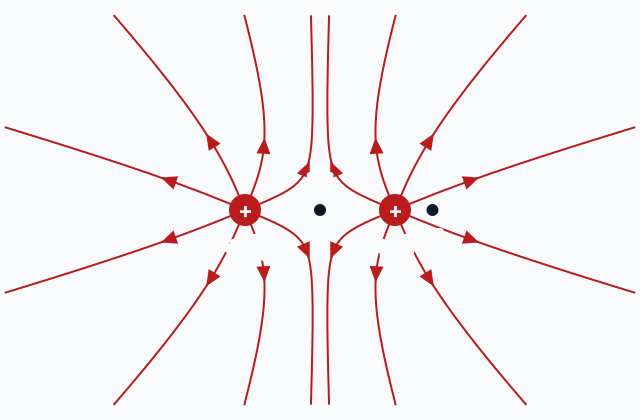
(a) Compare your sketch with the model below. Lines leave each charge pointing away from it, bend away from each other between the charges, and spread out far from the pair.
(b) At M the two fields have the same size, , and point in opposite directions, so . At N both fields point to the right, away from the charges: .
(c) Near M the lines curve away from each other and leave a gap, with no line through M, which matches a field of zero there. N sits right beside a charge, where the lines leaving it are packed close together, which matches a large field, about , four times what one charge gives at a distance .
 Tap to open the picture full size
Score your own answer. This is a self-check, not a grade. Tick each point your answer makes.
Part 6 Check yourself Reading a field line diagram
Both case questions use the figure.
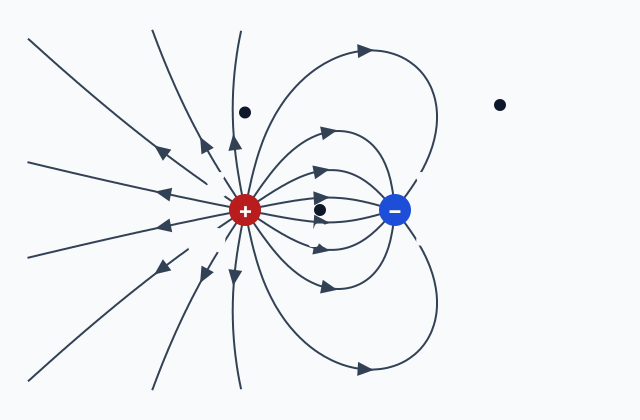
The diagram shows field lines around two point charges, X and Y, drawn so that the number of lines leaving or ending on a charge is proportional to the size of its charge.
 Tap to open the picture full size
Case question 1 · Rank it
Using the field line diagram of charges X and Y: X and Y are a distance 2a apart. Point A is midway between them, point B is a distance 1.3a directly above X, and point C is 1.4a to the right of Y and 1.4a above the line through X and Y. Rank the points by the size of the electric field there.
Strongest field first
Give each one a place, 1 for first. Give two the same place if they are equal.
Your ranking: none yet
Case question 2 · Multiple choice
Using the field line diagram of charges X and Y: an electron is placed at rest at point B, directly above X. Which describes the electric force on it at that moment?
The rest stand on their own and do not use the case.
Check yourself · Spot the error
A student measures the electric field at point P near a fixed point charge. Tap the first line that goes wrong.
Check yourself · Fill the statement
Tap a blank, then an answer.
To measure the field at a point, place a charge there, small enough that it does not significantly change the field. Near an isolated negative point charge, the field points the charge, and an electron placed there is pushed the charge.
Part 7 Keep it Bring back earlier ideas
Conductors, insulators and grounding come back in this topic as the fields inside and around charged objects. Pulling them back up is what makes them last.
Each question below turns on where electrons can go. Before you answer, say which way you expect them to move.
Now follow one total through several touches. Predict first: which sphere ends with the most negative charge?
From 10.2 Conservation of Electric Charge and the Process of Charging · Decide and justify
A metal sphere on an insulating stand carries nC, and no other charged object is nearby. A wire connected to Earth touches the sphere for a moment. Afterward, is the sphere's net charge close to zero?
Which reason supports your answer?
From 10.1 Electric Charge and Electric Force · Match
Tap a term, then the statement that describes it.
In three lines
- The electric field is the force per unit charge on a test charge, ; a positive charge is pushed along it and a negative charge against it.
- A point charge's field is , away from a positive charge and toward a negative one, and the fields of several charges add by components.
- Field lines crowd where the field is strong and are not paths; a conductor at rest has zero field inside and its excess charge on its surface.
Exam strategy for this topic
- Section I, Multiple Choice: 42 questions in 85 minutes.
- Section II, Free Response: 4 questions in 95 minutes.
- This lesson's Explain it is shaped like free-response question 2, Translation Between Representations.
- A four-function, scientific, or graphing calculator is allowed on both sections of the exam.
To find a net field, draw each source's field at the point first, away from positive charges and toward negative ones, then add components. For the force on a charge, multiply the field by the charge, and reverse the direction if the charge is negative.
Questions students ask
What is an electric field?
The electric force per unit charge on a test charge at a point, , in newtons per coulomb. It describes how charges affect the space around them.
Does the electric field depend on the test charge?
No. A larger test charge feels a proportionally larger force, so the force per unit charge stays the same. The field is set by the source charges.
Which way does an electric field point?
Away from positive charges and toward negative charges. A positive test charge is pushed along the field and a negative one against it.
What do electric field lines show?
The field's direction along each line, and its relative size from how close the lines are. They start on positive charges, end on negative charges and never cross. They are not the paths charges follow.
Why is the electric field inside a conductor zero?
In a conductor at rest the free electrons have stopped moving. Any field inside would push them, so in electrostatic equilibrium the field inside is zero and excess charge sits on the surface.
Beyond the AP Exam
College Board sets this limit on what the AP Exam asks about this topic. Anything past it is not on the exam.
AP Physics 2 only expects students to make calculations of the electric field resulting from four or fewer charged objects or systems. Analysis of the electric field resulting from more charges is allowed in situations of high symmetry. Students will only be expected to perform qualitative analysis of electric fields within insulators.
Course alignment, for teachers
AP Physics 2: Algebra-Based topic 10.3, Unit 10: Electric Force, Field, and Potential.
- Skill 1.A: Create diagrams, tables, charts, or schematics to represent physical situations.
- Skill 2.A: Derive a symbolic expression from known quantities by selecting and following a logical mathematical pathway.
- Skill 2.B: Calculate or estimate an unknown quantity with units from known quantities, by selecting and following a logical computational pathway.
- Skill 3.B: Apply an appropriate law, definition, theoretical relationship, or model to make a claim.
This lesson maps all 13 essential knowledge statements of the topic to the part that teaches each one: 13 are checked by a scored question. The map is in the lesson file.