Unit 10 · Topic 10.4 · about 30 minutes · 7 parts · 10 scored checks, 1 of them multiple choice, plus 2 from earlier lessons
AP Physics 2: Algebra-Based 10.4: Electric Potential Energy
Unit 10: 15 to 18% of the multiple-choice section
What you'll be able to do
- Describe the electric potential energy of a system of point charges: what it means, what its sign says, how it depends on distance, and how to find it for up to four charges.
Key vocabulary
| Term | What it means | The exam trap |
|---|---|---|
| Electric potential energy | The energy a system of charged objects has because of where the charges are, , measured in joules. | Answers often come out in millijoules or microjoules, so convert to joules before you compare one with a work or a kinetic energy given in joules. |
| Point charge | A charged object small enough, compared with the distances to other charges, that its size can be ignored. | A charged sphere counts as a point charge only when the distances in a problem are large compared with its size, so check the sizes before you use . |
| External force | A force exerted on a system by something outside it, such as a hand or a machine that moves a charge. | The external force is separate from the electric forces the charges exert on each other, so in an energy question decide whose work is being asked for. |
 Tap to open the picture full size
Part 1 Think first Pushing two charges together
Commit to a guess first. Being wrong now makes the right idea stick better.
Predict first
Two small beads, each with a positive charge, rest on a level, frictionless track made of plastic, far apart. Lena slowly pushes one bead toward the other until they are 2 cm apart, then holds both beads still. Compared with when the beads were far apart, the energy stored in the arrangement of the two beads has:
In short. Electric potential energy is the energy a system of charged objects has because of where they are; for two point charges it is , the work an external force does to bring them together from far apart.
- Like charges give a positive energy and unlike charges a negative one, measured from zero when the charges are far apart.
- The energy goes as , not : twice the distance, half the energy.
- For three or four charges, add the energy of every pair once, as signed numbers.
Part 2 Learn it Energy stored in an arrangement of charges
2a. The work to bring two charges together
Electric potential energy, , belongs to a system of charged objects, not to any one of them. For two point charges, it equals the work an external force must do to bring them from infinitely far apart to where they are now. The charges are brought in slowly, so neither gains kinetic energy and all of that work is stored.
Far apart, the charges do not interact, so their electric potential energy is zero. That is the reference every other value is measured from.
- Like charges repel. To bring them together, the external force pushes the way they move, so it does positive work, and is positive.
- Unlike charges attract. Left alone they would rush together, so to bring them in slowly the external force pulls back, against the motion. It does negative work, and is negative.
A negative means the pair holds less energy than the same two charges far apart: an external force would have to do positive work to pull them apart again.
Throughout, the charges are point charges: objects small compared with the distances between them.
Quick check · Decide and justify
An electron and a proton start very far apart. An external force brings them together slowly until they are m apart, and holds them there. A student says the electric potential energy of the electron-proton system is now positive, because the external force acted on the particles all the way in. Is the student right?
Which reason supports your answer?
2b. The energy of a pair of point charges
For two point charges and a distance apart, the electric potential energy of the system is
Keep the signs of the charges in. Like charges give a positive product and a positive ; unlike charges give a negative one, as the work argument said. is a scalar: it has a sign but no direction.
Compare it with Coulomb's law. The force goes as , but the energy goes as . Doubling the distance makes the force a quarter as large, but only half as large. Doubling one charge doubles both.
Two charges of C, 0.30 m apart, have J. An external force did 0.12 J of work to bring them there from far apart.
Quick check · Calculate
Point charges of C and C are 0.15 m apart in a vacuum, far from any other charge. Take . What is the electric potential energy of the two-charge system? Give your answer to the nearest 0.01 J, with its sign.
2c. Three or four charges: add every pair
With more than two charges, the system's electric potential energy is the sum of the energies of every pair:
Three charges make three pairs: 1 and 2, 1 and 3, 2 and 3. Four charges make six. Count each pair once; the pair 1 and 2 is the same interaction as the pair 2 and 1.
The sum is of signed numbers, not vectors. There are no components to find and no directions to draw, so a positive pair and a negative pair can partly cancel.
The total is the work an external force does to assemble the whole group from far apart. Bring the charges in one at a time: the first costs nothing, since nothing is there to push on it, and each later one costs the energy of the pairs it forms with the charges already in place. Calculations in this course use at most four point charges.
Quick check · Rank it
Three point charges sit in a row in a vacuum, each a distance from the next, so the two end charges are apart. Four systems are built this way, listed from left to right. System A: , , . System B: , , . System C: , , . System D: , , . Rank the systems by their total electric potential energy.
Greatest (most positive) first
Give each one a place, 1 for first. Give two the same place if they are equal.
Your ranking: none yet
Part 3 Watch it done Three charges, three pairs
Predict first, then watch each step, then finish the problem yourself.
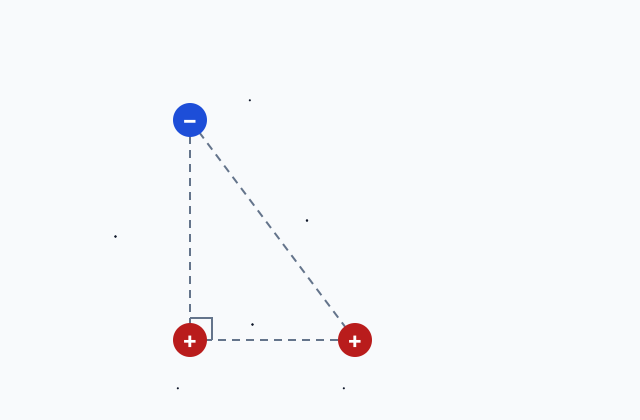
In the picture at the top of this lesson, point charges are fixed in a vacuum at the corners of a right triangle: C at the right angle, C 0.30 m to its right, and C 0.40 m above , so and are 0.50 m apart. Take . What is the total electric potential energy of the system?
Predict first
Before you open the first step, predict: is the total electric potential energy positive, negative or zero?
Step 1 · List the pairs
Three charges make three pairs: and , 0.30 m apart; and , 0.40 m apart; and , 0.50 m apart. Each pair's energy is with the signs kept.
Step 2 · The pair q1 and q2
Both charges are positive, so this energy is positive:
Step 3 · The pair q1 and q3
The signs are unlike, so this energy is negative:
Why this step?
Why are the pair energies simply added, with no components?
Electric potential energy is a scalar. Each pair contributes a signed number with no direction, so the total is their sum. Components belong to vectors, such as forces and fields.
Your step · Calculate
Finish it. Point charges are fixed in a vacuum at the corners of a right triangle: C at the right angle, C 0.30 m from , and C 0.40 m from and 0.50 m from . Take . What is the total electric potential energy of the three-charge system? Give your answer in millijoules, to the nearest 1 mJ.
mJ
Part 4 Try it Bringing in one more charge
Assembling charges one at a time shows where the energy goes. Predict first: two equal positive charges are fixed in place, and a third positive charge is brought in from far away to the point exactly midway between them, where the forces from the two cancel. Does that take any work?
Try it · Calculate
Two point charges, each C, are fixed 0.60 m apart in a vacuum. An external force brings a third point charge, C, slowly from very far away to the point midway between them, along the line through the midpoint at a right angle to the line joining them. Take . How much work does the external force do? Give your answer in millijoules, to the nearest 1 mJ.
Now draw how the energy of one pair depends on the distance between its charges.
Try it · Sketch the graph
Two point charges, C and C, are held in a vacuum at distances from 0.10 m to 0.40 m apart. Sketch the electric potential energy of the pair against the distance between the charges. The first point is fixed at 180 mJ, the energy at 0.10 m.
One shape that fits
Drag a point up or down, or tap it and use the arrow keys. Only the shape is checked.
Part 5 Explain it Zero energy, but not zero force
On the exam this is handwritten, so answer on paper first. Nothing you type here leaves this page. Then check your answer against the model and each scoring point.
Free response is 50% of the exam score. This one is shaped like Question 1, Mathematical Routines.
Free-response practice · Question 1 style
Two point charges, each , and a third point charge are fixed at the corners of an equilateral triangle with sides of length , in a vacuum.
(a) Derive an expression for the total electric potential energy of the three-charge system, in terms of , , and .
(b) For C and m, calculate the value of , with its sign, that makes the total electric potential energy zero.
(c) A student claims that with this value of , the net electric force on is zero, because the system has no electric potential energy. Justify whether the claim is correct.
Model answer
(a) There are three pairs, each a distance apart: .
(b) when , so C. The positive pair, J, is cancelled by the two negative pairs, J each.
(c) Incorrect. Energies add as signed numbers, so a positive pair can cancel negative ones, but forces add as vectors. Each attracts with a force of N along its own side of the triangle. The two pulls are apart, so they cannot cancel: the net force on is N, toward the midpoint of the side joining the two charges.
Score your own answer. This is a self-check, not a grade. Tick each point your answer makes.
Part 6 Check yourself Assembling charges one at a time
Both case questions use the table.
A student works out how much work an external force does to assemble three small spheres, each carrying C, at the corners of an equilateral triangle with sides of 0.30 m, in a vacuum. Each sphere is brought slowly from very far away, one at a time, and the spheres can be treated as point charges. She uses .
| Step | Sphere brought in | Work by the external force (J) |
|---|---|---|
| 1 | Sphere 1, to the first corner | 0 |
| 2 | Sphere 2, to the second corner | 0.12 |
| 3 | Sphere 3, to the third corner | 0.24 |
Case question 1 · Calculate
Using the table of the three spheres: a fourth sphere, also C, is then brought slowly from very far away to the center of the triangle, 0.173 m from each corner. How much work does the external force do in this step? Give your answer to the nearest 0.01 J.
Case question 2 · Multiple choice
Using the table of the three spheres: why does step 3 take twice the work of step 2?
The rest stand on their own and do not use the case.
Check yourself · Fill the statement
Tap a blank, then an answer.
Two point charges are a distance r apart. Doubling the distance makes their electric potential energy . Tripling one charge and also tripling the distance leaves the energy . Replacing one charge with a charge of the same size and the opposite sign makes the energy .
Check yourself · Spot the error
A student finds the electric potential energy of four point charges, each , at the corners of a square with sides , in a vacuum. Tap the first line that goes wrong.
Part 7 Keep it Bring back earlier ideas
Coulomb's law and the field of a point charge come back here: the energy of a pair uses the same charges and distances, with one fewer power of the distance. Pulling them back up is what makes them last.
From 10.3 Electric Fields · Calculate
An isolated point charge of nC sits in a vacuum. At a certain distance from it, its electric field has a size of 500 N/C. Take . What is that distance? Give your answer to the nearest 0.01 m.
From 10.1 Electric Charge and Electric Force · Sort it
Each card names a force between two objects. Tap a card, then whether that force attracts, repels, could do either, or is not there at all.
Attracts
Repels
Could do either
No force at all
In three lines
- Electric potential energy belongs to a system of charges; for two point charges it is , the work to bring them together from far apart.
- It is positive for like charges and negative for unlike charges, and it falls off as one over the distance.
- For three or four charges, add the energy of every pair once, as signed numbers, with no components.
Exam strategy for this topic
- Section I, Multiple Choice: 42 questions in 85 minutes.
- Section II, Free Response: 4 questions in 95 minutes.
- This lesson's Explain it is shaped like free-response question 1, Mathematical Routines.
- A four-function, scientific, or graphing calculator is allowed on both sections of the exam.
To find the electric potential energy of a group of charges, list every pair once, put each pair's charges into with their signs, and add the results as plain numbers. No components, and one power of , not two.
Questions students ask
What is electric potential energy?
The energy a system of charged objects has because of where the charges are. For two point charges it equals the work an external force does to bring them together from far apart, .
Can electric potential energy be negative?
Yes. For unlike charges it is negative: the pair holds less energy than when the charges were far apart, and an external force must do positive work to separate them.
How do you find the electric potential energy of three or more charges?
Add the energy of every pair, each counted once, with signs. Three charges make three pairs and four charges make six.
How is electric potential energy different from the electric force?
The force is a vector that falls off as . The energy is a scalar that falls off as . Doubling the distance makes the force a quarter as large and the energy half as large.
Course alignment, for teachers
AP Physics 2: Algebra-Based topic 10.4, Unit 10: Electric Force, Field, and Potential.
- Skill 1.C: Create qualitative sketches of graphs that represent features of a model or the behavior of a physical system.
- Skill 2.A: Derive a symbolic expression from known quantities by selecting and following a logical mathematical pathway.
- Skill 2.D: Predict new values or factors of change of physical quantities using functional dependence between variables.
- Skill 3.C: Justify or support a claim using evidence from experimental data, physical representations, or physical principles or laws.
This lesson maps all 3 essential knowledge statements of the topic to the part that teaches each one: 3 are checked by a scored question. The map is in the lesson file.