Unit 10 · Topic 10.5 · about 30 minutes · 7 parts · 11 scored checks, 2 of them multiple choice, plus 2 from earlier lessons
AP Physics 2: Algebra-Based 10.5: Electric Potential
Unit 10: 15 to 18% of the multiple-choice section
What you'll be able to do
- Describe the electric potential at a point due to one or more charged objects, and the potential difference between two points, including across a battery and between conductors in contact.
- Describe how the electric potential and the electric field are related, using potential differences, equipotential lines and field maps.
Key vocabulary
| Term | What it means | The exam trap |
|---|---|---|
| Volt | The unit of electric potential and potential difference, written V. | The letter V stands for both the quantity and its unit, so read V as a potential of 12 volts. |
| Equipotential line | A line joining points that are all at the same electric potential, also called an isoline. | Maps draw equipotential lines at a fixed step, such as every 10 V or every 2 V, so read the step between neighboring labels before you calculate with the map. |
| Terminal | One of the two contacts on a battery, marked + or -, where it connects to a circuit. | In a circuit diagram the longer line of a battery symbol is the + terminal, so check which end is which before you follow a charge around. |
 Tap to open the picture full size
Part 1 Think first What the label on a charger means
Commit to a guess first. Being wrong now makes the right idea stick better.
Predict first
A phone charger is labeled 5 V. Which of these does the 5 V describe?
In short. Electric potential is the electric potential energy per unit charge at a point, measured in volts, and the potential of several point charges is the sum of as signed numbers.
- A potential difference, , comes from separated charge, including the charge a battery's chemistry separates.
- The field points toward lower potential, with an average size of , and crosses every equipotential line at a right angle.
- Conductors in contact end up at the same potential, which is what decides where their charge goes.
Part 2 Learn it Potential: energy per unit charge
2a. Potential and potential difference
Electric potential energy belongs to a system and depends on the charge you put in it. Divide it by that charge and what is left belongs to the point: the electric potential, , the electric potential energy per unit charge at a point in space. Its unit is the joule per coulomb, called the volt (V).
What is usually measured is a potential difference, : the change in electric potential energy per unit charge when a test charge moves between two points,
The sign of matters. A positive charge moved to a higher potential gains electric potential energy; a negative charge moved to a higher potential loses it.
A potential difference can also come from chemistry. In a battery, chemical processes push positive and negative charge apart, toward its two terminals, so the terminals are held at different potentials. A 1.5 V battery changes the electric potential energy of each coulomb that moves between its terminals by 1.5 J.
Quick check · Calculate
A charge of nC is moved from point A to point B near a charged object, and the electric potential energy of the system decreases by J. What is the potential difference ? Give your answer to the nearest 1 V, with its sign.
2b. Point charges: add numbers, not arrows
A point charge makes a potential at a distance from it, taking very far away. The sign comes from the charge: positive near a positive charge, negative near a negative one.
With several point charges, the potential at a point is the sum of the potentials each one makes there:
This is scalar superposition: add signed numbers, with no directions and no components. The field, by contrast, is added as vectors.
That difference is why zero field and zero potential are separate questions. Midway between two equal positive charges, the two fields are equal and opposite, so the field is zero, but the two potentials are both positive and add, so the potential is not zero. Midway between equal positive and negative charges it is the other way round: the potentials cancel to zero, while both fields point toward the negative charge and add.
Quick check · Sort it
Each card names a point near point charges in a vacuum, all of the same size , with the potential taken as zero very far away. Tap a card, then what is true at that point.
The field is zero; the potential is not
The potential is zero; the field is not
Both are zero
2c. The field from the potential
Between two points a distance apart, the size of the average electric field is the potential difference divided by the distance:
So a field can be given in volts per meter, the same unit as newtons per coulomb. Where the potential changes quickly with distance, the field is strong.
The field points in the direction of decreasing potential. A positive charge released at rest is pushed that way, toward lower potential; a negative charge is pushed toward higher potential.
Points at the same potential form equipotential lines, also called isolines. Along one, the potential does not change, so the field has no component along it: the field crosses every equipotential line at a right angle. Drawn at equal steps of potential, the lines crowd together where the field is strong and spread apart where it is weak. So a map of field vectors can be turned into a map of equipotential lines, drawn at right angles to the vectors, and back again.
Quick check · Decide and justify
Points A and B are 4.0 cm apart on a line along a uniform electric field. The potential is 120 V at A and 40 V at B. A student says the field is V/m and points from A toward B. Is the student right?
Which reason supports your answer?
2d. Conductors, and predicting motion
When conductors are in electrical contact, touching or joined by a wire, electrons move between them until there is nothing left to push them. That happens when the surfaces of the conductors are at the same electric potential. A metal object at rest is all at one potential.
Charge stops flowing when the potentials match, not when the charges do. Two different-sized metal spheres, far apart and joined by a wire, end at the same potential but with different charges.
Which sphere holds less. Outside a charged sphere, the field is that of a point charge at its center (see 10.3 Electric Fields), and so is the potential, so a sphere far from other charges sits at , where is its radius. At equal potential, the smaller sphere holds less charge.
Field maps and equipotential maps both predict motion. A positive charge released from rest starts moving along the field, toward lower potential; a negative charge starts moving the other way, toward higher potential. Its path need not follow a field line once it is moving, but at every point the force on it is at a right angle to the equipotential line through that point.
Quick check · Multiple choice
A large metal sphere carrying nC is joined by a long, thin wire to a small, neutral metal sphere far away. Both sit on insulating stands. Once charge stops moving, which is true?
Part 3 Watch it done The potential of two charges at a point
Predict first, then watch each step, then finish the problem yourself.
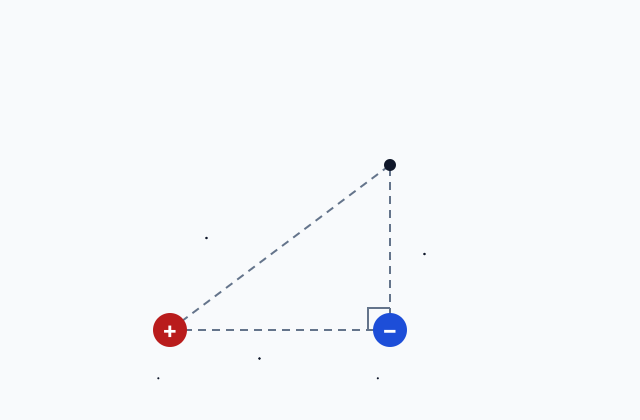
In the picture at the top of this lesson, point charge nC is fixed in a vacuum, and nC is fixed 0.40 m to its right. Point P is 0.30 m directly above , so it is 0.50 m from . Take , and take the potential to be zero very far away. What is the electric potential at P?
Predict first
Before you open the first step, predict: is the potential at P positive, negative or zero?
Step 1 · List the sources and distances
Each charge makes its own potential at P: from 0.50 m away and from 0.30 m away. The potential at P is the sum of the two, with their signs.
Step 2 · The potential from q1
Step 3 · The potential from q2
It is negative because is negative. is smaller than but closer to P.
Why this step?
Why don't you split these potentials into components, the way you split fields?
Potential is a scalar: energy per unit charge, with a sign but no direction. Potentials from several charges add as signed numbers. Only vectors, such as the field, have components.
Your step · Calculate
Finish it. Point charge nC is fixed in a vacuum, and nC is fixed 0.40 m to its right. Point P is 0.30 m directly above , and 0.50 m from . Take , and take the potential to be zero very far away. What is the electric potential at P? Give your answer to the nearest 1 V, with its sign.
V
Part 4 Try it Mapping the potential in a tray of water
A student maps the potential in a shallow tray of salt water. A small metal post standing in the water is held at a positive potential, and the edge of the tray is held at 0 V. With a voltmeter probe, she measures the potential at points along a straight line leading away from the post. Predict first: is the field strongest close to the post or far from it?
| Distance from the post (cm) | Potential (V) |
|---|---|
| 1.0 | 9.0 |
| 2.0 | 6.9 |
| 3.0 | 5.7 |
| 4.0 | 4.8 |
| 5.0 | 4.2 |
Try it · Calculate
Using the table of the tray of salt water: what is the size of the average electric field between the points 1.0 cm and 2.0 cm from the post? Give your answer to the nearest 1 V/m.
Try it · Multiple choice
Using the table of the tray of salt water: a tiny, positively charged bead is released at rest in the water 3.0 cm from the post. Which way does it start to move?
Part 5 Explain it Draw the field and the line, then compare
On the exam this is handwritten, so answer on paper first. Nothing you type here leaves this page. Then check your answer against the model and each scoring point.
Free response is 50% of the exam score. This one is shaped like Question 2, Translation Between Representations.
Free-response practice · Question 2 style
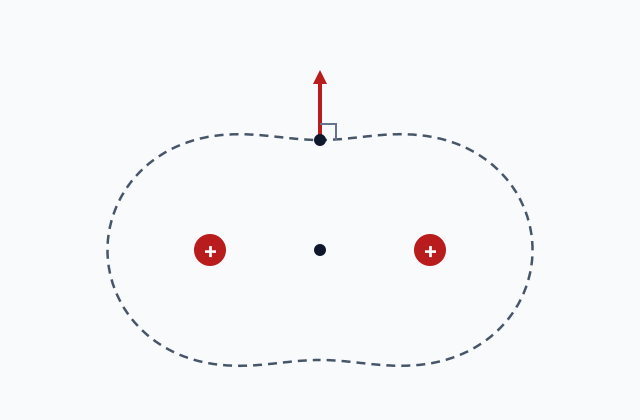
Two point charges, each , are fixed a distance apart in a vacuum. Point M is midway between them. Point P is a distance from M, on the line through M at a right angle to the line joining the charges. Take the potential to be zero very far away.
(a) On paper, draw the two charges and points M and P. At each point, draw an arrow for the direction of the electric field, or write zero if there is none. Then sketch the equipotential line that passes through P, near P. Do this by hand before you open the model.
(b) Derive expressions for the electric potential and the size of the electric field at M and at P, in terms of , and .
(c) A student claims that because the potential at M is higher than the potential at P, the field at M must be stronger than the field at P. Use your drawing and your expressions to explain whether the claim is correct.
Model answer
(a) Compare your drawing with the model below. M has no arrow, since the field there is zero. At P the arrow points straight away from the line joining the charges, and the equipotential line through P runs parallel to that line there, crossing the arrow at a right angle.
(b) Each charge is from M and from P. Potentials add as numbers: and . Fields add as vectors. At M the two fields are equal and opposite, so . At P each field has size ; their parts along the line of the charges cancel and their parts away from it add, so .
(c) Incorrect. is higher than , yet while is not zero, and the drawing shows the same thing: no arrow at M, an arrow at P. The field depends on how fast the potential changes with position, not on how large the potential is.
 Tap to open the picture full size
Score your own answer. This is a self-check, not a grade. Tick each point your answer makes.
Part 6 Check yourself Reading an equipotential map
Both case questions use the figure.
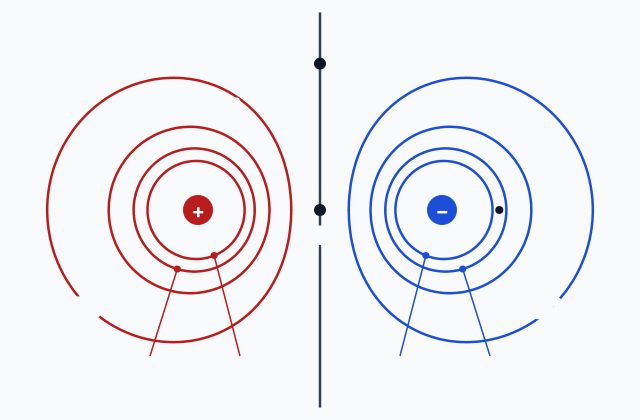
The map shows equipotential lines around two point charges, on the left and on the right, in a vacuum, with the potential taken as zero very far away. The lines are drawn every 50 V, and each is labeled with its potential. The straight line midway between the charges is at 0 V.
 Tap to open the picture full size
Case question 1 · Rank it
Using the equipotential map of and : point A is midway between the charges, point B is on the 0 V line above A, and point C is on the line through the charges, just beyond , between the V and V lines. Rank the points by the size of the electric field there.
Strongest field first
Give each one a place, 1 for first. Give two the same place if they are equal.
Your ranking: none yet
Case question 2 · Decide and justify
Using the equipotential map of and : an electron is released at rest at point B. A student says it stays at rest, because B is on the 0 V line. Is the student right?
Which reason supports your answer?
The rest stand on their own and do not use the case.
Check yourself · Match
Tap a feature of an equipotential map or a field map, then what it tells you.
Check yourself · Fill the statement
Tap a blank, then an answer.
In a battery, processes separate positive and negative charge, so its two terminals are at different potentials. When +2.0 C of charge moves from the negative terminal to the positive terminal of a 9.0 V battery, the electric potential energy changes by . When an electron moves the same way, the electric potential energy .
Part 7 Keep it Bring back earlier ideas
Potential is electric potential energy per unit charge, so the energy of a pair, and the way charge spreads between touching conductors, come straight back here. Pulling them back up is what makes them last.
From 10.4 Electric Potential Energy · Calculate
Point charges of C and C are 0.15 m apart in a vacuum, far from any other charge. Take . What is the electric potential energy of the two-charge system? Give your answer to the nearest 0.01 J, with its sign.
Each question below turns on where electrons can go. Before you answer, say which way you expect them to move.
Now follow one total through several touches. Predict first: which sphere ends with the most negative charge?
From 10.2 Conservation of Electric Charge and the Process of Charging · Rank it
Four identical metal spheres sit on insulating stands. Sphere P carries nC, sphere Q carries nC, and spheres R and S are neutral. P is touched to Q, and they are separated. Then Q is touched to R, and they are separated. Then R is touched to S, and they are separated. Rank the spheres by their final charge.
Most positive (least negative) first
Give each one a place, 1 for first. Give two the same place if they are equal.
Your ranking: none yet
In three lines
- Electric potential is energy per unit charge at a point, in volts, and a potential difference is .
- Potentials of point charges, , add as signed numbers, so zero field and zero potential are separate questions.
- The field points toward lower potential, crosses equipotential lines at right angles, and is strong where the lines crowd together.
Exam strategy for this topic
- Section I, Multiple Choice: 42 questions in 85 minutes.
- Section II, Free Response: 4 questions in 95 minutes.
- This lesson's Explain it is shaped like free-response question 2, Translation Between Representations.
- A four-function, scientific, or graphing calculator is allowed on both sections of the exam.
Before you add anything, ask whether it is a scalar or a vector. Potential and potential energy add as signed numbers; field and force add by components. Find the field and the potential at a point separately, and read the field from how fast the potential changes, never from its value.
Questions students ask
What is electric potential?
The electric potential energy per unit charge at a point, measured in volts. For a point charge it is , taking zero very far away.
What is the difference between electric potential and electric potential energy?
Potential energy belongs to a system and depends on the charge placed at a point. Potential is that energy divided by the charge, so it belongs to the point itself.
Can the electric field be zero where the potential is not?
Yes. Midway between two equal positive charges the fields cancel, but the potentials, both positive, add. The reverse also happens: midway between equal positive and negative charges, the potential is zero and the field is not.
How are equipotential lines related to the electric field?
The field crosses every equipotential line at a right angle and points toward lower potential. Where lines drawn at equal steps crowd together, the field is strong.
Why are conductors in contact at the same potential?
Any difference in potential would push electrons from one to the other. They move until there is no difference left, so the surfaces end at one potential.
Beyond the AP Exam
College Board sets this limit on what the AP Exam asks about this topic. Anything past it is not on the exam.
As the methods to calculate the electric potential due to extended charges exceed the scope of the course, AP Physics 2 only expects that students calculate the electric potential of configurations of four or fewer particles (or more in situations of high symmetry).
Course alignment, for teachers
AP Physics 2: Algebra-Based topic 10.5, Unit 10: Electric Force, Field, and Potential.
- Skill 1.A: Create diagrams, tables, charts, or schematics to represent physical situations.
- Skill 2.A: Derive a symbolic expression from known quantities by selecting and following a logical mathematical pathway.
- Skill 2.C: Compare physical quantities between two or more scenarios or at different times and locations in a single scenario.
- Skill 3.B: Apply an appropriate law, definition, theoretical relationship, or model to make a claim.
This lesson maps all 11 essential knowledge statements of the topic to the part that teaches each one: 11 are checked by a scored question. The map is in the lesson file.