Unit 10 · Topic 10.6 · about 30 minutes · 7 parts · 11 scored checks, 1 of them multiple choice, plus 2 from earlier lessons
AP Physics 2: Algebra-Based 10.6: Capacitors
Unit 10: 15 to 18% of the multiple-choice section
What you'll be able to do
- Describe a parallel-plate capacitor: the charge on its plates, what sets its capacitance, the uniform field between its plates and how a charge moves in it, what a dielectric does, and the energy it stores.
Key vocabulary
| Term | What it means | The exam trap |
|---|---|---|
| Capacitance | The charge a capacitor holds on each plate per volt of potential difference, , measured in farads. | Capacitances are usually given in microfarads, nanofarads or picofarads, so write in the power of ten before you calculate. |
| Farad | The unit of capacitance, one coulomb per volt, written F. | A farad is enormous, so a lab result near 1 F from plates on a bench almost always means a power of ten was dropped along the way. |
| Dielectric constant | A number, , that says how many times a material between the plates raises a capacitor's capacitance compared with a vacuum. | has no unit, so an answer for it that carries a unit is a different quantity, often the permittivity . |
 Tap to open the picture full size
Part 1 Think first What is inside a camera flash
Commit to a guess first. Being wrong now makes the right idea stick better.
Predict first
Maya takes apart a broken camera flash and finds a capacitor: two thin metal sheets separated by a thin insulating layer. When it was charged, one sheet carried C. Before she opened it, what was the net charge of the whole capacitor?
In short. A parallel-plate capacitor holds equal and opposite charges on two plates, and its capacitance, , depends only on how it is built: .
- Between the plates the field is uniform, , so a charged particle there moves like a projectile.
- A dielectric between the plates makes an opposing field inside itself and raises the capacitance by the factor .
- The energy stored is the work done to separate the charge, .
Part 2 Learn it Two plates that store charge and energy
2a. Equal and opposite charge, and capacitance
A parallel-plate capacitor is two flat conducting plates facing each other across a gap of air or an insulating material. Connect it to a battery and electrons move from one plate, through the battery, to the other. The plates end with equal amounts of charge of opposite sign, and , and a potential difference between them. always means the size of the charge on one plate.
More charge on the plates means a larger potential difference, in proportion. The ratio is the capacitance:
Its unit is the coulomb per volt, called the farad (F). A farad is huge: real capacitors are measured in microfarads, nanofarads ( F) or picofarads ( F). A 3.0 nF capacitor at 6.0 V holds nC on each plate.
The plates are treated as large compared with the gap between them, so effects at their edges are ignored.
Quick check · Calculate
One plate of a parallel-plate capacitor carries nC and the other carries nC, and the potential difference between the plates is 12 V. What is the capacitance? Give your answer in nanofarads, to the nearest 0.01 nF.
2b. What sets the capacitance
Capacitance depends only on the capacitor itself: its shape and the material between its plates. Raise the potential difference and rises with it, but their ratio, , stays the same. For a parallel-plate capacitor,
where is the area of one plate, is the distance between the plates, is the permittivity of free space, and is the dielectric constant of the material in the gap: 1 for a vacuum, very nearly 1 for air, and larger for an insulator such as plastic or glass. Plates twice as large give twice the capacitance; plates twice as far apart give half.
A dielectric is an insulator placed between the plates. The field of the plates polarizes it: the charges in its molecules shift slightly, which makes a field inside the dielectric opposite to the field of the plates. For the same charge on the plates, the field in the gap is weaker and the potential difference smaller, so is larger, by the factor .
Quick check · Rank it
Four parallel-plate capacitors are built from flat plates, and each is connected to its own battery. P has plate area , separation and air between its plates, on a 6 V battery. Q has area , separation and air, on a 12 V battery. R has area , separation and air, on a 3 V battery. S has area , separation and a plastic with filling the gap, on a 12 V battery. Rank the capacitors by capacitance.
Largest capacitance first
Give each one a place, 1 for first. Give two the same place if they are equal.
Your ranking: none yet
2c. The field between the plates
Between two large plates with opposite charges spread evenly over them, the electric field is uniform: the same size and the same direction everywhere in the gap, pointing from the positive plate to the negative one. Only near the edges does it bend and weaken, and those edge effects are ignored unless a question says otherwise.
Its size can be found two ways:
The first is the link between field and potential from the last topic. The second comes from the charge on the plates and holds when the gap is much smaller than the plates.
A uniform field means a constant force, , on a charged particle in the gap, and so a constant acceleration. A particle fired into the gap parallel to the plates moves like a ball thrown sideways near Earth's surface: a steady speed along the plates, a steadily growing speed across them, and a path that is a parabola. For an electron or a proton the electric force is so much larger than gravity that gravity is ignored.
Quick check · Fill the statement
Tap a blank, then an answer.
Between the plates of a charged parallel-plate capacitor, away from the edges, the electric field is . A proton fired into the gap parallel to the plates has an acceleration that while it is between them, and its path there is .
2d. The energy stored in a capacitor
Charging a capacitor takes work. Each bit of charge moved from one plate to the other is pushed against the field of the charge already there. The electric potential energy stored in the capacitor equals the work done by the external force, a battery or a hand, to separate that charge.
The first bit of charge moves across almost no potential difference and the last across the full . On average, charge crosses half the final potential difference, so
not . A 3.0 nF capacitor charged to 6.0 V holds 18 nC and stores J. The energy comes back out when the plates are joined by a conductor and the charge flows back.
Quick check · Calculate
A charger moves charge slowly from one plate of an uncharged 2.0 nF capacitor to the other until the potential difference between the plates is 9.0 V. How much work does the charger do to separate the charge? Give your answer in nanojoules, to the nearest 1 nJ.
Part 3 Watch it done An electron crossing a capacitor
Predict first, then watch each step, then finish the problem yourself.
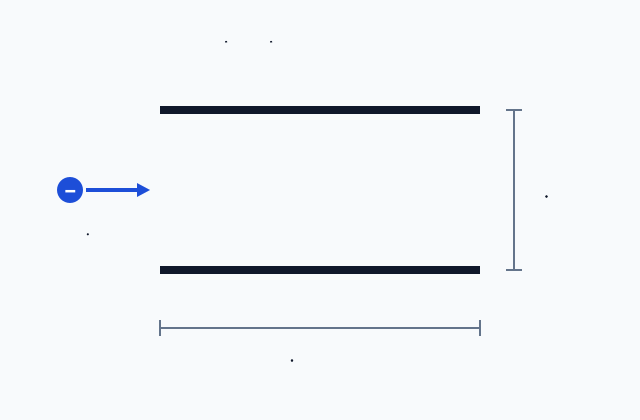
In the picture at the top of this lesson, two parallel plates 0.040 m long are 0.020 m apart, with a potential difference of 80 V between them; the top plate is positive. An electron enters midway between the plates at m/s, parallel to them. Take C and the electron's mass as kg, and ignore gravity and edge effects. How far from its starting line, and in which direction, has the electron moved when it leaves the plates?
Predict first
Before you open the first step, predict: which way does the electron's path bend between the plates?
Step 1 · The field between the plates
The field is uniform and points from the positive plate down to the negative one:
Step 2 · The force and the acceleration
The electron is negative, so the force on it points opposite to the field, up toward the positive plate: N. Its acceleration is constant and upward:
Step 3 · The time between the plates
No force acts along the plates, so the electron's speed along them stays m/s, and it is between the plates for s.
Why this step?
Why does the electron keep the same speed along the plates the whole time?
The field between the plates is at a right angle to them, so the force on the electron is too. With no force along the plates, the part of the velocity along them does not change, just as a ball thrown sideways keeps its sideways speed while gravity pulls it down.
Your step · Calculate
Finish it. Two parallel plates 0.040 m long are 0.020 m apart, with a potential difference of 80 V between them; the top plate is positive. An electron enters midway between them at m/s, parallel to the plates. Take C and the electron's mass as kg, and ignore gravity and edge effects. How far from its starting line has the electron moved when it leaves the plates? Give the distance in millimeters, to the nearest 0.1 mm.
mm
Part 4 Try it Rebuilding a capacitor
A capacitor can be changed on a lab bench: its plates moved, a sheet slid between them. Predict first: if you charge a capacitor, disconnect it from the battery and then slide a plastic sheet into the gap, what happens to the potential difference between its plates?
Try it · Decide and justify
A parallel-plate capacitor is charged by a battery and then disconnected, so the charge on its plates cannot change. A plastic sheet is slid in to fill the gap. A student says the potential difference between the plates decreases. Is the student right?
Which reason supports your answer?
Working out a capacitance from the size of the plates takes care with powers of ten.
Try it · Calculate
Two square metal plates, 0.10 m on a side, face each other 0.50 mm apart with air between them. Take and for air. What is the capacitance? Give your answer in picofarads, to the nearest 1 pF.
Part 5 Explain it Design it, then find the dielectric constant
On the exam this is handwritten, so answer on paper first. Nothing you type here leaves this page. Then check your answer against the model and each scoring point.
Free response is 50% of the exam score. This one is shaped like Question 3, Experimental Design and Analysis.
Free-response practice · Question 3 style
A student wants to find the dielectric constant of a plastic. She has two flat, square aluminum plates, each 0.20 m on a side, a stack of identical plastic sheets each about 0.50 mm thick, a capacitance meter and a micrometer.
(a) Describe a procedure she could use to collect data for a graph from whose slope she can find the dielectric constant . Say what she changes, what she measures, and one step that reduces experimental uncertainty.
(b) Her results are below, with the gap between the plates filled by plastic each time. On paper, plot capacitance against , with a scale and units on each axis, and draw a best-fit line. Do this by hand before you open the model.
- 1 sheet, mm: nF
- 2 sheets, mm: nF
- 3 sheets, mm: nF
- 4 sheets, mm: nF
- 5 sheets, mm: nF
(c) Use your best-fit line to calculate the dielectric constant of the plastic. Take .
Model answer
(a) Lay one sheet on one plate and the other plate on top, measure the thickness of the plastic with the micrometer, and read the capacitance with the meter. Repeat with 2, 3, 4 and 5 sheets, keeping the same two plates. To reduce uncertainty, press the plates flat so there is no air gap, and measure the thickness at several places and average.
(b) See the graph below: a labeled scale on each axis, with in inverse millimeters, and one straight best-fit line close to the origin.
(c) , so the slope is . From and on the line, the slope is nF mm, which is F m. With , , about 2.2 to 2.3 depending on the line drawn.
Capacitance against one over the separation, with the best-fit line
The line passes very near the origin and through (2.00, 1.607 nF).
Score your own answer. This is a self-check, not a grade. Tick each point your answer makes.
Part 6 Check yourself Four capacitors compared
Both case questions use the table.
A student builds four parallel-plate capacitors, with air or a plastic between the plates, and connects each to its own battery until it is fully charged. The plates are large compared with the gaps, so edge effects can be ignored.
| Capacitor | Plate area | Separation | Between the plates | Battery |
|---|---|---|---|---|
| W | 1.0 mm | air | 6.0 V | |
| X | 2.0 mm | air | 12 V | |
| Y | 1.0 mm | air | 6.0 V | |
| Z | 1.0 mm | plastic, | 6.0 V |
Case question 1 · Rank it
Using the table of four capacitors: rank them by the electric potential energy each stores.
Most energy first
Give each one a place, 1 for first. Give two the same place if they are equal.
Your ranking: none yet
Case question 2 · Multiple choice
Using the table of four capacitors: which has the strongest electric field between its plates?
The rest stand on their own and do not use the case.
Check yourself · Spot the error
A student works out the energy stored in a capacitor. Tap the first line that goes wrong.
Check yourself · Put it in order
A student tests how the capacitance of two flat metal plates depends on the distance between them, using a capacitance meter, a ruler and thin plastic spacers of known thickness. Tap her steps in order.
Part 7 Keep it Bring back earlier ideas
The field between capacitor plates is read from a potential difference, and the charge on a conductor sits on its surface. Pulling those back up is what makes them last.
From 10.5 Electric Potential · Decide and justify
Points A and B are 4.0 cm apart on a line along a uniform electric field. The potential is 120 V at A and 40 V at B. A student says the field is V/m and points from A toward B. Is the student right?
Which reason supports your answer?
A charged metal sphere at rest is a source you will meet often. Predict first: if the same charge were put on a metal sphere half as wide, would the field at the same distance from the center be larger, smaller or the same?
Now look just outside the surface of a charged metal object that is not a sphere.
From 10.3 Electric Fields · Calculate
A solid metal sphere of radius 0.10 m carries an excess charge of nC and is in electrostatic equilibrium in a vacuum, far from other charges. Take . What is the size of the electric field at a point 0.30 m from the sphere's center? Give your answer to the nearest 10 N/C.
In three lines
- A parallel-plate capacitor holds and ; its capacitance depends only on how it is built.
- The field between the plates is uniform, , so a charged particle there follows a parabola, and a dielectric weakens the field for the same charge.
- The energy stored is the work to separate the charge, .
Exam strategy for this topic
- Section I, Multiple Choice: 42 questions in 85 minutes.
- Section II, Free Response: 4 questions in 95 minutes.
- This lesson's Explain it is shaped like free-response question 3, Experimental Design and Analysis.
- A four-function, scientific, or graphing calculator is allowed on both sections of the exam.
Before any capacitor calculation, write every quantity in base units: nanofarads to farads, millimeters to meters, the side of a plate squared to give its area. Then decide what stays fixed: a capacitor left connected to a battery keeps its potential difference, and one disconnected keeps its charge.
Questions students ask
What is capacitance?
The charge a capacitor holds on each plate per volt of potential difference across it, , measured in farads.
What does the capacitance of a parallel-plate capacitor depend on?
Only on how it is built: , larger for bigger plates, a smaller gap or a material with a larger dielectric constant. The charge and the battery do not change it.
Why is the energy stored in a capacitor one half Q times the potential difference?
The first charge moved crosses almost no potential difference and the last crosses all of it, so on average charge crosses half the final potential difference.
What does a dielectric do in a capacitor?
It is polarized by the field of the plates and makes a field inside itself in the opposite direction. That weakens the field in the gap for the same charge and raises the capacitance by the dielectric constant.
Is the field between capacitor plates uniform?
Yes, away from the edges: the same size and direction everywhere in the gap, pointing from the positive plate to the negative one, with size equal to the potential difference divided by the separation.
Course alignment, for teachers
AP Physics 2: Algebra-Based topic 10.6, Unit 10: Electric Force, Field, and Potential.
- Skill 1.B: Create quantitative graphs with appropriate scales and units, including plotting data.
- Skill 2.B: Calculate or estimate an unknown quantity with units from known quantities, by selecting and following a logical computational pathway.
- Skill 2.C: Compare physical quantities between two or more scenarios or at different times and locations in a single scenario.
- Skill 3.A: Create experimental procedures that are appropriate for a given scientific question.
- Skill 3.C: Justify or support a claim using evidence from experimental data, physical representations, or physical principles or laws.
This lesson maps all 10 essential knowledge statements of the topic to the part that teaches each one: 10 are checked by a scored question. The map is in the lesson file.