Unit 10 · Topic 10.7 · about 30 minutes · 7 parts · 10 scored checks, 1 of them multiple choice, plus 2 from earlier lessons
AP Physics 2: Algebra-Based 10.7: Conservation of Electric Energy
Unit 10: 15 to 18% of the multiple-choice section
What you'll be able to do
- Describe how the electric potential energy and the kinetic energy of a system change when a charged object moves between two points at different electric potentials.
Key vocabulary
| Term | What it means | The exam trap |
|---|---|---|
| Kinetic energy | The energy an object has because it is moving, . | A mass may be given in grams, so change it to kilograms before you use . |
| Conservation of energy | The total energy of a system changes only when energy is transferred into or out of it. | Name the system first: electric potential energy belongs to a system that includes the charge and whatever makes the field, so an energy equation for a single charge alone has no potential energy term. |
| Alpha particle | A helium nucleus, two protons and two neutrons, with a charge of and about four times the mass of a proton. | An alpha particle's charge is , not : its neutrons add mass but no charge. |
 Tap to open the picture full size
Part 1 Think first Doubling the voltage on an X-ray tube
Commit to a guess first. Being wrong now makes the right idea stick better.
Predict first
In an X-ray tube, electrons leave a hot wire almost at rest and are pulled across a gap by a potential difference. One tube runs at 20,000 V and another at 40,000 V. Compared with the first tube, how much energy does each electron gain crossing the gap in the second?
In short. When a charge moves through a potential difference , the electric potential energy of the system changes by , and if only the electric force does work, the kinetic energy changes by the opposite amount.
- Positive charges speed up moving to lower potential; negative charges speed up moving to higher potential.
- Only the potentials at the start and the end matter, not the path between them.
- A particle released from rest that crosses a potential difference of size ends with kinetic energy .
Part 2 Learn it Energy changes as charges move
2a. The change in electric potential energy
When a charged object moves between two points at different electric potentials, the electric potential energy of the object-field system changes by
where is the potential at the end minus the potential at the start, and keeps its sign.
- A positive charge moving to lower potential, or a negative charge moving to higher potential, makes negative: the system loses electric potential energy.
- A positive charge moving to higher potential, or a negative charge moving to lower potential, makes positive.
- Between two points at the same potential, , whatever path the charge takes in between.
Only the start and end potentials matter, not the path. A proton moving from a point at 300 V to a point at 100 V has J, whatever route it takes.
Quick check · Sort it
Each card describes a charged particle moving between two points. Tap a card, then what happens to the electric potential energy of the system.
It increases
It decreases
It does not change
2b. Kinetic energy from potential energy
If the electric force is the only force doing work on a charged object, the energy of the object-field system is conserved: whatever electric potential energy the system loses, the object gains as kinetic energy.
So a positive charge speeds up as it moves to lower potential, and a negative charge speeds up as it moves to higher potential. Moving the other way, each slows down, and it stops and turns back if it runs out of kinetic energy before it gets there.
A particle released from rest that crosses a potential difference of size ends with , so its speed is .
An electron crossing 100 V toward higher potential gains J of kinetic energy, the same as a proton crossing 100 V toward lower potential. The proton, almost 2000 times as massive, ends up much slower.
Quick check · Calculate
A small sphere of mass kg and charge C is released from rest at a point where the electric potential is 1200 V. Only the electric force does work on it, and it moves to a point where the potential is 300 V. What is its speed there? Give your answer to the nearest 0.1 m/s.
2c. Graphs of the energy
In a uniform field, such as the field between capacitor plates, the potential changes by the same amount for each meter along the field. So for a charge moving along the field, is proportional to the distance it moves, and when only the electric force does work, so is the kinetic energy it gains.
A graph of the electric potential energy against distance is then a straight line, and the graph of the kinetic energy is a straight line that changes by the same amount in the other direction. Their sum, the system's total energy, is a flat line.
Near a point charge the field is not uniform, so these graphs bend. A positive charge pushed away from a fixed positive charge gains kinetic energy quickly at first, where the field is strong, and then more and more slowly, approaching a limit far away.
Quick check · Sketch the graph
A small bead with charge C is released from rest at the positive plate of a parallel-plate capacitor whose plates are 4.0 cm apart, with a potential difference of 400 V between them. Only the electric force does work on the bead, and the field between the plates is uniform. Sketch the bead's kinetic energy against its distance from the positive plate. The first point is fixed at zero.
One shape that fits
Drag a point up or down, or tap it and use the arrow keys. Only the shape is checked.
Part 3 Watch it done How close can it get?
Predict first, then watch each step, then finish the problem yourself.
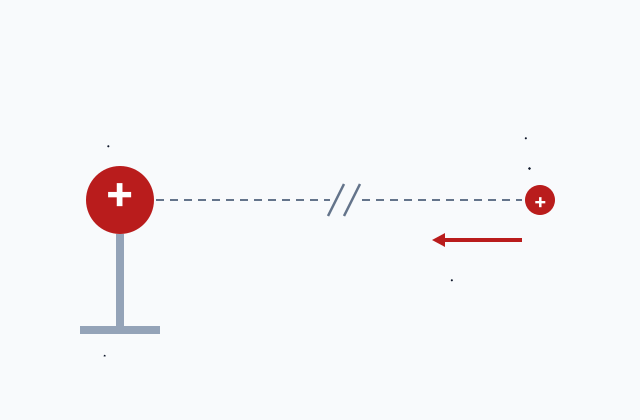
In the picture at the top of this lesson, a sphere with charge C is held fixed. A small bead with charge C and mass 2.0 g starts very far away, moving straight toward the sphere at 6.0 m/s. Only the electric force acts on the bead, and the sphere and bead can be treated as point charges in a vacuum. Take . How close to the center of the sphere does the bead get?
Predict first
Before you open the first step, predict: what is the bead's speed at the moment it is closest to the sphere?
Step 1 · Choose the system and its energy
The system is the bead and the fixed sphere. Only the electric force does work, so the energy of the system is conserved: the kinetic energy the bead loses becomes electric potential energy. At its closest point the bead stops for an instant, so all of its kinetic energy has been converted.
Step 2 · The energy at the start
Very far away, the potential due to the sphere is zero, so the system starts with and J.
Step 3 · The energy at the closest point
At a distance from the sphere's center the potential is , so moving in from far away changes the energy by . All of the starting kinetic energy goes into it:
Why this step?
Why can the potential very far away be taken as zero here?
Only differences in potential matter for a change in energy. Taking very far away fits , which goes to zero at large distances, and it is where the bead starts.
Your step · Calculate
Finish it. A sphere with charge C is held fixed. A small bead with charge C and mass 2.0 g starts very far away, moving straight toward the sphere at 6.0 m/s. Only the electric force acts on the bead, and the sphere and bead can be treated as point charges in a vacuum. Take . How close to the center of the sphere does the bead get? Give your answer to the nearest 0.01 m.
m
Part 4 Try it Slowing down on the way
A charge does not always speed up as it moves. Predict first: a negatively charged bead moves toward a region at lower potential. Does it speed up or slow down?
Try it · Calculate
A small bead with charge C and mass 2.0 g passes point A, where the electric potential is V, moving at 4.0 m/s. Only the electric force does work on it, and it moves to point B, where the potential is V. What is its speed at B? Give your answer to the nearest 0.01 m/s.
Try it · Decide and justify
A small bead with charge C and mass 2.0 g passes point A, where the electric potential is V, moving at 4.0 m/s toward point C, where the potential is V. The potential falls steadily along its path from A to C. Only the electric force does work on it. A student says the bead can never reach C, because a negative charge is pushed toward higher potential. Is the student right?
Which reason supports your answer?
Part 5 Explain it Same push, different particles
On the exam this is handwritten, so answer on paper first. Nothing you type here leaves this page. Then check your answer against the model and each scoring point.
Free response is 50% of the exam score. This one is shaped like Question 4, Qualitative/Quantitative Translation.
Free-response practice · Question 4 style
A proton, with charge and mass , and an alpha particle, with charge and mass , are each released from rest at the positive plate of a parallel-plate capacitor and cross the gap to the negative plate. The potential difference between the plates is . Ignore gravity.
(a) Without using equations, explain which particle has more kinetic energy when it reaches the negative plate, and which is moving faster.
(b) Derive expressions for the speed of each particle at the negative plate, in terms of , and .
(c) Explain how your expressions in (b) support your reasoning in (a).
Model answer
(a) Both particles cross the same potential difference, and the energy the field gives a charge depends on how much charge crosses it. The alpha particle has twice the charge, so it gains twice the kinetic energy. But it has four times the mass, so twice the energy is not enough to make it as fast: the proton moves faster.
(b) Energy is conserved, so each gains . For the proton, , so . For the alpha particle, , so .
(c) The kinetic energies are and , so the alpha particle's is twice the proton's, as argued. The speeds differ by a factor of , , so the proton is faster, as argued: twice the energy cannot make up for four times the mass.
Score your own answer. This is a self-check, not a grade. Tick each point your answer makes.
Part 6 Check yourself An electron along a path
Both case questions use the table.
An electron is released from rest at point A in a region with an electric field, in a vacuum. Only the electric force acts on it, and it passes points B, C and D in turn. The table gives the electric potential at each point.
| Point | Electric potential (V) |
|---|---|
| A | 0 |
| B | 100 |
| C | 250 |
| D | 100 |
Case question 1 · Rank it
Using the table of the electron's path: rank the points by the electron's kinetic energy there.
Most kinetic energy first
Give each one a place, 1 for first. Give two the same place if they are equal.
Your ranking: none yet
Case question 2 · Multiple choice
Using the table of the electron's path: at which point is the electric potential energy of the electron-field system greatest?
The rest stand on their own and do not use the case.
Check yourself · Fill the statement
Tap a blank, then an answer.
A proton and an electron are each released from rest in a vacuum and cross potential differences of the same size, the proton toward lower potential and the electron toward higher potential. Each system loses electric potential energy, so the two particles end with kinetic energies, and the is moving faster.
Check yourself · Spot the error
A student works out what happens to an electron that moves between two points. Tap the first line that goes wrong.
Part 7 Keep it Bring back earlier ideas
How a capacitor is built and how a pair of charges stores energy both come back here, as the source of the energy a moving charge gains. Pulling them back up is what makes them last.
From 10.6 Capacitors · Rank it
Four parallel-plate capacitors are built from flat plates, and each is connected to its own battery. P has plate area , separation and air between its plates, on a 6 V battery. Q has area , separation and air, on a 12 V battery. R has area , separation and air, on a 3 V battery. S has area , separation and a plastic with filling the gap, on a 12 V battery. Rank the capacitors by capacitance.
Largest capacitance first
Give each one a place, 1 for first. Give two the same place if they are equal.
Your ranking: none yet
From 10.4 Electric Potential Energy · Decide and justify
An electron and a proton start very far apart. An external force brings them together slowly until they are m apart, and holds them there. A student says the electric potential energy of the electron-proton system is now positive, because the external force acted on the particles all the way in. Is the student right?
Which reason supports your answer?
In three lines
- A charge moving through a potential difference changes the system's electric potential energy by , whatever its path.
- With only the electric force doing work, the kinetic energy changes by the opposite amount: positive charges speed up toward lower potential and negative charges toward higher potential.
- Released from rest across , a particle ends with , so equal charges get equal energies and the lighter one moves faster.
Exam strategy for this topic
- Section I, Multiple Choice: 42 questions in 85 minutes.
- Section II, Free Response: 4 questions in 95 minutes.
- This lesson's Explain it is shaped like free-response question 4, Qualitative/Quantitative Translation.
- A four-function, scientific, or graphing calculator is allowed on both sections of the exam.
Write with the sign of the charge and with the end potential minus the start potential, then use conservation of energy. Check the sign before you go on: a charge that speeds up must have lost electric potential energy.
Questions students ask
How does a charge gain kinetic energy in an electric field?
If the electric force is the only force doing work, the electric potential energy the system loses becomes kinetic energy. A charge released from rest across a potential difference of size ends with kinetic energy .
Do charges always move toward lower potential?
Positive charges are pushed toward lower potential and negative charges toward higher potential. A charge can move the other way if it is already moving, but then it slows down.
Does the path a charge takes change its energy?
No. The change in electric potential energy, , depends only on the potentials at the start and the end.
Why does an electron gain the same energy as a proton across the same potential difference?
Their charges have the same size, so the energy change, the charge times the potential difference, has the same size. The electron is much lighter, so it ends up much faster.
Course alignment, for teachers
AP Physics 2: Algebra-Based topic 10.7, Unit 10: Electric Force, Field, and Potential.
- Skill 1.C: Create qualitative sketches of graphs that represent features of a model or the behavior of a physical system.
- Skill 2.A: Derive a symbolic expression from known quantities by selecting and following a logical mathematical pathway.
- Skill 2.C: Compare physical quantities between two or more scenarios or at different times and locations in a single scenario.
- Skill 3.C: Justify or support a claim using evidence from experimental data, physical representations, or physical principles or laws.
This lesson maps all 2 essential knowledge statements of the topic to the part that teaches each one: 2 are checked by a scored question. The map is in the lesson file.