Unit 11 · Topic 11.1 · about 30 minutes · 7 parts · 12 scored checks, 3 of them multiple choice
AP Physics 2: Algebra-Based 11.1: Electric Current
Unit 11: 15 to 18% of the multiple-choice section
What you'll be able to do
- Describe how electric charge moves through a wire or other medium: current as a rate, what makes the charge move, and which way the current points.
Key vocabulary
| Term | What it means | The exam trap |
|---|---|---|
| Electric current | The rate at which charge passes through a cross section of a wire, , measured in amperes; one ampere is one coulomb per second. | Times in a question may be given in minutes or hours while an ampere needs seconds, so convert the time before you divide. |
| Charge carrier | A charged particle that can move through a material and so carry a current, such as an electron in a metal wire or an ion in salt water. | Note the sign of the charge on each kind of carrier in a question before you name a direction for the current. |
| Conventional current | The direction of a current, defined as the direction in which positive charge would move. | A question may describe the motion of the carriers or the direction of the current, so check which of the two it gives you before you use it. |
| Electromotive force (emf) | The potential difference a source such as a battery keeps between its terminals, written and measured in volts. | Despite its name an emf is not a force, so an answer for one in newtons has treated it as the wrong kind of quantity. |
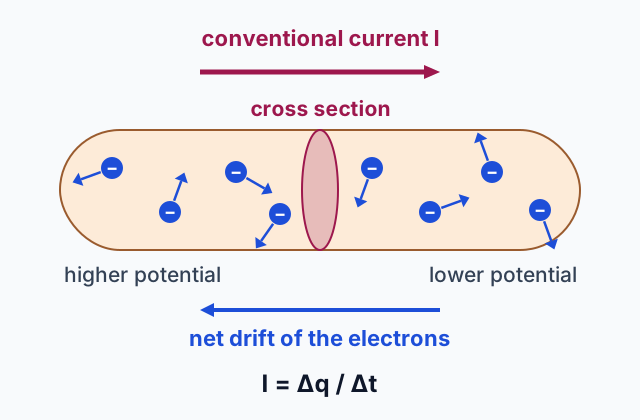 Tap to open the picture full size
Part 1 Think first An unplugged charging cable
Commit to a guess first. Being wrong now makes the right idea stick better.
Predict first
Your phone's charging cable is unplugged and lying on your desk, so nothing is flowing through it. Copper has free electrons, electrons that are not tied to any one atom. What are the free electrons in the cable doing right now?
In short. Electric current is the rate at which charge passes through a cross section of a wire, , measured in amperes.
- Charge moves in a circuit in response to a potential difference, also called an emf. With zero current the charge carriers still move, but with no net motion along the wire.
- Current is not a vector, but it has a direction along the wire: conventional current points the way positive charge would move.
- In common circuits the moving charges are electrons, so they drift the opposite way to the conventional current.
Part 2 Learn it How charge moves through a wire
2a. Current is a rate
Electric current is the rate at which charge passes through a cross section of a wire. Picture a slice straight across the wire and count the charge that crosses it each second:
Its unit is the ampere, A, one coulomb per second. A charging cable that passes 3.0 C through a cross section every second carries 3.0 A.
Keep charge and current apart. Charge is an amount, in coulombs. Current is a rate, in coulombs per second. A wire that passes 1200 C in an hour has passed a lot of charge, but its current is only A.
In a single wire carrying a steady current, the current is the same through every cross section. Charge is not used up along the way: what enters one end each second leaves the other.
The moving charges are called charge carriers, and in a copper wire they are free electrons. They never sit still. Even with no current, each one darts about at high speed in a random direction, and every second about as many cross a slice one way as the other. Their net motion is zero, and so is the current. Zero current means zero net motion, not carriers at rest.
Quick check · Decide and justify
In wire P, 30 C of charge passes through a cross section in 10 s. In wire Q, 12 C passes through a cross section in 2.0 s. A classmate says P has the larger current, because more charge passes through it. Is the classmate right?
Which reason supports your answer?
2b. What makes the charge move
Charge moves in a circuit in response to an electric potential difference between two points. A battery's chemical reactions separate positive and negative charge and keep a potential difference between its terminals. That potential difference is sometimes called the electromotive force, or emf, written . Despite the name it is not a force. Like any potential difference, it is measured in volts.
Join the battery's terminals through a circuit, say a lamp and its two copper leads, and charge flows around it in response to that potential difference. The free electrons keep their random motion, but on top of it they now drift steadily in one direction, toward higher potential. That drift is the current. Strictly, a small potential difference along each lead drives the drift in that lead. From the next lesson on, connecting wires are treated as ideal, with no change in potential along them, and the potential difference is counted across the battery and the other elements.
The battery does not supply the charge carriers. The electrons were in the copper all along, and the battery pushes on the ones already there. So the number of free electrons in a wire tells you nothing about its current. What matters is whether a potential difference is driving them.
Quick check · Sort it
Each card describes a copper wire at one moment. Tap a card, then whether there is a current in that wire.
Current in the wire
No current in the wire
2c. Which way the current points
Current has a direction, but it is not a vector. It has no components, and it does not care which way you point an x-axis. Its direction is simply along the wire: from point P to point Q, or clockwise around a loop. Bend a wire around a corner and the current is the same on both sides of the bend.
By convention, the direction of a current is the direction positive charge would move. That is conventional current. Along a current's path outside a battery, conventional current points from higher potential toward lower potential: out of the battery's positive terminal, around the circuit and into its negative terminal. Circuit diagrams in this course show conventional current.
In common circuits the carriers that actually move are electrons, which are negative, so they drift the opposite way, from lower potential toward higher. That is no contradiction. Negative charge moving left leaves the left side more negative and the right side more positive, exactly as positive charge moving right would. Both count as current to the right.
The picture at the top of this lesson shows it: the electrons drift left, and the conventional current points right.
Quick check · Multiple choice
In a copper wire joining points X and Y, the free electrons drift from X toward Y. Which way does the current in the wire point?
Part 3 Watch it done Counting electrons in a lamp filament
Predict first, then watch each step, then finish the problem yourself.
In the tungsten filament of a lamp, electrons pass through a cross section in 4.0 s, drifting from end P toward end Q. Each electron carries a charge of , where C. What is the current in the filament, and which way does it point?
Predict first
Before you open the first step, predict: which way does the current in the filament point?
Step 1 · Define the system and list what you know
The system is the filament. Known: electrons cross in s, and each carries a charge of magnitude C. Unknown: the size of the current and its direction.
Step 2 · Derive the current symbolically
The charge that crosses is the number of electrons times the charge each carries, so its size is , and
Units: , a current, as it should be. Limiting case: if no electrons cross, and .
Step 3 · Find the direction
The electrons are negative and drift from P to Q. Conventional current points the way positive charge would move, so it points from Q to P. That also says Q is the end at higher potential, since electrons drift toward higher potential.
Why this step?
Why does the current point against the electrons, when they are the charges that actually move?
Conventional current is defined by positive charge. Negative charge moving from P to Q leaves P more positive and Q more negative, exactly what positive charge moving from Q to P would do, so both describe the same current.
Your step · Calculate
Finish it. In the tungsten filament of a lamp, electrons pass through a cross section in 4.0 s, and each carries a charge of magnitude C. What is the size of the current in the filament? Give your answer to the nearest 0.01 A.
A
Part 4 Try it Same definition, new carriers
Each question below uses only the definition of current. Before you rank the wires, say which one you expect to come first, and check yourself against .
Try it · Rank it
Four wires each carry a steady current. In wire W, 1800 C of charge passes through a cross section in 10 minutes. In wire X, 120 C passes in 40 s. In wire Y, 900 C passes in 30 minutes. In wire Z, 50 C passes in 5.0 s. Rank the wires by the current in them.
Greatest current first
Give each one a place, 1 for first. Give two the same place if they are equal.
Your ranking: none yet
Charge carriers are not always electrons. In salt water they are ions, and they move both ways at once.
Try it · Calculate
Two metal plates dip into salt water and are joined to a battery. In 2.0 s, sodium ions, each with charge , cross a cross section of the water moving east, and chloride ions, each with charge , cross the same cross section moving west. Take C. What is the size of the current in the water? Give your answer to the nearest 0.01 A.
Part 5 Explain it A wire and a beam of alpha particles
On the exam this is handwritten, so answer on paper first. Nothing you type here leaves this page. Then check your answer against the model and each scoring point.
Free response is 50% of the exam score. This one is shaped like Question 4, Qualitative/Quantitative Translation.
Free-response practice · Question 4 style
Wire 1 is a copper wire in a circuit. In a time interval , electrons, each with charge , pass through a cross section of the wire moving to the left. Beam 2 is a beam of helium nuclei (alpha particles) in a vacuum tube. Each nucleus has charge , and in the same time , nuclei pass through a cross section of the beam moving to the right.
(a) On paper, make a table that sets wire 1 and beam 2 side by side: the charge on each carrier, how many cross in time , and which way they move.
(b) Without using equations, compare the size and the direction of the current in wire 1 with the size and the direction of the current in beam 2. Explain your reasoning.
(c) Derive an expression for the size of the current in each, in terms of , and .
(d) Explain how your expressions in (c) support your comparison in (b).
Model answer
(a) Compare your table with the one below.
(b) The currents are the same size and point the same way, to the right. Beam 2 has half as many carriers crossing in the same time, but each carries twice as much charge, so the same amount of charge crosses each second. Wire 1's electrons are negative and move left, which counts as current to the right, and beam 2's nuclei are positive and move right.
(c) Wire 1: . Beam 2: .
(d) The two expressions are equal, which is the equal size claimed in (b): the factor of one half in the number of nuclei cancels the factor of 2 in each one's charge.
| Quantity | Wire 1 | Beam 2 |
|---|---|---|
| Charge carriers | Electrons | Alpha particles |
| Charge on each carrier | ||
| Carriers through a cross section in | ||
| Way the carriers move | Left | Right |
| Size of the charge through it in | ||
| Current | , to the right | , to the right |
Score your own answer. This is a self-check, not a grade. Tick each point your answer makes.
Part 6 Check yourself A data logger on a lamp lead
Both case questions use the table.
A lamp is joined to a battery. A data logger records the total charge that has passed through a cross section of one of the lamp's copper leads, counted from . At s the student disconnects the battery.
| Time (s) | Charge (C) |
|---|---|
| 0 | 0 |
| 2.0 | 0.30 |
| 4.0 | 0.60 |
| 6.0 | 0.90 |
| 8.0 | 0.90 |
| 10.0 | 0.90 |
Case question 1 · Calculate
Using the table from the data logger: what is the current in the lead at s? Give your answer to the nearest 0.01 A.
Case question 2 · Multiple choice
Using the table from the data logger: what are the free electrons in the lead doing between s and s?
The rest stand on their own and do not use the case.
Check yourself · Spot the error
A student works out which way the current points in a copper wire. Tap the first line that goes wrong.
Check yourself · Fill the statement
A lamp is joined to a battery by two copper leads, and it glows. Tap a blank, then an answer.
Charge flows around the circuit in response to the the battery maintains. Outside the battery, conventional current runs from the battery's terminal, through the lamp, to its terminal, and the free electrons in the leads drift the other way.
Part 7 Keep it Bring back earlier ideas
A current is charge moving through a potential difference, and both ideas come from the unit before this one. Pulling them back up is what makes them last.
Bring it back · Calculate
A small sphere with a charge of is released from rest at a point where the electric potential is 3000 V. Only the electric force acts on it, and it moves to a point where the electric potential is 500 V. What is its kinetic energy there? Give your answer in millijoules, to the nearest 1 mJ.
Bring it back · Multiple choice
Points A and B are 0.20 m apart along a line in a uniform electric field. The electric potential is 9.0 V at A and 3.0 V at B. Which describes the electric field between them?
In three lines
- Current is the rate charge passes through a cross section, , in amperes, and it is not the same thing as an amount of charge.
- Charge moves in response to a potential difference, or emf; with zero current the carriers still move, but with no net motion.
- Conventional current points the way positive charge would move, from higher to lower potential in a wire; electrons drift the other way.
Exam strategy for this topic
- Section I, Multiple Choice: 42 questions in 85 minutes.
- Section II, Free Response: 4 questions in 95 minutes.
- This lesson's Explain it is shaped like free-response question 4, Qualitative/Quantitative Translation.
- A four-function, scientific, or graphing calculator is allowed on both sections of the exam.
When a question describes moving electrons, find which way they drift first, then point the conventional current the other way, from higher to lower potential in the wire. When it gives a charge and a time, change the time to seconds before you divide.
Questions students ask
What is electric current?
The rate at which charge passes through a cross section of a wire, . One ampere is one coulomb passing each second.
Which way does conventional current flow?
The way positive charge would move: from higher to lower potential in a wire, so out of a battery's positive terminal, around the circuit and into its negative terminal.
Why does conventional current point opposite to the electrons?
Current was defined by the motion of positive charge long before anyone knew electrons carry it in wires. Negative charge moving one way has the same effect as positive charge moving the other way, so the definition still works.
If there is no current, are the electrons in a wire at rest?
No. They keep moving fast in random directions, but about as many cross any cross section one way as the other, so their net motion, and the current, is zero.
Is electric current a vector?
No. It has a direction along the wire, from one point to another or around a loop, but it has no components and does not depend on any coordinate axes.
Course alignment, for teachers
AP Physics 2: Algebra-Based topic 11.1, Unit 11: Electric Circuits.
- Skill 1.A: Create diagrams, tables, charts, or schematics to represent physical situations.
- Skill 2.C: Compare physical quantities between two or more scenarios or at different times and locations in a single scenario.
- Skill 3.B: Apply an appropriate law, definition, theoretical relationship, or model to make a claim.
- Skill 3.C: Justify or support a claim using evidence from experimental data, physical representations, or physical principles or laws.
This lesson maps all 6 essential knowledge statements of the topic to the part that teaches each one: 6 are checked by a scored question. The map is in the lesson file.