Unit 11 · Topic 11.2 · about 30 minutes · 7 parts · 11 scored checks, 3 of them multiple choice, plus 2 from earlier lessons
AP Physics 2: Algebra-Based 11.2: Simple Circuits
Unit 11: 15 to 18% of the multiple-choice section
What you'll be able to do
- Describe the behavior of a circuit: which loops are closed, open or shorted, which elements share loops, and how a schematic represents it.
Key vocabulary
| Term | What it means | The exam trap |
|---|---|---|
| Electrical loop | A closed path through which charge can flow, made of wires and circuit elements such as batteries, bulbs, resistors, capacitors, switches and meters. | Several loops can share elements, so before you decide anything about one loop, list every element that is in it. |
| Open circuit | A circuit with a gap in it, such as an open switch, so that charge cannot flow. | An open switch is drawn with its arm raised clear of the second contact, so read the state of every switch before you trace a loop. |
| Short circuit | A path that lets charge flow with no change in potential difference, such as a wire joined across an element. | A short circuit does not damage the element it bypasses: remove the short and that element works again, so do not describe a shorted bulb as broken. |
| Circuit schematic | A drawing that represents a circuit, with a standard symbol for each element and a straight line for each wire. | Two schematics can look different and show the same circuit, so compare what each element is joined to rather than where it sits on the page. |
 Tap to open the picture full size
Part 1 Think first One battery, one bulb, one wire
Commit to a guess first. Being wrong now makes the right idea stick better.
Predict first
You have a battery, a small flashlight bulb and one piece of wire. The bulb has two metal contacts: the tip at its bottom and the metal side of its base. Which setup makes the bulb light?
In short. A circuit is made of electrical loops, charge flows only around a loop that is closed, and a schematic represents the loops with standard symbols.
- An open switch or a broken filament anywhere in a loop stops the charge everywhere in that loop, not just past the gap.
- A short circuit is a path that lets charge flow with no change in potential, so an element it bypasses has no potential difference across it.
- One element can be part of several loops, and what a circuit does depends on how its elements are connected, which is what a schematic shows.
Part 2 Learn it Loops, gaps and shortcuts
2a. A circuit is made of closed loops
A circuit is made of electrical loops. A loop can include wires, batteries, resistors, lightbulbs, capacitors, switches, ammeters and voltmeters, which are all called circuit elements.
A closed loop is a closed path through which charge can flow: start at any point, follow the wires through each element in turn, and you arrive back where you began with no gap. A circuit whose loop is closed is a closed circuit, and with a battery in the loop, charge flows.
An open circuit has a gap somewhere, so charge cannot flow. An open switch is a gap made on purpose. A broken filament in a bulb, or a wire pulled off a terminal, is a gap made by accident.
Where the gap sits does not matter. Charge does not set off from the battery and travel around the loop in order, reaching one bulb before the next. The charge carriers are already in every wire and every element, and they all move together or not at all. So a gap anywhere in a loop stops the flow everywhere in that loop, on both sides of the gap.
Quick check · Decide and justify
A battery, bulb A, a switch and bulb B are joined in one loop by ideal wires, in that order starting from the battery's positive terminal. The switch is open. Is bulb A glowing?
Which reason supports your answer?
2b. Wires, potential and short circuits
In this course wires are ideal: charge moves along a wire with no change in electric potential. So every point on one stretch of wire is at the same potential, and a closed ideal switch acts as one more piece of wire. An ideal wire needs no potential difference along it to carry a current: the battery's emf drives the charge around the whole loop.
The potential changes across elements instead. Across a battery's terminals it changes by the battery's potential difference. Across a glowing bulb there is a potential difference too, and that is what drives charge through its filament.
A short circuit is a path that lets charge flow with no change in potential difference. Join an ideal wire from one contact of a bulb to its other contact, and the wire puts both contacts at the same potential. With no potential difference across it, no charge flows through the filament and the bulb goes dark. The charge flows through the wire instead.
A wire joined straight across a battery's terminals is a short circuit across the battery. A real battery then drives a large current through the wire, which gets hot while the battery drains fast, so never do it.
Quick check · Multiple choice
Bulbs A and B are joined in one loop with a battery by ideal wires, and both glow. An ideal wire is then connected from one contact of bulb B to its other contact. What happens?
2c. One element, several loops
Most circuits have more than one loop, and a single element can be part of several of them. Put bulbs P and Q side by side, each joined straight across the same battery. One loop runs through the battery and P, and another through the battery and Q. The battery is part of both.
Each loop is closed or open on its own. Unscrew Q from its socket and its loop has a gap, so no charge flows through Q's socket. P's loop has no gap, so P keeps glowing. The battery is still in a closed loop, the one through P.
That is why the arrangement of a circuit matters. The same battery and the same two bulbs behave differently when both bulbs share one loop than when each has a loop of its own. What a circuit does depends on how its elements are connected, not only on which elements it has.
Quick check · Select all
A battery is joined to two branches by ideal wires. One branch holds bulb P alone. The other holds switch S, bulb Q and bulb R, one after another. With S closed all three bulbs glow. S is then opened. Which two statements are true? Pick two.
Select 2 answers, then check.
2d. Drawing a circuit as a schematic
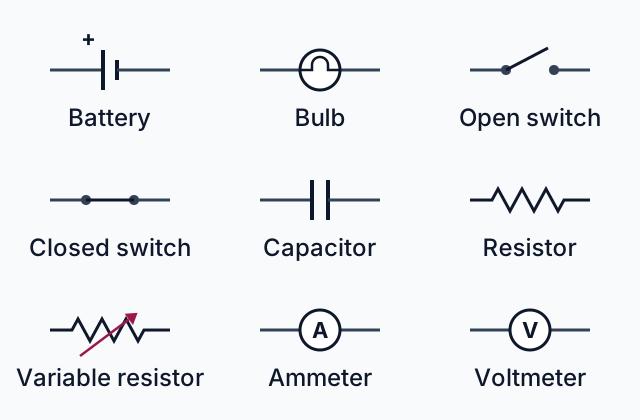
A circuit schematic is a drawing that represents a circuit so you can describe and analyze it. Each element gets a standard symbol, shown in the key below, and wires are drawn as straight lines.
A schematic shows what is connected to what, and nothing else. The length of a wire on the page, where an element sits and which way the drawing is turned mean nothing. Two schematics that look different show the same circuit if every element joins the same two points.
A few symbols are easy to mix up. A battery is a long line beside a shorter one, and the long line is the positive terminal. A capacitor is two lines of the same length. A diagonal arrow drawn through a symbol marks a variable element, such as a variable resistor, whose resistance can be adjusted.
Unless a question says otherwise, a current arrow on a schematic shows conventional current: out of the battery's positive terminal, around the loop and into its negative terminal.
 Tap to open the picture full size
Quick check · Match
Tap the name of an element, then the drawing of its symbol.
Part 3 Watch it done A switch wired across one bulb
Predict first, then watch each step, then finish the problem yourself.
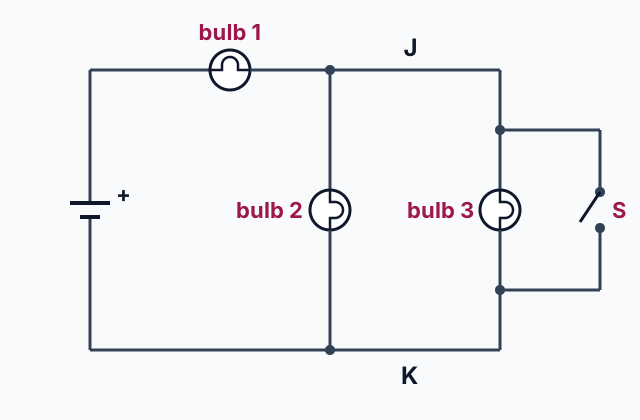
The circuit at the top of this lesson has a battery, bulbs 1, 2 and 3, and switch S, joined by ideal wires. Bulb 1 is on the top wire. Past it, bulbs 2 and 3 each join the top wire, J, to the bottom wire, K. Switch S is wired from a point just above bulb 3 to a point just below it. With S open, all three bulbs glow. S is then closed. Which bulbs glow now?
Predict first
Before you open the first step, predict: which bulbs glow once S is closed?
Step 1 · Find the loops through the battery
With S open there are two: the battery, bulb 1, bulb 2 and back, and the battery, bulb 1, bulb 3 and back. Bulb 1 and the battery are in both loops. J is one stretch of ideal wire, so every point on it is at one potential, and the same goes for K.
Step 2 · See what the closed switch joins
The wire just above bulb 3 is part of J, and the wire just below it is part of K. So once it is closed, S is an ideal path from J to K: a short circuit, with no change in potential from one end to the other.
Step 3 · Compare the potentials
With S closed, J and K are at the same potential. Now look at where each bulb's two ends are joined, and at which loops through the battery are still closed.
Why this step?
Why does it matter which two points S joins, and not which bulb it is drawn next to?
A potential difference is always between two points. S makes J and K the same potential, so every element joined between J and K loses its potential difference, whichever one the drawing puts the switch beside.
Your step · Multiple choice
Finish it. Bulb 1 is on the top wire of a circuit with a battery and ideal wires. Past bulb 1, bulbs 2 and 3 each join the top wire to the bottom wire, and switch S is wired from a point just above bulb 3 to a point just below it. With S open all three bulbs glow. S is then closed. Which bulbs glow now?
Part 4 Try it Trace it, then follow the potential
Each card below describes a battery and a bulb joined by ideal wires. Trace the path through the bulb's filament, from one battery terminal to the other, before you tap.
Try it · Sort it
Each card describes a circuit with a battery and a bulb, joined by ideal wires. Tap a card, then what happens to the charge in that bulb's circuit.
Closed: charge flows through the bulb
Open: no charge flows
Shorted: charge flows, but not through the bulb
Now follow the electric potential around one loop. Predict first: along which parts of the loop does the potential change?
Try it · Rank it
A battery, a closed switch and two bulbs A and B are joined in one loop by ideal wires, in this order from the battery's positive terminal: the switch, then A, then B, then back to the negative terminal. Both bulbs glow, and the switch is ideal. Point 1 is on the wire between the positive terminal and the switch, point 2 is on the wire between the switch and A, point 3 is on the wire between A and B, and point 4 is on the wire between B and the negative terminal. Rank the points by their electric potential.
Highest potential first
Give each one a place, 1 for first. Give two the same place if they are equal.
Your ranking: none yet
Part 5 Explain it Draw it, predict, then check against the bench
On the exam this is handwritten, so answer on paper first. Nothing you type here leaves this page. Then check your answer against the model and each scoring point.
Free response is 50% of the exam score. This one is shaped like Question 2, Translation Between Representations.
Free-response practice · Question 2 style
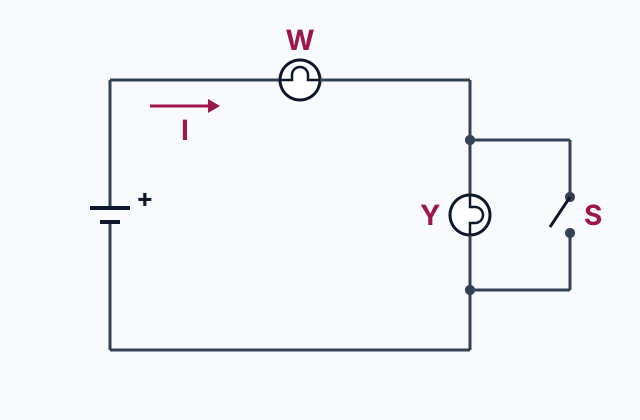
A student builds a circuit on a bench from a battery, two bulbs W and Y, and a switch S, joined by ideal wires. One loop runs from the battery's positive terminal through bulb W, then through bulb Y, and back to the negative terminal. Switch S is wired from one contact of bulb Y to its other contact.
(a) On paper, draw a schematic of the circuit using standard symbols, with S drawn open, and mark the direction of the conventional current in the wire leaving the battery. Do this by hand before you open the model.
(b) Using only your schematic, predict which bulbs glow with S open, and which glow with S closed.
(c) The student closes S and sees bulb Y go dark while bulb W keeps glowing. Explain whether this agrees with your prediction in (b), using your schematic.
Model answer
(a) Compare your drawing with the schematic below. It is right if W and Y sit in one loop with the battery and S joins Y's two ends, wherever each element sits on your page. The current arrow leaves the battery from its long line, the positive terminal.
(b) With S open there is one closed loop through W and Y, so both glow. With S closed, W glows and Y is dark.
(c) It agrees. Closed, S joins Y's two ends with no change in potential, so Y has no potential difference across it and goes dark. W is still in a closed loop with the battery, through S, so it keeps glowing.
 Tap to open the picture full size
Score your own answer. This is a self-check, not a grade. Tick each point your answer makes.
Part 6 Check yourself A sealed box of switches and bulbs
Both case questions use the table.
A sealed box holds a battery, two switches S1 and S2, and three bulbs X, Y and Z, joined by ideal wires. Only the bulbs and the switch levers show on the lid. A student tries every setting of the two switches and records which bulbs glow.
| Switch S1 | Switch S2 | Bulbs that glow |
|---|---|---|
| Open | Open | None |
| Closed | Open | X and Y |
| Closed | Closed | X, Y and Z |
| Open | Closed | None |
Case question 1 · Multiple choice
Using the table for the sealed box: which wiring inside the box fits all four rows?
Case question 2 · Decide and justify
Using the table for the sealed box: a student claims that bulb Z is in a loop with the battery that does not pass through switch S1. Do the data support the claim?
Which reason supports your answer?
The rest stand on their own and do not use the case.
Check yourself · Spot the error
A student explains how to mark the current on a schematic of one battery and one bulb. Tap the first line that goes wrong.
Check yourself · Fill the statement
Two students build circuits from the same battery and the same two bulbs, joined by ideal wires. Tap a blank, then an answer.
In Ana's circuit both bulbs are in one loop with the battery, so unscrewing either bulb puts out . In Ben's circuit each bulb has its own loop with the battery, so unscrewing one bulb puts out . What differs between the two circuits is the of their parts.
Part 7 Keep it Bring back earlier ideas
Every loop you traced here carries a current with a size and a direction, the two ideas of the last lesson. Pulling them back up is what makes them last.
From 11.1 Electric Current · Multiple choice
In a copper wire joining points X and Y, the free electrons drift from X toward Y. Which way does the current in the wire point?
Each question below uses only the definition of current. Before you rank the wires, say which one you expect to come first, and check yourself against .
Charge carriers are not always electrons. In salt water they are ions, and they move both ways at once.
From 11.1 Electric Current · Rank it
Four wires each carry a steady current. In wire W, 1800 C of charge passes through a cross section in 10 minutes. In wire X, 120 C passes in 40 s. In wire Y, 900 C passes in 30 minutes. In wire Z, 50 C passes in 5.0 s. Rank the wires by the current in them.
Greatest current first
Give each one a place, 1 for first. Give two the same place if they are equal.
Your ranking: none yet
In three lines
- A circuit is made of loops; charge flows only around a closed loop, and a gap anywhere in a loop stops it everywhere in that loop.
- A short circuit lets charge flow with no change in potential, so an element it bypasses has no potential difference across it and no current.
- One element can be in several loops, and a schematic shows how the elements connect, with conventional current out of the positive terminal.
Exam strategy for this topic
- Section I, Multiple Choice: 42 questions in 85 minutes.
- Section II, Free Response: 4 questions in 95 minutes.
- This lesson's Explain it is shaped like free-response question 2, Translation Between Representations.
- A four-function, scientific, or graphing calculator is allowed on both sections of the exam.
Before you say whether a bulb glows, trace every loop through it back to the battery, check each loop for a gap, and check whether any wire joins the bulb's two ends. Draw schematics with straight lines and standard symbols, and mark conventional current out of the long line.
Questions students ask
What is the difference between an open and a closed circuit?
A closed circuit has a complete loop, so charge can flow. An open circuit has a gap somewhere in the loop, such as an open switch or a broken filament, so no charge flows anywhere in that loop.
What is a short circuit?
A path that lets charge flow with no change in potential difference. A wire joined across a bulb is one: the bulb's two contacts are then at the same potential, so it goes dark.
Does it matter where a switch sits in a single loop?
No. An open switch anywhere in a single loop stops the current everywhere in that loop, on both sides of the switch.
What do the symbols on a circuit schematic mean?
A battery is a long line beside a shorter one, the long line positive; a capacitor is two equal lines; a resistor is a zigzag; meters are circles marked A or V; and a diagonal arrow through any symbol marks a variable element.
Which way does current go on a circuit diagram?
Unless a question says otherwise, a schematic shows conventional current: out of the battery's positive terminal, around the circuit and into its negative terminal.
Course alignment, for teachers
AP Physics 2: Algebra-Based topic 11.2, Unit 11: Electric Circuits.
- Skill 1.A: Create diagrams, tables, charts, or schematics to represent physical situations.
- Skill 2.C: Compare physical quantities between two or more scenarios or at different times and locations in a single scenario.
- Skill 3.B: Apply an appropriate law, definition, theoretical relationship, or model to make a claim.
- Skill 3.C: Justify or support a claim using evidence from experimental data, physical representations, or physical principles or laws.
This lesson maps all 9 essential knowledge statements of the topic to the part that teaches each one: 9 are checked by a scored question. The map is in the lesson file.