Unit 11 · Topic 11.3 · about 30 minutes · 7 parts · 13 scored checks, 2 of them multiple choice, plus 2 from earlier lessons
AP Physics 2: Algebra-Based 11.3: Resistance, Resistivity, and Ohm’s Law
Unit 11: 15 to 18% of the multiple-choice section
What you'll be able to do
- Describe the resistance of a wire or resistor from the material it is made of, its length and its cross-sectional area.
- Describe how the current in a circuit element depends on the potential difference across it, and find the resistance of an ohmic element from lab data.
Key vocabulary
| Term | What it means | The exam trap |
|---|---|---|
| Resistance | How strongly one object opposes the movement of electric charge through it, , measured in ohms. | A resistance is in ohms and belongs to one object, so before you compare two, read every dimension each one is given: a question often changes two at once. |
| Resistivity | A property of a material, , set by its atomic and molecular structure, that says how strongly it opposes moving charge, measured in ohm meters. | A question that asks for a resistivity wants a property of a material in ohm meters, so an answer in plain ohms has answered a different question. |
| Cross-sectional area | The area of the face you would see if you cut a wire straight across; for a round wire of diameter it is . | Wire sizes are usually given as a diameter in millimeters, while the area in must be in square meters. |
| Ohm's law | : the current in a circuit element equals the potential difference across it divided by its resistance. | Ohm's law applies to one element at a time, so use the potential difference across that element and the current in that same element. |
| Ohmic material | A material that obeys Ohm's law with the same resistance at every current; in this course its resistivity is treated as constant regardless of temperature. | Deciding whether a part is ohmic takes readings across the whole range a question covers; a single pair of readings cannot settle it. |
 Tap to open the picture full size
Part 1 Think first Two extension cords
Commit to a guess first. Being wrong now makes the right idea stick better.
Predict first
Two extension cords are the same length, and both have copper wires inside. One is a heavy-duty cord whose wires are twice as wide across as the wires in the light cord. Which cord's wire has more resistance?
In short. Resistance measures how strongly an object opposes the movement of charge, it is set by the material's resistivity and the object's length and cross-sectional area, and Ohm's law ties it to the current and the potential difference.
- : a longer wire has more resistance and a thicker one has less, and the resistivity belongs to the material, not to the object.
- Ohm's law, , relates the current in an element to the potential difference across it, and an ohmic element keeps the same resistance at every current.
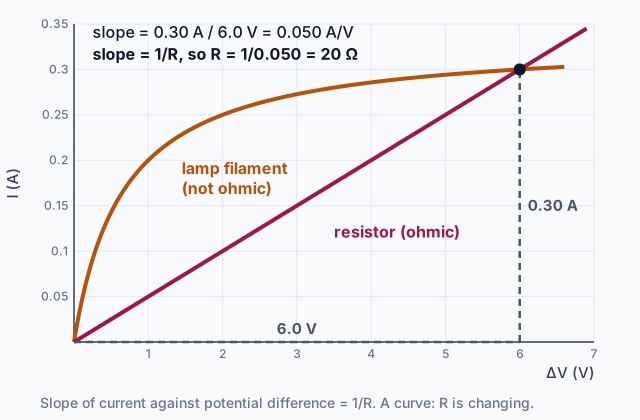
- On a graph of current against potential difference, an ohmic element gives a straight line through the origin whose slope is , not . A lamp filament gives a curve, because its resistivity rises as it heats.
Part 2 Learn it Where resistance comes from
2a. Resistance belongs to an object, resistivity to a material
Put the same potential difference across two different wires and you can get very different currents. Resistance, , measures how strongly an object opposes the movement of charge through it. Its unit is the ohm, , one volt per ampere.
Resistance belongs to one particular object: this wire, this resistor, this lamp filament. Reshape the object and its resistance changes.
Resistivity, (the Greek letter rho), belongs to the material the object is made of. It comes from the material's atomic and molecular structure, and it says how strongly that material opposes moving charge, whatever shape you make it into. Its unit is the ohm meter, .
At room temperature copper's resistivity is about , which is why house wiring is copper. Nichrome, a nickel and chromium alloy used in heating elements and some resistors, is about , roughly 65 times larger. A thin copper wire and a thick copper bar have very different resistances and exactly the same resistivity.
Quick check · Fill the statement
A spool of copper wire is cut into a short, thick piece and a long, thin piece, and both are kept at room temperature. Tap a blank, then an answer.
The two pieces have different , because that depends on each piece's shape. They have the same , because that depends only on the they are made of.
2b. Longer means more, thicker means less
For a piece of material with uniform geometry, the same cross section all the way along like a wire or a rod, the resistance is
where is the length and is the cross-sectional area: the area of the circle you would see if you cut the wire straight across.
Read it as two proportions. Resistance is proportional to length. Charge has to make its way through twice as much material, so twice the length gives twice the resistance. Resistance is inversely proportional to area. A wider wire gives charge more room to move side by side, so twice the area gives half the resistance.
That is what decided the extension cords. The area of a circle is for a diameter , so doubling the diameter makes the area four times larger and the resistance a quarter as large. When a problem gives a diameter, square it.
The two effects can cancel. A copper wire twice as long with twice the area has the same resistance as the original: .
Quick check · Rank it
Four wires are at room temperature. Wire W is copper, 1.0 m long, with a cross-sectional area of . Wire X is copper, 2.0 m long, with an area of . Wire Y is copper, 1.0 m long, with an area of . Wire Z is nichrome, 1.0 m long, with an area of . Nichrome's resistivity is about 65 times copper's. Rank the wires by resistance.
Greatest resistance first
Give each one a place, 1 for first. Give two the same place if they are equal.
Your ranking: none yet
2c. Ohm's law, ohmic parts, and heat
Ohm's law relates three things for one element of a circuit, the potential difference across it, the current in it and its resistance:
A 6.0 V potential difference across a 20 resistor gives a current of 0.30 A. Keep the same potential difference and double the resistance, and the current halves.
A material that keeps the same resistance at every current is ohmic. Double the potential difference across an ohmic resistor and the current doubles, because stays put. In this course an ohmic material's resistivity is treated as constant regardless of temperature.
Real conductors are less tidy. A resistor converts electrical energy to thermal energy, which can warm the resistor and the air around it, and the resistivity of a conductor typically increases with temperature. In a lamp filament that matters a great deal. The filament glows white hot, and its resistance when lit is many times its resistance cold. So a lamp is not ohmic: its resistance rises as the current and the temperature rise. The ohmic model fits when the temperature barely changes, as in a resistor carrying a small current, or in an alloy such as nichrome whose resistivity changes little with temperature. It fails for a filament that heats by thousands of degrees.
One more thing a resistor does not do: use up current. The charge that flows in each second flows out each second. What it uses up is electrical energy.
Quick check · Decide and justify
A student tests a small lamp. With 2.0 V across it the current is 0.20 A, and with 6.0 V across it the current is 0.40 A. Is the lamp's filament ohmic?
Which reason supports your answer?
2d. Reading resistance from a graph
In a lab you do not trust one reading. You set several potential differences across the element, measure the current at each, and plot current on the vertical axis against potential difference on the horizontal axis.
For an ohmic element the points fall on a straight line through the origin, because has the form . Match them up and the slope is , not . So take the slope from two points on your best-fit line, not from two data points, and then take one over it.
The graph at the top of this lesson shows it. The resistor's line rises 0.30 A over 6.0 V, a slope of 0.050 A/V, so . A steeper line means less resistance, because more current flows for each volt. The lamp's graph bends toward the potential difference axis: each extra volt adds less current than the one before, because its resistance keeps rising.
Units keep you honest. If a table gives current in milliamperes, change it to amperes before you divide: 85 mA is 0.085 A.
The graph below shows a different resistor. You will find its resistance in the check.
A resistor's current against potential difference
Quick check · Calculate
A student plots the current in a resistor against the potential difference across it. Her best-fit line passes through the origin and through the point (8.0 V, 0.100 A). What is the resistance of the resistor? Give your answer to the nearest 1 .
Part 3 Watch it done How much wire is in a resistor?
Predict first, then watch each step, then finish the problem yourself.
A 12 resistor is made by winding nichrome wire, of resistivity and diameter 0.50 mm, around a ceramic core. Treat the nichrome as ohmic. What length of wire does it need?
Predict first
Before you open the first step, predict: about how much wire does the resistor need?
Step 1 · Define the system and list what you know
The system is the wire, a uniform cylinder. The ceramic core is an insulator and carries no current, so it is not part of it. Known: , , and m. Unknown: the length .
Step 2 · Derive the length symbolically
Start from and solve for the length: . The cross section is a circle of diameter , so , and
Step 3 · Check the units and a limiting case
Units: , a length, as it should be. Limiting case: as goes to 0, grows without bound, so a perfect conductor never reaches 12 at any length, which is right. The trends fit too: a thicker wire, with on top, must be longer, and a material of larger resistivity needs less wire.
Why this step?
Why derive the expression before putting in any numbers?
An expression can be checked before arithmetic hides a mistake: its units come out in meters, and it changes the right way when or changes. It also shows the diameter is squared, which is exactly where a slip with the radius or with millimeters multiplies the answer by 4 or by a million.
Your step · Calculate
Finish it. A 12 resistor is made by winding nichrome wire, of resistivity and diameter 0.50 mm, around a ceramic core. Treat the nichrome as ohmic. What length of wire does it need? Give your answer to the nearest 0.1 m.
m
Part 4 Try it Change one thing at a time
An investigation changes one quantity, keeps everything else the same, and watches what happens to another. Each card below changes one thing about a single wire or resistor. Say your prediction before you tap, and check it against and Ohm's law.
Try it · Sort it
Each card changes one thing about a single wire or resistor and keeps everything else the same. Tap a card, then what happens to that wire's or resistor's resistance.
Increases
Decreases
Stays the same
Try it · Multiple choice
A student raises the potential difference across a resistor in steps. At the highest currents the resistor is warm to the touch, yet every point on her graph of current against potential difference lies on one straight line through the origin. What can she conclude about the resistor's material over this range?
Now change the resistor in a circuit and keep the battery. Predict first: does the current stay the same, rise, or fall?
Try it · Calculate
An ohmic 10 resistor connected across a battery carries a current of 0.60 A. It is replaced by an ohmic 25 resistor across the same battery. Treat the battery as ideal, so the potential difference across it does not change. What is the current in the new resistor? Give your answer to the nearest 0.01 A.
Part 5 Explain it Design it, then plot it on paper
On the exam this is handwritten, so answer on paper first. Nothing you type here leaves this page. Then check your answer against the model and each scoring point.
Free response is 50% of the exam score. This one is shaped like Question 3, Experimental Design and Analysis.
Free-response practice · Question 3 style
A student wants to find the resistivity of the metal in a long, uniform wire with a diameter of 0.30 mm. She has an adjustable power supply, an ammeter, a voltmeter, a meter stick, two clips that can be attached anywhere along the wire, and connecting leads.
(a) Describe a procedure she could use to collect data for a graph that gives the resistivity. Say what she changes, what she measures, and one step that reduces experimental uncertainty.
(b) Her results are below. On paper, plot resistance against length, with a scale and units on each axis, and draw a best-fit line. Do this by hand before you open the model.
- Length 0.20 m: resistance 3.2
- Length 0.40 m: resistance 6.1
- Length 0.60 m: resistance 9.4
- Length 0.80 m: resistance 12.3
- Length 1.00 m: resistance 15.7
(c) Use your best-fit line to calculate the resistivity of the metal.
Model answer
(a) Connect the power supply, the ammeter and the wire between the clips in one loop, with the voltmeter across the clips. Set the clips 0.20 m apart, record and , then repeat at 0.40, 0.60, 0.80 and 1.00 m, and calculate for each. Repeat each reading and average, with a small current so the wire stays cool.
(b) See the graph below: a labeled scale on each axis and one straight best-fit line between the points.
(c) , so the slope is . From (0.20 m, 3.1 ) and (1.00 m, 15.6 ) on the line, the slope is 15.6 /m. , so .
Resistance against length, with the best-fit line
The line passes very near the origin and through (1.00 m, 15.6 ).
Score your own answer. This is a self-check, not a grade. Tick each point your answer makes.
Part 6 Check yourself Two parts on a lab bench
Both case questions use the table.
A student tests two parts from a kit, a resistor X and a small lamp Y. For each part she sets the potential difference across it and reads the current in it. Her ammeter reads in milliamperes, and 1 mA = 0.001 A.
| Potential difference (V) | Current in X (mA) | Current in Y (mA) |
|---|---|---|
| 1.0 | 21 | 80 |
| 2.0 | 43 | 120 |
| 3.0 | 64 | 150 |
| 4.0 | 85 | 175 |
Case question 1 · Calculate
Using the table of currents in resistor X and lamp Y: what is the resistance of resistor X? Use all four rows. Give your answer to the nearest 1 .
Case question 2 · Multiple choice
Using the table of currents in resistor X and lamp Y: how does the resistance of lamp Y change as the potential difference across it rises from 1.0 V to 4.0 V?
The rest stand on their own and do not use the case.
Check yourself · Spot the error
A student plots the current in a resistor against the potential difference across it and finds the resistance from the graph. Tap the first line that goes wrong.
Check yourself · Match
Tap a term, then the statement that describes it.
Check yourself · Decide and justify
A resistor carries a steady current for several minutes, and both the resistor and the air around it get warmer. A classmate says the resistor is using up some of the charge to make the heat. Is the classmate right?
Which reason supports your answer?
Part 7 Keep it Bring back earlier ideas
Ohm's law joins two quantities from earlier in the course: current and potential difference. Pulling them back up is what makes them last.
Each card below describes a battery and a bulb joined by ideal wires. Trace the path through the bulb's filament, from one battery terminal to the other, before you tap.
Now follow the electric potential around one loop. Predict first: along which parts of the loop does the potential change?
From 11.2 Simple Circuits · Rank it
A battery, a closed switch and two bulbs A and B are joined in one loop by ideal wires, in this order from the battery's positive terminal: the switch, then A, then B, then back to the negative terminal. Both bulbs glow, and the switch is ideal. Point 1 is on the wire between the positive terminal and the switch, point 2 is on the wire between the switch and A, point 3 is on the wire between A and B, and point 4 is on the wire between B and the negative terminal. Rank the points by their electric potential.
Highest potential first
Give each one a place, 1 for first. Give two the same place if they are equal.
Your ranking: none yet
A lamp is joined to a battery. A data logger records the total charge that has passed through a cross section of one of the lamp's copper leads, counted from . At s the student disconnects the battery.
| Time (s) | Charge (C) |
|---|---|
| 0 | 0 |
| 2.0 | 0.30 |
| 4.0 | 0.60 |
| 6.0 | 0.90 |
| 8.0 | 0.90 |
| 10.0 | 0.90 |
From 11.1 Electric Current · Calculate
Using the table from the data logger: what is the current in the lead at s? Give your answer to the nearest 0.01 A.
In three lines
- Resistance measures how strongly an object opposes the movement of charge, and : more length, more resistance; more area, less.
- Resistivity belongs to the material, and a conductor's resistivity typically rises with temperature; an ohmic material is treated as keeping one resistivity and one resistance.
- Ohm's law is , and the slope of current against potential difference for an ohmic element is .
Exam strategy for this topic
- Section I, Multiple Choice: 42 questions in 85 minutes.
- Section II, Free Response: 4 questions in 95 minutes.
- This lesson's Explain it is shaped like free-response question 3, Experimental Design and Analysis.
- A four-function, scientific, or graphing calculator is allowed on both sections of the exam.
When a lab table gives current in milliamperes or a diameter in millimeters, change to amperes and meters before you calculate, and keep the powers of ten in every line. On a graph of current against potential difference, take one over the slope to get the resistance.
Questions students ask
What is the difference between resistance and resistivity?
Resistance belongs to one object and depends on its shape; resistivity belongs to the material. A thin copper wire and a thick copper bar have different resistances and the same resistivity, about at room temperature.
Why does a thicker wire have less resistance?
A wider wire gives moving charge more room side by side, and puts the area underneath. Twice the diameter gives four times the area, so a quarter of the resistance.
Is the slope of a current against potential difference graph the resistance?
No. The slope is , which is . A line that rises 0.30 A over 6.0 V has a slope of 0.050 A/V, so the resistance is .
Why is a light bulb not ohmic?
Its filament heats up as the current grows, and the resistivity of a conductor typically rises with temperature. So grows with the potential difference, and its graph of current against potential difference curves instead of staying straight.
Does a resistor use up current?
No. The charge that flows into a resistor each second flows out each second. What a resistor uses up is electrical energy, which it converts to thermal energy.
Course alignment, for teachers
AP Physics 2: Algebra-Based topic 11.3, Unit 11: Electric Circuits.
- Skill 1.B: Create quantitative graphs with appropriate scales and units, including plotting data.
- Skill 2.B: Calculate or estimate an unknown quantity with units from known quantities, by selecting and following a logical computational pathway.
- Skill 2.D: Predict new values or factors of change of physical quantities using functional dependence between variables.
- Skill 3.A: Create experimental procedures that are appropriate for a given scientific question.
- Skill 3.B: Apply an appropriate law, definition, theoretical relationship, or model to make a claim.
This lesson maps all 9 essential knowledge statements of the topic to the part that teaches each one: 9 are checked by a scored question. The map is in the lesson file.