Unit 11 · Topic 11.4 · about 30 minutes · 7 parts · 10 scored checks, 1 of them multiple choice, plus 2 from earlier lessons
AP Physics 2: Algebra-Based 11.4: Electric Power
Unit 11: 15 to 18% of the multiple-choice section
What you'll be able to do
- Describe how fast energy is transferred into, out of or within a circuit using power, and use power to predict which bulbs in a circuit glow brighter.
Key vocabulary
| Term | What it means | The exam trap |
|---|---|---|
| Electric power | The rate at which a circuit element transfers, converts or dissipates energy, , measured in watts. | Power is quoted in watts and energy in joules, so read which of the two a question asks for before you calculate. |
| Watt | The unit of power, W: one joule per second. | Labels and tables often give kilowatts or milliwatts, so convert to watts before you combine a power with a current or a time. |
| Dissipate | To convert electrical energy into thermal energy that spreads into the surroundings, as a resistor does. | Dissipate is a word about energy, so a question asking where dissipated energy goes wants a form of energy, such as thermal energy, in the answer. |
| Brightness | How much light a bulb gives out, which increases with the power the bulb converts. | A question that asks which bulb is brightest needs the same quantity worked out for every bulb it names, so do not stop after the first two. |
 Tap to open the picture full size
Part 1 Think first Two lights on one car battery
Commit to a guess first. Being wrong now makes the right idea stick better.
Predict first
A car's 12 V battery runs a 55 W headlight bulb and a 5 W parking light bulb. Each bulb is wired in a loop of its own straight across the battery, and you can treat the battery as ideal. Which bulb's filament has more resistance?
In short. Electric power is the rate at which a circuit element transfers, converts or dissipates energy, and it depends on both the current in the element and the potential difference across it.
- , measured in watts, joules per second; with Ohm's law it becomes or .
- Power is a rate, not an amount: the energy converted is the power times the time, .
- A bulb's brightness increases with its power, so compare powers, not currents alone, to predict which bulb is brighter.
Part 2 Learn it Power, its three forms, and brightness
2a. Power is how fast energy moves
A battery gives energy to the charge it drives around a circuit, and every element the charge passes through transfers, converts or dissipates some of it. A bulb converts it to light and thermal energy. A resistor dissipates it as thermal energy, which spreads into its surroundings. Power, , is the rate at which that happens: energy per second. Its unit is the watt, W, one joule per second.
Two quantities you already know combine to give it. The potential difference across an element is the energy each coulomb of charge gives up passing through it, in joules per coulomb. The current is how many coulombs pass through each second. Multiply them and the coulombs cancel:
A phone charger that supplies 2.0 A at 5.0 V delivers W, so 10 joules every second.
Power is a rate, not an amount. A 10 W charger does not hold 10 J. Leave it running for an hour, which is 3600 s, and it delivers 10 W times 3600 s, which is 36,000 J. The energy is the power times the time:
Quick check · Calculate
A car's rear window defroster is a resistor that carries 12 A when the car's 12 V battery is across it. Treat the battery as ideal. How much energy does the defroster convert to thermal energy in 5.0 minutes? Give your answer in kilojoules, to the nearest 0.1 kJ.
2b. Three ways to write the power
For a resistor, Ohm's law, , lets you write the power two more ways. Put in place of , or in place of :
All three give the same number for the same element. A 3.0 resistor with 6.0 V across it carries 2.0 A, and , and each give 12 W.
Which form to pick depends on what stays the same when something changes. If the potential difference across a resistor stays the same, as it does for a resistor joined straight across an ideal battery, use : twice the resistance gets half the power, because the current halves. If the current stays the same, use .
The squares matter. Double the potential difference across an ohmic resistor and the current doubles too, so the power becomes four times as large. That holds only while the resistance stays put. A lamp filament heats up and its resistance rises, so doubling the potential difference across a lamp less than quadruples its power.
Quick check · Sort it
Each card changes one thing and keeps everything else the same. Every battery is ideal and every resistor is ohmic. Tap a card, then choose what happens to the power in the resistor or heater the card names.
Becomes four times as large
Becomes half as large
Stays the same
2c. Brightness follows power
A bulb's brightness increases with its power, the rate at which its filament converts electrical energy into light and thermal energy. So to predict which of two bulbs is brighter, compare their powers.
Current alone does not decide it, and neither does potential difference alone. A bulb with 2.0 A in it and 1.5 V across it converts 3.0 W. A bulb with only 0.50 A in it but 12 V across it converts 6.0 W, and it is the brighter one although its current is a quarter as large.
How the bulbs are joined tells you which form of the power to use. Take each filament's resistance as fixed. Two bulbs each joined straight across the same ideal battery, in separate loops, have the same potential difference across them, so compare : the bulb with less resistance is brighter. Two bulbs on a single path with no branches, the only loop in the circuit, carry the same current, because charge is not used up along the path. Then compare : the bulb with more resistance is brighter. Rearranging the same two bulbs can swap which one is brighter.
Quick check · Rank it
A student measures three glowing bulbs, each in a circuit of its own. Bulb X carries 0.50 A with 6.0 V across it. Bulb Y carries 0.25 A with 12 V across it. Bulb Z carries 1.0 A with 2.0 V across it. Assume a bulb's brightness depends only on its power. Rank the bulbs by brightness.
Brightest first
Give each one a place, 1 for first. Give two the same place if they are equal.
Your ranking: none yet
Part 3 Watch it done Two bulbs with different ratings on one path
Predict first, then watch each step, then finish the problem yourself.
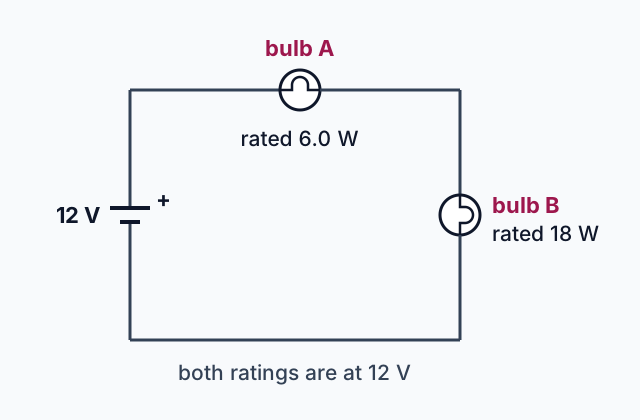
The circuit at the top of this lesson has an ideal 12 V battery and two bulbs on a single path with no branches, joined by ideal wires. A bulb's rating is the power it converts with 12 V across it: bulb A is rated 6.0 W and bulb B is rated 18 W. Treat each filament's resistance as fixed at the value its rating gives. Which bulb is brighter in this circuit, and by what factor is its power larger?
Predict first
Before you open the first step, predict: which bulb glows brighter in this circuit?
Step 1 · Get each resistance from its rating
A rating is a power at 12 V, so use the form with the potential difference in it: gives . So and . The bulb with the smaller rating has the larger resistance.
Step 2 · Find what is the same in both bulbs
In this circuit neither bulb has 12 V across it, because the two bulbs split the battery's potential difference between them. What is the same in both is the current. Charge is not used up in a bulb and there is only one path, so every coulomb that passes through A passes through B in the same second.
Step 3 · Use the form of the power that has it
With the same current in both, gives and . Divide one by the other and the unknown current cancels:
On this path, the bulb with more resistance converts energy faster.
Why this step?
Why use here, when gave the resistances?
Every form is true, but only one holds a quantity that is the same for both bulbs in this circuit. The current is the same in A and B while their potential differences are different and unknown, so lets the current cancel. The ratings were measured with 12 V across each bulb, which is why was the right form for the first step.
Your step · Calculate
Finish it. An ideal 12 V battery and two bulbs are joined by ideal wires on a single path with no branches. Bulb A is rated 6.0 W at 12 V and bulb B is rated 18 W at 12 V, and each filament's resistance stays at the value its rating gives. In this circuit, what is the ratio of the power in bulb A to the power in bulb B, ? Give your answer to the nearest 0.1.
Part 4 Try it Draw it, then judge a claim
Now draw how a resistor's power depends on its current. Before you drag anything, say what doubling the current does to the power.
Try it · Sketch the graph
An ohmic 4.0 resistor carries a current that is raised in steps from 0 to 2.0 A. Sketch the power in the resistor against the current. The first point is fixed at 0 W.
One shape that fits
Drag a point up or down, or tap it and use the arrow keys. Only the shape is checked.
Next, two bulbs sit on a single path with a battery. Predict before you choose: which one glows brighter?
Try it · Decide and justify
Bulbs P and Q and a battery are joined by ideal wires on a single path with no branches, and both bulbs glow. Treat each filament's resistance as fixed: P's is 6.0 and Q's is 12 . A student says P is brighter, because its smaller resistance lets more current through it. Is the student right?
Which reason supports your answer?
Part 5 Explain it Choose a seat heater
On the exam this is handwritten, so answer on paper first. Nothing you type here leaves this page. Then check your answer against the model and each scoring point.
Free response is 50% of the exam score. This one is shaped like Question 1, Mathematical Routines.
Free-response practice · Question 1 style
A car seat heater is a resistor of resistance , joined by ideal wires straight across the car's battery. Treat the battery as ideal, with a potential difference .
(a) Derive an expression for the energy the heater converts to thermal energy in a time , in terms of , and . Then calculate for V, and 10 minutes.
(b) On paper, sketch a graph of the heater's power against its resistance , for the same battery. Do this by hand before you open the model.
(c) A student claims that a heater with more resistance warms the seat faster, because resistance is what produces the heating. Use your expression from (a) to justify whether the claim is correct for this heater.
Model answer
(a) The battery keeps across the heater, so and . With 10 minutes as 600 s, , which is 28,800 J, about J.
(b) See the graph below: the power falls as grows, steeply at first and then more slowly.
(c) Incorrect for this heater. is fixed and is in the denominator of , so more resistance converts less energy in the same time. The current falls by the same factor the resistance rises, so falls.
Power against resistance for a heater across a 12 V battery
Drawn for = 12 V: 48 W at 3.0 , and half that, 24 W, at twice the resistance.
Score your own answer. This is a self-check, not a grade. Tick each point your answer makes.
Part 6 Check yourself A small lamp on the bench
Both case questions use the table.
A student tests a small lamp. She sets the potential difference across it, reads the current in it, and notes how bright it looks.
| Potential difference (V) | Current (A) | How it looks |
|---|---|---|
| 2.0 | 0.20 | Dull red glow |
| 4.0 | 0.29 | Dim orange |
| 6.0 | 0.35 | Bright yellow |
| 8.0 | 0.40 | Very bright white |
Case question 1 · Calculate
Using the table for the small lamp: by what factor does the power in the lamp increase when the potential difference across it rises from 2.0 V to 4.0 V? Give your answer to the nearest 0.1.
Case question 2 · Multiple choice
Using the table for the small lamp: which statement do the data support?
The rest stand on their own and do not use the case.
Check yourself · Spot the error
A heater in a camper van runs from a 12 V battery and carries 25 A. A student works out how much energy it converts in 3.0 minutes. Tap the first line that goes wrong.
Check yourself · Match
Tap a situation, then the calculation that fits it.
Part 7 Keep it Bring back earlier ideas
Power multiplies two quantities from earlier lessons, the current and the potential difference. Pulling them back up is what makes them last.
From 11.3 Resistance, Resistivity, and Ohm’s Law · Calculate
A student plots the current in a resistor against the potential difference across it. Her best-fit line passes through the origin and through the point (8.0 V, 0.100 A). What is the resistance of the resistor? Give your answer to the nearest 1 .
From 11.1 Electric Current · Decide and justify
In wire P, 30 C of charge passes through a cross section in 10 s. In wire Q, 12 C passes through a cross section in 2.0 s. A classmate says P has the larger current, because more charge passes through it. Is the classmate right?
Which reason supports your answer?
In three lines
- Power is the rate of energy transfer, in watts, and the energy converted is .
- For a resistor ; pick the form whose quantity, the current or the potential difference, stays the same.
- A bulb's brightness increases with its power, so compare powers, not currents alone.
Exam strategy for this topic
- Section I, Multiple Choice: 42 questions in 85 minutes.
- Section II, Free Response: 4 questions in 95 minutes.
- This lesson's Explain it is shaped like free-response question 1, Mathematical Routines.
- A four-function, scientific, or graphing calculator is allowed on both sections of the exam.
Before you compare bulbs, decide what is the same for them: the current (one path with no branches) or the potential difference (each straight across the same ideal battery). Use or so that quantity cancels, and change minutes to seconds before you multiply a power by a time.
Questions students ask
What is the formula for electric power?
, the current times the potential difference. For a resistor, Ohm's law turns it into or , and all three give the same number for the same element.
Is power the same as energy?
No. Power is the rate of energy transfer, in watts, which are joules per second. The energy is the power times the time: a 144 W defroster converts 43,200 J in 5.0 minutes.
Does a bigger resistance give more power or less?
It depends on what stays the same. Across the same potential difference a bigger resistance gets less power, from . With the same current, as on a single path with no branches, a bigger resistance gets more, from .
How does power predict how bright a bulb is?
A bulb's brightness increases with its power, the rate at which its filament converts electrical energy to light and thermal energy. Work out or compare each bulb's power; the bulb with the larger power is brighter.
Does a brighter bulb use up more current?
No. Charge is not used up in a bulb, so the current into it equals the current out. A brighter bulb converts electrical energy to light and thermal energy at a higher rate.
Course alignment, for teachers
AP Physics 2: Algebra-Based topic 11.4, Unit 11: Electric Circuits.
- Skill 1.C: Create qualitative sketches of graphs that represent features of a model or the behavior of a physical system.
- Skill 2.A: Derive a symbolic expression from known quantities by selecting and following a logical mathematical pathway.
- Skill 2.D: Predict new values or factors of change of physical quantities using functional dependence between variables.
- Skill 3.C: Justify or support a claim using evidence from experimental data, physical representations, or physical principles or laws.
This lesson maps all 2 essential knowledge statements of the topic to the part that teaches each one: 2 are checked by a scored question. The map is in the lesson file.