Unit 11 · Topic 11.6 · about 30 minutes · 7 parts · 11 scored checks, 1 of them multiple choice, plus 2 from earlier lessons
AP Physics 2: Algebra-Based 11.6: Kirchhoff’s Loop Rule
Unit 11: 15 to 18% of the multiple-choice section
What you'll be able to do
- Describe a circuit or its elements with Kirchhoff's loop rule: the energy a charge gains and gives up, the potential differences around a closed loop, and a graph of electric potential around the loop.
Key vocabulary
| Term | What it means | The exam trap |
|---|---|---|
| Change in electric potential energy | For a charge moving through a potential difference , , in joules. | Here is a potential difference in volts. The same letters stand for a change in velocity or volume elsewhere in physics, so read the units. |
| Closed loop | Any path through a circuit that starts and ends at the same point without passing through any element twice. | On a schematic a loop can turn corners or run along the edges of the page; only the elements it passes through matter, not the shape it is drawn in. |
| Kirchhoff's loop rule | The rule for how the potential differences across the elements of any closed loop in a circuit are related to one another. | The rule is about a closed loop. Two points that are not part of one, such as the two contacts of an open switch, can have a potential difference between them even though no charge flows. |
| Electric potential | The electric potential energy per unit charge at a point, in volts, measured from a point chosen as 0 V. | A potential at one point depends on which point is called 0 V, so read where the question puts it before comparing values. |
 Tap to open the picture full size
Part 1 Think first Which one gets more
Commit to a guess first. Being wrong now makes the right idea stick better.
Predict first
An electrician wires a small lamp and a heater to an ideal 12 V battery with ideal wires, on a single path with no branches. Charge leaving the battery's positive terminal reaches the lamp first. The lamp has a resistance of 4.0 ohms and the heater 8.0 ohms, and both stay fixed. Which one has the larger potential difference across it?
In short. Kirchhoff's loop rule says the potential differences across all the elements in any closed loop add to zero, , because a charge that goes once around the loop ends with the electric potential energy it started with.
- A charge moving through a potential difference changes its electric potential energy by .
- Going around a loop, crossing a battery from its negative to its positive terminal is , and crossing a resistor in the direction of the current is .
- A graph of electric potential against position around a loop rises across a battery, stays level along ideal wires, falls across each resistor and ends where it began.
Part 2 Learn it Energy, the loop rule, signs and graphs
2a. Energy carried around a circuit
A battery does work on charge and raises its electric potential energy. In the rest of the circuit the charge gives that energy up: a bulb converts it to light and thermal energy, a resistor to thermal energy.
When a charge moves through a potential difference , its electric potential energy changes by
A volt is a joule per coulomb. So 2.0 C crossing a 6.0 V battery from its negative terminal to its positive terminal gains J. If that charge then moves with the current through a bulb with 6.0 V across it, it goes to lower potential: V, so J, and the charge gives up 12 J in the bulb.
Treat the moving charge as positive, as the direction of conventional current does. The charge is never used up. What changes as it goes round is its energy, and a potential difference measures that change per coulomb.
Quick check · Calculate
In 30 s, 15 C of charge passes through a resistor that has 4.0 V across it. By how much does the electric potential energy of that charge decrease as it passes through the resistor? Give your answer to the nearest joule.
2b. Why the loop rule holds
Follow one coulomb once around a closed loop, back to where it started. It is at the same electric potential as when it set out, so by it has the same electric potential energy. Whatever energy it gained crossing the battery, it gave up again in the other elements.
That is Kirchhoff's loop rule: the potential differences across all the elements in a closed loop add to zero, counting rises as positive and falls as negative.
It is conservation of energy, written per coulomb.
In the circuit at the start of this lesson, the 12 V battery raises the potential by 12 V, so the lamp and heater must lower it by 12 V between them: 4.0 V across the lamp and 8.0 V across the heater. The elements on a single path split the battery's potential difference. They do not each get all of it, and with the same current in both, the one with more resistance has the larger potential difference.
Quick check · Decide and justify
An ideal 6.0 V battery and two resistors are joined by ideal wires on a single path with no branches. A student reports 2.5 V across one resistor and 4.5 V across the other. Could both readings be right?
Which reason supports your answer?
2c. Going around a loop with signs
To use the rule, pick a starting point and a direction, then add each change in potential as you pass it:
- Across a battery from its negative terminal to its positive terminal: . The other way: .
- Across a resistor in the direction of the current: , since current flows to lower potential. Against the current: .
- Along an ideal wire: no change.
If you do not know which way the current flows, guess. A negative answer for means it flows the other way, with the same size.
A battery's sign follows the direction you walk around the loop, not the direction the charge moves. Walking from its negative terminal to its positive terminal is ; walking from positive to negative is . In a loop with two batteries, charge can be pushed backward through the weaker one, as when a car's alternator recharges a battery, and the signs are written exactly the same way.
A loop does not have to pass through a battery. Going down one of two parallel branches and back up the other gives , which is why parallel branches have the same potential difference.
Quick check · Spot the error
An ideal 12 V battery, a 2.0 resistor, an ideal 4.0 V battery and a second 2.0 resistor are joined in that order by ideal wires, on a single path with no branches. The 12 V battery's positive terminal faces the first resistor, and the 4.0 V battery's positive terminal also faces the first resistor. The current flows out of the 12 V battery's positive terminal, and a student goes around the loop in that direction. Tap the first line that goes wrong.
2d. Potential around the loop as a graph
Choose one point as 0 V, often a battery's negative terminal. Then go around the loop in the direction of the current and plot the electric potential at each point.
Take an ideal 12 V battery with a 4.0 and an 8.0 resistor, in that order, on a single path with no branches. The current is A. The graph
- jumps up 12 V across the battery,
- stays level along each ideal wire, since an ideal wire has no potential difference across it,
- falls steadily by 4.0 V through the first resistor and by 8.0 V through the second,
- arrives back at 0 V, where it started.
The rises and falls add to zero, so the graph is the loop rule drawn. Two points joined only by an ideal wire are at the same potential, and a voltmeter between them reads zero.
Quick check · Sketch the graph
An ideal 9.0 V battery, a 2.0 resistor and a 1.0 resistor are on a single path with no branches, joined by ideal wires. Going in the direction of the current: point 0 is the battery's negative terminal and point 1 its positive terminal; a wire runs from point 1 to point 2; the 2.0 resistor runs from point 2 to point 3; a wire runs from point 3 to point 4; the 1.0 resistor runs from point 4 to point 5; and a wire runs from point 5 to point 6, back at the negative terminal. Sketch the electric potential at each point, taking the negative terminal as 0 V. The first point is fixed at 0 V.
One shape that fits
Drag a point up or down, or tap it and use the arrow keys. The shape is checked, and so are the values the question lets you work out.
Part 3 Watch it done Two batteries pushing opposite ways
Predict first, then watch each step, then finish the problem yourself.
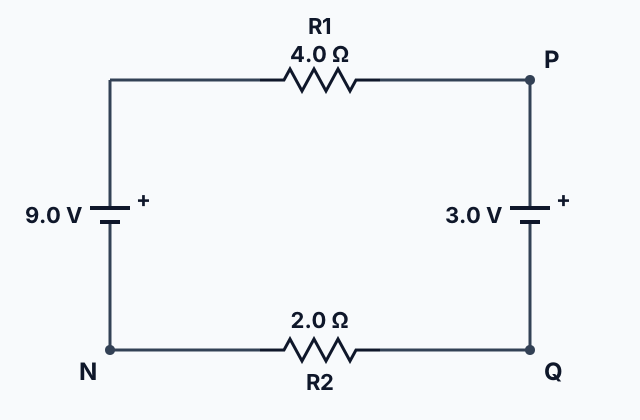
In the circuit at the top of this lesson, an ideal 9.0 V battery and an ideal 3.0 V battery are on a single path with no branches, with on the top wire and on the bottom wire. Both batteries have their positive terminals at the top, so they push charge opposite ways around the loop. The wires are ideal. Taking N, the negative terminal of the 9.0 V battery, as 0 V, what is the electric potential at P?
Predict first
Before you open the first step, predict: what is the electric potential at P?
Step 1 · Choose a direction for the current
The 9.0 V battery pushes charge clockwise and the 3.0 V battery pushes it counterclockwise. Guess clockwise and call the current : up through the 9.0 V battery, right through , down through the 3.0 V battery and left through . If the guess were wrong, would come out negative.
Step 2 · Go once around the loop
Start at N and go clockwise. Up through the 9.0 V battery, negative terminal to positive: V. Through with the current: . Down through the 3.0 V battery, entering at its positive terminal: V. Through with the current: . Back at N the sum is zero:
so A, clockwise as guessed.
Why this step?
Why is the 3.0 V battery a fall and not a rise?
Going clockwise you cross it from its positive terminal to its negative terminal, which is a fall in potential whichever way the charge moves. Its sign depends on which terminal you meet first, not on which battery is larger.
Your step · Calculate
Finish it. An ideal 9.0 V battery, a 4.0 resistor , an ideal 3.0 V battery and a 2.0 resistor are joined in that order by ideal wires, on a single path with no branches. Point N is the 9.0 V battery's negative terminal, and point P is between and the positive terminal of the 3.0 V battery, so the two batteries push charge opposite ways. Taking N as 0 V, what is the electric potential at P? Give your answer to the nearest 0.1 V.
V
Part 4 Try it Rank, then match
 Tap to open the picture full size
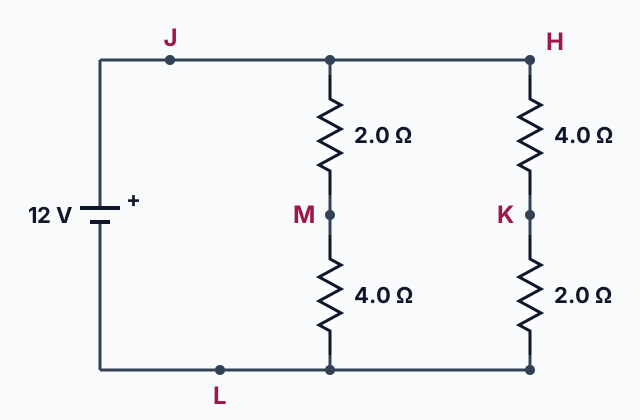
Rank the points before you work anything out. Then check: take the bottom wire as 0 V and use the loop through the battery and each branch.
Try it · Rank it
An ideal 12 V battery has its positive terminal joined to the top wire and its negative terminal to the bottom wire, by ideal wires. Point J is on the top wire near the battery and point H is on the top wire far from it; point L is on the bottom wire. Two branches join the top wire to the bottom wire. In the first, a 2.0 resistor at the top and a 4.0 resistor below it have point M between them. In the second, a 4.0 resistor at the top and a 2.0 resistor below it have point K between them. Rank the points by electric potential.
Highest potential first
Give each one a place, 1 for first. Give two the same place if they are equal.
Your ranking: none yet
Now the signs. Going around a loop in a chosen direction, each crossing changes the potential by one of these.
Try it · Match
You go around a loop in a chosen direction, and the current in each resistor has size . Tap each crossing, then the change in potential it adds to the loop rule.
Part 5 Explain it Does the order of the resistors matter?
On the exam this is handwritten, so answer on paper first. Nothing you type here leaves this page. Then check your answer against the model and each scoring point.
Free response is 50% of the exam score. This one is shaped like Question 1, Mathematical Routines.
Free-response practice · Question 1 style
A battery of emf with negligible internal resistance is joined by ideal wires to resistors and , on a single path with no branches. Charge leaving the battery's positive terminal reaches first.
(a) Starting from the loop rule, derive an expression for the potential difference across in terms of , and .
(b) For V, and , calculate the change in electric potential energy of 3.0 C of charge as it passes through .
(c) A student claims that swapping and , so that charge reaches first, would make larger, because the charge would no longer give up energy in before reaching . Use your expression from (a) to justify whether the claim is correct.
Model answer
(a) Going once around the loop, the potential rises by across the battery and falls by and across the resistors: . So and .
(b) V. Moving with the current, the charge goes to lower potential, so J: its electric potential energy falls by 24 J.
(c) Incorrect. The expression depends only on , and , not on their order, so after the swap is still 8.0 V. On a single path the current is the same everywhere, and the emf splits between the resistors in proportion to their resistances, not by which one the charge reaches first.
Score your own answer. This is a self-check, not a grade. Tick each point your answer makes.
Part 6 Check yourself Readings around a loop
Both case questions use the table.
A student builds a single path with no branches: an ideal 9.0 V battery, then a bulb, a resistor and a small motor, joined by ideal wires. She keeps the negative lead of an ideal voltmeter on the battery's negative terminal and touches the positive lead to five points in turn, going around the loop in the direction of the current.
| Point | Where it is | Reading (V) |
|---|---|---|
| 1 | The battery's positive terminal | 9.00 |
| 2 | Just before the bulb | 9.00 |
| 3 | Between the bulb and the resistor | 5.40 |
| 4 | Between the resistor and the motor | 3.00 |
| 5 | Just past the motor | 0.00 |
Case question 1 · Calculate
Using the table of voltmeter readings: by how much does the electric potential energy of 2.0 C of charge decrease as it passes through the resistor? Give your answer to the nearest 0.1 J.
Case question 2 · Multiple choice
Using the table of voltmeter readings: which statement do the readings support?
The rest stand on their own and do not use the case.
Check yourself · Fill the statement
Tap a blank, then an answer.
The loop rule follows from conservation of . A charge that goes once around a loop comes back to the same it started at, so the energy it gains crossing the battery equals the energy it in the other elements.
Check yourself · Decide and justify
A flashlight holds two identical 1.5 V cells and a bulb on a single path with no branches, joined by ideal wires. One cell has been put in backward, so the two positive terminals face each other. Treat the cells as ideal and the bulb's resistance as fixed. Does the bulb light?
Which reason supports your answer?
Part 7 Keep it Bring back earlier ideas
The loop rule uses the potential differences from the last few lessons: across a real battery, and across resistors that obey Ohm's law. Pulling them back up is what makes them last.
From 11.5 Compound Direct Current (DC) Circuits · Calculate
A battery with an emf of 9.0 V and an internal resistance of 0.50 is connected to a 4.0 resistor by ideal wires. What is the potential difference across the battery's terminals? Give your answer to the nearest 0.1 V.
From 11.3 Resistance, Resistivity, and Ohm’s Law · Decide and justify
A student tests a small lamp. With 2.0 V across it the current is 0.20 A, and with 6.0 V across it the current is 0.40 A. Is the lamp's filament ohmic?
Which reason supports your answer?
In three lines
- A charge moving through a potential difference changes its electric potential energy by .
- Around any closed loop , conservation of energy per coulomb: from a battery's negative terminal to its positive one, through a resistor with the current.
- A graph of potential against position rises across a battery, stays level along ideal wires, falls across each resistor and returns to where it began.
Exam strategy for this topic
- Section I, Multiple Choice: 42 questions in 85 minutes.
- Section II, Free Response: 4 questions in 95 minutes.
- This lesson's Explain it is shaped like free-response question 1, Mathematical Routines.
- A four-function, scientific, or graphing calculator is allowed on both sections of the exam.
Mark the current's direction, guessing if you must, choose a direction around the loop, and write the sign of each change before any numbers: from a battery's negative terminal to its positive one, through a resistor with the current. Then check that the rises and falls cancel.
Questions students ask
What is Kirchhoff's loop rule?
The sum of the potential differences across all the elements in any closed loop of a circuit is zero, . Rises, as across a battery from its negative terminal to its positive one, count as positive, and falls, as through a resistor with the current, count as negative.
Why does the loop rule follow from conservation of energy?
A charge that goes once around a loop returns to the same electric potential, so by it has the same electric potential energy. The energy it gained in the battery must equal the energy it gave up in the other elements.
How do I choose the signs in a loop equation?
Pick a direction around the loop. Crossing a battery from its negative to its positive terminal is , and the other way is . Crossing a resistor with the current is , and against it is . An ideal wire adds nothing.
What if the current comes out negative?
Your guess of its direction was wrong. The size is right, and the current flows the other way.
What does a graph of electric potential around a loop look like?
Starting from a point called 0 V, it rises across each battery crossed from its negative terminal, stays level along ideal wires, falls across each resistor in the direction of the current, and comes back to 0 V where it started.
Course alignment, for teachers
AP Physics 2: Algebra-Based topic 11.6, Unit 11: Electric Circuits.
- Skill 1.C: Create qualitative sketches of graphs that represent features of a model or the behavior of a physical system.
- Skill 2.A: Derive a symbolic expression from known quantities by selecting and following a logical mathematical pathway.
- Skill 2.C: Compare physical quantities between two or more scenarios or at different times and locations in a single scenario.
- Skill 3.B: Apply an appropriate law, definition, theoretical relationship, or model to make a claim.
This lesson maps all 4 essential knowledge statements of the topic to the part that teaches each one: 4 are checked by a scored question. The map is in the lesson file.