Unit 11 · Topic 11.7 · about 30 minutes · 7 parts · 10 scored checks, 1 of them multiple choice, plus 2 from earlier lessons
AP Physics 2: Algebra-Based 11.7: Kirchhoff’s Junction Rule
Unit 11: 15 to 18% of the multiple-choice section
What you'll be able to do
- Describe a circuit or its elements with Kirchhoff's junction rule: why charge entering a junction each second equals charge leaving it, and how to use that with the loop rule to find currents.
Key vocabulary
| Term | What it means | The exam trap |
|---|---|---|
| Junction | A point in a circuit where three or more wires meet. | A schematic marks a junction with a dot. Two wires drawn crossing with no dot are not joined. |
| Branch | A path between two junctions, with no junction along it. | In a schematic a branch can bend around corners, so trace it from junction to junction rather than looking for a straight line. |
| Kirchhoff's junction rule | The rule for how the currents in the wires that meet at a junction are related to one another. | Currents at a junction are often given in milliamperes, so convert 250 mA to 0.25 A before adding it to a current in amperes. |
| Conservation of electric charge | Electric charge is never created or destroyed: the total charge of an isolated system stays the same. | Charge, in coulombs, and current, in amperes, are different quantities: current is the rate at which charge passes a point. |
 Tap to open the picture full size
Part 1 Think first Where the wire splits
Commit to a guess first. Being wrong now makes the right idea stick better.
Predict first
In a model car, 3.0 A leaves the battery along one wire. Further on, that wire splits in two: one branch runs to the motor and the other to a headlight bulb, and the branches join again before the wire returns to the battery. Treat the motor's branch as a fixed 2.0 ohms and the headlight's as a fixed 4.0 ohms, with ideal wires. How does the 3.0 A divide?
In short. Kirchhoff's junction rule says the total current into a junction equals the total current out of it, , because charge is conserved and does not build up at the junction.
- A junction is a point where three or more wires meet, and the charge arriving there each second equals the charge leaving each second.
- The junction rule fixes the total of the currents, not how they divide: parallel branches have the same potential difference, so the branch with less resistance carries more current.
- With the junction rule and the loop rule together, guess a direction for each current and solve; a negative current flows the other way.
Part 2 Learn it Junctions, the rule, and how current divides
2a. Charge in, charge out
A junction is a point in a circuit where three or more wires meet. On a schematic it is drawn as a dot.
Electric charge is conserved: it is never created or destroyed. In a circuit with a steady current, it does not build up anywhere either. If more charge arrived at a junction each second than left, charge would collect there, and that collected charge would repel the charge still arriving. A circuit settles, in a tiny fraction of a second after it is switched on, into a steady state where nothing builds up.
So in a steady current the charge arriving at a junction each second equals the charge leaving each second. Current is charge per second, so the currents arriving add up to the currents leaving.
The same holds for any element. A bulb converts energy, but the charge that enters it each second leaves it each second, so the current out of a bulb equals the current into it.
Quick check · Multiple choice
At a junction in a working circuit, a steady 2.0 A arrives along one wire and leaves along two others. Why must the two outgoing currents add to 2.0 A?
2b. The junction rule
Kirchhoff's junction rule: the total current into a junction equals the total current out of it.
It holds however many wires meet there. If 4.0 A and 1.0 A arrive along two wires and 2.0 A leaves along a third, the fourth wire must carry the other 3.0 A away.
Often you do not know which way a current flows. Guess a direction for each unknown current, mark it with an arrow, and keep that guess through every equation. If a current comes out negative, it flows the other way, with the size you found.
Every junction in a circuit gives one equation, but the last junction you write always repeats what the others already said, so in a circuit with two junctions only one of them is needed.
Quick check · Calculate
Five wires meet at junction J in a circuit with steady currents. Wire 1 carries 3.0 A into J, wire 2 carries 1.5 A into J, wire 3 carries 2.0 A out of J and wire 4 carries 0.5 A out of J. What is the current in wire 5? Count a current out of J as positive and one into J as negative. Give your answer to the nearest 0.1 A.
2c. How the current divides
The junction rule says how much current leaves a junction in all. It says nothing about how that current divides. For two branches that leave one junction and meet again at another, the loop rule fixes the split: a loop down one branch and back up the other gives , so the branches have the same potential difference.
Then the branch with less resistance carries more current. If 1.2 A reaches a junction where a 4.0 branch and a 12 branch leave it, the branches need , so . With A, the currents are 0.90 A and 0.30 A, and each branch has 3.6 V across it.
Charge does not "take the path of least resistance" in the sense of all of it going one way: every branch with a potential difference across it carries some current. The branch with less resistance just carries more of it.
Quick check · Spot the error
A steady 1.5 A reaches a junction where the wire splits into a 5.0 branch and a 10 branch, which meet again at a second junction. The wires are ideal. A student works out the branch currents. Tap the first line that goes wrong.
Part 3 Watch it done Two batteries, three branches
Predict first, then watch each step, then finish the problem yourself.
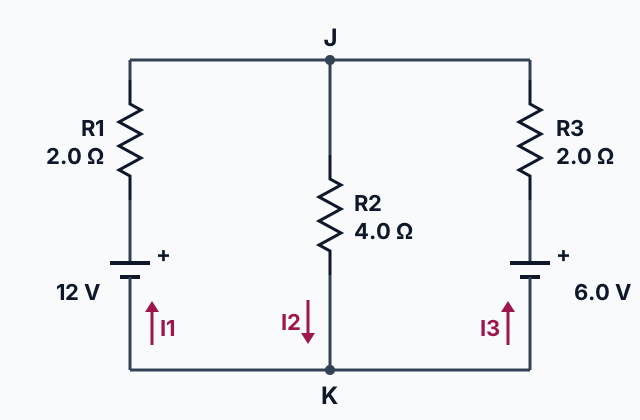
In the circuit at the top of this lesson, three branches join junction J to junction K. The left branch holds and an ideal 12 V battery, the middle branch holds , and the right branch holds and an ideal 6.0 V battery. Both batteries have their positive terminals toward J, and the wires are ideal. What is the current in ?
Predict first
Before you open the first step, predict: which way does charge flow through the 6.0 V battery?
Step 1 · Name the currents, then use the junction rule
Guess a direction in each branch, as the arrows show: up the left branch into J, up the right branch into J, and down the middle branch out of J. At J the current in equals the current out:
Step 2 · Write a loop equation for each half
Left loop, going up the left branch and down the middle from K: the 12 V battery is a rise, and are falls with their currents.
Right loop, up the right branch and down the middle:
Each loop equation gives one branch current in terms of : and .
Why this step?
Why are two loop equations needed, and not three?
There are three unknown currents, and the junction rule gives one equation, so two more are needed. The loop around the outside, through both batteries, is the difference of these two loops, so it adds nothing new.
Your step · Calculate
Finish it. Three branches join junction J to junction K by ideal wires. One branch holds a 2.0 resistor and an ideal 12 V battery, one holds a 4.0 resistor alone, and one holds a 2.0 resistor and an ideal 6.0 V battery. Both batteries have their positive terminals toward J. What is the current in the 4.0 resistor? Give your answer to the nearest 0.1 A.
A
Part 4 Try it Sort the readings, then decide
Each set of readings below comes from ideal ammeters in every wire at one junction. Decide which sets can all be right.
Try it · Sort it
Each card gives the readings of ideal ammeters in every wire that meets at one junction of a circuit with steady currents. Tap a card, then choose whether the readings agree with the junction rule.
Agree with the junction rule
Cannot all be right
Predict first: when a current divides between two branches of different resistance, where does more of it go?
Try it · Decide and justify
A steady 0.90 A reaches a junction where the wire splits into a 10 branch and a 20 branch, which meet again at a second junction. The wires are ideal. Does the 10 branch carry more than half of the 0.90 A?
Which reason supports your answer?
Part 5 Explain it Test the junction rule with ammeters
On the exam this is handwritten, so answer on paper first. Nothing you type here leaves this page. Then check your answer against the model and each scoring point.
Free response is 50% of the exam score. This one is shaped like Question 3, Experimental Design and Analysis.
Free-response practice · Question 3 style
A student wants to test the junction rule at junction J, where the wire from an adjustable power supply splits into two branches, each holding a different resistor. The branches meet again before the wire returns to the supply.
(a) Describe a procedure that uses ammeters to collect data testing the junction rule at J. Say where each ammeter goes, what she changes, and one step that reduces experimental uncertainty.
(b) Her results are below. On paper, plot the sum of the two branch currents against the current into J, with a scale and units on each axis, and draw a best-fit line. Do this by hand before you open the model.
- Into J 0.20 A: branches 0.13 A and 0.08 A
- Into J 0.40 A: branches 0.27 A and 0.14 A
- Into J 0.60 A: branches 0.41 A and 0.20 A
- Into J 0.80 A: branches 0.52 A and 0.27 A
- Into J 1.00 A: branches 0.66 A and 0.35 A
(c) Use the slope of your line to justify whether the data support the junction rule.
Model answer
(a) Measure, with ammeters in series, the current arriving at J and the current leaving J along each branch. Record all three at one supply setting, then change the setting in steps and repeat. Taking each setting twice and averaging reduces uncertainty.
(b) The sums are 0.21, 0.41, 0.61, 0.79 and 1.01 A. See the graph below: a labeled scale on each axis and one straight best-fit line.
(c) If the current leaving J equals the current arriving, the line has a slope of 1 and passes through the origin. The best-fit slope is 0.99, and every point lies within 0.01 A of the line with slope 1 through the origin, which is the precision of the readings. So the data support the junction rule.
Sum of the branch currents against the current into J
The best-fit line has a slope of 0.99 and passes very near the origin.
Score your own answer. This is a self-check, not a grade. Tick each point your answer makes.
Part 6 Check yourself Currents at five points
Both case questions use the circuit.
 Tap to open the picture full size
Case question 1 · Rank it
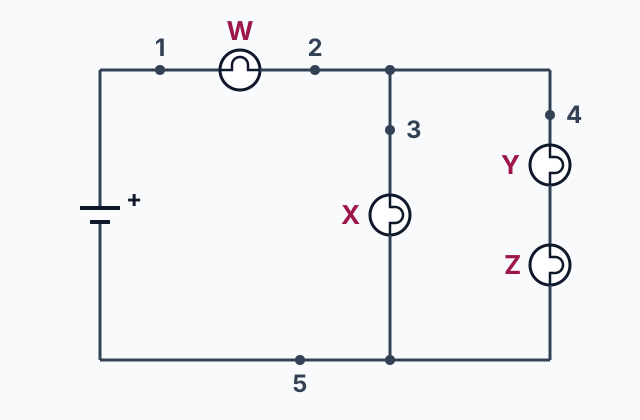
Four identical bulbs, each with a fixed resistance, are joined to an ideal battery by ideal wires. Bulb W is on the main wire, between point 1 near the battery and point 2. Past point 2 the circuit splits into two branches that meet again: one holds bulb X alone, with point 3 just above it, and the other holds bulbs Y and Z, one after the other, with point 4 just above Y. Point 5 is on the wire returning to the battery. Rank the current at the five points.
Greatest current first
Give each one a place, 1 for first. Give two the same place if they are equal.
Your ranking: none yet
Case question 2 · Calculate
In the circuit of four identical bulbs, an ideal ammeter placed at point 1 reads 0.90 A. What would an ideal ammeter placed at point 4, just above bulb Y, read? Give your answer to the nearest 0.01 A.
The rest stand on their own and do not use the case.
Check yourself · Fill the statement
Tap a blank, then an answer.
The junction rule follows from conservation of . In a steady current no charge at a junction, so the charge that enters it each second equals the charge that it each second.
Check yourself · Select all
The wire from a battery reaches junction J and splits into two branches that meet again at junction K. The first branch holds resistor . The second holds resistor and then resistor , one after the other. The resistances are not given. Which two ideal ammeter positions must read the same current, whatever the resistances? Pick two.
Select 2 answers, then check.
Part 7 Keep it Bring back earlier ideas
The junction rule works with the loop rule from the last lesson, and every current it finds carries energy at a rate set by power. Pulling them back up is what makes them last.
From 11.6 Kirchhoff’s Loop Rule · Spot the error
An ideal 12 V battery, a 2.0 resistor, an ideal 4.0 V battery and a second 2.0 resistor are joined in that order by ideal wires, on a single path with no branches. The 12 V battery's positive terminal faces the first resistor, and the 4.0 V battery's positive terminal also faces the first resistor. The current flows out of the 12 V battery's positive terminal, and a student goes around the loop in that direction. Tap the first line that goes wrong.
From 11.4 Electric Power · Calculate
A car's rear window defroster is a resistor that carries 12 A when the car's 12 V battery is across it. Treat the battery as ideal. How much energy does the defroster convert to thermal energy in 5.0 minutes? Give your answer in kilojoules, to the nearest 0.1 kJ.
In three lines
- At any junction , because charge is conserved and does not build up there.
- The junction rule fixes the total, not the split: parallel branches have the same potential difference, so the branch with less resistance carries more current.
- With both rules, guess each current's direction, write one junction equation and enough loop equations, and solve; a negative current flows the other way.
Exam strategy for this topic
- Section I, Multiple Choice: 42 questions in 85 minutes.
- Section II, Free Response: 4 questions in 95 minutes.
- This lesson's Explain it is shaped like free-response question 3, Experimental Design and Analysis.
- A four-function, scientific, or graphing calculator is allowed on both sections of the exam.
Draw an arrow for every unknown current before writing anything, write one junction equation and as many loop equations as you need for the rest, and keep each arrow through every equation. A negative answer means the current flows against its arrow.
Questions students ask
What is Kirchhoff's junction rule?
At any junction in a circuit, the total current flowing in equals the total current flowing out: .
Why does the junction rule follow from conservation of charge?
Charge is never created or destroyed, and in a steady current it does not build up at a junction. So the charge arriving each second equals the charge leaving each second, and current is charge per second.
Does the current split equally at a junction?
Only when the branches have equal resistance. Branches between the same two junctions have the same potential difference, so the one with less resistance carries more current. The junction rule fixes the total, not the current in each branch.
What does a negative current mean?
The direction you guessed for it was wrong. The size is right, and the current flows the other way.
How many junction equations do I need?
One fewer than the number of junctions. In a circuit with two junctions, the second junction's equation repeats the first, so the loop rule supplies the other equations.
Course alignment, for teachers
AP Physics 2: Algebra-Based topic 11.7, Unit 11: Electric Circuits.
- Skill 1.A: Create diagrams, tables, charts, or schematics to represent physical situations.
- Skill 2.B: Calculate or estimate an unknown quantity with units from known quantities, by selecting and following a logical computational pathway.
- Skill 2.C: Compare physical quantities between two or more scenarios or at different times and locations in a single scenario.
- Skill 3.C: Justify or support a claim using evidence from experimental data, physical representations, or physical principles or laws.
This lesson maps all 2 essential knowledge statements of the topic to the part that teaches each one: 2 are checked by a scored question. The map is in the lesson file.