Unit 12 · Topic 12.1 · about 30 minutes · 7 parts · 10 scored checks, 2 of them multiple choice, plus 2 from earlier lessons
AP Physics 2: Algebra-Based 12.1: Magnetic Fields
Unit 12: 12 to 15% of the multiple-choice section
What you'll be able to do
- Describe a magnetic field as a vector field whose lines leave a magnet's north pole, return to its south pole and close into loops.
- Explain a material's magnetic behavior from how the magnetic dipoles inside it are arranged and how they respond to an outside field.
- Describe magnetic permeability, the constant value for free space and the varying values for matter.
Key vocabulary
| Term | What it means | The exam trap |
|---|---|---|
| Magnetic dipole | An object with a north pole and a south pole, such as a bar magnet, a compass needle or a loop of wire carrying a current. | Poles are named by which way the outside field points, so read a field line diagram's arrows to tell north from south, not its colors. |
| Magnetic domain | A small region inside a ferromagnetic material in which the atomic dipoles all point the same way. | Domains exist in every piece of iron, magnetized or not, so having domains does not by itself tell you that a piece of iron is a magnet. |
| Magnetic permeability | A measure of how much a material magnetizes in response to an outside magnetic field, written . | The same Greek letter writes the prefix micro, as in T, so check whether a in a problem is a permeability or part of a unit. |
 Tap to open the picture full size
Part 1 Think first A compass walked around a magnet
Commit to a guess first. Being wrong now makes the right idea stick better.
Predict first
A bar magnet lies on a table, and you slide a small compass to several spots around it, near each end and along its sides. Does the compass needle point the same way at every spot?
In short. A magnetic field is a vector field made by magnets and moving charges; outside a magnet it points away from the north pole and back to the south pole, and its lines always close into loops.
- Magnets are always dipoles: like poles repel, opposite poles attract, and a broken magnet gives two smaller magnets, never a lone pole.
- A compass lines up with the field it sits in, so it can map a field, and a magnet's field weakens with distance.
- Magnetism comes from moving charge; how a material's atomic dipoles respond makes it ferromagnetic, paramagnetic or only diamagnetic, and permeability measures how much it magnetizes.
Part 2 Learn it Magnetic fields and magnetic materials
2a. Fields, field lines and compasses
A magnet changes the space around it. That change is a magnetic field, , a vector with a size and a direction at every point, measured in tesla (T). The field at a point sets the magnetic force that a moving charge, a current or a piece of magnetic material feels there.
A compass needle is a small magnet that can turn freely. In a field it turns until it lines up with the field, its north end pointing along . Moving a compass around a magnet maps the field.
There are two ways to draw the map. A vector field map puts an arrow at each point, longer where the field is stronger. A field line diagram draws lines that run along the field, with arrows, and the lines crowd together where the field is strong.
Outside a bar magnet the field points away from one end, the north pole, and curves around to return to the other end, the south pole. Inside the magnet the lines keep going, from the south end back to the north end, so every line is a closed loop. The farther you go from the magnet, the weaker its field.
Quick check · Multiple choice
A small compass is placed on the axis of a bar magnet, a short distance beyond the magnet's north end. Which way does the north end of the compass needle point?
2b. Poles come in pairs
Every magnet has a north pole and a south pole, so a magnet is a magnetic dipole. Two north poles push each other apart, and so do two south poles. A north pole and a south pole pull together.
Poles never come alone. Snap a bar magnet in half and you do not get a north piece and a south piece. Each half is a complete magnet with its own north and south ends, and the new ends appear at the break. Cut it again and again, down to single atoms, and every piece is still a dipole. Nobody has ever found a magnetic monopole, a north pole on its own; magnetic fields come only from dipoles or combinations of them.
Earth itself behaves like a giant dipole, as if a bar magnet sat inside it. A compass's north end points roughly toward the Arctic, so the field near the surface points toward the Arctic. Outside a magnet the field points toward its south pole, so the magnetic pole near Earth's geographic North Pole is a magnetic south pole.
Quick check · Fill the statement
A bar magnet is snapped in two at its middle. Tap a blank, then an answer.
Each of the two pieces now has . If the broken ends are brought back together, as they were before the break, they , because they are .
2c. Where magnetism comes from
A magnetic field comes from moving charge. A charge going around in a circle, or spinning, makes a magnetic dipole, and in a material the motion of the electrons makes each atom a tiny dipole. What a material does in a magnet's field depends on what it is made of.
- Ferromagnetic materials, such as iron, nickel and cobalt, contain regions called domains in which the atomic dipoles all point the same way. An outside field lines the domains up, so the material becomes a magnet itself and is pulled strongly toward the magnet. The alignment can stay after the field is gone, which is how a permanent magnet is made.
- Paramagnetic materials, such as aluminum, titanium and magnesium, line up weakly with an outside field, so a strong magnet pulls them weakly. The alignment does not stay once the field is removed.
- Diamagnetism is in every material: its electrons respond with a weak alignment opposite the outside field, so it is pushed weakly away. In copper, water and wood it is the only effect.
A permanent magnet and a nail magnetized by a nearby magnet are the same thing at heart: dipoles lined up.
Quick check · Sort it
Each card describes a material near a strong magnet. Tap a card, then the kind of material it is.
Ferromagnetic
Paramagnetic
Only diamagnetic
2d. Permeability
How much a material magnetizes in response to an outside field is measured by its magnetic permeability, written . A material with a large permeability magnetizes a lot, adding a field of its own to the outside one.
Empty space has a fixed value, the vacuum permeability:
It is a constant of nature, and it appears in the equations for the fields of moving charges and currents later in this unit.
The permeability of matter has values different from , set by what the material is made of and how its atoms are arranged. For a ferromagnet such as iron it can be thousands of times larger. It is not a fixed constant of the material, though: it changes with the temperature, with the orientation of the sample, and with how strong the outside field is. Heat iron past about 770 °C and its ferromagnetism disappears altogether.
Quick check · Decide and justify
A student is building an electromagnet with an iron core. She says she can look up iron's magnetic permeability once, like its melting point, and use that one value whatever the iron's temperature and however strong the field from the coil. Is she right?
Which reason supports your answer?
Part 3 Watch it done Which way does the compass point?
Predict first, then watch each step, then finish the problem yourself.
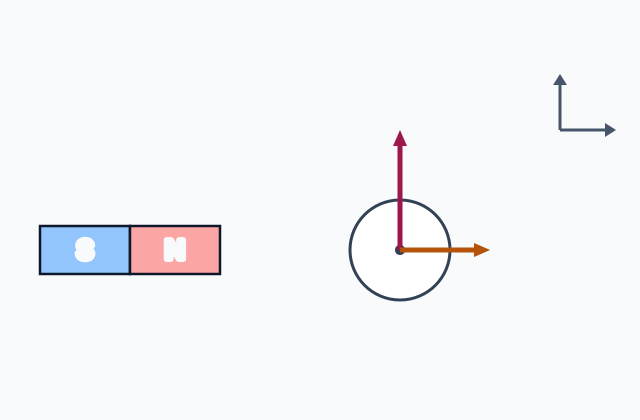
In the picture at the top of this lesson, seen from above, Earth's magnetic field at a compass has a horizontal part of 20 T pointing north. A bar magnet lies on the east-west line through the compass, to the west of it, with its north end facing the compass, and adds a field of 15 T at the compass. Ignore any vertical part of Earth's field. Which way does the north end of the compass needle point?
Predict first
Before you open the first step, predict: where does the needle's north end point?
Step 1 · Give each field its direction
Earth's field points north. Outside a magnet the field points away from its north pole, and this magnet's north end faces the compass from the west, so its field at the compass points east.
Step 2 · Add the fields as vectors
The two fields are at right angles, so the net field is the hypotenuse of a right triangle with sides 20 T and 15 T:
It points between north and east.
Why this step?
Why does the needle follow the net field rather than the stronger of the two fields?
At the compass there is only one magnetic field, the vector sum of everything nearby. A compass needle is a dipole, and a dipole turns to line up with the field it is in, so it lines up with that sum.
Your step · Calculate
Finish it. At a compass, Earth's field has a horizontal part of 20 T pointing north, and a bar magnet to the west, its north end facing the compass, adds a field of 15 T pointing east. Ignore any vertical part of Earth's field. How many degrees east of north does the north end of the compass needle point? Give your answer to the nearest degree.
°
Part 4 Try it Inside and outside a magnet
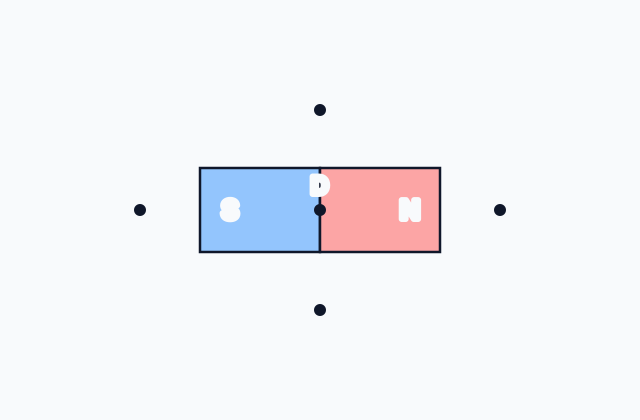
Predict first: at the middle of a bar magnet, inside it, does the field point the same way as the field just outside its middle, or the opposite way? Then sort the cards.
Try it · Sort it
The picture shows a bar magnet with its north end on the right, and five points A to E; D is inside the magnet. Tap a card, then the direction of the magnet's field at that point.
Toward the right
Toward the left
Part 5 Explain it A magnet on the north side
On the exam this is handwritten, so answer on paper first. Nothing you type here leaves this page. Then check your answer against the model and each scoring point.
Free response is 50% of the exam score. This one is shaped like Question 4, Qualitative/Quantitative Translation.
Free-response practice · Question 4 style
A compass sits on a table where the horizontal part of Earth's magnetic field is 20 T, pointing north. A bar magnet is placed on the north-south line through the compass, north of it, with the magnet's north end facing the compass. The magnet is then slid slowly toward the compass. Ignore any vertical part of Earth's field.
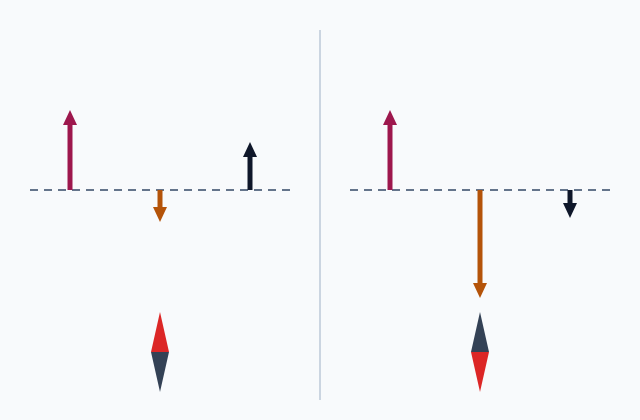
(a) On paper, draw an arrow for Earth's field, an arrow for the magnet's field and an arrow for the net field at the compass, once while the magnet is still far away and once when it is close. Then, without using equations, explain what the compass needle does as the magnet approaches.
(b) Taking north as positive, derive an expression for the net field at the compass in terms of the size of Earth's field, , and the size of the magnet's field there, . Use it to find the net field when is 8.0 T and when it is 27 T.
(c) Explain how your expression in (b) supports your reasoning in (a).
Model answer
(a) Compare your drawing with the model below. Outside a magnet the field points away from its north end, so at the compass the magnet's field points south, against Earth's. While the magnet is far away its field there is weak, the net field still points north, and the needle points north. The magnet's field gets stronger as it comes closer. Once it is stronger than Earth's field, the net field points south, and the needle swings round to point south.
(b) The two fields lie along one line, so they add as signed numbers: . With T, T, north. With T, T, south.
(c) The sign of gives the direction of the net field, and the needle lines up with the net field. While is less than the expression is positive and the needle points north. Once is greater than it is negative and the needle points south, as argued in (a). The swing happens where T.
 Tap to open the picture full size
Score your own answer. This is a self-check, not a grade. Tick each point your answer makes.
Part 6 Check yourself Two magnets end to end
Both case questions use the field line diagram.
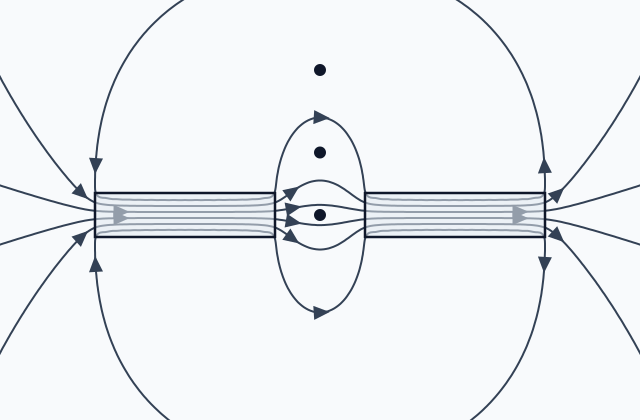
Two identical bar magnets lie end to end on a table, with a gap between them. The field lines drawn are those of the two magnets together, with arrows showing the direction of the field.
 Tap to open the picture full size
Case question 1 · Multiple choice
Using the field line diagram of the two magnets: what can you conclude about the two ends that face each other across the gap?
Case question 2 · Rank it
Using the field line diagram of the two magnets: rank the strength of the magnetic field at points P, Q and R.
Strongest field first
Give each one a place, 1 for first. Give two the same place if they are equal.
Your ranking: none yet
The rest stand on their own and do not use the case.
Check yourself · Spot the error
A student works out which kind of magnetic pole lies near Earth's geographic North Pole. Tap the first line that goes wrong.
Check yourself · Select all
Which two statements about where a magnet's field comes from are true? Pick two.
Select 2 answers, then check.
Part 7 Keep it Bring back earlier ideas
Unit 11's circuits come back here: a current is moving charge, and moving charge is what makes every magnetic field. Answering them again now, a few lessons on, is what keeps them from fading.
From 11.8 Resistor-Capacitor (RC) Circuits · Calculate
A 100 F capacitor charged to 9.0 V is disconnected from its battery and then joined across a 30 resistor by ideal wires. What is the current in the resistor just after it is joined? Give your answer to the nearest 0.01 A.
From 11.6 Kirchhoff’s Loop Rule · Decide and justify
A flashlight holds two identical 1.5 V cells and a bulb on a single path with no branches, joined by ideal wires. One cell has been put in backward, so the two positive terminals face each other. Treat the cells as ideal and the bulb's resistance as fixed. Does the bulb light?
Which reason supports your answer?
In three lines
- A magnetic field is a vector field; outside a magnet it points from the north pole around to the south pole, and inside from south to north, so its lines close.
- Magnets are dipoles: like poles repel, opposite poles attract, a broken magnet gives two magnets, and Earth acts as a dipole with a magnetic south pole near the Arctic.
- Moving electrons make atoms tiny dipoles; how they align makes a material ferromagnetic, paramagnetic or only diamagnetic, and permeability measures how much it magnetizes.
Exam strategy for this topic
- Section I, Multiple Choice: 42 questions in 85 minutes.
- Section II, Free Response: 4 questions in 95 minutes.
- This lesson's Explain it is shaped like free-response question 4, Qualitative/Quantitative Translation.
- A four-function, scientific, or graphing calculator is allowed on both sections of the exam.
Before you add magnetic fields, give each one a direction from the picture: away from a north pole and toward a south pole outside a magnet. Fields along one line add as signed numbers; fields at right angles add like the sides of a right triangle.
Questions students ask
What is a magnetic field?
A vector field around magnets and moving charges. At each point it has a size, in tesla, and a direction, and it sets the magnetic force on moving charges, currents and magnetic materials there.
Which way do magnetic field lines point?
Outside a magnet they point away from the north pole and toward the south pole. Inside they run from south to north, so every line is a closed loop.
Can a magnet have a north pole without a south pole?
No. Breaking a magnet gives two complete magnets, and no isolated magnetic pole, or monopole, has ever been found.
Why are some metals attracted to magnets and others not?
In ferromagnetic metals such as iron, nickel and cobalt, the atoms' magnetic dipoles line up in domains, so the metal becomes a magnet and is pulled strongly. Aluminum is pulled only weakly, and copper is pushed weakly away.
What is magnetic permeability?
A measure of how much a material magnetizes in an outside field. Free space has the constant value T·m/A; a material's permeability is different and changes with temperature and field strength.
Course alignment, for teachers
AP Physics 2: Algebra-Based topic 12.1, Unit 12: Magnetism and Electromagnetism.
- Skill 1.A: Create diagrams, tables, charts, or schematics to represent physical situations.
- Skill 2.C: Compare physical quantities between two or more scenarios or at different times and locations in a single scenario.
- Skill 3.B: Apply an appropriate law, definition, theoretical relationship, or model to make a claim.
- Skill 3.C: Justify or support a claim using evidence from experimental data, physical representations, or physical principles or laws.
This lesson maps all 20 essential knowledge statements of the topic to the part that teaches each one: 20 are checked by a scored question. The map is in the lesson file.