Unit 12 · Topic 12.2 · about 30 minutes · 7 parts · 11 scored checks, 2 of them multiple choice, plus 2 from earlier lessons
AP Physics 2: Algebra-Based 12.2: Magnetism and Moving Charges
Unit 12: 12 to 15% of the multiple-choice section
What you'll be able to do
- Describe the magnetic field a moving charged object produces: what its size depends on and which way it points.
- Describe the magnetic force a magnetic field exerts on a moving charged object, on its own and alongside an electric field.
Key vocabulary
| Term | What it means | The exam trap |
|---|---|---|
| Uniform field | A field with the same size and the same direction at every point in a region. | A uniform field drawn as rows of dots or crosses shows its direction only; the spacing of the symbols says nothing about how strong it is. |
| Position vector | The arrow from a moving charge to the point where you want to know its magnetic field. | It runs from the charge to the point, not from the point to the charge; drawn backward, it makes the right-hand rule give the field reversed. |
| Hall effect | The potential difference that builds up across a conductor carrying a current through a magnetic field with a part at right angles to the moving charges. | In a metal strip the Hall potential difference is tiny, often microvolts, so sensors use semiconductor strips, in which the moving charges drift much faster. |
 Tap to open the picture full size
Part 1 Think first Two protons side by side
Commit to a guess first. Being wrong now makes the right idea stick better.
Predict first
Two protons in a particle accelerator's beam fly side by side in the same direction at the same speed. Their electric forces push them apart. Is there also a magnetic force between them?
In short. A moving charged object makes a magnetic field, and a magnetic field exerts a force on a charged object moving through it, at right angles to both its velocity and the field.
- Find directions with the right-hand rule: index finger along the velocity, middle finger along the field, thumb along the force on a positive charge; for a negative charge the force reverses.
- A charge at rest, or one moving along the field, feels no magnetic force; the force is largest when the velocity is at right angles to the field.
- Electric and magnetic forces act independently and add as vectors; in a conductor the magnetic force separates charge and makes the Hall potential difference.
Part 2 Learn it Moving charges and magnetic fields
2a. A moving charge makes a magnetic field
A charge at rest makes no magnetic field, but a moving one does. At a point near it, the field's size depends on the charge's velocity and on the distance from the charge to the point: a faster charge makes a stronger field, and the field weakens with distance. At a given distance, the field is strongest where the line from the charge to the point is at right angles to the velocity.
The field points at right angles to both the velocity and that line. Find it with the right-hand rule, used all through this unit. Point your right index finger along the first quantity, bend your middle finger at a right angle along the second, and hold your thumb at right angles to both. Your thumb points along the result.
For the field of a moving positive charge: index finger along the velocity, middle finger from the charge to the point, and your thumb gives the field there. For a negative charge the field points the other way. If the line to the point is at an angle to the velocity, use only the part of the velocity at right angles to that line; the part along it adds no field.
A circle with a dot, , means out of the page, toward you; a circle with a cross, , means into the page. A proton moving up the page makes a field into the page at points to its right.
Quick check · Sort it
Each card names a point near a charged particle moving in the plane of the page. Tap a card, then the direction of the magnetic field the particle makes at that point.
Out of the page
Into the page
2b. The size of the force on a moving charge
A magnetic field exerts a force on a charged object only while it moves, and only on the part of its motion across the field. The size of the force is
where is the size of the charge, its speed, the size of the field and the angle between the velocity and the field.
- Moving at right angles to the field, , the force is greatest: .
- Moving along the field or straight against it, or , the force is zero.
- At rest, , there is no magnetic force, however strong the field.
At other angles the force is in between, larger the closer the angle is to 90°.
A proton, C, moving at m/s at right angles to a 0.50 T field feels N. The force is always at right angles to the velocity, so it turns the proton without speeding it up or slowing it down.
Quick check · Calculate
A small sphere with a charge of C moves at 50 m/s through a uniform 0.30 T magnetic field, at right angles to the field. What is the size of the magnetic force on it? Give your answer in micronewtons, to the nearest 1 N.
2c. Which way the force points
The magnetic force is at right angles to both the velocity and the field. Use the same right-hand rule:
- Index finger along the velocity of the charge.
- Middle finger along the magnetic field.
- Thumb along the force on a positive charge.
For a negative charge, such as an electron, the force reverses: it points opposite your thumb. Do the rule as if the charge were positive, then flip the answer.
A proton moving up the page through a field into the page: index finger up, middle finger into the page, and your thumb points to the left. An electron moving the same way is pushed to the right.
If the field is not at right angles to the velocity, point your middle finger along the part of the field that is. The part along the velocity adds no force.
This is also how two moving charges interact magnetically. Each one makes a magnetic field where the other is, and each moves through the other's field, so each feels a force from the other.
Quick check · Match
Each case is a particle moving in the plane of the page through a uniform magnetic field. Tap a case, then the direction of the magnetic force on the particle.
2d. Two fields at once, and the Hall effect
In a region with both an electric field and a magnetic field, a moving charge feels two forces, one from each field, and each acts independently of the other: the electric force , whether or not the charge moves, and the magnetic force from its motion. The net force is their vector sum. If they point opposite ways with equal sizes, the charge goes straight through.
The Hall effect is that idea inside a conductor. Charges moving along a strip, in a magnetic field across it, are pushed toward one edge. They pile up there, leaving the opposite edge with the opposite charge, and the separated charge makes a potential difference across the strip, the Hall potential difference. The pile-up stops growing when the electric force from it balances the magnetic force on the moving charges. Hall sensors measure magnetic fields this way, including many phone compass chips.
Which edge becomes negative depends on the sign of the moving charges. In a metal they are electrons, drifting opposite the current, so find the force on them with the rule and reverse it.
Quick check · Multiple choice
A flat metal strip lies in the page and carries a current up the page, through a uniform magnetic field that points out of the page. The moving charges in the strip are electrons, drifting down the page. Once the Hall potential difference has built up, which edge of the strip is at the higher potential?
Part 3 Watch it done Reading a Hall sensor
Predict first, then watch each step, then finish the problem yourself.
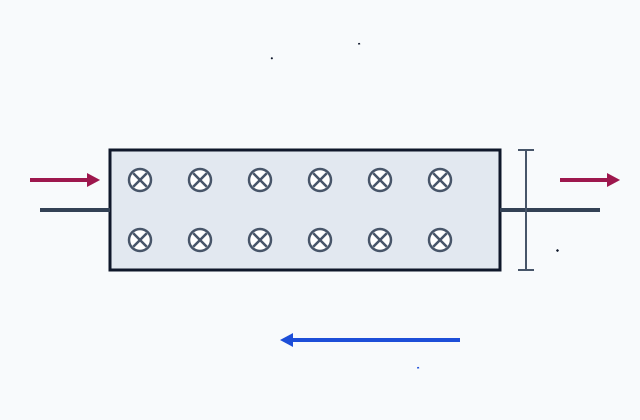
In the picture at the top of this lesson, a Hall sensor is a thin semiconductor strip, 2.0 mm wide, carrying a current to the right through a uniform 0.050 T magnetic field that points into the page. The moving charges in the strip are electrons, drifting to the left at 40 m/s. Which edge of the strip becomes negative, and what is the Hall potential difference between the edges once it has built up?
Predict first
Before you open the first step, predict: on which edge do the electrons pile up?
Step 1 · Find the force on the electrons
Do the rule as if the charge were positive: index finger along the velocity, to the left, and middle finger into the page. Your thumb points down the page. An electron is negative, so the force on it is reversed: up the page. Electrons pile up on the top edge, which becomes negative, and the bottom edge is left positive.
Step 2 · Balance the two forces
The separated charge makes an electric field across the strip, from the positive bottom edge toward the negative top edge, and it pushes the electrons back down. The pile-up stops growing when the electric force balances the magnetic force on a drifting electron: , so .
Step 3 · Turn the field into a potential difference
The field across the strip is uniform, so across its width the potential difference is . That result is not one of the course's given equations; it is built from and , so derive it each time you need it.
Why this step?
Why does the pile-up of charge stop growing instead of going on forever?
Every electron that reaches the top edge strengthens the electric field across the strip, and that field pushes the next electrons back. Once the electric force on a drifting electron is as large as the magnetic force, it feels no net sideways force, so no more electrons are added to the pile.
Your step · Calculate
Finish it. A Hall sensor is a thin semiconductor strip, 2.0 mm wide, carrying a current through a uniform 0.050 T magnetic field at right angles to the strip. The moving charges are electrons drifting along the strip at 40 m/s. What is the Hall potential difference between the strip's edges once it has built up? Give your answer in millivolts, to the nearest 0.1 mV.
mV
Part 4 Try it Angles and distances
The force formula is used with numbers at 0°, 90° and 180°. Between those, reason from the pattern: the force grows as the angle between the velocity and the field gets closer to 90°. Predict first: is the force on a proton moving at 30° to a field larger than, smaller than, or the same as the force at 150°?
Try it · Rank it
Four identical protons move at the same speed through the same uniform magnetic field. The angle between each proton's velocity and the field is 30° for proton W, 90° for proton X, 150° for proton Y and 180° for proton Z. Rank the protons by the size of the magnetic force on them.
Largest force first
Give each one a place, 1 for first. Give two the same place if they are equal.
Your ranking: none yet
Try it · Decide and justify
A proton moves to the right at a steady speed. At one instant, point P is 2.0 cm from it, straight above it, so the line from the proton to P is at right angles to its velocity. Point Q is also 2.0 cm from it, above and ahead of it, on a line at 45° to its velocity. A student says the magnetic field the proton makes is stronger at P than at Q. Is the student right?
Which reason supports your answer?
Part 5 Explain it Two fields, one path
On the exam this is handwritten, so answer on paper first. Nothing you type here leaves this page. Then check your answer against the model and each scoring point.
Free response is 50% of the exam score. This one is shaped like Question 1, Mathematical Routines.
Free-response practice · Question 1 style
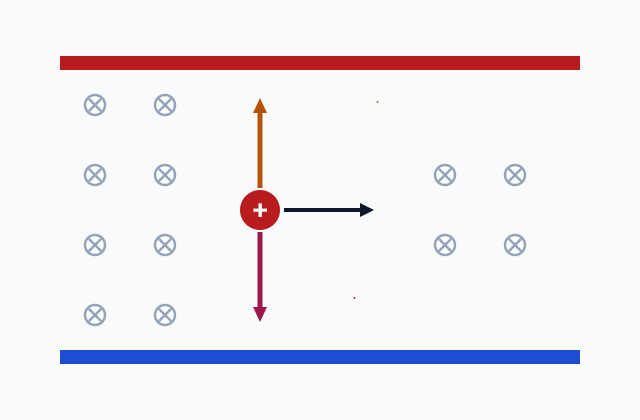
A beam of positive ions, each with charge , enters the region between two parallel plates. The top plate is positive and the bottom plate negative, so the electric field between them, of size , points down the page. A uniform magnetic field of size points into the page throughout the region. Some of the ions, moving to the right, pass straight through without being deflected. Ignore gravity.
(a) On paper, draw an ion moving to the right between the plates, with an arrow for the electric force and an arrow for the magnetic force on it. Do this by hand before you open the model.
(b) Derive an expression for the speed of the ions that pass straight through, in terms of and .
(c) The potential difference between the plates is 400 V, the plates are 2.0 cm apart, and T. Calculate the speed of the ions that pass straight through.
(d) A student claims that a negative ion moving at the same speed would be deflected, because the magnetic force on a negative charge points the other way. Justify whether the claim is correct.
Model answer
(a) Compare your drawing with the model below. The electric force on a positive ion points along the electric field, down the page. For the magnetic force, index finger along the velocity, to the right, middle finger into the page: the thumb points up the page. The two arrows are the same length, because the ion is not deflected.
(b) The ion moves in a straight line at a steady speed, so the net force on it is zero and the two forces are equal in size: , so . The charge cancels.
(c) V/m, so m/s.
(d) Incorrect. For a negative ion both forces reverse: the electric force points up the page, against the field, and the magnetic force points down. Their sizes are still and , which are equal at whatever the charge, so a negative ion at this speed also passes straight through.
 Tap to open the picture full size
Score your own answer. This is a self-check, not a grade. Tick each point your answer makes.
Part 6 Check yourself Five particles in one field
Both case questions use the picture.
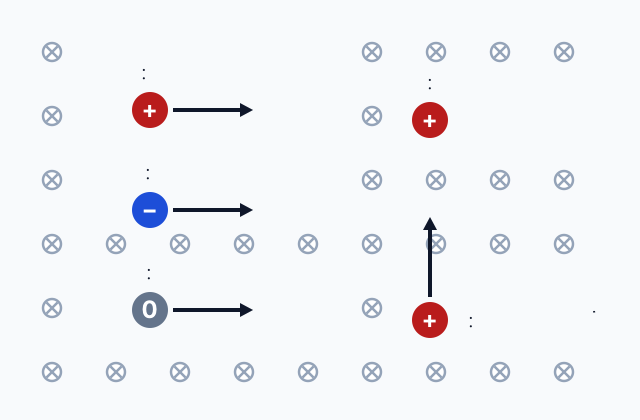
A uniform magnetic field points into the page. The picture shows five particles at one instant, with arrows for the velocities of those that are moving. Particles 1, 2 and 3 move at the same speed. Particle 5 is an alpha particle, a helium nucleus with a charge of .
Case question 1 · Multiple choice
Using the picture of the five particles: which way is the magnetic force on particle 2, the electron, at the instant shown?
Case question 2 · Select all
Using the picture of the five particles: which two particles feel no magnetic force at the instant shown? Pick two.
Select 2 answers, then check.
The rest stand on their own and do not use the case.
Check yourself · Decide and justify
Two protons move at the same speed along parallel paths in the plane of the page, a short distance apart: the upper one moves to the right and the lower one moves to the left. Consider only the magnetic forces between them. A student says they attract each other magnetically, just as two protons moving side by side in the same direction do. Is the student right?
Which reason supports your answer?
Check yourself · Spot the error
A student finds the direction of the magnetic force on an electron. Tap the first line that goes wrong.
Part 7 Keep it Bring back earlier ideas
Poles and dipoles from the last lesson, and junctions from Unit 11, both lead here: the field of a magnet and the current in a wire are both made of moving charge. Recalling them before going on is what keeps them from slipping.
From 12.1 Magnetic Fields · Fill the statement
A bar magnet is snapped in two at its middle. Tap a blank, then an answer.
Each of the two pieces now has . If the broken ends are brought back together, as they were before the break, they , because they are .
From 11.7 Kirchhoff’s Junction Rule · Select all
The wire from a battery reaches junction J and splits into two branches that meet again at junction K. The first branch holds resistor . The second holds resistor and then resistor , one after the other. The resistances are not given. Which two ideal ammeter positions must read the same current, whatever the resistances? Pick two.
Select 2 answers, then check.
In three lines
- A moving charge makes a magnetic field that depends on its velocity and the distance to the point, at right angles to both the velocity and the line to the point.
- A field exerts on a moving charge: index finger along the velocity, middle finger along the field, thumb along the force on a positive charge, reversed for a negative one.
- Electric and magnetic forces act independently and add; balanced, they let a charge pass straight through, and in a conductor they set the Hall potential difference.
Exam strategy for this topic
- Section I, Multiple Choice: 42 questions in 85 minutes.
- Section II, Free Response: 4 questions in 95 minutes.
- This lesson's Explain it is shaped like free-response question 1, Mathematical Routines.
- A four-function, scientific, or graphing calculator is allowed on both sections of the exam.
Do the right-hand rule as if the charge were positive, then reverse the result for a negative charge. Write that reversal as a separate line of your answer, since it is the step students most often skip.
Questions students ask
Does a magnetic field exert a force on a charge at rest?
No. A magnetic field exerts a force only on a charge that is moving, and only on the part of its motion across the field.
How do you find the direction of the magnetic force on a moving charge?
Use your right hand: index finger along the velocity, middle finger along the field, and your thumb points along the force on a positive charge. For a negative charge, the force points the opposite way.
Why is the magnetic force zero when a charge moves along the field?
The force is , and is zero when the velocity is parallel or antiparallel to the field.
What is the Hall effect?
When charges move along a conductor in a magnetic field across it, the magnetic force pushes them toward one edge, building a potential difference across the conductor. Sensors use it to measure magnetic fields.
Does a moving charge make a magnetic field?
Yes. Its field at a point depends on its velocity and on the distance to the point, and it points at right angles to both the velocity and the line from the charge to the point.
Beyond the AP Exam
College Board sets this limit on what the AP Exam asks about this topic. Anything past it is not on the exam.
Quantitative treatment of the magnitude of the magnetic force exerted by a magnetic field on a moving charge is limited to angles of 0, 90, and 180 degrees between the velocity and the magnetic field. Qualitative analysis of other angles is permitted.
Course alignment, for teachers
AP Physics 2: Algebra-Based topic 12.2, Unit 12: Magnetism and Electromagnetism.
- Skill 1.A: Create diagrams, tables, charts, or schematics to represent physical situations.
- Skill 2.A: Derive a symbolic expression from known quantities by selecting and following a logical mathematical pathway.
- Skill 2.C: Compare physical quantities between two or more scenarios or at different times and locations in a single scenario.
- Skill 3.B: Apply an appropriate law, definition, theoretical relationship, or model to make a claim.
This lesson maps all 10 essential knowledge statements of the topic to the part that teaches each one: 10 are checked by a scored question. The map is in the lesson file.