Unit 12 · Topic 12.3 · about 30 minutes · 7 parts · 11 scored checks, 2 of them multiple choice, plus 2 from earlier lessons
AP Physics 2: Algebra-Based 12.3: Magnetism and Current-Carrying Wires
Unit 12: 12 to 15% of the multiple-choice section
What you'll be able to do
- Describe the magnetic field a current-carrying wire produces: around a long straight wire, at the center of a loop, and near two or more wires.
- Describe the force a magnetic field exerts on a current-carrying wire, its size and its direction.
Key vocabulary
| Term | What it means | The exam trap |
|---|---|---|
| Long, straight wire | A wire much longer than its distance from the point being considered, so that its ends are too far away to affect the field there. | Near the end of a real wire, or near a bend, the field no longer follows the long-wire equation, so check that the wire is long before using it. |
| Current loop | A wire bent into a circle, carrying a current all the way around it. | The long-wire equation does not give the field at a loop's center, since it needs a straight wire much longer than the distance to the point. |
| Right-hand rule | A way to find a direction at right angles to two others with the index finger, middle finger and thumb of the right hand; for the field of a current, a curl grip of the right hand gives the same answer. | Use your right hand every time, whichever version of the rule you use: the left hand gives every direction reversed. |
 Tap to open the picture full size
Part 1 Think first A compass under a wire
Commit to a guess first. Being wrong now makes the right idea stick better.
Predict first
A compass sits on a table, its needle pointing north. A long, straight wire is stretched just above it, also running north and south. A large, steady current is switched on in the wire. What does the compass needle do?
In short. A current-carrying wire makes a magnetic field that circles it, of size for a long, straight wire, and a magnetic field exerts a force on a wire carrying a current.
- For the field: index finger along the current, middle finger from the wire to the point, thumb along the field. For the force: index finger along the current, middle finger along the field, thumb along the force.
- The field at the center of a current loop points along the loop's axis, and the fields of several wires add as vectors.
- The force on a wire is largest when it runs at right angles to the field and zero when it runs along the field.
Part 2 Learn it Fields of currents and forces on currents
2a. The field around a long, straight wire
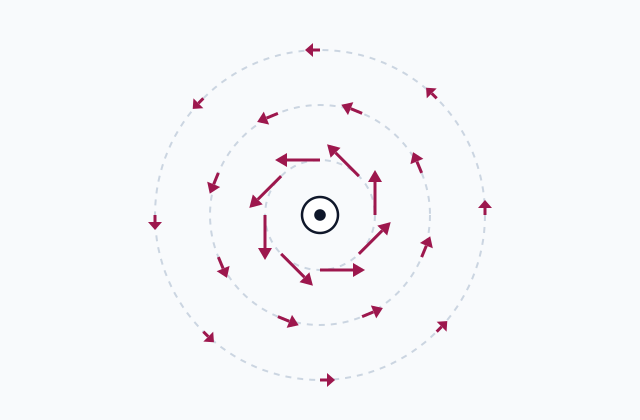
A current is a stream of moving charges, and together their fields make a magnetic field around the wire. Around a long, straight wire the field forms circles centered on the wire. At each point the field is tangent to the circle through that point: it has no part pointing toward the wire, away from it, or along it.
Which way the field circles comes from the right-hand rule: index finger along the current, middle finger from the wire to the point, and your thumb points along the field there. Do it at a few points around the wire and you find the field runs round in one direction. The picture shows a current out of the page, : there the field circles counterclockwise. Reverse the current and it circles the other way.
A curl grip is a quicker way to the same answer: wrap your right hand around the wire with your thumb along the current, and your fingers curl the way the field runs. The two versions always agree, so use whichever you trust; what you write down is the direction, not the hand shape.
The arrows also shrink with distance, because the field weakens the farther you are from the wire.
 Tap to open the picture full size
Quick check · Multiple choice
A long, straight wire runs at right angles to the page and carries a current into the page. Point P is in the page, a short distance to the right of the wire. Which way does the wire's magnetic field point at P?
2b. How strong the field is
For a long, straight wire, the size of the field at a perpendicular distance from the wire's central axis is
It is proportional to the current and inversely proportional to the distance: twice the current gives twice the field, and twice as far away gives half the field, not a quarter. "Long" means the wire is much longer than , so its ends are too far away to matter.
With T·m/A, the constant is T·m/A. A wire carrying 10 A makes a field of T, or 40 T, at 5.0 cm, about as strong as Earth's field. That is why the compass in Think first moved.
Fields from more than one wire add as vectors. Find each wire's field at the point, its size and its direction, and then add them. Where two fields point opposite ways, they partly cancel.
Quick check · Calculate
A long, straight wire carries a steady current of 15 A. What is the size of its magnetic field at a point 3.0 cm from the wire? Give your answer in microtesla, to the nearest 1 T.
2c. The field at the center of a loop
Bend the wire into a circle and every part of it makes a field at the center pointing the same way, so the fields add. At the center of a current-carrying loop the field points along the loop's axis, at right angles to the plane of the loop.
Find which way with the same rule. Pick any part of the loop: index finger along the current there, middle finger from that part toward the center, and your thumb gives the field at the center. Every part of the loop gives the same answer, which is a good check. The curl grip works here the other way round: curl your right fingers along the current around the loop, and your thumb points along the field at the center.
For a loop lying flat in the page with its current running counterclockwise, take the bottom of the loop: the current there runs to the right and the center is above it, so your thumb points out of the page.
A current loop is a magnetic dipole, and the face its field comes out of acts as a north pole. That ties this unit together: charge moving around a circle is what makes a magnet, as the first lesson said.
Quick check · Fill the statement
A circular loop of wire lies flat on a table and carries a current that runs clockwise as seen from above. Tap a blank, then an answer.
At the center of the loop, its magnetic field points . So the loop's upper face, the one seen from above, acts as a pole.
2d. The force on a current-carrying wire
A wire carrying a current through a magnetic field feels a force, the total of the forces on its moving charges. Its size is
where is the current, the length of wire inside the field, the field and the angle between the current and the field. The force is largest when the wire runs at right angles to the field and zero when it runs along the field.
Its direction comes from the same right-hand rule: index finger along the current, middle finger along the field, thumb along the force. A current's direction is already the way positive charge would move, so nothing needs reversing here, even though the charges moving in a metal wire are electrons.
A wire carrying current up the page through a field into the page is pushed to the left. With 2.0 A, and 0.10 m of the wire at right angles to a 0.50 T field, N.
Quick check · Match
Each case is a straight wire lying in the plane of the page, in a uniform magnetic field. Tap a case, then the direction of the magnetic force on the wire.
Part 3 Watch it done Two wires, one point
Predict first, then watch each step, then finish the problem yourself.
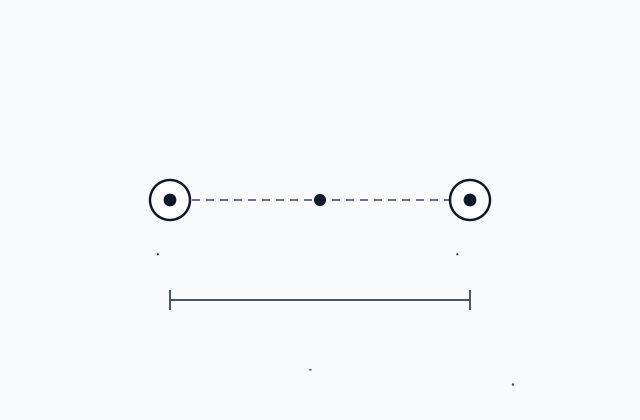
In the picture at the top of this lesson, two long, straight, parallel wires, seen end on, are 10 cm apart in air. Wire X carries 6.0 A and wire Y carries 2.0 A, both out of the page. Point P is midway between them. What is the net magnetic field at P?
Predict first
Before you open the first step, predict: if wire Y's current were reversed, so that it ran into the page, would the net field at P be larger than, smaller than, or the same as it is with both currents out of the page?
Step 1 · Find the size of each wire's field
Each wire is 5.0 cm, or 0.050 m, from P. T, and T.
Step 2 · Find the direction of each wire's field
For X: index finger out of the page, along its current, and middle finger to the right, from X to P. Your thumb points up the page. For Y: index finger out of the page, and middle finger to the left, from Y to P. Your thumb points down the page. The two fields at P point opposite ways.
Why this step?
Why find the directions before combining the sizes?
Magnetic fields are vectors, so two fields add to the full sum of their sizes only when they point the same way. Fields pointing opposite ways partly cancel, and fields at an angle combine by components. The directions decide which arithmetic to do.
Your step · Calculate
Finish it. Two long, straight, parallel wires are 10 cm apart in air. Wire X carries 6.0 A and wire Y carries 2.0 A, both out of the page. Point P is midway between them. What is the size of the net magnetic field at P? Give your answer in microtesla, to the nearest 1 T.
µT
Part 4 Try it Change one thing at a time
Predict first: if you move twice as far from a long, straight wire, does its field become half as strong, a quarter as strong, or stay the same? Then sort the cards, each of which changes one thing about a wire or the point beside it.
Try it · Sort it
Each card changes one thing and keeps everything else the same. Tap a card, then what happens to the size of the quantity it names.
It doubles
It halves
It stays the same
Try it · Decide and justify
A straight wire carrying a large current lies along the field lines of a strong, uniform magnetic field, parallel to them. A student says the field exerts no force on the wire, however large the current. Is the student right?
Which reason supports your answer?
Part 5 Explain it Measuring a field with a force
On the exam this is handwritten, so answer on paper first. Nothing you type here leaves this page. Then check your answer against the model and each scoring point.
Free response is 50% of the exam score. This one is shaped like Question 3, Experimental Design and Analysis.
Free-response practice · Question 3 style
A student wants to find the strength of the uniform magnetic field between the poles of a large magnet. She has a straight wire that can be clamped at right angles to the field with 5.0 cm of its length between the poles, a force sensor that measures the magnetic force on the wire, a variable power supply, an ammeter and connecting leads.
(a) Describe a procedure she could use to collect data for a graph that gives the field. Say what she changes, what she measures, and one step that reduces experimental uncertainty.
(b) Her results are below. On paper, plot the force against the current, with a scale and units on each axis, and draw a best-fit line. Do this by hand before you open the model.
- Current 0.50 A: force 2.1 mN
- Current 1.00 A: force 3.9 mN
- Current 1.50 A: force 6.2 mN
- Current 2.00 A: force 7.9 mN
- Current 2.50 A: force 10.1 mN
(c) Use your best-fit line to calculate the strength of the magnetic field.
Model answer
(a) Clamp the wire at right angles to the field with 5.0 cm between the poles, attach it to the force sensor, and connect it in series with the power supply and the ammeter. Zero the sensor with no current. Set the current to 0.50 A and record the current and the force, then repeat at 1.00, 1.50, 2.00 and 2.50 A. Take each reading a few times and average them.
(b) See the graph below: a labeled scale on each axis and one straight best-fit line between the points.
(c) With the wire at right angles to the field, , so a graph of force against current is a straight line through the origin with slope . From (0.50 A, 2.04 mN) and (2.50 A, 10.04 mN) on the line, the slope is mN/A N/A. So T.
Force on the wire against current, with the best-fit line
The line passes very near the origin and through (2.50 A, 10.04 mN).
Score your own answer. This is a self-check, not a grade. Tick each point your answer makes.
Part 6 Check yourself Two wires with opposite currents
Both case questions use the picture.
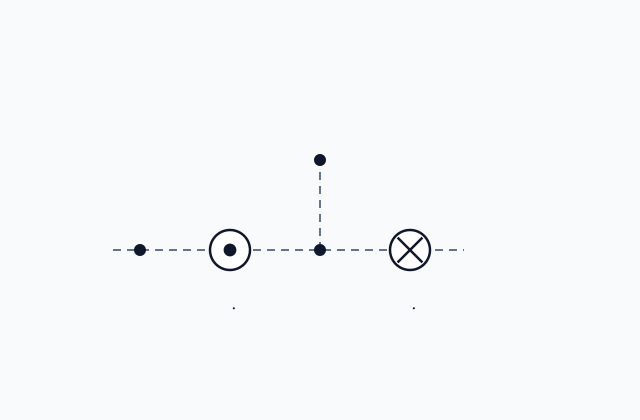
Two long, straight, parallel wires are seen end on, a distance 2d apart in air. Each carries a current of 4.0 A, wire X out of the page and wire Y into the page.
Case question 1 · Rank it
Using the picture of the two wires: rank the size of the net magnetic field at points M, N and Q.
Strongest field first
Give each one a place, 1 for first. Give two the same place if they are equal.
Your ranking: none yet
Case question 2 · Multiple choice
Using the picture of the two wires: which way is the magnetic force that wire X exerts on wire Y?
The rest stand on their own and do not use the case.
Check yourself · Calculate
A straight wire carries a current of 4.0 A at right angles to a uniform 0.30 T magnetic field, and 25 cm of the wire lies in the field. What is the size of the magnetic force on the wire? Give your answer to the nearest 0.01 N.
Check yourself · Spot the error
A student predicts how a wire's magnetic field changes with distance. Tap the first line that goes wrong.
Part 7 Keep it Bring back earlier ideas
The force on a moving charge from the last lesson is what pushes a whole wire here, and a capacitor's current from Unit 11 is a current like any other. Each one you get back without looking holds better the next time it comes up.
From 12.2 Magnetism and Moving Charges · Match
Each case is a particle moving in the plane of the page through a uniform magnetic field. Tap a case, then the direction of the magnetic force on the particle.
The next question describes four circuits in words. Rank them before you work anything out, then check your ranking with the time constant, combining the capacitors first.
Now let a charged capacitor run a bulb. Predict first: what does the bulb do as the capacitor empties?
From 11.8 Resistor-Capacitor (RC) Circuits · Decide and justify
A capacitor is fully charged and then disconnected from its battery. It is then joined across a bulb by ideal wires, and the bulb lights. Treat the bulb's resistance as fixed. Does the bulb get dimmer as time goes on?
Which reason supports your answer?
In three lines
- A long, straight wire's field circles it, with size : index finger along the current, middle finger from the wire to the point, thumb along the field.
- At the center of a loop the field points along its axis, and the fields of several wires add as vectors, partly cancelling where they point opposite ways.
- A wire in a field feels : index finger along the current, middle finger along the field, thumb along the force, which is zero along the field.
Exam strategy for this topic
- Section I, Multiple Choice: 42 questions in 85 minutes.
- Section II, Free Response: 4 questions in 95 minutes.
- This lesson's Explain it is shaped like free-response question 3, Experimental Design and Analysis.
- A four-function, scientific, or graphing calculator is allowed on both sections of the exam.
For each wire, find its field's direction at the point with the right-hand rule before you combine anything. Write each field's size and direction, then add them as vectors, subtracting where they point opposite ways.
Questions students ask
What does the magnetic field around a straight wire look like?
Circles centered on the wire, in planes at right angles to it. The field is tangent to those circles, and it weakens in proportion to one over the distance from the wire.
How do you find the direction of the field around a wire?
Point your right index finger along the current and your middle finger from the wire to the point; your thumb points along the field. Around a current out of the page, the field circles counterclockwise.
What is the force on a current-carrying wire in a magnetic field?
, where is the length of wire in the field and the angle between the current and the field. It is zero when the wire runs along the field.
What is in the equation for a wire's field?
The vacuum permeability, T·m/A, a constant that sets how strong a current's magnetic field is in empty space. In the long-wire equation it appears as T·m/A.
Course alignment, for teachers
AP Physics 2: Algebra-Based topic 12.3, Unit 12: Magnetism and Electromagnetism.
- Skill 1.B: Create quantitative graphs with appropriate scales and units, including plotting data.
- Skill 2.A: Derive a symbolic expression from known quantities by selecting and following a logical mathematical pathway.
- Skill 2.D: Predict new values or factors of change of physical quantities using functional dependence between variables.
- Skill 3.A: Create experimental procedures that are appropriate for a given scientific question.
- Skill 3.C: Justify or support a claim using evidence from experimental data, physical representations, or physical principles or laws.
This lesson maps all 9 essential knowledge statements of the topic to the part that teaches each one: 9 are checked by a scored question. The map is in the lesson file.