Unit 14 · Topic 14.1 · about 30 minutes · 7 parts · 11 scored checks, 2 of them multiple choice, plus 2 from earlier lessons
AP Physics 2: Algebra-Based 14.1: Properties of Wave Pulses and Waves
Unit 14: 12 to 15% of the multiple-choice section
What you'll be able to do
- Describe the physical properties of waves and wave pulses: what they carry, what they need to travel through, which way the medium moves, what sets their speed, and what their amplitude tells you.
Key vocabulary
| Term | What it means | The exam trap |
|---|---|---|
| Disturbance | A change from the undisturbed state of a medium, such as a rope pulled to one side or a region of air squeezed together. | A disturbance does not have to be a change in position. In sound it is a change in the air's pressure. |
| Tension | The pulling force along a stretched string or rope, written . | Tension is a force, measured in newtons, not a stretch measured in meters. |
| Mass per length | The mass of a string or rope divided by its length, , in kilograms per meter. | A uniform rope has the same mass per length however much of it you take: half the rope has half the mass and half the length. |
 Tap to open the picture full size
Part 1 Think first A wave around a stadium
Commit to a guess first. Being wrong now makes the right idea stick better.
Predict first
Fans at a stadium do "the wave": each person stands up and sits back down just after the person beside them, and the wave sweeps all the way around the stands. When it has gone once around, where are the fans?
In short. A wave pulse or a wave carries energy from one place to another through a medium, or through empty space for an electromagnetic wave, while the medium itself stays where it was.
- Mechanical waves, such as sound and waves on a rope, need a medium; electromagnetic waves do not, and in a vacuum they all travel at m/s.
- In a transverse wave the medium moves perpendicular to the wave's travel; in a longitudinal wave, such as sound, it moves parallel, making compressions and rarefactions.
- On a string, ; amplitude, measured from equilibrium, sets loudness and energy but not speed.
Part 2 Learn it Pulses, waves and what sets their speed
1a. What a pulse carries
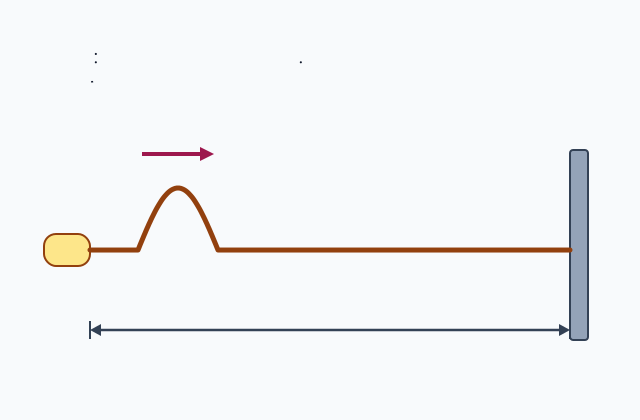
Flick one end of a long stretched rope once and a bump runs along it to the far end. That bump is a wave pulse: a single disturbance that carries energy from one place to another without carrying the rope along. A ribbon tied to the rope jumps up and settles back as the pulse goes by, and it ends up where it started.
Move the end up and down steadily instead, and you send a wave: a continuous, periodic disturbance, the same shape over and over, with a definite wavelength (the length of one repeat) and frequency (repeats each second). The next lesson works with both.
The material a wave travels through is its medium. A rope, a spring, water and air are media. Mechanical waves and pulses, such as sound or a ripple on a pond, need a medium: with no material, there is nothing to disturb. Electromagnetic waves, such as light and radio waves, need no medium, which is how sunlight crosses the nearly empty space between the Sun and Earth.
Quick check · Select all
Ana flicks one end of a long stretched spring once, and a pulse runs along it to Ben, who holds the other end. Which two statements are true? Pick two.
Select 2 answers, then check.
1b. Which way the medium moves
Compare the direction the medium moves with the direction the wave travels.
- In a transverse wave, the medium moves perpendicular to the direction the wave travels. Shake a rope up and down and the wave runs sideways along it.
- In a longitudinal wave, the medium moves parallel to the direction the wave travels. Push and pull the end of a stretched spring along its length and the coils bunch and spread along it.
Sound is modeled as a mechanical, longitudinal wave. A loudspeaker cone pushes forward and squeezes the air in front of it, then pulls back and lets it spread out. Each layer of air moves back and forth along the line the sound travels. Where the air is squeezed together, its pressure is above normal: a compression. Where it is spread apart, its pressure is below normal: a rarefaction. A sound wave is a train of compressions and rarefactions moving away from the source, while each bit of air only jiggles about its own place.
Quick check · Fill the statement
Complete the statements about a guitar. Tap a blank, then an answer.
A plucked guitar string moves up and down while its waves run along its length, so the waves on the string are . The sound it sends through the air is : the air moves back and forth the direction the sound travels. A region where the air is squeezed together is a .
1c. What sets the speed
How fast a wave or pulse travels depends on the type of wave and the properties of the medium, not on how the wave was made.
On a stretched string or rope,
where is the tension and is the string's mass per length. A tighter string carries a pulse faster; a heavier string at the same tension carries it more slowly. Nothing about the flick appears in the equation.
The square root matters. Four times the tension gives twice the speed, not four times.
For sound in a given medium, the speed increases with the temperature of the medium. In air at room temperature, sound travels at about 343 m/s, a typical value that changes with the weather.
Every electromagnetic wave in a vacuum travels at the same speed, a universal physical constant:
Quick check · Decide and justify
A student holds one end of a long rope tied to a wall, and the tension in the rope stays the same throughout. She says that if she flicks her end harder, making a taller pulse, the pulse will reach the wall sooner. Is she right?
Which reason supports your answer?
1d. Amplitude
The amplitude of a wave is its maximum displacement from its equilibrium position, where the medium sits when no wave passes. On a graph of a rope's displacement it is the height of a crest above the middle line, not the distance from a trough up to a crest, which is twice the amplitude.
In a sound wave the disturbance is a change in the air's pressure. So the amplitude of a sound wave can be given as the maximum increase or decrease in pressure from the undisturbed, equilibrium pressure. If the pressure swings from 0.20 Pa above normal to 0.20 Pa below normal, the amplitude is 0.20 Pa.
Two things grow with amplitude:
- The loudness of a sound increases as its amplitude increases.
- The energy a wave carries increases as its amplitude increases.
Amplitude does not change the speed. The medium sets that, as the last section showed.
Quick check · Multiple choice
A tuning fork is struck once gently and once hard, and each time its sound crosses the room to a microphone. Compared with the gentle strike, the sound of the hard strike has
Part 3 Watch it done A pulse along a rope
Predict first, then watch each step, then finish the problem yourself.
In the picture at the top of this lesson, a uniform rope 12 m long with a mass of 1.5 kg is stretched between a hand and a post with a tension of 200 N. The hand flicks the rope once. How long does the pulse take to reach the post?
Predict first
Before you open the first step, predict: how long does the pulse take to travel the 12 m to the post?
Step 1 · Find the mass per length
kg/m.
Step 2 · Find the speed
m/s.
Why this step?
Why divide the tension by the mass per length, and not by the rope's whole mass?
The speed depends on how heavy each meter of rope is, not on how long the rope is. A rope twice as long with twice the mass has the same mass per length, and a pulse runs along it at the same speed; it only has farther to go.
Your step · Calculate
Finish it. A pulse travels at 40 m/s along a rope 12 m long. How long does it take to reach the far end? Use your time to test a classmate's claim that a pulse this fast arrives in less than a tenth of a second.
s
Part 4 Try it Tension, mass and a bigger flick
Predict first: if you double the tension in a rope, does a pulse go more than twice as fast, exactly twice as fast, or less than twice as fast? Then rank five ropes, and sketch how the speed grows with the tension.
Try it · Rank it
Five ropes each carry one pulse. Rope A: tension 40 N, mass per length 0.010 kg/m. Rope B: 40 N, 0.040 kg/m. Rope C: 160 N, 0.040 kg/m. Rope D: 40 N, 0.010 kg/m, flicked twice as hard as A, so its pulse is twice as tall. Rope E: 10 N, 0.010 kg/m. Rank the pulses by speed.
Fastest first
Give each one a place, 1 for first. Give two the same place if they are equal.
Your ranking: none yet
Try it · Sketch the graph
A rope has a fixed mass per length. At a tension of 100 N, a pulse travels along it at 20 m/s. Sketch the speed of a pulse against the tension in the rope, from 100 N to 400 N, placing each point at its speed to the nearest m/s. The first point is fixed at 20 m/s, the speed at 100 N.
One shape that fits
Drag a point up or down, or tap it and use the arrow keys. The shape is checked, and so are the values the question lets you work out.
Part 5 Explain it Two strings, one tension
On the exam this is handwritten, so answer on paper first. Nothing you type here leaves this page. Then check your answer against the model and each scoring point.
Free response is 50% of the exam score. This one is shaped like Question 4, Qualitative/Quantitative Translation.
Free-response practice · Question 4 style
Two strings, 1 and 2, are each 2.0 m long and stretched with the same tension. String 2 has four times the mass per length of string 1. At the same instant, a pulse is started at one end of each.
(a) Without using equations, explain which pulse reaches the far end first, and why.
(b) Derive an expression for the ratio of the times the two pulses take to reach the far ends. A student then flicks string 2 harder than string 1. Use your expression to explain whether that changes the ratio.
(c) Explain how your expression in (b) agrees with your reasoning in (a).
Model answer
(a) The pulse on string 1 arrives first. With the same tension pulling on both, each bit of the heavier string 2 has more mass to get moving, so the disturbance passes along it more slowly. String 1 is lighter for every meter, so its pulse travels faster and covers the same 2.0 m in less time.
(b) Each pulse travels at a steady speed, so with , writing for the mass per length. Then : the pulse on string 2 takes twice as long. Nothing about the flick appears in the expression. A harder flick makes a taller pulse on string 2 that carries more energy, but at the same speed, so the ratio stays 2.
(c) They agree. In (a), more mass per meter at the same tension meant a slower pulse and a longer time. In (b), is greater than 1 whenever string 2 is heavier per meter, and the expression adds how much: the time grows as the square root of the mass per length, so four times the mass per length gives twice the time, not four times.
Score your own answer. This is a self-check, not a grade. Tick each point your answer makes.
Part 6 Check yourself Sound in a tube
Both case questions use the graph.
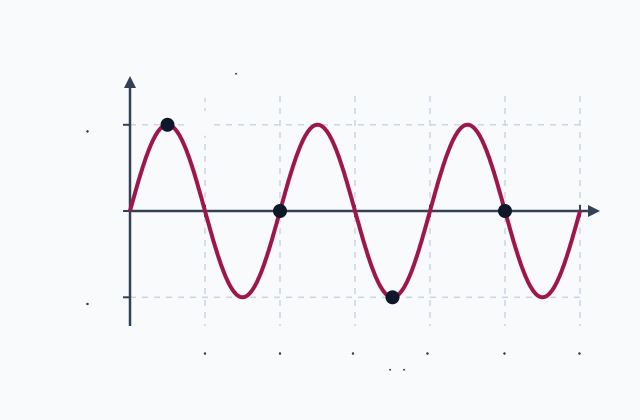
A loudspeaker at one end of a long tube of air plays a steady note. At one instant, sensors along the tube record how far the air pressure at each place is above or below its undisturbed value. The graph shows that change in pressure against position along the tube, not against time.
Case question 1 · Multiple choice
Using the graph: at which labeled point is the air at the center of a rarefaction?
Case question 2 · Calculate
Using the graph: what is the pressure amplitude of this sound wave?
The rest stand on their own and do not use the case.
Check yourself · Sort it
Each card describes a wave or a pulse. Tap a card, then whether it needs a medium to travel.
Needs a medium
Needs no medium
Check yourself · Spot the error
A student explains when an echo comes back sooner. Tap the first line that goes wrong.
Part 7 Keep it Bring back earlier ideas
Lenses and mirrors from Unit 13 are still part of the course. Retrieving them now, between new ideas, is what makes them easy to find later.
From 13.4 Images Formed by Lenses · Calculate
A thin converging lens has a focal length of 15 cm. An object stands on the principal axis 10 cm from the lens. What is the image distance, with its sign in this course's convention, where a real image has a positive image distance and a virtual image a negative one? Give your answer in centimeters.
From 13.2 Images Formed by Mirrors · Decide and justify
A student walks straight toward a flat mirror at 1.0 m/s. She says that the distance between her and her image shrinks at 2.0 m/s. Is she right?
Which reason supports your answer?
In three lines
- A pulse is a single disturbance and a wave a continuous, periodic one; both carry energy without carrying matter.
- Mechanical waves need a medium and electromagnetic waves do not; transverse waves move the medium across their travel, longitudinal waves such as sound move it along.
- The speed depends on the wave and the medium, on a string; amplitude, from equilibrium, sets loudness and energy.
Exam strategy for this topic
- Section I, Multiple Choice: 42 questions in 85 minutes.
- Section II, Free Response: 4 questions in 95 minutes.
- This lesson's Explain it is shaped like free-response question 4, Qualitative/Quantitative Translation.
- A four-function, scientific, or graphing calculator is allowed on both sections of the exam.
When a question changes how a wave is made, a harder flick or a louder speaker, ask first whether the medium changed. If it did not, the speed did not, and say so in one sentence before anything else.
Questions students ask
What is the difference between a wave pulse and a wave?
A pulse is a single disturbance, such as one flick sent along a rope. A wave is a continuous, periodic disturbance that repeats, so it has a definite wavelength and frequency. Both carry energy without carrying the medium along.
Does sound need a medium?
Yes. Sound is a mechanical, longitudinal wave of compressions and rarefactions, so it needs a material such as air or water. Electromagnetic waves, such as light, need no medium and cross a vacuum.
What sets the speed of a wave on a string?
The tension and the mass per length: . How hard or how fast the end is moved does not appear, so it does not change the speed.
What is the difference between transverse and longitudinal waves?
In a transverse wave the medium moves perpendicular to the direction the wave travels, as on a shaken rope. In a longitudinal wave it moves parallel to that direction, as in sound.
How do you find the amplitude of a sound wave?
Take the largest increase or decrease in pressure from the undisturbed pressure. On a graph of pressure change, it is the height of a crest above the zero line, not the distance from a trough to a crest.
Course alignment, for teachers
AP Physics 2: Algebra-Based topic 14.1, Unit 14: Waves, Sound, and Physical Optics.
- Skill 1.C: Create qualitative sketches of graphs that represent features of a model or the behavior of a physical system.
- Skill 2.C: Compare physical quantities between two or more scenarios or at different times and locations in a single scenario.
- Skill 3.B: Apply an appropriate law, definition, theoretical relationship, or model to make a claim.
- Skill 3.C: Justify or support a claim using evidence from experimental data, physical representations, or physical principles or laws.
This lesson maps all 16 essential knowledge statements of the topic to the part that teaches each one: 16 are checked by a scored question. The map is in the lesson file.