Unit 14 · Topic 14.3 · about 30 minutes · 7 parts · 10 scored checks, 1 of them multiple choice, plus 2 from earlier lessons
AP Physics 2: Algebra-Based 14.3: Boundary Behavior of Waves and Polarization
Unit 14: 12 to 15% of the multiple-choice section
What you'll be able to do
- Describe how a wave interacts with a boundary: when it is reflected and transmitted, when the reflected wave is inverted, what stays the same across the boundary, and how polarization can reduce a wave's intensity.
Key vocabulary
| Term | What it means | The exam trap |
|---|---|---|
| Boundary | The place where two media meet, such as a knot joining two strings or the surface between air and water. | The boundary is where the media meet, not either medium; what happens there depends on both sides. |
| Transmitted wave | The part of a wave that crosses a boundary and carries on into the second medium. | The transmitted and reflected waves both come from the one incoming wave; neither is a new wave started at the boundary. |
| Power | The rate at which energy is transferred, in watts, where one watt is one joule each second. | Power is how fast energy is transferred, not how much: a dim lamp left on all day can transfer more energy than a bright flash. |
 Tap to open the picture full size
Part 1 Think first A rope tied to a chain
Commit to a guess first. Being wrong now makes the right idea stick better.
Predict first
You hold one end of a light rope whose far end is tied to a heavy chain, and the rope and chain are pulled tight. You flick the rope once, sending an upward pulse toward the chain. What comes back to you along the rope?
In short. At a boundary between two media, part of a wave is reflected and part is transmitted, and both keep the frequency of the wave that arrived.
- The reflected wave is inverted if the wave slows down in the new medium, and upright if it speeds up.
- With the frequency fixed, the transmitted wavelength changes with the speed: .
- Only transverse waves can be polarized, and polarizing a wave can reduce its intensity, the average power per unit area.
Part 2 Learn it Reflection, transmission and polarization
3a. Part goes on, part comes back
When a wave reaches a boundary between two media, such as the knot joining a light string to a heavy one, part of it is transmitted into the second medium and part is reflected back into the first. How much of each depends on the properties of the boundary.
Whether the reflected pulse comes back upright or upside down depends on the wave's speed on each side:
- If the wave slows down in the new medium, the reflected pulse is inverted. A pulse on a light string reaching a heavier one, at the same tension, comes back upside down.
- If the wave speeds up in the new medium, the reflected pulse is not inverted. A pulse on a heavy string reaching a lighter one comes back upright.
The transmitted pulse keeps its side and carries on into the second medium at that medium's speed.
A rope tied firmly to a wall is the extreme of the first case. The wall does not move, so nothing is transmitted, and the whole pulse comes back inverted.
Quick check · Sort it
Each card describes a pulse on a stretched string or rope reaching a boundary. Tap a card, then how the reflected pulse comes back.
Upright
Inverted
3b. The frequency carries over
At a boundary the speed can change, but the frequency does not. The second medium is shaken back and forth by the first, once for each oscillation that arrives at the boundary, so it oscillates exactly as often. The reflected wave stays in the first medium, so it keeps the speed and the frequency of the incoming wave.
With the frequency fixed, says the transmitted wavelength follows the speed:
- Into a slower medium, the transmitted wavelength is shorter.
- Into a faster medium, it is longer.
A pulse does the same thing with its width. The front of a pulse reaches the boundary first and carries on at the new speed while the back is still arriving at the old speed. Into a slower string the transmitted pulse comes out narrower, and into a faster one, wider.
Sound and light behave the same way. A 440 Hz note passing from air into water is still 440 Hz in the water, with a longer wavelength, because sound travels faster there.
Quick check · Calculate
A wave on a string travels at 12 m/s with a wavelength of 0.30 m. It reaches a knot, beyond which a second string, at the same tension, carries waves at 6.0 m/s. What is the wavelength of the transmitted wave?
3c. Polarization and intensity
A transverse wave's disturbance is perpendicular to its direction of travel, which leaves a choice: up and down, side to side, or any angle between. A transverse wave that oscillates in a single plane is polarized. Shake a rope only up and down and its wave is polarized in the vertical plane.
A longitudinal wave cannot be polarized. Its disturbance runs along its direction of travel, so there is no plane to choose. Sound cannot be polarized.
Transverse waves can become polarized when they reflect from a surface, refract through a medium, or pass through certain openings. A polarizing filter passes light oscillating in one plane and blocks the rest, much as a picket fence lets through a rope wave shaken along the slats and stops one shaken across them.
Polarizing a wave can reduce its intensity, the power it transfers per unit area, in W/m². A wave's power rises and falls during each oscillation, so intensity is the average power per unit area over one period. Light through a polarizing filter carries less power through each square meter, so it looks dimmer.
Quick check · Select all
Which two of these waves can be polarized? Pick two.
Select 2 answers, then check.
Part 3 Watch it done From a heavy rope to a light one
Predict first, then watch each step, then finish the problem yourself.
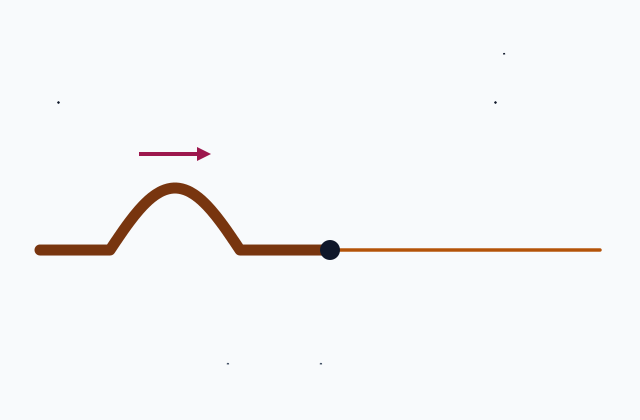
In the picture at the top of this lesson, a heavy rope with a mass per length of 0.040 kg/m is knotted to a light rope with 0.010 kg/m, and both carry a tension of 16 N. An upright pulse on the heavy rope reaches the knot. How far apart are the peaks of the reflected and transmitted pulses 0.050 s after the incoming peak reaches the knot?
Predict first
Before you open the first step, predict: 0.050 s after the peak reaches the knot, how far apart are the peaks of the reflected and transmitted pulses?
Step 1 · Find each speed
Heavy rope: m/s. Light rope: m/s.
Step 2 · Say where each pulse goes
The transmitted pulse runs on along the light rope at 40 m/s, upright. The reflected pulse runs back along the heavy rope at 20 m/s. The wave speeds up beyond the knot, so the reflected pulse is upright too.
Why this step?
Why does the reflected pulse travel at 20 m/s and not 40 m/s?
It never leaves the heavy rope. A pulse's speed is set by the rope it is on, and the reflection travels back along the rope the incoming pulse came along.
Your step · Calculate
Finish it. At a knot, a reflected pulse heads back along a heavy rope at 20 m/s and a transmitted pulse heads on along a light rope at 40 m/s, their peaks leaving the knot at the same instant. How far apart are the two peaks 0.050 s later? Use it to test a classmate's claim that the peaks are only 1.0 m apart then.
m
Part 4 Try it Glare and a filter
Predict first: when polarizing sunglasses are slowly turned in front of the glare off a lake, does the glare stay just as bright, change in brightness, or change color? Then decide a claim, and work out an intensity.
Try it · Decide and justify
Sunlight reflecting off a calm lake is partly polarized. A student looks at the glare through polarizing sunglasses and slowly turns them. She says that the glare will look brighter at some angles and dimmer at others. Is she right?
Which reason supports your answer?
Try it · Calculate
A laser beam with an intensity of 2000 W/m² falls on a polarizing filter, lighting a spot with an area of m². The light that passes through carries an average power of W over the same area. What is the intensity of the light that passes through? Use it to test the claim that the filter lets through more than half the intensity that falls on it.
Part 5 Explain it A pulse meets a heavier rope
On the exam this is handwritten, so answer on paper first. Nothing you type here leaves this page. Then check your answer against the model and each scoring point.
Free response is 50% of the exam score. This one is shaped like Question 2, Translation Between Representations.
Free-response practice · Question 2 style
A light rope is knotted to a heavy rope with four times its mass per length, and both are stretched with the same tension. A single upright pulse 0.40 m wide travels along the light rope toward the knot at 8.0 m/s.
(a) On paper, draw both ropes as they look 0.20 s after the front of the pulse reaches the knot. Show the reflected and the transmitted pulse, each the right way up, with its width and its distance from the knot. Do this by hand before you open the model.
(b) Derive an expression for the width of the transmitted pulse in terms of the width of the incoming pulse, its speed on the light rope and the speed on the heavy rope. Use it to calculate the width of the transmitted pulse.
(c) Does your drawing in (a) agree with your result in (b)? Explain why the transmitted pulse has the width it has, and why the reflected pulse is the way up it is.
Model answer
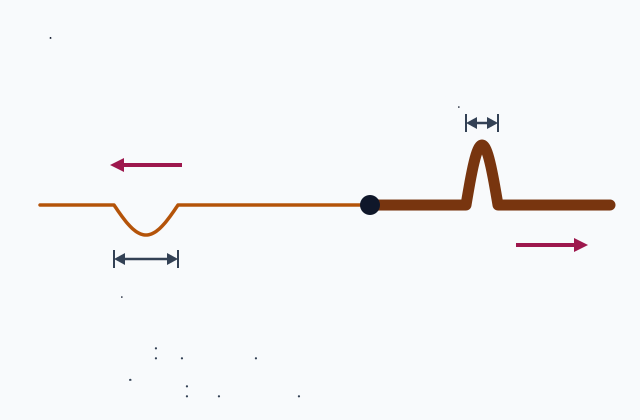
(a) Compare your drawing with the model below. On the light rope, an inverted pulse 0.40 m wide lies between 1.2 m and 1.6 m from the knot, moving away from it. On the heavy rope, an upright pulse 0.20 m wide lies between 0.60 m and 0.80 m past the knot, moving away from it. Both are smaller in height than the incoming pulse.
(b) The heavy rope has four times the mass per length at the same tension, so m/s. The incoming pulse takes to pass into the knot, front first. In that time the front of the transmitted pulse moves beyond the knot before the back arrives, so its width is m.
(c) They agree: the drawing shows the transmitted pulse half as wide as the incoming one, 0.20 m, as the expression gives. It is narrower because it travels at half the speed while taking the same time to pass the knot, the same reason a transmitted wave keeps its frequency and gets a shorter wavelength. The reflected pulse stays on the light rope at 8.0 m/s, so it keeps the 0.40 m width, and it is inverted because the wave slows down in the heavy rope.
 Tap to open the picture full size
Score your own answer. This is a self-check, not a grade. Tick each point your answer makes.
Part 6 Check yourself Two springs, before and after
Both case questions use the two snapshots.
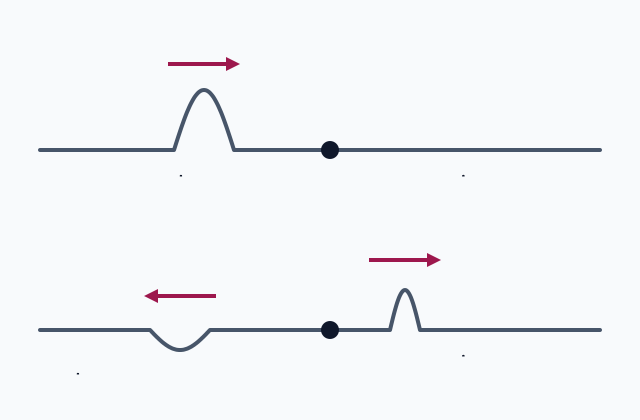
Two stretched springs, 1 and 2, are joined at a knot, with the same tension in both. The top snapshot shows a single upright pulse on spring 1 moving toward the knot. The bottom snapshot shows the springs a moment after the pulse has met the knot. The springs are drawn alike, so the picture does not show which is heavier.
Case question 1 · Multiple choice
Using the two snapshots: on which spring do waves travel faster, and what shows it?
Case question 2 · Rank it
Using the two springs: instead of a single pulse, a steady 5.0 Hz wave is sent along spring 1 toward the knot. Rank the incoming wave on spring 1, the reflected wave on spring 1 and the transmitted wave on spring 2 by wavelength.
Longest wavelength first
Give each one a place, 1 for first. Give two the same place if they are equal.
Your ranking: none yet
The rest stand on their own and do not use the case.
Check yourself · Spot the error
A student predicts what happens to a wave at a knot. Tap the first line that goes wrong.
Check yourself · Fill the statement
Complete the statements about polarized sunglasses. Tap a blank, then an answer.
Light is a wave, so it can be polarized. A polarizing filter passes light that oscillates in one and blocks the rest, so less power gets through each square meter: the of the light is reduced. Sound cannot be polarized at all, because it is a wave.
Part 7 Keep it Bring back earlier ideas
Wavelength and frequency from the last lesson, and thin lenses from Unit 13, are still part of the course. Retrieving them now, between new ideas, is what makes them easy to find later.
From 14.2 Periodic Waves · Rank it
Four sound waves: A is 200 Hz in air, B is 400 Hz in air, C is 400 Hz in water, and D is 800 Hz in water. Take sound to travel at 340 m/s in this air and 1500 m/s in this water. Rank the waves by wavelength.
Longest wavelength first
Give each one a place, 1 for first. Give two the same place if they are equal.
Your ranking: none yet
From 13.4 Images Formed by Lenses · Decide and justify
A student says that a single thin diverging lens in air always forms a virtual image of a real object, wherever the object is. Is the student right?
Which reason supports your answer?
In three lines
- At a boundary a wave is partly reflected and partly transmitted; the reflection is inverted where the wave slows down and upright where it speeds up.
- The frequency does not change at a boundary, so the transmitted wavelength, and a pulse's width, follow the new speed.
- Only transverse waves can be polarized; polarizing a wave can reduce its intensity, the average power per unit area over one period.
Exam strategy for this topic
- Section I, Multiple Choice: 42 questions in 85 minutes.
- Section II, Free Response: 4 questions in 95 minutes.
- This lesson's Explain it is shaped like free-response question 2, Translation Between Representations.
- A four-function, scientific, or graphing calculator is allowed on both sections of the exam.
When you draw a reflected and a transmitted pulse, decide the speeds first, then the ways up, then the widths. Write the speed on each side of the boundary on your drawing, so a reader can see every choice follows from it.
Questions students ask
When is a reflected wave inverted?
When the wave slows down in the new medium, as when a pulse on a light string reaches a heavier string at the same tension, or reaches a fixed end. If the wave speeds up in the new medium, the reflected pulse comes back upright.
Does the frequency of a wave change when it enters a new medium?
No. The second medium is driven by the first, one oscillation for each that arrives, so the frequency stays the same. The speed changes, so the wavelength changes: .
Why can't sound be polarized?
Polarization picks out one plane of oscillation across the direction of travel. Sound is longitudinal, so the air moves along the direction of travel and there is no such plane.
What is intensity?
The power a wave transfers per unit area, in W/m², averaged over one period of the wave. Polarizing a wave can reduce its intensity.
Is a transmitted pulse ever inverted?
No. The transmitted pulse keeps the side of the incoming one. Only the reflected pulse can come back inverted.
Course alignment, for teachers
AP Physics 2: Algebra-Based topic 14.3, Unit 14: Waves, Sound, and Physical Optics.
- Skill 1.A: Create diagrams, tables, charts, or schematics to represent physical situations.
- Skill 2.C: Compare physical quantities between two or more scenarios or at different times and locations in a single scenario.
- Skill 3.B: Apply an appropriate law, definition, theoretical relationship, or model to make a claim.
- Skill 3.C: Justify or support a claim using evidence from experimental data, physical representations, or physical principles or laws.
This lesson maps all 11 essential knowledge statements of the topic to the part that teaches each one: 11 are checked by a scored question. The map is in the lesson file.