Unit 14 · Topic 14.4 · about 30 minutes · 7 parts · 10 scored checks, 2 of them multiple choice, plus 2 from earlier lessons
AP Physics 2: Algebra-Based 14.4: Electromagnetic Waves
Unit 14: 12 to 15% of the multiple-choice section
What you'll be able to do
- Describe the properties of an electromagnetic wave: the fields that make it up, why it is transverse and needs no medium, and how its categories, the colors of light among them, are ordered by wavelength.
Key vocabulary
| Term | What it means | The exam trap |
|---|---|---|
| Electric field | The electric force per unit charge at a point, a vector written . | The field points the way the force on a positive charge points; the force on a negative charge points the opposite way. |
| Wave front | A surface along which a wave is at the same point in its cycle, such as a crest, at one instant. | A wave front is the crest itself, spread out across space, not the path one part of the wave follows. |
| Electromagnetic spectrum | The whole range of electromagnetic waves, arranged by wavelength. | The spectrum is far wider than the colors you can see; most of it is invisible to the eye. |
 Tap to open the picture full size
Part 1 Think first What waves in a beam of light?
Commit to a guess first. Being wrong now makes the right idea stick better.
Predict first
Sound is air being squeezed and stretched. Sunlight reaches you from the Sun. What is it that oscillates as light travels?
In short. An electromagnetic wave is a pair of oscillating electric and magnetic fields, perpendicular to each other and to the direction the wave travels, that needs no medium.
- Every electromagnetic wave travels at m/s in a vacuum; the categories differ in wavelength, and so in frequency, .
- From the longest wavelength to the shortest: radio waves, microwaves, infrared, visible light, ultraviolet, X-rays, gamma rays.
- Visible light from the longest wavelength to the shortest: red, orange, yellow, green, blue, violet.
Part 2 Learn it Fields, the spectrum and color
4a. Two fields at right angles
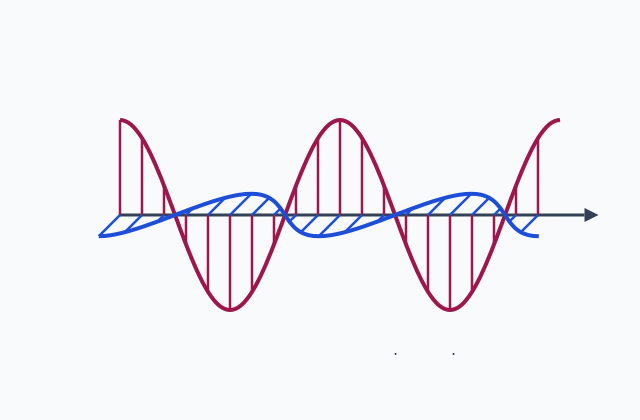
An electromagnetic wave is made of an oscillating electric field and an oscillating magnetic field. The two fields are mutually perpendicular: at every point, the magnetic field is at right angles to the electric field.
Both fields also oscillate at right angles to the direction the wave travels, so electromagnetic waves are transverse. If a wave travels north with its electric field oscillating east and west, its magnetic field oscillates up and down, and neither field points north or south.
No material is shaken. The fields themselves are the disturbance, so electromagnetic waves do not need a medium. They cross a vacuum, where they all travel at m/s.
The surfaces where a wave is at a crest at one instant are its wave fronts. Far from the source they are very nearly flat, so electromagnetic waves are commonly modeled as plane waves: waves with planar wave fronts, all moving the same way.
Quick check · Multiple choice
An electromagnetic wave travels east. At one point, its electric field oscillates up and down. Along which line does its magnetic field oscillate at that point?
4b. The electromagnetic spectrum
All electromagnetic waves are the same kind of wave, and in a vacuum they all travel at . What sorts them into categories is their wavelength. In order of decreasing wavelength:
- radio waves
- microwaves
- infrared
- visible light
- ultraviolet
- X-rays
- gamma rays
The whole range runs from wavelengths of kilometers, for long radio waves, down to picometers, for gamma rays. The edges between neighboring categories are not sharp, and the course framework says students are not expected to define exact wavelength ranges. Know the order.
Since every category travels at in a vacuum, puts them in the reverse order by frequency: radio waves have the lowest frequencies and gamma rays the highest.
Quick check · Put it in order
Tap the categories of electromagnetic waves in order, from the longest wavelength to the shortest.
4c. Light and its colors
Visible electromagnetic waves are also called light. Within the visible range, the colors are themselves categories ordered by wavelength. From the longest to the shortest:
red, orange, yellow, green, blue, violet
Red light, at the long end, sits next to infrared, and violet light, at the short end, sits next to ultraviolet. The names come from that: infrared is beyond red, ultraviolet beyond violet. In a vacuum every color travels at , so violet light, with the shortest wavelength, has the highest frequency of the visible colors.
The word light is sometimes stretched to cover electromagnetic waves of every wavelength, and the whole family is also called electromagnetic radiation. When a question says light, check whether it means the visible part or the whole spectrum.
Quick check · Rank it
Four beams travel through a vacuum: red light, green light, violet light and an infrared beam. Rank them by frequency.
Highest frequency first
Give each one a place, 1 for first. Give two the same place if they are equal.
Your ranking: none yet
Part 3 Watch it done A radio station and a microwave oven
Predict first, then watch each step, then finish the problem yourself.
In the picture at the top of this lesson, an FM radio station broadcasts at 100 MHz and a microwave oven works at 2.45 GHz. Both send electromagnetic waves through air, where they travel at very nearly . How many times as long as the oven's wavelength is the radio station's?
Predict first
Before you open the first step, predict: about how many times as long as the oven's wavelength is the radio station's?
Step 1 · Find the radio wavelength
m.
Step 2 · Find the oven's wavelength
m, about 12 cm.
Why this step?
Why can one speed, , be used for both waves?
Radio waves and microwaves are both electromagnetic waves, and every electromagnetic wave travels at in a vacuum and very nearly that in air. The two differ only in wavelength and frequency.
Your step · Calculate
Finish it. An FM radio wave has a wavelength of 3.00 m, and a microwave oven's waves have a wavelength of 0.122 m. How many times as long as the oven's wavelength is the radio wavelength?
Part 4 Try it Signals from the Sun and the stars
Predict first: a flare on the Sun gives off radio waves, light and X-rays at one instant. Do the X-rays arrive first, the radio waves first, or all of them together? Then decide a claim, and pick what is true of starlight.
Try it · Decide and justify
A flare on the Sun gives off radio waves, visible light and X-rays at the same instant. A student says that the X-rays reach Earth first because they carry the most energy. Is he right?
Which reason supports your answer?
Try it · Select all
Light from a distant star crosses space and enters a telescope on Earth. Which two statements about that light are true? Pick two.
Select 2 answers, then check.
Part 5 Explain it Talking to a rover on Mars
On the exam this is handwritten, so answer on paper first. Nothing you type here leaves this page. Then check your answer against the model and each scoring point.
Free response is 50% of the exam score. This one is shaped like Question 1, Mathematical Routines.
Free-response practice · Question 1 style
Engineers send a radio signal of frequency from Earth to a rover on Mars, a distance away. Treat the space between as a vacuum.
(a) On paper, draw the signal's electric and magnetic fields at one instant, along a short stretch of its path, and mark the direction it travels. Do this by hand before you open the model.
(b) Derive an expression for the number of wavelengths that fit between Earth and the rover, in terms of , and .
(c) On one day m and Hz. Calculate the time the signal takes to reach the rover and the value of .
(d) An engineer suggests switching to a signal of twice the frequency so that commands arrive sooner. Justify whether this would work, and explain what would change about the signal instead.
Model answer
(a) Compare your drawing with the model below. The electric field oscillates along one line, say up and down; the magnetic field oscillates along a line at right angles to it; and both are at right angles to the direction of travel.
(b) The wavelength is , so .
(c) s, or 12.5 minutes. wavelengths.
(d) It would not work. Every electromagnetic wave travels at in a vacuum whatever its frequency, so the travel time stays 750 s. Doubling the frequency halves the wavelength, , so twice as many wavelengths, , fit between Earth and the rover.
 Tap to open the picture full size
Score your own answer. This is a self-check, not a grade. Tick each point your answer makes.
Part 6 Check yourself A snapshot of a radio wave
Both case questions use the graph.
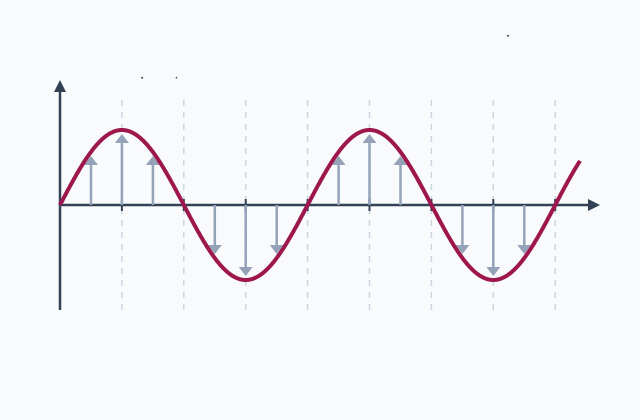
The graph is a snapshot of the electric field of a radio wave from a broadcast station, traveling along the x-axis through air, where it travels at very nearly . It shows the field against position at one instant, not against time. Up on the graph means the field points up; down means it points down.
Case question 1 · Calculate
Using the graph: what is the frequency of the radio wave? Use it to test a classmate's claim that its frequency is above 100 MHz.
Case question 2 · Multiple choice
Using the graph: the station switches to a frequency twice as high. In a snapshot of the new wave against position, how far apart are neighboring crests?
The rest stand on their own and do not use the case.
Check yourself · Spot the error
A student compares a red laser beam with a violet one. Tap the first line that goes wrong.
Check yourself · Fill the statement
Complete the statements about electromagnetic waves. Tap a blank, then an answer.
Far from its source, an electromagnetic wave's wave fronts are very nearly flat, so it is modeled as a wave. The visible part of the spectrum is called , a word sometimes stretched to cover electromagnetic of every wavelength.
Part 7 Keep it Bring back earlier ideas
What happens at a boundary and which waves need a medium, from this unit's first lessons, are still part of the course. Retrieving them now, between new ideas, is what makes them easy to find later.
From 14.3 Boundary Behavior of Waves and Polarization · Calculate
A wave on a string travels at 12 m/s with a wavelength of 0.30 m. It reaches a knot, beyond which a second string, at the same tension, carries waves at 6.0 m/s. What is the wavelength of the transmitted wave?
From 14.1 Properties of Wave Pulses and Waves · Sort it
Each card describes a wave or a pulse. Tap a card, then whether it needs a medium to travel.
Needs a medium
Needs no medium
In three lines
- An electromagnetic wave is oscillating electric and magnetic fields, perpendicular to each other and to its travel, so it is transverse; it is usually modeled as a plane wave.
- Electromagnetic waves need no medium and all travel at in a vacuum; the categories differ in wavelength.
- Longest to shortest: radio, microwave, infrared, visible (red to violet), ultraviolet, X-ray, gamma.
Exam strategy for this topic
- Section I, Multiple Choice: 42 questions in 85 minutes.
- Section II, Free Response: 4 questions in 95 minutes.
- This lesson's Explain it is shaped like free-response question 1, Mathematical Routines.
- A four-function, scientific, or graphing calculator is allowed on both sections of the exam.
When a question asks you to compare electromagnetic waves in a vacuum, write for all of them before anything else. Every comparison then comes down to wavelength and frequency, and turns one into the other.
Questions students ask
What is an electromagnetic wave made of?
Oscillating electric and magnetic fields, perpendicular to each other and to the direction the wave travels. The fields are the disturbance, so no medium is needed.
Why are electromagnetic waves transverse?
Both the electric and the magnetic field oscillate at right angles to the direction the wave travels.
What is the order of the electromagnetic spectrum?
From the longest wavelength to the shortest: radio waves, microwaves, infrared, visible light, ultraviolet, X-rays and gamma rays. By frequency the order is reversed.
Do I need to know the wavelength range of each kind of electromagnetic wave?
The course framework says students are expected to know the order of the spectrum, visible colors included, but not the exact wavelength range of each category.
Which color of visible light has the highest frequency?
Violet. All colors travel at in a vacuum, and violet has the shortest wavelength, so by it has the highest frequency.
Course alignment, for teachers
AP Physics 2: Algebra-Based topic 14.4, Unit 14: Waves, Sound, and Physical Optics.
- Skill 1.A: Create diagrams, tables, charts, or schematics to represent physical situations.
- Skill 2.C: Compare physical quantities between two or more scenarios or at different times and locations in a single scenario.
- Skill 3.B: Apply an appropriate law, definition, theoretical relationship, or model to make a claim.
- Skill 3.C: Justify or support a claim using evidence from experimental data, physical representations, or physical principles or laws.
This lesson maps all 8 essential knowledge statements of the topic to the part that teaches each one: 8 are checked by a scored question. The map is in the lesson file.