Unit 14 · Topic 14.5 · about 30 minutes · 7 parts · 10 scored checks, 3 of them multiple choice, plus 2 from earlier lessons
AP Physics 2: Algebra-Based 14.5: The Doppler Effect
Unit 14: 12 to 15% of the multiple-choice section
What you'll be able to do
- Describe how the frequency an observer measures depends on the relative motion of the wave's source and the observer, comparing it with the source's rest frequency without calculating it.
Key vocabulary
| Term | What it means | The exam trap |
|---|---|---|
| Rest frequency | The frequency a source gives its waves: its own frequency, such as the note a siren is built to sound. | The rest frequency belongs to the source, so it is the siren's own note whether or not the siren moves. |
| Observer | Whoever or whatever detects a wave and measures its frequency: a listener, a microphone or a telescope. | An observer does not have to be a person; a sensor or a telescope is an observer too. |
| Pitch | How high or low a sound seems to a listener, set by the frequency the listener measures. | Pitch is not loudness: a quiet sound can be high and a loud one low. |
 Tap to open the picture full size
Part 1 Think first A passing ambulance
Commit to a guess first. Being wrong now makes the right idea stick better.
Predict first
You stand beside a long, straight road. An ambulance with its siren on comes toward you at a steady speed, passes you, and drives away at the same speed. What do you hear?
In short. The Doppler effect is the difference between a source's rest frequency and the frequency an observer measures when the source and the observer move relative to each other.
- A source moving toward an observer is observed at a higher frequency than its rest frequency, a source moving away at a lower one, and a source moving with the observer at the same one.
- A greater relative speed makes a greater difference; for a source moving straight toward or away from you, the distance does not change the frequency, and the wave's speed does not change either.
- The course framework requires only a qualitative treatment: compare the observed and rest frequencies, without calculating them.
Part 2 Learn it Wave fronts from a moving source
5a. Bunched ahead, spread behind
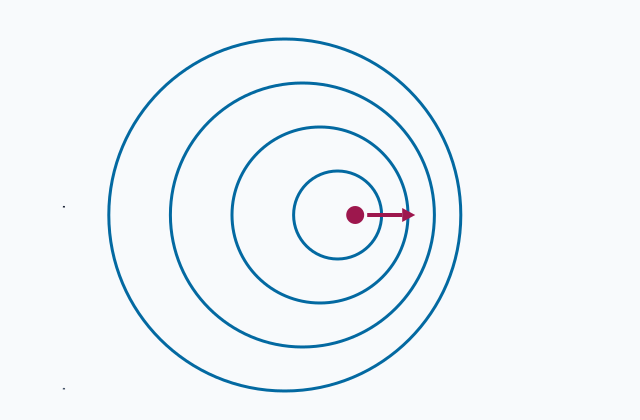
A siren at rest sends out wave fronts, one for each oscillation, as circles spreading evenly in every direction. Wherever you stand, crests arrive at the siren's own rate, its rest frequency.
Now let the siren move to the right while it sounds. Each wave front still spreads at the speed of sound in the air, but each one starts a little farther right than the one before. So the wave fronts bunch up ahead of the siren and spread out behind it, as the picture shows.
- Ahead, the crests are closer together. They still travel at the speed of sound, so more of them reach a listener each second: the observed frequency is greater than the rest frequency, and the pitch sounds higher.
- Behind, the crests are farther apart, fewer arrive each second, and the observed frequency is less than the rest frequency.
This is the Doppler effect: a difference between a source's rest frequency and the frequency an observer measures, caused by motion. The siren never changes its note.
Quick check · Sort it
A fire truck's siren plays one steady note. Each card describes a listener standing still. Tap a card, then how the frequency that listener hears compares with the siren's rest frequency.
Higher
Lower
The same
5b. How fast, and how far
A faster source, a bigger difference. A siren rushing toward you packs its wave fronts more tightly than one creeping toward you, so the frequency you hear is further above the rest frequency. Moving away, a faster source spreads its wave fronts more and drops the frequency further below.
Moving together, no difference. If the source and the observer move with the same velocity, the observer keeps the same place relative to the source, and the observed frequency equals the rest frequency. A paramedic riding in the ambulance hears the siren's own note the whole way.
Distance does not set the frequency. A siren 10 m away and one 500 m away, each coming toward you at the same steady speed, give the same observed frequency. The nearer one is louder, since loudness follows amplitude, but its pitch is no higher. While a source comes straight at you at a steady speed, its pitch stays steady.
The course framework treats the Doppler effect only qualitatively: you compare observed and rest frequencies rather than calculate them.
Quick check · Rank it
Four cars sound identical horns, one at a time. A listener stands still at the end of a long, straight road. Car A drives toward her at 25 m/s, car B drives toward her at 10 m/s, car C is parked, and car D drives away from her at 10 m/s. Rank the frequencies she hears.
Highest frequency first
Give each one a place, 1 for first. Give two the same place if they are equal.
Your ranking: none yet
5c. Light, water and the speed of the wave
The Doppler effect happens with every kind of wave. A source of light moving away from you is observed at a frequency below its rest frequency. Light in a vacuum always travels at , so a lower frequency means a longer wavelength, : visible light shifts toward the red end of the spectrum.
Astronomers use this. Hydrogen gas in a laboratory gives off light at a set pattern of rest frequencies. When the same pattern shows up in a star's light at lower frequencies, the star is moving away from us; at higher frequencies, toward us.
In a ripple tank, a dipper moving across the water draws wave fronts bunched ahead and spread behind, the same pattern as the siren's.
In every case, the speed of the wave does not change. Sound still travels at the speed of sound in the air, water waves at the speed the water sets, and light at . Motion changes how far apart the crests are, and so how often they reach an observer.
Quick check · Multiple choice
The light from a star shows the same pattern of frequencies as hydrogen gas in a laboratory, but every one of them is lower. What does this show about the star?
Part 3 Watch it done A cyclist and a siren
Predict first, then watch each step, then finish the problem yourself.
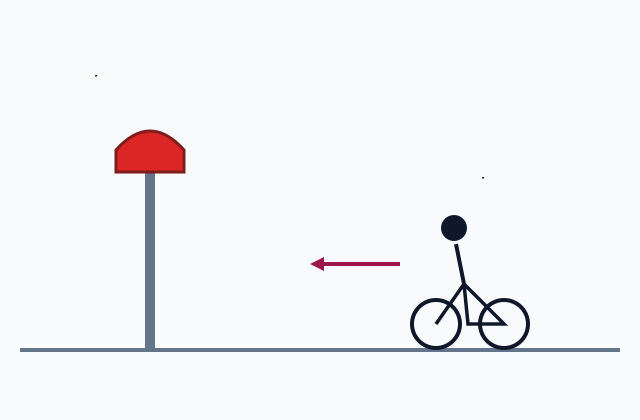
In the picture at the top of this lesson, a siren on a pole sounds a steady note and stays at rest. A cyclist rides at a steady speed along a straight road that runs right past the pole: first toward the siren, then past it and away from it at the same speed. How does the frequency she hears compare with the siren's rest frequency, before and after she passes?
Predict first
Before you open the first step, predict: after she passes the siren and rides away from it, what frequency does she hear?
Step 1 · Picture the waves
The siren is at rest, so its wave fronts are evenly spaced circles, one rest wavelength apart, spreading at the speed of sound. Standing still anywhere, she would meet them at the rest frequency.
Step 2 · Riding toward it
Riding toward the siren, she meets each wave front sooner than she would standing still, because she closes the gap from her side as well. More wave fronts reach her each second, so the frequency she hears is higher than the rest frequency, and steady while her speed is steady.
Why this step?
Why does she hear a higher frequency when the siren is not moving and its wave fronts are evenly spaced?
What she hears is how often wave fronts reach her. The spacing is the same, but she is moving into them, so she meets them more often. It is the relative motion of the source and the observer that matters: whether they close in or pull apart decides higher or lower, whichever one moves.
Your step · Multiple choice
Finish it. A cyclist rides at a steady speed away from a siren that is at rest and sounding a steady note. Which describes the frequency she hears?
Part 4 Try it Near and far, ahead and behind
Predict first: does a parked car's alarm sound higher-pitched, lower-pitched or the same pitch when you stand right beside it rather than across a parking lot? Then decide a claim, and complete the reason the pitch shifts ahead of a moving source.
Try it · Decide and justify
A parked car's alarm sounds a steady note. A student listens while standing still across a parking lot, then walks over and stands still right beside the car. She says that standing beside it she hears a higher pitch than she did standing across the lot. Is she right?
Which reason supports your answer?
Try it · Fill the statement
Complete the reason a moving siren sounds higher ahead of it. Tap a blank, then an answer.
Ahead of a moving siren, its wave fronts are , so the wavelength there is . The speed of sound in the air , so more crests reach a listener each second, and the frequency she hears is than the siren's rest frequency.
Part 5 Explain it An ambulance and two listeners
On the exam this is handwritten, so answer on paper first. Nothing you type here leaves this page. Then check your answer against the model and each scoring point.
Free response is 50% of the exam score. This one is shaped like Question 4, Qualitative/Quantitative Translation.
Free-response practice · Question 4 style
An ambulance drives along a straight road at a steady speed with its siren sounding a steady note. Listener A stands on the road ahead of it, and listener B on the road behind it.
(a) On paper, draw the siren's wave fronts as seen from above, with the ambulance and the two listeners marked. Do this by hand before you open the model.
(b) Without calculating any frequencies, explain why A hears a frequency higher than the siren's rest frequency and B a lower one. Use the fact that sound travels at one speed in the air, and the relationship .
(c) A second ambulance with an identical siren drives along the same road at a greater steady speed. Referring to your drawing in (a), explain how the frequency A hears from it compares with the frequency A hears from the first ambulance.
Model answer
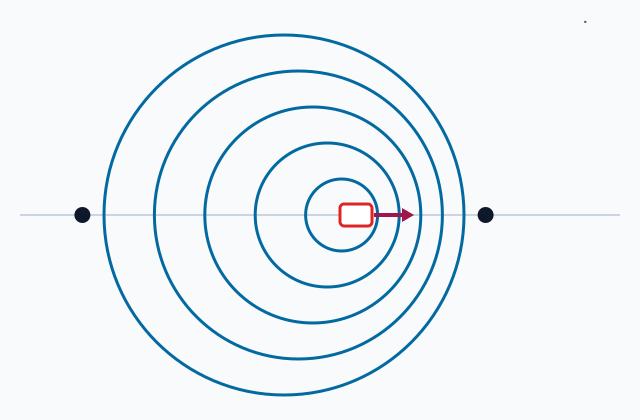
(a) Compare your drawing with the model below. Each wave front is a circle centered where the ambulance was when it sent that front, so the centers step forward along the road. The circles crowd together between the ambulance and A, ahead, and spread apart toward B, behind.
(b) The sound travels at the same speed in every direction through the air. Ahead of the ambulance the crests are closer together, so the wavelength reaching A is shorter than the siren's rest wavelength. With fixed, , so a shorter wavelength means more crests reach A each second: a frequency above the rest frequency. Behind, the crests are farther apart, the wavelength reaching B is longer, and B measures a frequency below the rest frequency.
(c) A hears a higher frequency from the faster ambulance. Moving faster, it travels farther between sending one wave front and the next, so in a drawing like (a) the circles would crowd even closer together ahead of it. That shorter wavelength, at the same speed of sound, means a higher frequency still: a greater relative speed makes a greater difference from the rest frequency.
 Tap to open the picture full size
Score your own answer. This is a self-check, not a grade. Tick each point your answer makes.
Part 6 Check yourself A dipper in a ripple tank
Both case questions use the picture.
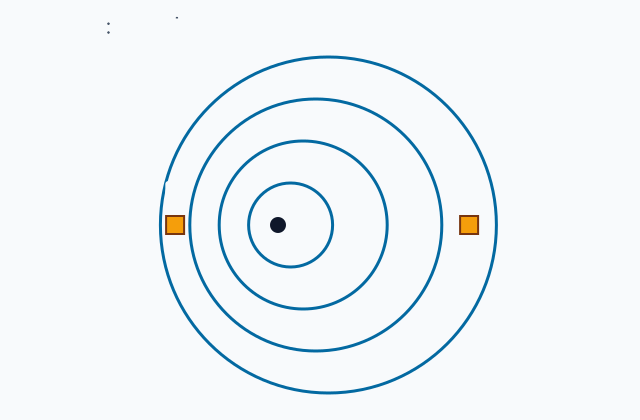
Seen from above, a small dipper moves at a steady speed across a ripple tank of uniform depth, tapping the water at a steady rate. Each circle is one wave front. Two floating sensors, P and Q, sit on the line the dipper moves along, one on each side of it.
Case question 1 · Multiple choice
Using the picture: which way is the dipper moving, and what shows it?
Case question 2 · Decide and justify
Using the picture: a student says that the waves reaching P have a shorter wavelength than the waves reaching Q, while traveling across the water at the same speed. Is she right?
Which reason supports your answer?
The rest stand on their own and do not use the case.
Check yourself · Spot the error
A student describes an ambulance coming straight toward her at a steady speed. Tap the first line that goes wrong.
Check yourself · Select all
In which two situations is the observed frequency greater than the rest frequency? Pick two.
Select 2 answers, then check.
Part 7 Keep it Bring back earlier ideas
The spectrum from the last lesson and the period from 14.2 are still part of the course. Retrieving them now, between new ideas, is what makes them easy to find later.
From 14.4 Electromagnetic Waves · Put it in order
Tap the categories of electromagnetic waves in order, from the longest wavelength to the shortest.
From 14.2 Periodic Waves · Calculate
A violin string vibrates at 250 Hz. What is the period of the sound wave it makes, in milliseconds? Use it to test a friend's claim that each vibration lasts longer than 5 ms.
In three lines
- A moving source bunches its wave fronts ahead and spreads them behind; the wave's speed does not change.
- Moving toward each other, the observed frequency is above the rest frequency; apart, below; with the same velocity, equal.
- A greater relative speed gives a greater difference; for a source moving straight toward or away from you, distance does not change the frequency, only the loudness.
Exam strategy for this topic
- Section I, Multiple Choice: 42 questions in 85 minutes.
- Section II, Free Response: 4 questions in 95 minutes.
- This lesson's Explain it is shaped like free-response question 4, Qualitative/Quantitative Translation.
- A four-function, scientific, or graphing calculator is allowed on both sections of the exam.
Answer a Doppler question in two sentences: first say whether the source and the observer are closing in, holding the same velocity, or pulling apart, then say what that does to the observed frequency compared with the rest frequency. Leave the distance out unless the question is about loudness.
Questions students ask
What is the Doppler effect?
The difference between a source's rest frequency and the frequency an observer measures when the two move relative to each other. Moving toward each other, the observed frequency is higher; moving apart, it is lower.
Does the Doppler effect change the speed of the wave?
No. The medium sets the speed of sound, and light travels at . Motion changes how far apart the crests are, and so how often they reach an observer.
Does the pitch of an approaching siren keep rising?
Not if it comes straight toward you at a steady speed. Its pitch is higher than the siren's own note and steady; it gets louder as it nears, and its pitch drops once it passes.
Does the Doppler effect happen if only the observer moves?
Yes. It depends on the relative motion of the source and the observer. A listener moving toward a source at rest meets its wave fronts more often and hears a higher frequency.
Do I need a Doppler equation for AP Physics 2?
The course framework requires only a qualitative treatment: say whether the observed frequency is higher, lower or the same as the rest frequency, and why.
Course alignment, for teachers
AP Physics 2: Algebra-Based topic 14.5, Unit 14: Waves, Sound, and Physical Optics.
- Skill 1.A: Create diagrams, tables, charts, or schematics to represent physical situations.
- Skill 2.C: Compare physical quantities between two or more scenarios or at different times and locations in a single scenario.
- Skill 3.B: Apply an appropriate law, definition, theoretical relationship, or model to make a claim.
- Skill 3.C: Justify or support a claim using evidence from experimental data, physical representations, or physical principles or laws.
This lesson maps all 5 essential knowledge statements of the topic to the part that teaches each one: 5 are checked by a scored question. The map is in the lesson file.