Unit 14 · Topic 14.6 · about 30 minutes · 7 parts · 12 scored checks, 2 of them multiple choice, plus 2 from earlier lessons
AP Physics 2: Algebra-Based 14.6: Wave Interference and Standing Waves
Unit 14: 12 to 15% of the multiple-choice section
What you'll be able to do
- Describe the net disturbance where two or more pulses or waves overlap: displacements add, constructively or destructively, and two close frequencies produce beats.
- Describe a standing wave: its nodes and antinodes, and how the length and the ends of a string or pipe set the wavelengths and harmonics it allows.
Key vocabulary
| Term | What it means | The exam trap |
|---|---|---|
| Superposition | The rule that where waves overlap, the medium's displacement at each point is the sum of the displacements each wave would cause alone. | Superposition adds displacements, at one point and one instant. It does not add the waves' speeds. |
| Node | A point on a standing wave where the amplitude is always zero. | A node is not just a point the string happens to pass through at one instant; it never moves at all. |
| Antinode | A point on a standing wave where the amplitude is always the largest on the wave. | An antinode is not always displaced; it swings through zero like any other point, with the biggest swing. |
| Fundamental | The standing wave with the longest wavelength a region allows, also called the first harmonic. | The longest wavelength gives the lowest frequency, not the highest. |
| Beats | The regular swelling and fading of loudness heard when two waves of slightly different frequencies overlap. | Beats are a change in loudness, heard over one note, not a change in pitch. |
 Tap to open the picture full size
Part 1 Think first Two pulses on one rope
Commit to a guess first. Being wrong now makes the right idea stick better.
Predict first
Two friends hold the ends of a long rope. At the same moment, one flicks an upward pulse along it and the other flicks a downward pulse of the same size and shape. The pulses meet in the middle. What happens after that?
In short. Wave interference is what happens where two or more waves overlap: the medium's displacement there is the sum of the displacements each wave would cause on its own.
- Displacements in the same direction add to a bigger one (constructive interference); in opposite directions they partly or fully cancel (destructive interference).
- Two waves of slightly different frequencies drift in and out of step, so the loudness swells and fades: beats, at a rate equal to the difference of the frequencies.
- Waves reflecting back and forth in a string or pipe can form a standing wave, whose possible wavelengths are set by the region's length and by what its ends allow.
Part 2 Learn it When waves overlap
6a. Adding displacements
Wave interference is what two or more pulses or waves do when they meet. They do not collide like balls. Each one travels through the other and comes out the far side as it went in.
While they overlap, the medium cannot move two ways at once. Its displacement at each point is the sum of the displacements the pulses would give it on their own. This adding is called superposition, and each displacement keeps its sign: up is positive, down is negative.
- When the displacements are in the same direction, they add to a larger one: constructive interference.
- When they are in opposite directions, they cancel, partly or completely: destructive interference.
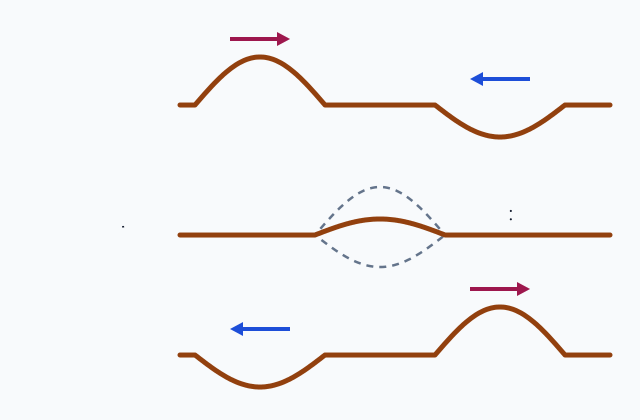
In the picture, a pulse 3 cm tall meets a pulse 2 cm deep. Where their peaks coincide, the rope stands cm up. Two pulses of the same size and shape, one up and one down, would add to zero there for that instant.
Drawing each pulse on its own, dashed, and then adding their heights point by point is the surest way to find the shape of the rope while they overlap.
Quick check · Calculate
Two pulses, identical in width and shape, travel toward each other along a stretched rope. Pulse 1 is an upward pulse 4.0 cm tall, and pulse 2 is a downward pulse 1.5 cm deep. At the instant their peaks are at the same point of the rope, what is the rope's displacement at that point? Take up as positive.
6b. Beats
Strike two tuning forks together, one at 440 Hz and one at 437 Hz. You do not hear two separate notes. You hear one note whose loudness swells and fades, again and again. These are beats, and tuning forks are the usual way to show them.
Beats come from superposition. The two sound waves have slightly different frequencies, so at your ear they drift in and out of step. When they are in phase, crest meeting crest, they add constructively and the sound is loud. A little later one wave has gained half a cycle on the other; they are out of phase, crest meeting trough, and the sound is faint. Then they come back into step. The amplitude of the combined wave rises and falls periodically.
The number of loud moments each second, the beat frequency, is the difference of the two frequencies:
For 440 Hz and 437 Hz that is 3 Hz: three swells every second. The beat frequency tells you how far apart the two frequencies are, but not which one is higher. Musicians tune by listening to beats: as two notes get closer, the beats slow down, and when the notes match, the beats stop.
Quick check · Fill the statement
Complete the explanation of beats. Tap a blank, then an answer.
Two tuning forks with slightly different frequencies sound together. At some moments their waves reach your ear , and the sound is loud; at others they arrive , and the sound is faint. The number of loud moments each second equals the of the two frequencies.
6c. Standing waves
Shake one end of a string tied to a post. Waves run to the post, reflect, and run back, so two waves of the same frequency travel through each other in opposite directions. For the right frequencies they superpose into a standing wave: a pattern that oscillates in place instead of traveling along the string.
A standing wave has two kinds of special point.
- Nodes, where the two waves always cancel. The amplitude there is always zero, so the string never moves. A fixed end is always a node.
- Antinodes, where the two waves always add constructively. The amplitude there is always the largest anywhere on the string.
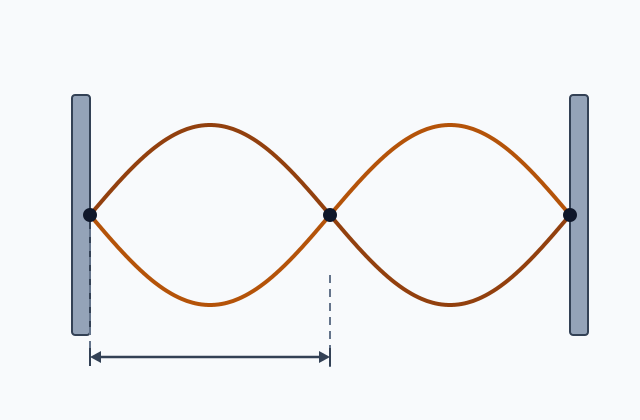
Neighboring nodes are half a wavelength apart, and each antinode sits midway between two nodes. Between them, each point swings up and down with an amplitude somewhere between zero and the antinode's. In the picture the string is one wavelength long, so it has two loops, three nodes and two antinodes.
Every point between two neighboring nodes moves in step: they all reach their highest point together. Nothing travels along the string, even though energy is stored in its motion.
Quick check · Rank it
A string 1.20 m long is fixed at both ends and vibrates in a standing wave with a wavelength of 0.80 m. Point P is 0.20 m from the left end, Q is 0.30 m from it, R is 0.40 m from it and S is 0.60 m from it. Rank the points by the amplitude of their oscillation.
Largest amplitude first
Give each one a place, 1 for first. Give two the same place if they are equal.
Your ranking: none yet
6d. Harmonics on strings and in pipes
A string or pipe holds only the standing waves whose pattern fits its length and its ends. A fixed string end or a closed pipe end is a node; a loose string end or an open pipe end is an antinode.
The standing wave with the longest wavelength that fits is the fundamental, or first harmonic. The next longest is the second harmonic, then the third, and so on. With fixed by the medium, , so a shorter wavelength means a higher frequency.
- Node at both ends (a string fixed at both ends), or antinode at both ends (a pipe open at both ends): the fundamental fits half a wavelength, . Every harmonic is possible, and .
- Node at one end, antinode at the other (a pipe closed at one end): the fundamental fits a quarter wavelength, . Each extra loop adds half a wavelength, so only odd harmonics can form: , , .
Drawing the pattern, the right point at each end and loops between, is the quickest way to connect length, wavelength, frequency, speed and harmonic.
| Region | Its ends | Fundamental wavelength | Harmonics possible |
|---|---|---|---|
| String fixed at both ends | node and node | 2L | every one: 1, 2, 3, ... |
| Pipe open at both ends | antinode and antinode | 2L | every one: 1, 2, 3, ... |
| Pipe closed at one end | node and antinode | 4L | odd only: 1, 3, 5, ... |
Quick check · Select all
In which two of these can only odd harmonics be established? Pick two.
Select 2 answers, then check.
Part 3 Watch it done How long is a closed pipe?
Predict first, then watch each step, then finish the problem yourself.
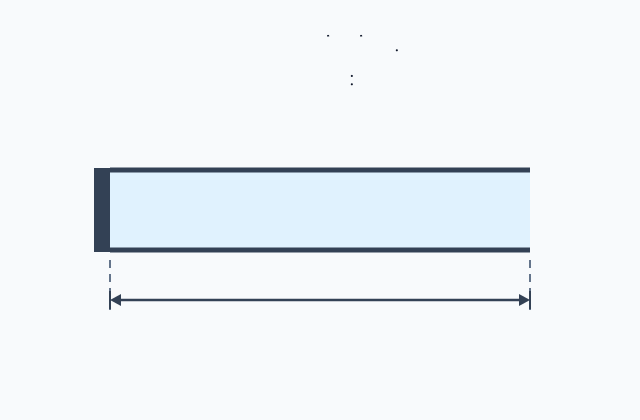
In the picture at the top of this lesson, a pipe is closed at its left end and open at its right. Sound travels at 340 m/s in the air inside, and the lowest frequency at which a standing wave forms in the pipe is 125 Hz. How long is the pipe?
Predict first
Before you open the first step, predict: how long is the pipe?
Step 1 · Mark the ends
The closed end is a node, since the air there cannot move. The open end is an antinode. So every pattern in this pipe has a node at one end and an antinode at the other.
Step 2 · Pick the pattern
The lowest frequency is the fundamental, the longest wavelength that fits. With a node at one end and an antinode at the other, the simplest pattern is a quarter of a wavelength: .
Step 3 · Find the wavelength
m.
Why this step?
Why is the fundamental's pattern a quarter of a wavelength, when a string fixed at both ends starts with a half?
Neighboring nodes are half a wavelength apart, and an antinode sits midway between them, a quarter wavelength from each. A region with a node at one end and an antinode at the other spans the distance from a node to its nearest antinode.
Your step · Calculate
Finish it. A pipe closed at one end and open at the other has a fundamental frequency of 125 Hz, and sound travels at 340 m/s in the air inside, so the fundamental's wavelength is 2.72 m. How long is the pipe?
m
Part 4 Try it Wavelengths, a capped tube and a fork
Predict first: from one harmonic to the next on a string fixed at both ends, does the wavelength fall by the same amount each time, by less each time, or by more each time? Then sketch it, predict what capping a tube does, and judge a claim about beats.
Try it · Sketch the graph
A string 1.50 m long is fixed at both ends. Sketch the wavelength of its standing waves against the harmonic number, from the first harmonic to the fourth. The first point is fixed at 3.00 m, the wavelength of the fundamental.
One shape that fits
Drag a point up or down, or tap it and use the arrow keys. The shape is checked, and so are the values the question lets you work out.
Try it · Multiple choice
A tube open at both ends has a fundamental frequency . A cap is then fitted over one end, and nothing else changes. What is the tube's new fundamental frequency?
Try it · Decide and justify
A tuning fork marked 512 Hz and a second fork with no marking are struck together, and the sound swells and fades 6 times each second. A student says the second fork must vibrate at 518 Hz. Is she right?
Which reason supports your answer?
Part 5 Explain it The harmonics of a guitar string
On the exam this is handwritten, so answer on paper first. Nothing you type here leaves this page. Then check your answer against the model and each scoring point.
Free response is 50% of the exam score. This one is shaped like Question 2, Translation Between Representations.
Free-response practice · Question 2 style
A guitar string of length is fixed at both ends, and waves travel along it at speed .
(a) On paper, draw the string in its third harmonic at its two extreme shapes. Label every node N and every antinode A. Do this by hand before you open the model.
(b) Derive an expression for the frequency of the string's th harmonic in terms of , and .
(c) For one string, m and m/s. On paper, graph against for to , with a scale and units on each axis.
(d) Say whether the shape of your graph in (c) agrees with your expression in (b), and what the slope of the graph tells you about the string.
Model answer
(a) Compare your drawing with the model below. The string forms three equal loops: four nodes, the two fixed ends and two points between, and three antinodes, one in the middle of each loop.
(b) The ends are both nodes, and neighboring nodes are half a wavelength apart, so the th harmonic fits half-wavelengths: , so . Then .
(c) : 200, 400, 600 and 800 Hz. See the graph below: four points on a straight line through the origin.
(d) They agree. The expression says is proportional to , and the points lie on a straight line through the origin. The slope, 200 Hz per harmonic, is , the fundamental frequency of the string.
 Tap to open the picture full size
Frequency of each harmonic against harmonic number
The points lie on a straight line through the origin with a slope of 200 Hz per harmonic.
Score your own answer. This is a self-check, not a grade. Tick each point your answer makes.
Part 6 Check yourself A string driven at 150 Hz
Both case questions use the picture.
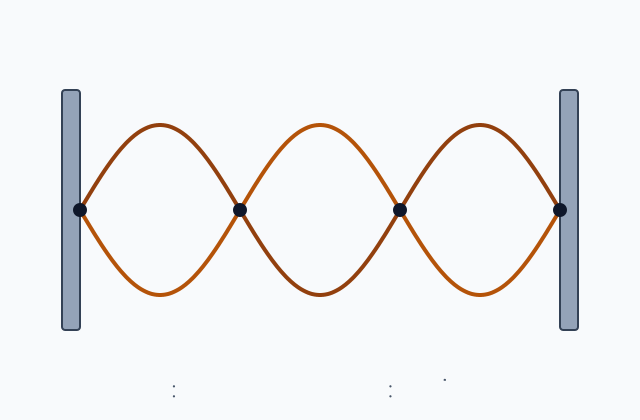
A small vibrator shakes one end of a stretched string at 150 Hz, and the far end is tied to a post. The vibrator moves its end so little that both ends act as fixed points. The picture shows the string at its two extreme shapes.
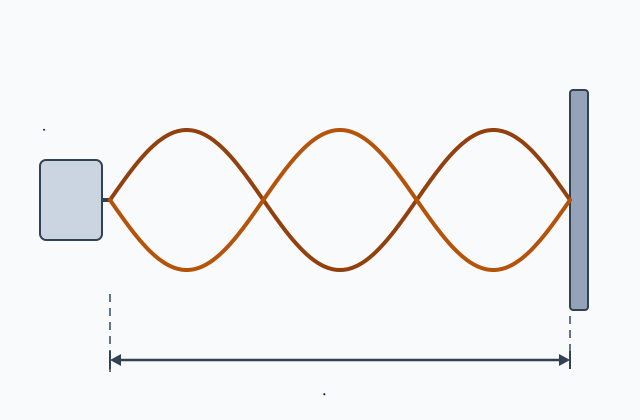
Case question 1 · Calculate
Using the picture: how fast do waves travel along this string?
Case question 2 · Multiple choice
Using the picture: what produces the pattern on the string?
The rest stand on their own and do not use the case.
Check yourself · Spot the error
A student describes two upward pulses, 3 cm and 2 cm tall, that meet on a long rope. Tap the first line that goes wrong.
Check yourself · Put it in order
A student wants to measure the speed of sound in air with a 512 Hz tuning fork and a long tube standing in deep water, so that the water closes its bottom end. She can raise the tube to lengthen the air column. Tap her steps in order.
Part 7 Keep it Bring back earlier ideas
The Doppler effect from the last lesson and reflection at a boundary from 14.3 are still part of the course. Retrieving them now, between new ideas, is what makes them easy to find later.
From 14.5 The Doppler Effect · Select all
In which two situations is the observed frequency greater than the rest frequency? Pick two.
Select 2 answers, then check.
From 14.3 Boundary Behavior of Waves and Polarization · Sort it
Each card describes a pulse on a stretched string or rope reaching a boundary. Tap a card, then how the reflected pulse comes back.
Upright
Inverted
In three lines
- Overlapping waves pass through each other, and the medium's displacement is the sum of theirs: constructive in the same direction, destructive in opposite ones.
- Two close frequencies drift in and out of phase, giving beats at .
- A standing wave has nodes half a wavelength apart; its ends decide the harmonics: every one with alike ends, odd only with a node at one end and an antinode at the other.
Exam strategy for this topic
- Section I, Multiple Choice: 42 questions in 85 minutes.
- Section II, Free Response: 4 questions in 95 minutes.
- This lesson's Explain it is shaped like free-response question 2, Translation Between Representations.
- A four-function, scientific, or graphing calculator is allowed on both sections of the exam.
For any standing-wave question, draw the pattern first: the right kind of point at each end, then loops between. Write the length as a number of half or quarter wavelengths from the drawing, and only then use .
Questions students ask
What is the difference between constructive and destructive interference?
Where overlapping waves displace the medium in the same direction, their displacements add to a larger one: constructive. In opposite directions they cancel, partly or completely: destructive.
Do two waves bounce off each other when they meet?
No. They pass through each other. While they overlap the displacements add, and afterward each wave carries on unchanged.
How do you find the beat frequency?
Subtract the two frequencies: . Two notes at 440 Hz and 436 Hz give 4 beats each second.
Why does a pipe closed at one end have only odd harmonics?
Its closed end is a node and its open end an antinode, so its length must be an odd number of quarter wavelengths: one, three, five. Even harmonics would need the same kind of point at both ends.
How far apart are the nodes of a standing wave?
Neighboring nodes are half a wavelength apart, and each antinode is midway between two nodes, a quarter wavelength from each.
Course alignment, for teachers
AP Physics 2: Algebra-Based topic 14.6, Unit 14: Waves, Sound, and Physical Optics.
- Skill 1.B: Create quantitative graphs with appropriate scales and units, including plotting data.
- Skill 1.C: Create qualitative sketches of graphs that represent features of a model or the behavior of a physical system.
- Skill 2.A: Derive a symbolic expression from known quantities by selecting and following a logical mathematical pathway.
- Skill 2.D: Predict new values or factors of change of physical quantities using functional dependence between variables.
- Skill 3.A: Create experimental procedures that are appropriate for a given scientific question.
- Skill 3.B: Apply an appropriate law, definition, theoretical relationship, or model to make a claim.
This lesson maps all 18 essential knowledge statements of the topic to the part that teaches each one: 18 are checked by a scored question. The map is in the lesson file.