Unit 14 · Topic 14.7 · about 30 minutes · 7 parts · 12 scored checks, 3 of them multiple choice, plus 2 from earlier lessons
AP Physics 2: Algebra-Based 14.7: Diffraction
Unit 14: 12 to 15% of the multiple-choice section
What you'll be able to do
- Describe how a wave spreads as it passes through a single opening, and use the bright and dark bands of its diffraction pattern to find the opening's width or the wave's wavelength.
Key vocabulary
| Term | What it means | The exam trap |
|---|---|---|
| Diffraction | The spreading of a wave around the edges of an obstacle or through an opening. | Diffraction is not light bouncing off the sides of an opening; it is the wave spreading out in the open space beyond it. |
| Monochromatic | Made of a single wavelength, as a laser's light is. | Monochromatic describes the wavelength, not how bright the light is. |
| Path length difference | How much farther one wave travels than another to reach the same point, written . | It is a difference in the distances the waves travel, not the distance between the two points they start from. |
| Small-angle approximation | For angles under about 10°, , so a sine can be replaced by a distance on the screen divided by the screen's distance. | It needs the angle checked first; on a near screen with a wide pattern it fails. |
 Tap to open the picture full size
Part 1 Think first A laser through a narrowing slit
Commit to a guess first. Being wrong now makes the right idea stick better.
Predict first
A laser shines through a narrow slit in a piece of foil and makes a bright stripe on a far wall. The slit is then made narrower, and nothing else changes. What happens to the bright stripe in the middle of the wall?
In short. Diffraction is the spreading of a wave as it passes through an opening or around the edge of an obstacle, and it is strongest when the opening is about as wide as the wavelength.
- Waves from different parts of one opening travel different distances to a screen, and their interference makes bright and dark bands there.
- The path length difference between waves from the two edges is ; a dark band forms where it is a nonzero whole number of wavelengths: one, two, three and so on.
- For angles under 10°, links the slit's width, the wavelength, the screen's distance and where the dark bands fall.
Part 2 Learn it Waves through one opening
7a. Spreading through an opening
Ocean waves passing through a gap in a harbor wall spread out in arcs behind it, instead of going on as a straight strip the width of the gap. This spreading of a wave around the edges of an obstacle, or through an opening, is diffraction.
How much a wave spreads depends on the size of the opening compared with the wavelength. Diffraction is most pronounced when the opening is about as wide as the wavelength. Through an opening many wavelengths wide, a wave goes on nearly straight.
Most of the sound of speech and music has wavelengths from about 10 centimeters to a few meters, comparable to a doorway, so sound spreads out through a doorway. Visible light has wavelengths of a few hundred nanometers, millions of times smaller than a doorway, so a doorway casts a sharp-edged shadow. Make the opening a slit a fraction of a millimeter wide, and light spreads too.
The shape of the opening shapes the pattern. A wave spreads most across an opening's narrowest direction, so a long thin slit spreads light into a row of bands at right angles to the slit, while a small round hole spreads it into rings.
Quick check · Sort it
Each card describes a wave passing through an opening. Tap a card, then how much the wave spreads out beyond the opening.
Spreads out a lot
Spreads very little
7b. Bright and dark bands from one slit
Shine monochromatic light, one wavelength , through a narrow slit of width onto a screen a distance away. The screen shows a wide bright band in the middle, then dark and dimmer bright bands on each side.
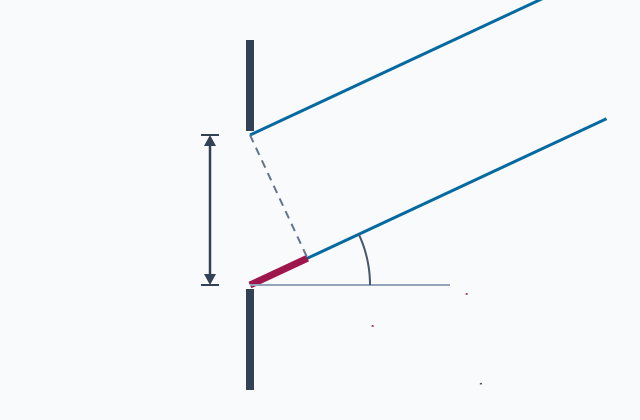
Every point across the slit sends wavefronts forward, and they overlap at the screen. Waves heading straight through all travel the same distance, so they arrive in step and add: the bright middle. Toward a direction at angle , waves from different parts of the slit travel different distances. The amount they interfere depends on that path length difference . Between the two edges of the slit, as the picture shows,
Where , split the slit into a top half and a bottom half. Each point in the top half has a partner half a slit lower whose path is longer by . Each pair arrives out of phase and cancels, and so does every other pair: a dark band. The same pairing works with quarters of the slit where , and so on. Between dark bands the waves only partly cancel, leaving the dimmer bright bands.
Quick check · Fill the statement
Complete the reasoning for the first dark band beside the middle of a single-slit pattern. Tap a blank, then an answer.
At the first dark band, the path length difference between waves from the two edges of the slit, , is . Split the slit into a top half and a bottom half: each wave from the top half has a partner from the bottom half whose path is longer by . Each pair arrives , so every pair cancels.
7c. Measuring the pattern
Dark bands fall where , with counted out from the middle. On a screen we measure distances, not angles. Call the distance from the middle of the central bright band to the th dark band. When the angle is small, under about 10°, , and
So the dark bands are evenly spaced, apart, and the central bright band, from the first dark band on one side to the first on the other, is wide: twice as wide as the others.
That expression says how the pattern responds:
- A narrower slit gives a wider pattern, since is proportional to .
- A longer wavelength gives a wider pattern: red light spreads more than blue through the same slit.
- A farther screen gives a wider pattern, in proportion to .
Run it the other way and the pattern measures the slit. Know and , measure , and follows; or know and find . The angle check matters: for a wide pattern on a near screen the approximation fails.
Quick check · Rank it
Five single-slit patterns are made on one screen, each the same distance from its slit, and every angle stays under 10°. Rank the patterns by the width of their central bright band.
Widest central band first
Give each one a place, 1 for first. Give two the same place if they are equal.
Your ranking: none yet
Part 3 Watch it done How wide is the slit?
Predict first, then watch each step, then finish the problem yourself.
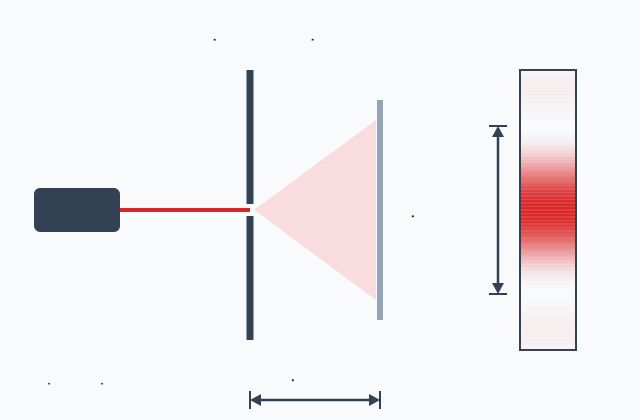
In the picture at the top of this lesson, laser light with a wavelength of 600 nm passes through a single slit onto a screen 2.00 m away. The central bright band, from the dark band on one side of it to the dark band on the other, is 2.40 cm wide. How wide is the slit?
Predict first
Before you open the first step, predict: how does the slit's width compare with the light's wavelength?
Step 1 · Read the dark band's distance
The first dark band on each side is the dark band, and is measured from the middle of the central band. So cm m.
Step 2 · Check the small angle
, so , far under 10°. The approximation holds.
Why this step?
Why halve the 2.40 cm instead of using it as it stands?
The 2.40 cm spans from the first dark band on one side to the first dark band on the other. The pattern is symmetric about its middle, and runs from the middle to one dark band, so it is half that span.
Your step · Calculate
Finish it. Laser light with a wavelength of 600 nm passes through a single slit onto a screen 2.00 m away, and the first dark band is 1.20 cm from the middle of the central bright band. Using the small-angle approximation, how wide is the slit? Give your answer in millimeters.
mm
Part 4 Try it Water, a gap in a wall and a rectangular hole
Predict first: if a laser, a single slit and its screen were all sunk in a tank of water, would the central bright band get wider, get narrower, or stay the same? Then judge a claim about it, work out a factor of change, compare three notes passing through a gap, and predict the pattern from a rectangular hole.
Try it · Decide and justify
A laser, a single slit and a screen are all sunk in a tank of water, where the laser light's wavelength is shorter than in air. Nothing else changes. A student says the central bright band gets narrower. Is she right?
Which reason supports your answer?
Try it · Calculate
Light passes through a single slit and makes a pattern whose angles are all under 10°. The slit is replaced by one half as wide, and the screen is moved twice as far from the slit; the light does not change. By what factor does the width of the central bright band change?
Try it · Multiple choice
A speaker behind a garden wall plays three notes in turn, all equally loud: a low 170 Hz hum, a 680 Hz tone and a high 6800 Hz whistle. You stand on the other side of the wall, off to one side of a gap 0.50 m wide. Sound travels at 340 m/s. Which note spreads least through the gap toward you?
Try it · Multiple choice
Laser light passes through a small rectangular hole, 0.05 mm wide and 0.20 mm tall, and falls on a far screen. How does the light spread out on the screen?
Part 5 Explain it The width of a central band
On the exam this is handwritten, so answer on paper first. Nothing you type here leaves this page. Then check your answer against the model and each scoring point.
Free response is 50% of the exam score. This one is shaped like Question 1, Mathematical Routines.
Free-response practice · Question 1 style
Light of wavelength passes through a single slit of width and falls on a screen a distance away.
(a) Derive an expression for the width of the central bright band, in terms of , and . State the approximation you use and when it holds.
(b) A green laser with a wavelength of 532 nm shines through a slit 0.050 mm wide onto a screen 1.20 m away. Calculate , and show that the approximation in (a) holds.
(c) A student says that a slit 0.025 mm wide would make the central band narrower, because less light gets through it. Using your expression from (a), justify whether the student is right.
Model answer
(a) The central band runs from the first dark band on one side to the first on the other. The first dark band is where the edges' path length difference is one wavelength, . For angles under about 10°, , so and .
(b) m, about 2.55 cm. Then , so , far under 10°.
(c) The student is wrong. is proportional to , so halving the slit's width doubles , to about 5.11 cm. Less light does get through, so the band is dimmer, but it spreads wider.
Score your own answer. This is a self-check, not a grade. Tick each point your answer makes.
Part 6 Check yourself Reading a single-slit pattern
Both case questions use the graph.
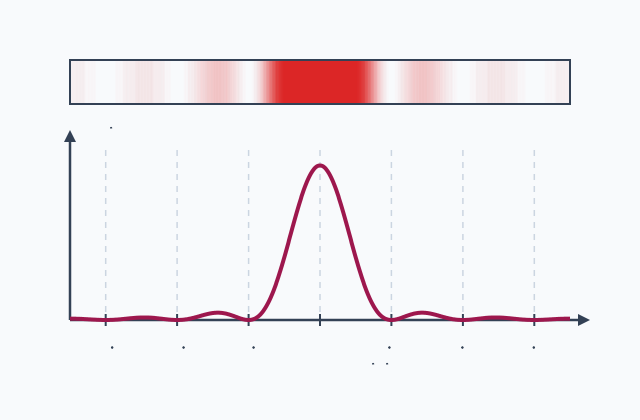
A laser shines through a single slit 0.080 mm wide onto a screen 1.50 m away. The graph shows the brightness across the pattern on the screen, measured from its middle.
Case question 1 · Multiple choice
Using the graph: let be the distance from the middle of the pattern to the dark band at +2.4 cm. Which expression gives the wavelength of the light, in terms of , the slit's width and the screen's distance ?
Case question 2 · Calculate
Using the graph: what is the wavelength of the laser light? Give your answer in nanometers.
The rest stand on their own and do not use the case.
Check yourself · Spot the error
A student works out the pattern that 500 nm light makes through a slit 0.25 mm wide on a screen 2.0 m away. Tap the first line that goes wrong.
Check yourself · Sort it
A laser shines through a single slit onto a screen, and every angle in the pattern stays under 10°. Each card makes a change and leaves everything else as it was. Tap a card, then what happens to the width of the central bright band.
It gets wider
It gets narrower
It stays the same
Part 7 Keep it Bring back earlier ideas
Superposition from the last lesson and the colors of the spectrum from 14.4 are still part of the course. Retrieving them now, between new ideas, is what makes them easy to find later.
From 14.6 Wave Interference and Standing Waves · Calculate
Two pulses, identical in width and shape, travel toward each other along a stretched rope. Pulse 1 is an upward pulse 4.0 cm tall, and pulse 2 is a downward pulse 1.5 cm deep. At the instant their peaks are at the same point of the rope, what is the rope's displacement at that point? Take up as positive.
From 14.4 Electromagnetic Waves · Rank it
Four beams travel through a vacuum: red light, green light, violet light and an infrared beam. Rank them by frequency.
Highest frequency first
Give each one a place, 1 for first. Give two the same place if they are equal.
Your ranking: none yet
In three lines
- Diffraction is a wave spreading through an opening or around an edge, most pronounced when the opening is comparable to the wavelength.
- Across one slit, the edges' path length difference is ; dark bands form where it is .
- For angles under 10°, : a narrower slit, longer wavelength or farther screen widens the pattern.
Exam strategy for this topic
- Section I, Multiple Choice: 42 questions in 85 minutes.
- Section II, Free Response: 4 questions in 95 minutes.
- This lesson's Explain it is shaped like free-response question 1, Mathematical Routines.
- A four-function, scientific, or graphing calculator is allowed on both sections of the exam.
When a single-slit question gives a band's width, decide first whether it is the whole central band or the distance from the middle to one dark band. Write with the of that dark band, convert every length to meters, and say the angle is under 10°.
Questions students ask
What is diffraction?
The spreading of a wave around the edges of an obstacle or through an opening. It is most pronounced when the opening is about as wide as the wavelength.
Why can you hear around a corner but not see around it?
Most sound of speech and music has wavelengths from about 10 centimeters to a few meters, comparable to a doorway, so sound spreads through it. Light's wavelengths are hundreds of nanometers, so through a doorway it goes almost straight.
Does a narrower slit make a narrower diffraction pattern?
No, a wider one. The distance to each dark band is , so it grows as the slit's width shrinks.
Where do the dark bands of a single slit fall?
Where the path length difference between waves from the two edges, , is a nonzero whole number of wavelengths: one, two, three and so on. For small angles that is , with
Why is the central bright band twice as wide as the others?
It runs from the first dark band on one side to the first on the other, , while each other bright band lies between two neighboring dark bands, apart.
Course alignment, for teachers
AP Physics 2: Algebra-Based topic 14.7, Unit 14: Waves, Sound, and Physical Optics.
- Skill 2.A: Derive a symbolic expression from known quantities by selecting and following a logical mathematical pathway.
- Skill 2.B: Calculate or estimate an unknown quantity with units from known quantities, by selecting and following a logical computational pathway.
- Skill 2.D: Predict new values or factors of change of physical quantities using functional dependence between variables.
This lesson maps all 10 essential knowledge statements of the topic to the part that teaches each one: 10 are checked by a scored question. The map is in the lesson file.