Unit 14 · Topic 14.8 · about 30 minutes · 7 parts · 11 scored checks, 3 of them multiple choice, plus 2 from earlier lessons
AP Physics 2: Algebra-Based 14.8: Double-Slit Interference and Diffraction Gratings
Unit 14: 12 to 15% of the multiple-choice section
What you'll be able to do
- Describe the pattern made by light passing through two or more openings, explaining each bright and dark fringe by the path length difference, and use the fringes to find a wavelength or a slit separation.
Key vocabulary
| Term | What it means | The exam trap |
|---|---|---|
| Slit separation | The distance between the centers of two neighboring slits. | The slit separation is not the width of a slit; each slit is much narrower than the distance between them. |
| Fringe | One of the bright or dark bands in an interference pattern. | A fringe is a band of light or darkness on the screen, not the slit or the beam of light that makes it. |
| Order | The whole number that labels a bright fringe or maximum, counted out from the center. | The same order appears on both sides of the center, at the same distance from it. |
| Diffraction grating | A collection of many evenly spaced parallel slits or openings. | Its maxima use the same condition as two slits, so do not swap in the single-slit condition. |
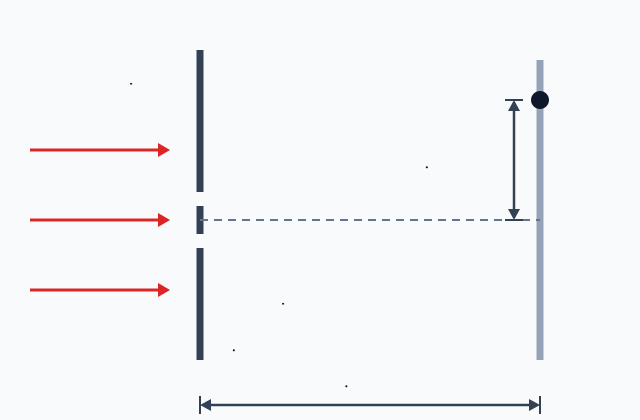 Tap to open the picture full size
Part 1 Think first Opening the second slit
Commit to a guess first. Being wrong now makes the right idea stick better.
Predict first
A laser shines on two narrow slits that are very close together. With one slit covered, the far wall shows one broad patch of light. Then the second slit is uncovered as well. What does the wall show now?
In short. In a double-slit pattern, a point on the screen is bright or dark according to the path length difference: how much farther light travels to it from one slit than from the other.
- With two slits, a path length difference of a whole number of wavelengths, zero included, gives a bright fringe; a whole number plus a half gives a dark fringe.
- For a far screen, , and for angles under 10° the bright fringes are evenly spaced: .
- A diffraction grating has many evenly spaced slits, so its bright maxima are sharp; white light splits into colors there, with red farthest from the center.
Part 2 Learn it Two slits and many
8a. Two paths to one point
Shine monochromatic light of wavelength on two narrow slits a distance apart. Each slit diffracts the light, so light from both spreads out and overlaps on the screen, and there the two waves interfere. The pattern comes from diffraction and interference together.
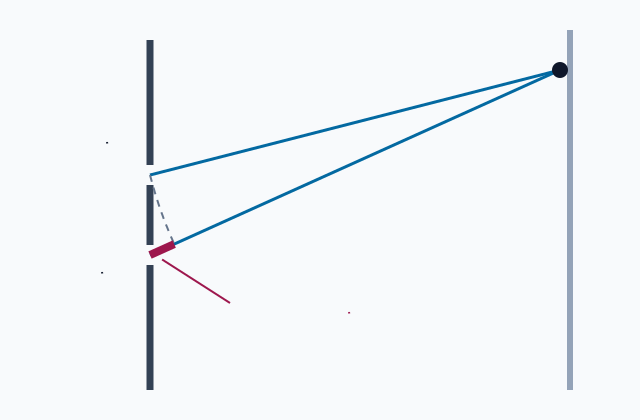
Pick any point P on the screen. Light from one slit has traveled farther to reach P than light from the other, by the path length difference , marked in the picture. That difference decides what P looks like.
- is a whole number of wavelengths, : the waves arrive crest on crest, interfere constructively, and P is in a bright fringe.
- is a whole number plus a half, : crest meets trough, they cancel, and P is in a dark fringe.
For a screen far away compared with , the two paths are nearly parallel, and , with measured from straight ahead.
This is Young's double-slit experiment. Light from two slits adding up to darkness is something only waves do, so the pattern showed that light has wave properties.
Quick check · Sort it
Light with a wavelength of 600 nm passes through two narrow slits onto a screen. Each card gives how much farther light travels to a point on the screen from one slit than from the other. Tap a card, then what is at that point.
The middle of a bright fringe
The middle of a dark fringe
8b. Where the bright fringes fall
Bright fringes form where the path length difference is a whole number of wavelengths:
The central bright fringe, straight ahead, is , and the order counts outward on each side.
On the screen we measure distances. Call the distance from the middle of the central bright fringe to the middle of the th bright fringe. For small angles, under about 10°, , so
Each step up in adds the same distance, . Considering interference alone, then, a double slit makes evenly spaced bright fringes, with a dark fringe midway between each pair.
That even spacing makes the pattern a measuring tool. Measure the distance across several fringes and divide to get the spacing; then with and known, follows, or with known, . Slits closer together spread the fringes farther apart, and a longer wavelength does too.
Quick check · Calculate
Light with a wavelength of 500 nm passes through two slits 0.25 mm apart onto a screen 3.0 m away. Using the small-angle approximation, how far is the middle of the bright fringe from the middle of the central bright fringe? Give your answer in millimeters.
8c. The single-slit envelope
Interference alone predicts bright fringes of equal brightness all along the screen. A real double-slit pattern is not like that. The fringes are brightest near the middle, fade toward the edges, and then disappear for a stretch.
The reason is that each slit has its own width, and each one makes the single-slit diffraction pattern of the last lesson. The interference fringes from the two slits sit inside that pattern, which acts as an envelope: where one slit sends light strongly, the fringes are bright, and where a single slit would send no light at all, the fringes vanish.
Two different sizes set two different features:
- The slit separation sets the fringe spacing, .
- The width of each slit sets the envelope's width: its first dark band is from the middle.
Since the slits are always narrower than the distance between them, the envelope is wider than the fringe spacing, and several fringes fit inside its central band. Narrower slits widen the envelope, so more fringes fit inside it, without moving the fringes.
Quick check · Multiple choice
In a double-slit setup, the two slits are replaced by two narrower slits whose centers are still 0.20 mm apart, and nothing else changes. What happens to the pattern on the screen?
8d. Diffraction gratings
A diffraction grating is a collection of many evenly spaced parallel slits; a typical grating has thousands in each centimeter. Its pattern is the combination of the diffraction patterns of all those slits laid over one another.
Neighboring slits are a distance apart, so bright maxima appear where , at the same angles as for two slits with that separation. With so many slits, though, light cancels almost everywhere else, so the maxima are much sharper and brighter, with wide dark spaces between. Grating angles are often large, so use itself, not the small-angle shortcut.
Send white light through a grating. At , straight ahead, every wavelength has zero path length difference, so every color arrives in step: the central maximum is white. In each higher order, each wavelength has its own angle, , so the colors separate into a rainbow. The longest wavelengths, red, land farthest from the center, and violet nearest.
Quick check · Rank it
White light falls on a diffraction grating, and the pattern appears on a screen. Rank these places in the pattern by their distance from the middle of the pattern.
Farthest from the middle first
Give each one a place, 1 for first. Give two the same place if they are equal.
Your ranking: none yet
Part 3 Watch it done Bright or dark at P?
Predict first, then watch each step, then finish the problem yourself.
In the picture at the top of this lesson, light with a wavelength of 480 nm passes through two slits 0.060 mm apart onto a screen 1.50 m away. Point P is 3.00 cm from the middle of the central bright fringe. Is P bright or dark, and which fringe is it in?
Predict first
Before you open the first step, predict: what is at P?
Step 1 · Check the angle
, so , under 10°. So .
Step 2 · Find the path length difference
m, or 1200 nm. Light from the farther slit travels 1200 nm more to reach P.
Why this step?
Why compare the 1200 nm with the wavelength instead of judging it on its own?
What matters is whether the two waves arrive in step, and that depends on how many wavelengths the extra distance holds. An extra distance of whole wavelengths puts crest on crest; whole wavelengths plus a half puts crest on trough. The same 1200 nm could mean bright for one wavelength and dark for another.
Your step · Multiple choice
Finish it. In a double-slit pattern made by 480 nm light, light from one slit travels 1200 nm farther to point P than light from the other. What is at P?
Part 4 Try it A claim about Q, and a sketch
Predict first: with 500 nm light, at a point that light from one slit reaches by a path 1750 nm longer than light from the other, is there a bright fringe, a dark fringe, or something in between? Then judge a student's claim about that point, and sketch where the bright fringes fall.
Try it · Decide and justify
Light with a wavelength of 500 nm passes through two slits onto a screen. At point Q, light from one slit has traveled 1750 nm farther than light from the other. A student says Q is the middle of a bright fringe, because light from both slits reaches it. Is the student right?
Which reason supports your answer?
Try it · Sketch the graph
Light with a wavelength of 500 nm passes through two slits 0.20 mm apart onto a screen 2.0 m away. Using the small-angle approximation, sketch the distance from the middle of the central bright fringe to the middle of the mth bright fringe against m, from m = 0 to m = 3. The first point is fixed at 0, the central fringe itself.
One shape that fits
Drag a point up or down, or tap it and use the arrow keys. The shape is checked, and so are the values the question lets you work out.
Part 5 Explain it Measuring a laser's wavelength
On the exam this is handwritten, so answer on paper first. Nothing you type here leaves this page. Then check your answer against the model and each scoring point.
Free response is 50% of the exam score. This one is shaped like Question 3, Experimental Design and Analysis.
Free-response practice · Question 3 style
A student wants to find the wavelength of a red laser. She has a double slit with a slit separation of 0.15 mm, a screen she can move, and a meter stick.
(a) Describe a procedure she could use to collect data for a graph whose slope gives the wavelength. Say what she changes, what she measures, and one step that reduces experimental uncertainty.
(b) Her results are below: is the distance from the slits to the screen, and the spacing between neighboring bright fringes. Describe what she should plot on each axis so that the slope of a straight best-fit line gives the wavelength, and explain why. Then make that graph on paper, with a scale on each axis, and draw a best-fit line. Do this by hand before you open the model.
- 1.00 m and 4.4 mm
- 1.50 m and 6.4 mm
- 2.00 m and 8.7 mm
- 2.50 m and 10.9 mm
- 3.00 m and 12.9 mm
(c) Use your best-fit line to calculate the wavelength of the laser.
(d) In terms of the path length difference, explain why the first bright fringe beside the central one is bright.
Model answer
(a) Set the laser, the slits and the screen in a line, and measure from the slits to the screen. Mark the middles of several bright fringes, measure the distance across, say, ten spacings, and divide by ten to get . Repeat at four or five other screen distances. Measuring across many fringes rather than one reduces the uncertainty in each spacing.
(b) From , neighboring bright fringes are apart. So plot on the vertical axis against on the horizontal axis: the points fall on a straight line through the origin with slope . See the graph below.
(c) From (1.20 m, 5.22 mm) and (2.80 m, 12.10 mm) on the line, the slope is . Then m, about 645 nm.
(d) At the middle of that fringe, light from the farther slit travels exactly one wavelength more than light from the nearer slit. So the two waves arrive crest on crest, in phase, and interfere constructively.
Fringe spacing against screen distance, with the best-fit line
The line passes very near the origin and through (2.80 m, 12.10 mm).
Score your own answer. This is a self-check, not a grade. Tick each point your answer makes.
Part 6 Check yourself Reading a double-slit pattern
Both case questions use the graph.
Light with a wavelength of 520 nm passes through two narrow slits 0.13 mm apart onto a screen 2.00 m away. The graph shows the brightness across the pattern, measured from its middle. Point P is marked on the screen.
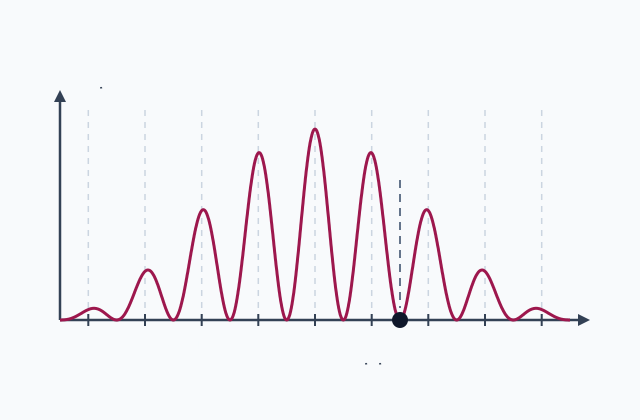
Case question 1 · Calculate
Using the graph: how much farther does light travel to P from one slit than from the other? Give your answer in nanometers.
Case question 2 · Multiple choice
Using the graph: the slits are replaced by a pair half as far apart, each slit as wide as before, and nothing else changes. What happens to the pattern?
The rest stand on their own and do not use the case.
Check yourself · Select all
A student wants to test whether light behaves as a wave. She has two narrow slits that she can cover one at a time, a screen, and two lasers of different colors whose wavelengths she knows. Which two steps would give her evidence that light has wave properties? Pick two.
Select 2 answers, then check.
Check yourself · Spot the error
A student decides what is at a point on the screen of a double-slit setup lit by 450 nm light. Tap the first line that goes wrong.
Part 7 Keep it Bring back earlier ideas
The single slit from the last lesson and the Doppler effect from 14.5 are still part of the course. Retrieving them now, between new ideas, is what makes them easy to find later.
Predict first: if a laser, a single slit and its screen were all sunk in a tank of water, would the central bright band get wider, get narrower, or stay the same? Then judge a claim about it, work out a factor of change, compare three notes passing through a gap, and predict the pattern from a rectangular hole.
From 14.7 Diffraction · Calculate
Light passes through a single slit and makes a pattern whose angles are all under 10°. The slit is replaced by one half as wide, and the screen is moved twice as far from the slit; the light does not change. By what factor does the width of the central bright band change?
Predict first: does a parked car's alarm sound higher-pitched, lower-pitched or the same pitch when you stand right beside it rather than across a parking lot? Then decide a claim, and complete the reason the pitch shifts ahead of a moving source.
From 14.5 The Doppler Effect · Fill the statement
Complete the reason a moving siren sounds higher ahead of it. Tap a blank, then an answer.
Ahead of a moving siren, its wave fronts are , so the wavelength there is . The speed of sound in the air , so more crests reach a listener each second, and the frequency she hears is than the siren's rest frequency.
In three lines
- At any point on the screen, the path length difference decides the fringe: whole wavelengths bright, a whole number plus a half dark.
- , and for angles under 10° the bright fringes are evenly spaced, apart, inside each slit's diffraction envelope.
- A grating's many slits make sharp maxima; with white light the center is white and each higher order is a spectrum with red farthest out.
Exam strategy for this topic
- Section I, Multiple Choice: 42 questions in 85 minutes.
- Section II, Free Response: 4 questions in 95 minutes.
- This lesson's Explain it is shaped like free-response question 3, Experimental Design and Analysis.
- A four-function, scientific, or graphing calculator is allowed on both sections of the exam.
When a question asks why a point is bright or dark, write the path length difference in wavelengths before anything else: a whole number means the waves arrive in phase, a whole number plus a half means they cancel. Then say which fringe it is, counting from the central one as .
Questions students ask
What decides whether a point in a double-slit pattern is bright or dark?
The path length difference, how much farther light travels to that point from one slit than from the other. A whole number of wavelengths gives a bright fringe; a whole number plus a half gives a dark one.
Why are double-slit fringes evenly spaced?
For small angles, , so each step up in order adds the same distance, .
Why do the fringes fade toward the edges of the pattern?
Each slit has a width and makes its own single-slit diffraction pattern. The interference fringes sit inside that envelope, bright where one slit sends light strongly and missing where it sends none.
What did Young's double-slit experiment show?
That light has wave properties. Dark fringes appear where light from two slits overlaps, and only waves can add to darkness.
Why is red light farthest from the center in a grating's spectrum?
In each order, , so the longest wavelength has the largest angle. In the central maximum every color has zero path length difference, so the center is white.
Course alignment, for teachers
AP Physics 2: Algebra-Based topic 14.8, Unit 14: Waves, Sound, and Physical Optics.
- Skill 1.B: Create quantitative graphs with appropriate scales and units, including plotting data.
- Skill 2.A: Derive a symbolic expression from known quantities by selecting and following a logical mathematical pathway.
- Skill 2.B: Calculate or estimate an unknown quantity with units from known quantities, by selecting and following a logical computational pathway.
- Skill 2.D: Predict new values or factors of change of physical quantities using functional dependence between variables.
- Skill 3.A: Create experimental procedures that are appropriate for a given scientific question.
This lesson maps all 11 essential knowledge statements of the topic to the part that teaches each one: 11 are checked by a scored question. The map is in the lesson file.