Unit 14 · Topic 14.9 · about 30 minutes · 7 parts · 11 scored checks, 3 of them multiple choice, plus 2 from earlier lessons
AP Physics 2: Algebra-Based 14.9: Thin-Film Interference
Unit 14: 12 to 15% of the multiple-choice section
What you'll be able to do
- Describe how light reflected from the two surfaces of a thin film interferes, using the indices of refraction, any phase changes, the film's thickness and the wavelength, and explain soap-film colors and antireflection coatings.
Key vocabulary
| Term | What it means | The exam trap |
|---|---|---|
| Thin film | A layer of material whose thickness is comparable to the wavelength of light, such as a coating on a lens. | Thin here means comparable to a wavelength of light, a few hundred nanometers, not just thinner than paper. |
| Phase | Where a wave is in its cycle at a given place and time: at a crest, at a trough, or between. | Two waves can have the same frequency and still be out of phase. |
| Antireflection coating | A thin layer on a lens or screen that reduces the light it reflects. | A coating cancels the reflection of one wavelength most strongly and of others less, so a coated lens still reflects a little colored light. |
 Tap to open the picture full size
Part 1 Think first Colors on a soap bubble
Commit to a guess first. Being wrong now makes the right idea stick better.
Predict first
A soap bubble drifting in sunlight shows swirling bands of color, though the soapy water it was blown from looks clear. Where do the colors come from?
In short. Thin-film interference is the interference of light reflected from the two surfaces of a layer whose thickness is comparable to the light's wavelength.
- Light reflecting from a medium with a greater index of refraction is shifted half a cycle (180°); reflecting from a lower index, or passing through a surface, it is not.
- At normal incidence the light from the back surface travels farther, measured in wavelengths in the film, and the phase shifts decide whether that extra path makes the reflections add or cancel.
- Film thickness picks which colors a soap bubble or oil slick reflects, and a coating a quarter wavelength thick, with an index between air's and the glass's, cancels reflection.
Part 2 Learn it Light in a thin film
9a. A half-cycle flip on reflection
When light reaches the boundary between two media, some of it is transmitted into the new medium, some is reflected, and some is absorbed.
The reflected light can come back shifted in phase. Which way it goes depends on the indices of refraction of the two media.
- Reflecting from a medium with a greater index than the one the light is traveling in, the light is shifted by half a cycle, a phase change of 180°: where a crest arrived, a trough leaves.
- Reflecting from a medium with a lower index, there is no phase change.
This is the same rule you saw for pulses on a rope in 14.3. A pulse reflecting from a heavier rope, where waves travel slower, comes back inverted; from a lighter rope it comes back upright. Light travels slower in a medium with a greater index, so the same thing happens.
The transmitted light is different again. Light that refracts into a new medium keeps its phase: it changes speed and wavelength, but no shift is added at the surface.
So light in air reflecting from water flips, while light inside water reflecting from the air above does not.
Quick check · Sort it
Each card describes light meeting a surface. Tap a card, then what happens to the phase of the light described.
Shifted by half a cycle
No phase change
9b. Two reflections from one film
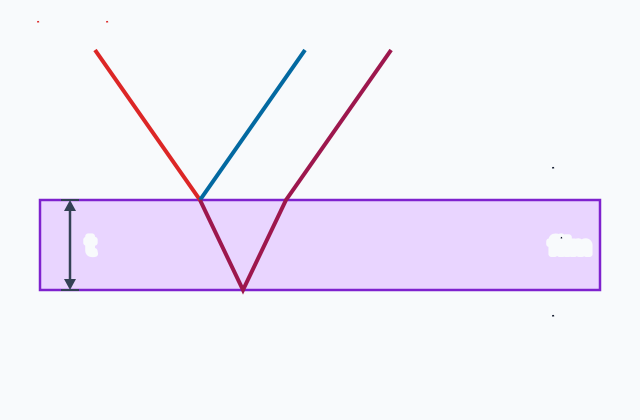
A thin film is a layer whose thickness is comparable to the wavelength of light: a soap film, a layer of oil, a coating on a lens. Light striking it reflects twice. Ray 1 reflects from the top surface. The rest enters the film, reflects from the bottom surface, and comes back out as ray 2. The two overlap and add into one reflected wave.
How much they reinforce or cancel depends on four things: the film's thickness , the wavelength, any phase shifts, and the angle the light strikes at. For light striking straight on, ray 2 travels farther, down and back, all of it inside the film. There the wavelength is shorter, , so measure in film wavelengths.
Then count the half-cycle shifts.
- One of the two reflections shifted: the reflection is bright when and dark when .
- Neither or both shifted: the shifts make no difference between the rays, so the reflection is bright when and dark when .
Quick check · Fill the statement
A soap film hangs in air, and light strikes it straight on. Complete the statements. Tap a blank, then an answer.
Light reflecting from the front surface of the film is . Light reflecting from the back surface is . The light from the back surface also travels a distance of the film's thickness more than the light from the front.
9c. Bubbles, oil slicks and coatings
In white light, a thin film reflects some wavelengths bright and cancels others, depending on its thickness, so where the thickness changes, the color changes. That is why a soap film draining in an upright loop, thinner at the top than the bottom, shows bands of color that run across it.
Antireflection coatings use the same physics to make reflections cancel. A camera lens is coated with a thin layer whose index of refraction is greater than air's and less than the glass's. Then both reflections are from a greater index, so both are shifted half a cycle, and the two shifts make no difference between them.
With neither shift counting, the reflections cancel when ray 2's extra path is half a wavelength in the coating: . So the simplest coating is a quarter of the wavelength in the coating thick, , for light striking straight on.
Light that does not reflect is transmitted into the glass, so a coated lens passes more light. A coating cancels the reflection of one wavelength most strongly and of others less, so the faint reflection from a coated lens often looks purple: the coating is tuned to green, and some red and violet still reflect.
Quick check · Multiple choice
A lens of glass with an index of refraction of 1.52 has a coating of index 1.38, a quarter of a wavelength thick in the coating, and light strikes it straight on. Why do the light reflected from the top of the coating and the light reflected from the glass interfere destructively?
Part 3 Watch it done The thinnest bright soap film
Predict first, then watch each step, then finish the problem yourself.
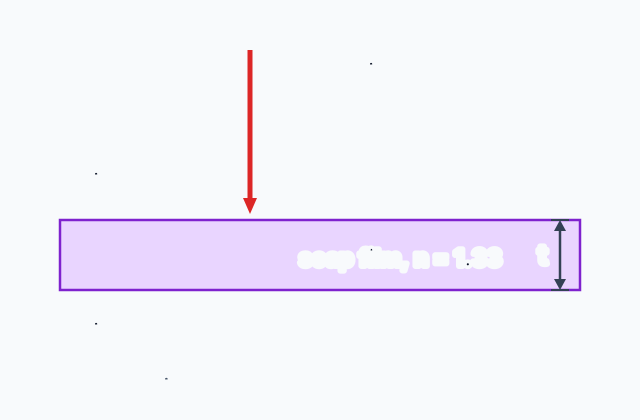
In the picture at the top of this lesson, a soap film with an index of refraction of 1.33 hangs in air, and light with a wavelength of 600 nm strikes it straight on. What is the thinnest the film can be and still reflect this light strongly?
Predict first
Before you open the first step, predict: an antireflection coating on glass, with the soap's index of 1.33 and made for the same 600 nm light, would be a quarter of a wavelength in the coating thick. How does the thinnest soap film that reflects this light strongly compare with that coating?
Step 1 · Count the shifts
At the front surface, light in air reflects from soap, a greater index: shifted half a cycle. At the back surface, light in soap reflects from air, a lower index: no shift. One of the two reflections is shifted.
Step 2 · Write the condition
With one shift, the reflection is bright when . The thinnest film has : , so .
Why this step?
Why does an extra path of only half a wavelength make the reflections add rather than cancel here?
The front reflection is already half a cycle behind because of its shift. Ray 2 falls half a wavelength behind on its extra path, so the two end up a whole cycle apart, which is back in step.
Your step · Calculate
Finish it. A soap film with an index of refraction of 1.33 hangs in air, and light with a wavelength of 600 nm in air strikes it straight on. With one of the two reflections shifted, the thinnest film that reflects the light strongly is a quarter of a wavelength in the film thick. How thick is it, in nanometers?
nm
Part 4 Try it An oil patch, a tank wall and a slant
Predict first: a drop of oil spreads on a still puddle into a round patch, thickest at its center and thinner toward its rim. Lit by white light, will its colors form rings, straight stripes, or one even color? Then pick what is true for light meeting glass under water, judge a claim about the oil patch, and explain a change of color.
Try it · Select all
Under water, index 1.33, a diver shines a flashlight straight at the glass wall of a tank, index 1.52. Which two statements are true? Pick two.
Select 2 answers, then check.
Try it · Decide and justify
A drop of oil spreads on a still puddle into a round patch, thickest at its center and thinner toward its rim, with the same thickness all the way around at any distance from the center. Lit by white light, it shows color. A student says the colors form rings around the center. Is she right?
Which reason supports your answer?
Try it · Multiple choice
You look at one spot of an oil slick on a wet road from straight above, then from a low slant, and the color at that spot changes. Which explains the change?
Part 5 Explain it A coated lens
On the exam this is handwritten, so answer on paper first. Nothing you type here leaves this page. Then check your answer against the model and each scoring point.
Free response is 50% of the exam score. This one is shaped like Question 4, Qualitative/Quantitative Translation.
Free-response practice · Question 4 style
A lens maker coats glass of index 1.52 with a thin layer of a material of index , to cut down the reflection of light of wavelength nm striking straight on.
(a) On paper, draw the light striking the coating and the two reflected rays, and mark each place where a reflected ray is shifted half a cycle. Do this by hand before you open the model.
(b) Without equations, explain why the two reflected rays can cancel each other.
(c) Derive an expression for the smallest coating thickness that makes them cancel, in terms of and , and calculate it.
(d) A second maker uses a material of index 1.70, also a quarter of a wavelength thick in that material. Using your reasoning in (b) and your expression in (c), explain whether this coating reduces the reflection.
Model answer
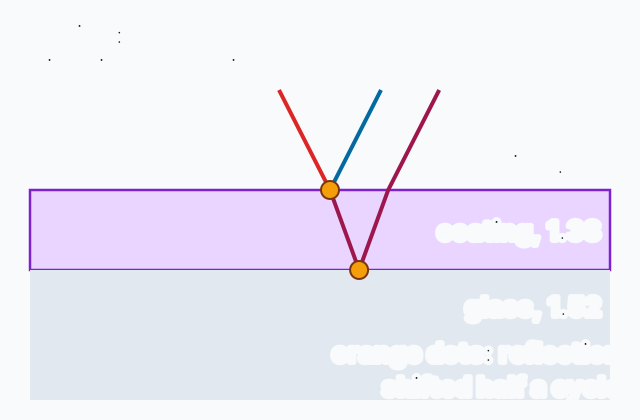
(a) Compare your drawing with the model below. Light reflects from the top of the coating and from the glass; both reflections are marked as shifted half a cycle.
(b) Each reflection is from a material with a greater index than the one the light is in, air to coating and coating to glass, so both are shifted half a cycle and the shifts make no difference between them. Only the extra trip through the coating separates the two rays. If that trip puts one ray half a cycle behind the other, crest meets trough and they cancel.
(c) The extra path is and must be half a wavelength in the coating: , so nm, about 100 nm.
(d) It does not reduce the reflection; it increases it. Now the top reflection, air to 1.70, is shifted, but the bottom one, 1.70 to 1.52, is not, so the shifts put the rays half a cycle apart. The quarter-wavelength thickness adds another half cycle, as in (c), so the rays end up a whole cycle apart, in step, and reinforce.
 Tap to open the picture full size
Score your own answer. This is a self-check, not a grade. Tick each point your answer makes.
Part 6 Check yourself An oil film on water
Both case questions use the picture.
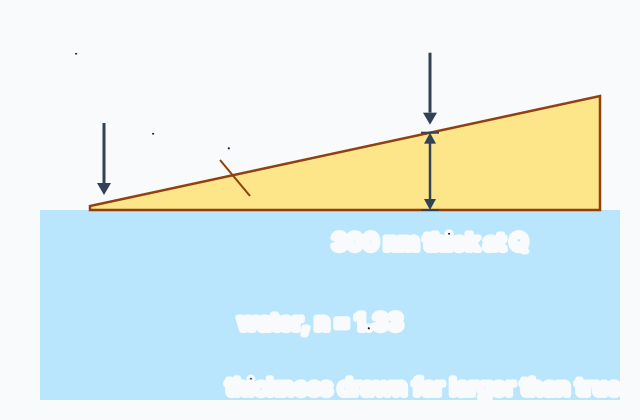
A thin film of oil, index of refraction 1.40, floats on water, index 1.33, with air above. White light strikes it straight on. The picture shows the film side on, with two points, P and Q, marked on it.
Case question 1 · Calculate
Using the picture: which wavelength, between 400 nm and 700 nm in air, does the oil at Q reflect most strongly? Give your answer in nanometers.
Case question 2 · Multiple choice
Using the picture: at P, the oil is far thinner than any wavelength of visible light. How does the oil at P look in the reflected light?
The rest stand on their own and do not use the case.
Check yourself · Spot the error
A student finds the thinnest soap film in air that strongly reflects 540 nm light striking it straight on. The soap has an index of refraction of 1.35. Tap the first line that goes wrong.
Check yourself · Rank it
Five antireflection coatings are each on glass of index 1.52, in air, and each is made as thin as possible while still cancelling the reflection of one wavelength striking straight on. Rank the coatings by thickness.
Thickest first
Give each one a place, 1 for first. Give two the same place if they are equal.
Your ranking: none yet
Part 7 Keep it Bring back earlier ideas
Path length difference from the last lesson and superposition from 14.6 are still part of the course. Retrieving them now, between new ideas, is what makes them easy to find later.
From 14.8 Double-Slit Interference and Diffraction Gratings · Sort it
Light with a wavelength of 600 nm passes through two narrow slits onto a screen. Each card gives how much farther light travels to a point on the screen from one slit than from the other. Tap a card, then what is at that point.
The middle of a bright fringe
The middle of a dark fringe
From 14.6 Wave Interference and Standing Waves · Spot the error
A student describes two upward pulses, 3 cm and 2 cm tall, that meet on a long rope. Tap the first line that goes wrong.
In three lines
- A reflection from a greater index is shifted half a cycle; from a lower index, or on refraction, there is no shift.
- At normal incidence the back reflection travels more, measured in film wavelengths; count the shifts, then compare with whole and half-integer film wavelengths.
- Thickness sets the colors of bubbles and oil slicks; a quarter-wavelength coating with an index between air's and the glass's cancels reflection.
Exam strategy for this topic
- Section I, Multiple Choice: 42 questions in 85 minutes.
- Section II, Free Response: 4 questions in 95 minutes.
- This lesson's Explain it is shaped like free-response question 4, Qualitative/Quantitative Translation.
- A four-function, scientific, or graphing calculator is allowed on both sections of the exam.
For any thin-film question, mark each surface first: is the light reflecting from a greater index (shifted half a cycle) or a lower one (no shift)? Count the shifts, write the extra path as in wavelengths in the film, and only then decide bright or dark.
Questions students ask
When does reflected light get a phase change?
When it reflects from a medium with a greater index of refraction than the one it is traveling in: a shift of half a cycle, 180°. Reflecting from a lower index, there is none, and refracted light is never shifted.
Why do soap bubbles show colors?
Light reflects from the bubble's outer and inner surfaces, and the two reflections interfere. Which colors add up depends on the soap's thickness, so the colors change as the soap thins and swirls.
Why is an antireflection coating a quarter wavelength thick?
With an index between air's and the glass's, both reflections are shifted, so only the extra path matters. A quarter wavelength in the coating, crossed twice, puts the reflections half a cycle apart, and they cancel.
Do I need the angle of the light in thin-film problems?
The angle does change the interference, along with the film's thickness, the wavelength and any phase shifts. Calculations in this course are limited to light striking the film straight on.
Beyond the AP Exam
College Board sets this limit on what the AP Exam asks about this topic. Anything past it is not on the exam.
Quantitative analysis of thin-film interference is limited to waves that are normal to the incident surface.
Course alignment, for teachers
AP Physics 2: Algebra-Based topic 14.9, Unit 14: Waves, Sound, and Physical Optics.
- Skill 1.A: Create diagrams, tables, charts, or schematics to represent physical situations.
- Skill 2.B: Calculate or estimate an unknown quantity with units from known quantities, by selecting and following a logical computational pathway.
- Skill 2.C: Compare physical quantities between two or more scenarios or at different times and locations in a single scenario.
- Skill 3.B: Apply an appropriate law, definition, theoretical relationship, or model to make a claim.
This lesson maps all 12 essential knowledge statements of the topic to the part that teaches each one: 12 are checked by a scored question. The map is in the lesson file.