Unit 15 · Topic 15.1 · about 30 minutes · 7 parts · 11 scored checks, 2 of them multiple choice, plus 2 from earlier lessons
AP Physics 2: Algebra-Based 15.1: Quantum Theory and Wave-Particle Duality
Unit 15: 12 to 15% of the multiple-choice section
What you'll be able to do
- Describe the properties and behavior of light and of particles that show both particle-like and wave-like behavior, using photon energy, photon speed and the de Broglie wavelength.
Key vocabulary
| Term | What it means | The exam trap |
|---|---|---|
| Photon | A massless, electrically neutral particle of light. | Light is modeled both as photons and as a wave; neither model alone explains everything light does. |
| Planck's constant | The constant J·s that links a photon's energy to its frequency. | With in J·s, energies come out in joules; use eV·nm when you want electron volts. |
| Electron volt | A unit of energy: 1 eV J. | To turn joules into electron volts, divide by ; multiplying goes the wrong way. |
| de Broglie wavelength | The wavelength that quantum theory gives a moving particle. | Work in SI units: in J·s and momentum in kg·m/s give a wavelength in meters. |
| Quantized | Able to take only certain separate values, not any value in a range. | Quantized does not mean small: it means the allowed values are separate, with none in between. |
 Tap to open the picture full size
Part 1 Think first Electrons through two slits
Commit to a guess first. Being wrong now makes the right idea stick better.
Predict first
A source fires electrons one at a time toward a barrier with two very narrow slits. A screen beyond the barrier records where each electron lands, as a single dot. After many thousands of electrons, what pattern do the dots make?
In short. Quantum theory describes light and matter at atomic scales: light arrives as photons of energy , and particles such as electrons travel as waves of wavelength .
- A photon is massless and electrically neutral; it travels at in free space and more slowly in a medium, in inverse proportion to the index of refraction.
- A particle's de Broglie wavelength grows as its momentum shrinks, and electrons sent through two slits build up an interference pattern.
- Quantum theory is needed when the de Broglie wavelength is comparable to the size of the system, and a bound system has only certain energies.
Part 2 Learn it Photons and matter waves
1a. Particles that make fringes
By 1900 physics seemed to have two finished pictures: particles obey Newton's laws, and light is a wave. Then experiments turned up results neither picture could explain: the sharp colored lines in the light from a heated gas, the spectrum that glowing hot objects give off, and the way light knocks electrons out of a metal. Quantum theory was developed to explain them, and it is the theory needed to describe matter at atomic and subatomic scales.
Its central surprise is the one in Think first. Fire electrons one at a time at two narrow slits. Each one lands at a single spot on the detector, as a particle would. But the spots pile up into bright and dark bands, the double-slit pattern of a wave, and covering one slit makes the dark bands disappear. In quantum theory, fundamental particles such as electrons show both particle-like and wave-like behavior, and which one you see depends on what you measure.
Light shows the same double nature from the other direction. You treated it as a wave in Unit 14, yet it also delivers its energy in separate packets.
Quick check · Sort it
Each card describes something seen in an experiment. Tap a card, then the kind of behavior it shows.
Particle-like behavior
Wave-like behavior
1b. Photons
Light can be modeled as a wave, with a wavelength and a frequency, or as a stream of particles called photons. Quantum theory needs both models.
A photon is massless and electrically neutral, and its energy is proportional to the frequency of the light:
where J·s is Planck's constant. Together they give : the shorter the wavelength, the more energy each photon carries. Photon energies are tiny in joules, so they are often given in electron volts, with 1 eV J, and then eV·nm makes the arithmetic quick. A photon of 620 nm red light carries eV.
Brightness is a separate matter. A brighter beam of the same color delivers more photons each second, and each of them carries the same energy as before.
A photon travels in a straight line unless it interacts with matter.
Quick check · Calculate
A blue-green laser emits light with a wavelength of 496 nm. How much energy does each of its photons carry? Use eV·nm, and give your answer in electron volts.
1c. How fast photons travel
In free space every photon travels at the same speed, the speed of light, m/s. A violet photon carries more energy than a red one, yet in a vacuum it is no faster.
In a medium such as water or glass, photons travel more slowly, and how much more slowly depends on the medium. The speed is inversely proportional to the index of refraction of the medium:
In water, with , light travels at m/s, about three quarters of its speed in a vacuum. This is the same index of refraction you used for refraction in Unit 13.
When light passes into a new medium, its frequency stays the same, so each photon's energy, , stays the same too. Its speed and its wavelength shrink together, since inside the medium. So work out a photon's energy from its frequency, or from its wavelength in a vacuum.
Between interactions, in any one medium, a photon keeps going in a straight line.
Quick check · Fill the statement
Tap a blank, then an answer.
Starlight passes between two charged plates in empty space. Each of its photons is , so it goes on in a past the plates. In that empty space, a violet photon travels a red photon. In glass with an index of refraction of 1.50, the photons travel at their speed in empty space.
1d. Matter waves, and when they matter
If light can act as a particle, can a particle act as a wave? Louis de Broglie proposed that it can, and gave any particle with momentum a wavelength, its de Broglie wavelength:
with . The wavelength increases as the momentum decreases. Variations of Young's double-slit experiment, done with electrons and even with whole molecules, show that these waves are real.
For everyday objects the wavelength is absurdly small. A 0.15 kg ball thrown at 40 m/s has m, far smaller than any opening it could pass through, so it shows no wave behavior and Newton's laws describe it well. Quantum theory is needed when the de Broglie wavelength is comparable to the size of the system, as for an electron inside an atom.
One more result holds for any bound system, such as an electron held in an atom: its energy and momentum can take only certain separate values. They are quantized.
Quick check · Multiple choice
A particle of mass moves slowly enough that its kinetic energy is . Which expression gives its de Broglie wavelength in terms of , and ?
Part 3 Watch it done An electron beam meets a crystal
Predict first, then watch each step, then finish the problem yourself.
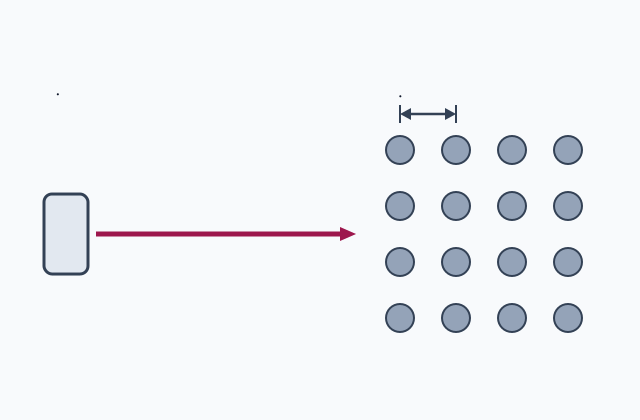
In the picture at the top of this lesson, electrons moving at m/s head toward a crystal whose rows of atoms are 0.30 nm apart. What is each electron's de Broglie wavelength, and is it close enough to the spacing for the crystal to act like a set of slits? Use J·s and kg.
Predict first
Before you open the first step, predict: how does each electron's de Broglie wavelength compare with the 0.30 nm spacing of the atoms?
Step 1 · Find the momentum
kg·m/s.
Step 2 · Set up the wavelength
. With in J·s and in kg·m/s, comes out in meters; convert to nanometers at the end to compare it with the spacing.
Why this step?
Why compare the wavelength with the spacing of the atoms at all?
Interference and diffraction show up clearly only when a wavelength is comparable to the openings or spacings it meets. A wavelength far smaller than the spacing would sail through like a stream of particles, and classical mechanics would describe it.
Your step · Calculate
Finish it. An electron moves at m/s. What is its de Broglie wavelength? Use J·s and kg, and give your answer in nanometers.
nm
Part 4 Try it Two particles, and a slow neutron
Predict first: an electron and a proton move at the same speed. Which has the longer de Broglie wavelength, or are the two equal? Then judge a claim, and find the speed a neutron needs.
Try it · Decide and justify
An electron and a proton move at the same speed. A proton's mass is about 1840 times an electron's. A student says the proton has the longer de Broglie wavelength, because it is the bigger particle. Is the student right?
Which reason supports your answer?
Try it · Calculate
Neutrons are used to study crystals whose atoms are about 0.20 nm apart. How fast must a neutron move for its de Broglie wavelength to be 0.20 nm? Use J·s and a neutron mass of kg, and give your answer in meters per second.
Part 5 Explain it Two lasers, one power
On the exam this is handwritten, so answer on paper first. Nothing you type here leaves this page. Then check your answer against the model and each scoring point.
Free response is 50% of the exam score. This one is shaped like Question 4, Qualitative/Quantitative Translation.
Free-response practice · Question 4 style
A red laser emits light with a wavelength of 650 nm, and a violet laser emits light with a wavelength of 405 nm. Each emits light energy at the same rate, 4.0 mW. Use J·s and m/s.
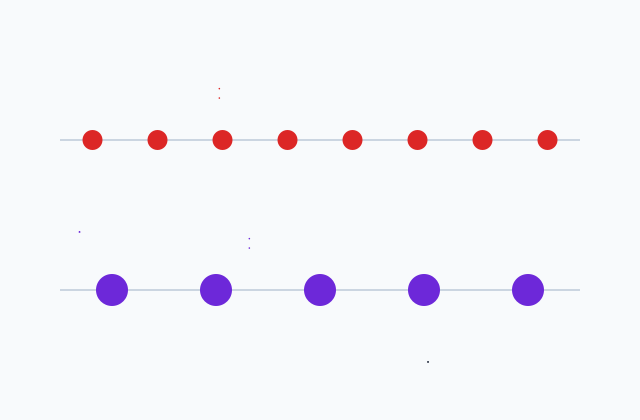
(a) On paper, draw each beam as a row of dots, one dot per photon, showing the photons each laser emits in the same short time. Let the size of each dot show the energy of one photon. Do this by hand before you open the model.
(b) Without equations, explain which laser's photons each carry more energy, and which laser emits more photons each second.
(c) Derive an expression for the number of photons a laser emits each second, in terms of its power , its wavelength , and . Then calculate for the red laser.
(d) A classmate says that turning the red laser up to 8.0 mW would double the energy of each of its photons. Using your expression from (c) and your reasoning in (b), explain whether the classmate is right.
Model answer
(a) Compare your drawing with the model below. The violet row has fewer, larger dots, and the red row has more, smaller ones: about 8 red photons for every 5 violet.
(b) A photon's energy is proportional to the light's frequency. Violet light has the shorter wavelength and so the higher frequency, so each violet photon carries more energy. Both lasers deliver the same energy each second, so the red laser, whose photons each carry less, must emit more of them.
(c) Each photon carries . In one second the laser emits photons, which together carry energy , so and . For the red laser, photons each second.
(d) The classmate is wrong. In (c), is proportional to , so doubling the power doubles the number of photons each second. The energy of each photon, , does not depend on at all; it changes only if the wavelength changes, as (b) says.
 Tap to open the picture full size
Score your own answer. This is a self-check, not a grade. Tick each point your answer makes.
Part 6 Check yourself Electrons through two slits
Both case questions use the picture.
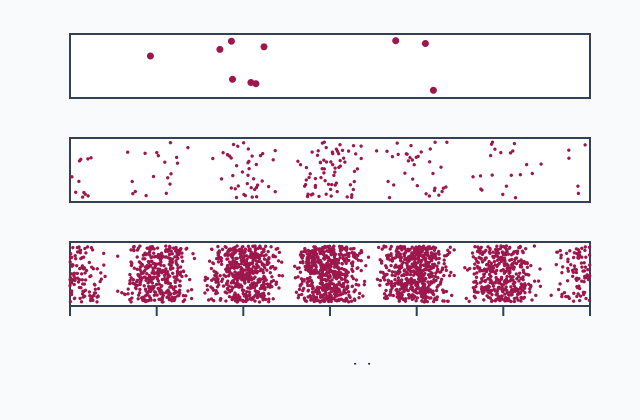
Electrons, each moving at m/s, are sent one at a time through two slits 1.2 µm apart. A detector 1.0 m beyond the slits marks where each electron lands. The picture shows the detector after 10, 200 and 2500 electrons. Use J·s and kg.
Case question 1 · Calculate
Using the picture: what is each electron's de Broglie wavelength? Give your answer in picometers (1 pm is m).
Case question 2 · Multiple choice
Using the picture: the experiment is repeated with faster electrons, and nothing else changes. How does the pattern after 2500 electrons change?
The rest stand on their own and do not use the case.
Check yourself · Select all
Which two observations could classical physics not explain, so that quantum theory had to be developed? Pick two.
Select 2 answers, then check.
Check yourself · Spot the error
A student reasons about an electron inside an atom. Use J·s. Tap the first line that goes wrong.
Part 7 Keep it Bring back earlier ideas
Thin films from the last lesson and the single slit from 14.7 are still part of the course. Retrieving them now, between new ideas, is what makes them easy to find later.
From 14.9 Thin-Film Interference · Rank it
Five antireflection coatings are each on glass of index 1.52, in air, and each is made as thin as possible while still cancelling the reflection of one wavelength striking straight on. Rank the coatings by thickness.
Thickest first
Give each one a place, 1 for first. Give two the same place if they are equal.
Your ranking: none yet
From 14.7 Diffraction · Sort it
A laser shines through a single slit onto a screen, and every angle in the pattern stays under 10°. Each card makes a change and leaves everything else as it was. Tap a card, then what happens to the width of the central bright band.
It gets wider
It gets narrower
It stays the same
In three lines
- Light is modeled both as a wave and as photons: massless, neutral particles with , traveling at in free space and at in a medium.
- Particles such as electrons have a de Broglie wavelength , and they make interference patterns as light does.
- Quantum theory is needed when that wavelength is comparable to the system's size, and bound systems have quantized energies.
Exam strategy for this topic
- Section I, Multiple Choice: 42 questions in 85 minutes.
- Section II, Free Response: 4 questions in 95 minutes.
- This lesson's Explain it is shaped like free-response question 4, Qualitative/Quantitative Translation.
- A four-function, scientific, or graphing calculator is allowed on both sections of the exam.
When a question compares two beams of light, keep two quantities apart: the energy of one photon, set by the frequency, and the number of photons each second. Decide which of the two the question asks about before you compare.
Questions students ask
Is light a wave or a particle?
Both models are needed. Light interferes and diffracts like a wave, and it delivers its energy in separate photons of energy like a stream of particles.
Does a photon's energy change when light enters glass?
No. The frequency of the light stays the same, so each photon's energy, , stays the same too. Its speed and its wavelength change together.
What is the de Broglie wavelength?
The wavelength of a moving particle, . It is longer for a particle with less momentum.
Why does a thrown ball not diffract?
Its de Broglie wavelength is around m, far smaller than any opening it could pass through, so it shows no wave behavior.
When is quantum theory needed?
Quantum theory is the theory of light and matter at atomic and subatomic scales. For everyday objects its predictions agree with classical physics, so Newton's laws still serve there.
Course alignment, for teachers
AP Physics 2: Algebra-Based topic 15.1, Unit 15: Modern Physics.
- Skill 1.A: Create diagrams, tables, charts, or schematics to represent physical situations.
- Skill 2.A: Derive a symbolic expression from known quantities by selecting and following a logical mathematical pathway.
- Skill 2.B: Calculate or estimate an unknown quantity with units from known quantities, by selecting and following a logical computational pathway.
- Skill 3.B: Apply an appropriate law, definition, theoretical relationship, or model to make a claim.
This lesson maps all 13 essential knowledge statements of the topic to the part that teaches each one: 13 are checked by a scored question. The map is in the lesson file.