Unit 15 · Topic 15.2 · about 30 minutes · 7 parts · 12 scored checks, 2 of them multiple choice, plus 2 from earlier lessons
AP Physics 2: Algebra-Based 15.2: The Bohr Model of Atomic Structure
Unit 15: 12 to 15% of the multiple-choice section
What you'll be able to do
- Describe the properties of an atom: its nucleus and electrons, how nuclear notation identifies isotopes and ions, and how the Bohr model and the electron's standing wave lead to discrete energy states.
Key vocabulary
| Term | What it means | The exam trap |
|---|---|---|
| Atomic number | The number of protons in a nucleus, which identifies the element. | The periodic table lists the elements in order of atomic number. |
| Mass number | The total number of protons and neutrons in a nucleus. | An isotope's name, such as carbon-14, gives its mass number. |
| Isotope | One of the forms of an element, identified by its total number of protons and neutrons. | Isotopes of one element behave almost alike in chemistry, since their electrons match. |
| Ion | An atom with a nonzero net electric charge. | Its charge is written at the upper right of its symbol, as in . |
| Bohr model | A model of the hydrogen atom with the electron moving in a circular orbit around the proton. | Its orbits and speeds are worked out for hydrogen, an atom with a single electron. |
 Tap to open the picture full size
Part 1 Think first How empty is an atom?
Commit to a guess first. Being wrong now makes the right idea stick better.
Predict first
Picture a hydrogen atom enlarged until its nucleus is the size of a marble. About how far from the marble would its electron be?
In short. An atom is a tiny, positive nucleus of protons and neutrons with electrons around it, and the Bohr model pictures those electrons moving in circular orbits held by the electric force.
- Nuclear notation gives the number of protons , which names the element, and the number of protons and neutrons , which names the isotope.
- In the Bohr model the electric force on the electron is the net force that keeps it moving in a circle: .
- Only orbits whose circumference holds a whole number of de Broglie wavelengths are allowed, which is why hydrogen has discrete energy states.
Part 2 Learn it Inside the atom
2a. Nucleus and electrons
An atom has internal structure. At its center is a small, positively charged nucleus, made of protons and neutrons. Around it are one or more negatively charged electrons. A proton carries charge , an electron carries , with C, and a neutron has no charge.
The nucleus is tiny. If hydrogen's nucleus were a marble, its electron would be about half a kilometer away. Yet the nucleus holds almost all of the atom's mass: a proton or a neutron has about 1840 times the mass of an electron, so the mass of an atom is dominated by the total mass of its protons and neutrons.
Each element has its own number of protons. Every carbon atom has 6 and every oxygen atom 8, and any atom with 7 protons is nitrogen, however many neutrons or electrons it has.
The electrons are what other atoms meet first. How many electrons an atom has, and how they are arranged, decides how it interacts with other atoms: how it bonds, and what it reacts with.
Quick check · Sort it
Each card describes part of an atom. Tap a card, then the part of the atom it describes.
The nucleus
The electrons
2b. Nuclear notation, isotopes and ions
Nuclear notation packs a nucleus into one symbol:
X is the element's chemical symbol, (the atomic number) is the number of protons, and (the mass number) is the total number of protons and neutrons. The number of neutrons is . Carbon-12 is : 6 protons and 6 neutrons.
Atoms of one element can have different numbers of neutrons, and the total number of protons and neutrons identifies the isotope. and are both carbon, since both have 6 protons, but carbon-14 has 8 neutrons.
A neutral atom has as many electrons as protons. An ion is an atom with a nonzero net electric charge, because it has gained or lost electrons. The charge is written at the upper right: has 8 protons and 10 electrons, so its net charge is .
Quick check · Fill the statement
An iron ion is written . Tap a blank, then an answer.
The ion has protons, neutrons and electrons.
2c. Bohr's model of hydrogen
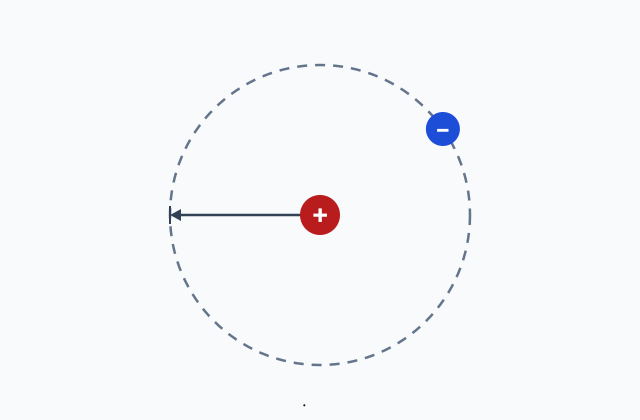
In 1913 Niels Bohr built a model of the hydrogen atom from classical physics. The electron, of mass and charge , moves in a circular orbit around the proton. The only force on it that matters is the electric force from the proton, and that force is the net force that keeps it moving in a circle:
Setting the two equal ties the electron's speed to the radius of its orbit:
There is no separate centripetal force to add. The electric force is the force toward the center, and is how much net force a circle of that size and speed needs.
The Bohr model is now history: electrons are not tiny planets on fixed tracks. Its lasting contribution is that it led to describing hydrogen in terms of discrete energy states, each with its own energy.
Quick check · Multiple choice
In the Bohr model of hydrogen, which statement correctly describes the forces on the orbiting electron?
2d. Standing waves around the orbit
Classical physics could not say which orbits were allowed. A circling charge should radiate energy and spiral into the nucleus, yet hydrogen atoms are stable. The wave picture of the last lesson supplies a reason.
Treat the electron as a wave with de Broglie wavelength , running around its orbit. If the circumference holds a whole number of wavelengths, the wave joins itself smoothly and forms a standing wave. If it does not, each trip around puts the wave out of step with itself, and it cancels. So only orbits with
are allowed. Each allowed orbit has a definite radius and speed, and so a definite energy. That is why the electron in hydrogen has specific allowed energy states, labeled by the whole number , rather than any energy at all. The lowest, , is the ground state.
In this course the description of an atom's electrons stops at these energy levels.
Quick check · Select all
Each choice gives a proposed circular orbit for an electron and the electron's de Broglie wavelength in that orbit. In which two could the electron form a standing wave, as the Bohr model requires? Pick two.
Select 2 answers, then check.
Part 3 Watch it done The electron's speed in hydrogen
Predict first, then watch each step, then finish the problem yourself.
In the picture at the top of this lesson, the electron in a hydrogen atom circles the proton at a radius of m, as the Bohr model pictures it. How fast does the electron move? Use N·m²/C², C and kg.
Predict first
Before you open the first step, predict: about how fast does the electron move?
Step 1 · Name the net force
The electric force from the proton points toward the center of the orbit and is the net force on the electron, so .
Step 2 · Solve for the speed
Multiply both sides by : , so .
Why this step?
Why can the gravitational force between the electron and the proton be left out?
It is about 10 to the 39 times weaker than the electric force between them, far too small to change the answer.
Your step · Calculate
Finish it. In the Bohr model, an electron circles a proton at a radius of m, and its speed is . Use N·m²/C², C and kg. How fast does the electron move? Give your answer in kilometers per second.
km/s
Part 4 Try it A bigger orbit, and waves that fit
Predict first: in an orbit four times as wide, does the electron move faster, more slowly, or at the same speed? Then judge a claim, and count the wavelengths around the smallest orbit.
Try it · Decide and justify
In the Bohr model of hydrogen, the electron's orbit in the state has four times the radius of its orbit in the ground state. A student says the electron moves more slowly in the larger orbit. Is the student right?
Which reason supports your answer?
Try it · Calculate
In the Bohr model, the electron in hydrogen's ground state moves at m/s around an orbit of radius m. How many of its de Broglie wavelengths fit around the circumference of that orbit? Use J·s and kg.
Part 5 Explain it A standing wave on the n = 4 orbit
On the exam this is handwritten, so answer on paper first. Nothing you type here leaves this page. Then check your answer against the model and each scoring point.
Free response is 50% of the exam score. This one is shaped like Question 2, Translation Between Representations.
Free-response practice · Question 2 style
In the Bohr model of hydrogen, the electron's orbit in the state has a radius of m. Use N·m²/C², C, kg and J·s.
(a) On paper, draw the nucleus and the orbit, and draw the electron's de Broglie wave as a standing wave around the orbit. Do this by hand before you open the model.
(b) Using your drawing, calculate the electron's de Broglie wavelength in this orbit.
(c) Starting from and , calculate the electron's speed in this orbit, and from it calculate the de Broglie wavelength .
(d) Say whether your two wavelengths agree, and explain how your drawing shows why an orbit whose circumference holds 4.5 wavelengths is not allowed.
Model answer
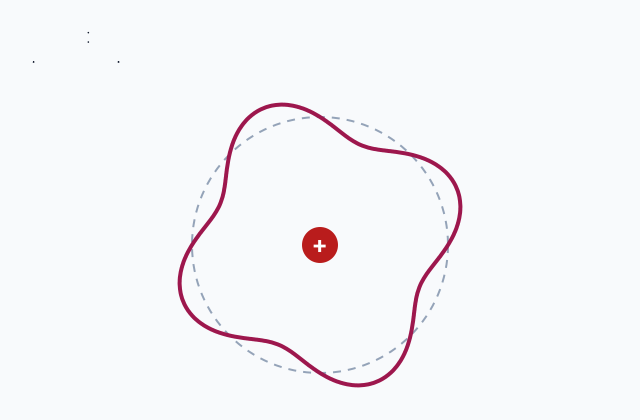
(a) Compare your drawing with the model below: a wave that runs once around the orbit with four crests and four troughs and joins itself smoothly.
(b) Four wavelengths fit the circumference: , so m.
(c) The electric force is the net force: , so m/s. Then m.
(d) They agree, at m. In the drawing the wave closes on itself, crest meeting crest after one trip. With 4.5 wavelengths, a crest would come round to meet a trough, so each trip would cancel the wave and no standing wave could form.
 Tap to open the picture full size
Score your own answer. This is a self-check, not a grade. Tick each point your answer makes.
Part 6 Check yourself Five atoms and ions
Both case questions use the table.
The table lists the particles in five atoms or ions, P to T.
| Atom or ion | Protons | Neutrons | Electrons |
|---|---|---|---|
| P | 6 | 6 | 6 |
| Q | 6 | 8 | 6 |
| R | 7 | 7 | 7 |
| S | 7 | 7 | 10 |
| T | 8 | 8 | 6 |
Case question 1 · Multiple choice
Using the table: which two are isotopes of the same element?
Case question 2 · Sort it
Using the table: tap a letter, then whether it is a neutral atom or an ion.
Neutral atom
Positive ion
Negative ion
The rest stand on their own and do not use the case.
Check yourself · Spot the error
A student finds the electric force on the electron in the Bohr model's orbit of hydrogen, of radius m, with N·m²/C² and C. Tap the first line that goes wrong.
Check yourself · Fill the statement
A sodium atom, , loses one electron and becomes the ion . Tap a blank, then an answer.
Compared with the atom, the ion has protons, so it is element. Its bonding and reactions are those of the neutral atom.
Check yourself · Fill the statement
Tap a blank, then an answer.
Niels Bohr's 1913 model of hydrogen pictures the electron circling the proton in a fixed orbit, much as a planet circles the sun, and it rests on physics. Physicists now treat it as a model, and it led to describing hydrogen in terms of energy states.
Part 7 Keep it Bring back earlier ideas
Photons from the last lesson and double-slit fringes from 14.8 are still part of the course. Retrieving them now, between new ideas, is what makes them easy to find later.
From 15.1 Quantum Theory and Wave-Particle Duality · Fill the statement
Tap a blank, then an answer.
Starlight passes between two charged plates in empty space. Each of its photons is , so it goes on in a past the plates. In that empty space, a violet photon travels a red photon. In glass with an index of refraction of 1.50, the photons travel at their speed in empty space.
From 14.8 Double-Slit Interference and Diffraction Gratings · Calculate
Light with a wavelength of 500 nm passes through two slits 0.25 mm apart onto a screen 3.0 m away. Using the small-angle approximation, how far is the middle of the bright fringe from the middle of the central bright fringe? Give your answer in millimeters.
In three lines
- An atom is a tiny, positive nucleus of protons and neutrons, which hold almost all of its mass, with electrons around it.
- In , the protons name the element, the protons and neutrons name the isotope, and a net charge makes an ion.
- In the Bohr model, , and only orbits holding a whole number of de Broglie wavelengths are allowed, which gives discrete energy states.
Exam strategy for this topic
- Section I, Multiple Choice: 42 questions in 85 minutes.
- Section II, Free Response: 4 questions in 95 minutes.
- This lesson's Explain it is shaped like free-response question 2, Translation Between Representations.
- A four-function, scientific, or graphing calculator is allowed on both sections of the exam.
In a Bohr-model question, write one equation before any numbers: the electric force equals . Then solve it for the quantity asked, and put the numbers in last.
Questions students ask
Who proposed the Bohr model, and when?
Niels Bohr, in 1913, to describe the hydrogen atom and the light it gives off.
What is the difference between atomic number and mass number?
The atomic number is the number of protons, which names the element. The mass number is the number of protons and neutrons together, which names the isotope.
What is an ion?
An atom with a nonzero net electric charge. The charge is written at the upper right of its symbol, as in .
Why did classical physics have trouble with the atom?
A charge moving in a circle should radiate energy and spiral into the nucleus in a tiny fraction of a second, yet atoms are stable. The Bohr model needed a new rule to explain that.
How big is a hydrogen atom?
The Bohr model puts the electron in hydrogen's ground state at a radius of m, about 0.05 nm, from the proton.
Beyond the AP Exam
College Board sets this limit on what the AP Exam asks about this topic. Anything past it is not on the exam.
The analysis and description of electron structure is limited to energy levels and will not include such advanced descriptions as orbitals, orbital shapes, or probability functions.
Course alignment, for teachers
AP Physics 2: Algebra-Based topic 15.2, Unit 15: Modern Physics.
- Skill 1.A: Create diagrams, tables, charts, or schematics to represent physical situations.
- Skill 2.B: Calculate or estimate an unknown quantity with units from known quantities, by selecting and following a logical computational pathway.
- Skill 2.C: Compare physical quantities between two or more scenarios or at different times and locations in a single scenario.
- Skill 3.B: Apply an appropriate law, definition, theoretical relationship, or model to make a claim.
This lesson maps all 12 essential knowledge statements of the topic to the part that teaches each one: 12 are checked by a scored question. The map is in the lesson file.