Unit 15 · Topic 15.3 · about 30 minutes · 7 parts · 11 scored checks, 2 of them multiple choice, plus 2 from earlier lessons
AP Physics 2: Algebra-Based 15.3: Emission and Absorption Spectra
Unit 15: 12 to 15% of the multiple-choice section
What you'll be able to do
- Describe how atoms emit and absorb photons, using energy-level diagrams to find photon energies and wavelengths, and use spectra to identify the elements in a source or a gas.
Key vocabulary
| Term | What it means | The exam trap |
|---|---|---|
| Energy level | One of the allowed energies of an atom, drawn as a horizontal line on an energy-level diagram. | The levels of a bound atom are negative, with zero for the electron and nucleus pulled apart. |
| Ground state | An atom's lowest energy level. | Lowest energy is not the same as easiest to ionize. |
| Emission spectrum | The spectrum of the light that a hot gas of one element gives off. | Spread the light with a prism or a grating to see it. |
| Absorption spectrum | The spectrum of light containing every wavelength after it passes through a cool gas, showing which wavelengths the gas removed. | It needs a source of light with every wavelength shining through the gas. |
| Binding energy | The energy needed to remove the electron from an atom, leaving the atom ionized. | It depends on which level the atom is in. |
 Tap to open the picture full size
Part 1 Think first The light of a glowing gas
Commit to a guess first. Being wrong now makes the right idea stick better.
Predict first
A tube of one gas, such as neon in a sign, glows when a current runs through it. Seen through a prism, which spreads light out by wavelength, what does its light look like?
In short. An atom absorbs or emits a photon only when the photon's energy equals the difference between two of its energy levels, .
- Absorbing a photon raises the atom to a higher energy state; an atom in an excited state falls to a lower one by emitting a photon.
- Each transition gives one frequency and one wavelength, , and each element's set of levels gives it a unique spectrum.
- Binding energy is the energy needed to remove the electron, and it is greatest from the ground state.
Part 2 Learn it Atoms and light
3a. Energy levels
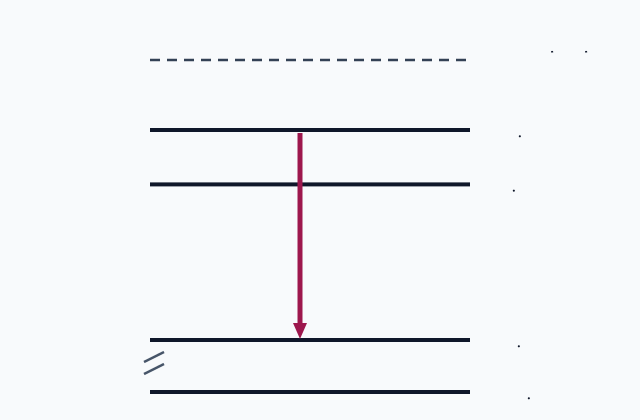
Model an atom as a system of a nucleus and an electron. The energy of that system is the interaction energy between the two, and it can take only certain values, the atom's energy levels. An energy-level diagram shows them as horizontal lines, higher energy higher up, like the hydrogen diagram at the top of this lesson.
The levels are negative. Zero is the energy of the electron and the nucleus pulled far apart, so a bound electron has less than that. The lowest level, , is the ground state; the higher ones are excited states.
When the atom moves from one level to another, its energy changes by the difference between the levels, and that is a change in the interaction energy between the electron and the nucleus. The energy has to come from somewhere or go somewhere. When light is involved, a photon carries it: energy is transferred to the atom when it absorbs a photon, and from the atom when it emits one.
In this course, energy-level diagrams are drawn for atoms with a single electron, such as hydrogen.
Quick check · Multiple choice
A hydrogen atom absorbs a photon and moves from its ground state to an excited state. Which statement describes the change in energy?
3b. Absorbing and emitting photons
An atom can absorb or emit energy only in amounts that match the difference between two of its energy levels:
- An atom in a given state can absorb a photon of just the right energy and move up to a higher state.
- An atom in an excited state can, on its own, emit a photon of just the right energy and move down to a lower state.
A photon whose energy matches no gap above the atom's present level, and is too small to free the electron, is not absorbed at all.
A transition between two levels means one photon of one energy, so one frequency and one wavelength. For hydrogen falling from ( eV) to ( eV), eV, and
which is red light. A larger energy gap gives a photon of higher frequency and shorter wavelength.
Quick check · Sort it
A hydrogen atom is in its ground state. Its levels are eV (), eV (), eV () and eV (). Each card gives the energy of a photon that reaches the atom. Tap a card, then what the atom does.
Absorbs the photon
Does not absorb the photon
3c. Spectra identify elements
Each element has a set of energy levels found in no other element. The gaps between those levels, and so the photon frequencies the element can absorb and emit, are unique to it as well. That set of frequencies is the element's spectrum.
A hot gas of one element glows with an emission spectrum: bright lines at its own wavelengths, with nothing between them. Match the lines against the known spectra of the elements and you know what the glowing source contains.
Now send light containing every wavelength through a cool gas. The gas atoms absorb the photons whose energies match their gaps, so the light that comes through is missing those wavelengths. The result is an absorption spectrum: a full rainbow crossed by dark lines. Each dark line sits at the wavelength of a bright line in the same gas's emission spectrum, so the dark lines also tell you which elements the gas contains. This is how astronomers learn what the gas around a star is made of.
Quick check · Fill the statement
Tap a blank, then an answer.
A glowing gas shows bright lines, and their wavelengths tell . Light containing every wavelength, sent through a cool gas of the same element, shows dark lines whose wavelengths are some of those bright lines, because the gas only photons whose energies match gaps between its levels.
3d. Binding energy
Give the electron enough energy and it leaves the atom altogether, leaving the atom ionized. The binding energy is the energy needed to remove the electron from the atom: enough to raise the system from its present level to zero.
For a level at energy , the binding energy is . An atom in the ground state sits lowest, so removing its electron takes the greatest energy, 13.60 eV for hydrogen. From it takes only 3.40 eV, since the atom is already partway up.
So a binding energy belongs to a level. When a table gives one number for an element, it is the ground state's.
Quick check · Calculate
A hydrogen atom is in its state, at eV. Its ground state is at eV. How much energy is needed to remove its electron? Give your answer in electron volts.
Part 3 Watch it done A line in hydrogen's spectrum
Predict first, then watch each step, then finish the problem yourself.
In the energy-level diagram at the top of this lesson, a hydrogen atom drops from ( eV) to ( eV). What is the wavelength of the photon it emits? Use eV·nm.
Predict first
Before you open the first step, predict: in what part of the spectrum is this photon?
Step 1 · Find the energy the atom loses
The photon carries away the energy the atom loses, the difference between the two levels: , upper minus lower.
Step 2 · Give it to one photon
All of that energy leaves as a single photon, so and , with in eV·nm and the energy in eV.
Why this step?
Why does one transition give just one wavelength?
The atom loses one fixed amount of energy, and all of it leaves in a single photon, so that photon has a single frequency and so a single wavelength. A different pair of levels would give a different line.
Your step · Calculate
Finish it. A hydrogen atom falls from a level at eV to a level at eV and emits one photon. Using eV·nm, what is the photon's wavelength? Give your answer in nanometers.
nm
Part 4 Try it Part of a photon, and four transitions
Predict first: an excited atom meets a photon with a little more energy than one of its gaps. Does it take what it needs and let the rest go, or not? Then judge a claim, and rank four transitions.
Try it · Decide and justify
A hydrogen atom is in its state, at eV. The levels above it are at eV () and eV (), and freeing the electron would take 3.40 eV. A photon of energy 2.20 eV reaches the atom. A student says the atom absorbs 1.89 eV of it and rises to , while the remaining 0.31 eV travels on as a weaker photon. Is the student right?
Which reason supports your answer?
Try it · Rank it
A hydrogen atom has levels at eV (), eV (), eV () and eV (); level 3 means , and so on. Rank the photons emitted in these transitions by their wavelength.
Longest wavelength first
Give each one a place, 1 for first. Give two the same place if they are equal.
Your ranking: none yet
Part 5 Explain it Testing hydrogen's lines
On the exam this is handwritten, so answer on paper first. Nothing you type here leaves this page. Then check your answer against the model and each scoring point.
Free response is 50% of the exam score. This one is shaped like Question 3, Experimental Design and Analysis.
Free-response practice · Question 3 style
A student looks at a hydrogen lamp through a diffraction grating and wants to test the claim that all of its visible lines come from transitions that end on the same lower level. Hydrogen's levels include eV (), eV (), eV (), eV () and eV (). Use eV·nm.
(a) Describe a procedure she could use with the grating, whose slit spacing is known, to measure the wavelength of each line. Say what she measures, and one step that reduces experimental uncertainty.
(b) Her four measured wavelengths are below, each paired with the upper level a classmate thinks it starts from. Describe what she should plot on each axis so that a straight line tests the claim, and explain how the line would give the energy of that common lower level. Then make that graph on paper, with a scale on each axis, and draw a best-fit line. Do this by hand before you open the model.
- 656 nm, from
- 487 nm, from
- 434 nm, from
- 412 nm, from
(c) Use your line to find the energy of the lower level, and justify whether the data support the claim and which level it is.
Model answer
(a) Shine the lamp's light through the grating onto a screen a measured distance away. For each line, measure the distance from the central maximum to the line's first-order maximum, find the angle from , and then . Measuring each line on both sides of the center and averaging reduces the uncertainty.
(b) If every line ends on the same level, each photon's energy is . So plot the photon energy, , on the vertical axis against the energy of the upper level on the horizontal axis. The claim predicts a straight line with a slope of 1, and its vertical intercept is . The photon energies are 1.89, 2.55, 2.86 and 3.01 eV. See the graph below.
(c) The best-fit line has a slope of about 0.99 and crosses the vertical axis at about 3.39 eV, so eV. The points lie along a straight line with a slope close to 1, as the claim predicts, and eV matches the level at eV. The data support the claim: all four visible lines end on .
Photon energy against the energy of the upper level, with the best-fit line
The line rises with a slope close to 1 and crosses the vertical axis near 3.39 eV.
Score your own answer. This is a self-check, not a grade. Tick each point your answer makes.
Part 6 Check yourself What is in the cloud?
Both case questions use the spectra.
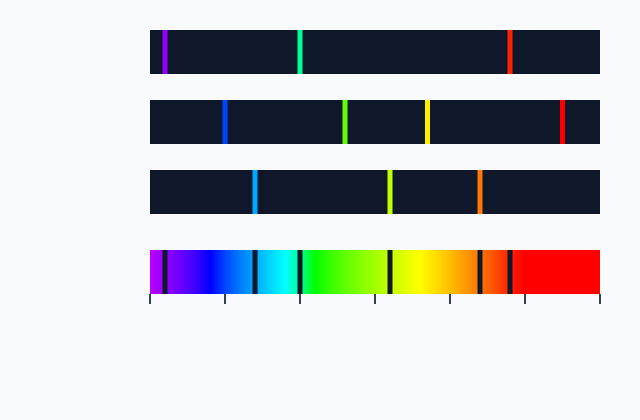
A lab has the emission spectra of three known gases, A, B and C. Light containing every visible wavelength passes through a cool cloud of an unknown mixture of gases, and its spectrum is shown at the bottom. Use eV·nm.
Case question 1 · Select all
Using the spectra: a fourth gas, D, not shown, has emission lines at 435 nm, 525 nm and 680 nm. Assume each gas in the cloud absorbs at every wavelength in this range at which it emits. Which two of the gases A, B, C and D are in the cloud? Pick two.
Select 2 answers, then check.
Case question 2 · Calculate
Using the spectra: one dark line is at 620 nm. What is the energy difference between the two levels of the atoms that absorb at this wavelength? Give your answer in electron volts.
The rest stand on their own and do not use the case.
Check yourself · Spot the error
A student finds the wavelength of the photon a hydrogen atom emits when it falls from ( eV) to ( eV), using eV·nm. Tap the first line that goes wrong.
Check yourself · Multiple choice
A hydrogen atom is in its state. On paper, draw the levels to and every downward arrow the atom could follow on its way to the ground state, in one jump or in several. Counting every possible jump from one level down to any lower level, how many different photon energies could it emit?
Part 7 Keep it Bring back earlier ideas
Nuclear notation from the last lesson and thin films from 14.9 are still part of the course. Retrieving them now, between new ideas, is what makes them easy to find later.
From 15.2 The Bohr Model of Atomic Structure · Fill the statement
An iron ion is written . Tap a blank, then an answer.
The ion has protons, neutrons and electrons.
Predict first: a drop of oil spreads on a still puddle into a round patch, thickest at its center and thinner toward its rim. Lit by white light, will its colors form rings, straight stripes, or one even color? Then pick what is true for light meeting glass under water, judge a claim about the oil patch, and explain a change of color.
From 14.9 Thin-Film Interference · Select all
Under water, index 1.33, a diver shines a flashlight straight at the glass wall of a tank, index 1.52. Which two statements are true? Pick two.
Select 2 answers, then check.
In three lines
- An atom absorbs or emits a photon only if its energy equals the difference between two levels, , so each transition gives one frequency and one wavelength.
- Each element's levels are its own, so its emission and absorption spectra identify it.
- Binding energy is the energy needed to remove the electron, , and it is greatest from the ground state.
Exam strategy for this topic
- Section I, Multiple Choice: 42 questions in 85 minutes.
- Section II, Free Response: 4 questions in 95 minutes.
- This lesson's Explain it is shaped like free-response question 3, Experimental Design and Analysis.
- A four-function, scientific, or graphing calculator is allowed on both sections of the exam.
On an energy-level diagram, every photon is a difference between two lines. Write as upper minus lower first, then , and before calling a photon absorbed, check that it matches a gap above the atom's present level.
Questions students ask
Why does a gas give off light only at certain wavelengths?
Its atoms have only certain energy levels. A photon is emitted when an atom drops between two of them, so its energy, and its wavelength, can only be one of the gaps.
What is the difference between an emission and an absorption spectrum?
An emission spectrum is bright lines from a hot gas. An absorption spectrum is a full rainbow with dark lines, made when light of every wavelength passes through a cool gas that absorbs the photons matching its gaps.
Why does a hot gas glow?
Collisions in the hot gas raise atoms to excited states, and each excited atom then drops to a lower state by emitting a photon.
What is an energy-level diagram?
A drawing of an atom's allowed energies as horizontal lines, with higher energy higher up. In this course they are drawn only for one-electron atoms such as hydrogen.
What is binding energy?
The energy needed to remove the electron and leave the atom ionized. It is largest for an atom in its ground state.
Course alignment, for teachers
AP Physics 2: Algebra-Based topic 15.3, Unit 15: Modern Physics.
- Skill 1.A: Create diagrams, tables, charts, or schematics to represent physical situations.
- Skill 2.B: Calculate or estimate an unknown quantity with units from known quantities, by selecting and following a logical computational pathway.
- Skill 2.C: Compare physical quantities between two or more scenarios or at different times and locations in a single scenario.
- Skill 3.C: Justify or support a claim using evidence from experimental data, physical representations, or physical principles or laws.
This lesson maps all 11 essential knowledge statements of the topic to the part that teaches each one: 11 are checked by a scored question. The map is in the lesson file.