Unit 15 · Topic 15.4 · about 30 minutes · 7 parts · 11 scored checks, 2 of them multiple choice, plus 2 from earlier lessons
AP Physics 2: Algebra-Based 15.4: Blackbody Radiation
Unit 15: 12 to 15% of the multiple-choice section
What you'll be able to do
- Describe the electromagnetic radiation an object emits because of its temperature, using Wien's law for the peak wavelength and the Stefan-Boltzmann law for the power.
Key vocabulary
| Term | What it means | The exam trap |
|---|---|---|
| Blackbody | An idealized object that absorbs all radiation that falls on it. | A blackbody need not look black; a hot one glows brightly. |
| Intensity per unit wavelength | How much radiation a body emits in a narrow band of wavelengths, divided by the width of the band; the vertical axis of a blackbody spectrum. | It is not a power by itself; it is radiation per band of wavelength. |
| Peak wavelength | The wavelength at which a blackbody emits the most radiation per unit wavelength. | It is found from the absolute temperature, in kelvins, never from degrees Celsius. |
| Stefan-Boltzmann law | : the power a blackbody of surface area emits. | The temperature must be in kelvins. |
| Planck's law | The formula that describes a blackbody's spectrum at every wavelength and matches the measurements. | It describes the whole curve, not only where the peak falls. |
 Tap to open the picture full size
Part 1 Think first Red hot, white hot
Commit to a guess first. Being wrong now makes the right idea stick better.
Predict first
A blacksmith heats an iron bar in a forge. As it gets hotter, it glows dull red, then orange, then yellow-white. Why does its color change?
In short. Every object turns some of its thermal energy into electromagnetic radiation, and a blackbody, which absorbs all the radiation that falls on it, emits a continuous spectrum that depends only on its temperature.
- The peak wavelength falls as the temperature rises: , Wien's law.
- The power emitted is , the Stefan-Boltzmann law, so it climbs steeply with temperature.
- Classical physics could not explain the spectrum's shape; Planck's law could, by treating the energy of light as quantized.
Part 2 Learn it Radiation from hot objects
4a. Matter that glows
Matter spontaneously turns some of its internal thermal energy into electromagnetic radiation. The jiggling charged particles in an object send out electromagnetic waves all the time. You feel this radiation from a stove burner across a kitchen, and a hot coal shows it as visible light.
To study it, physicists use an idealized model, the blackbody: an object that absorbs all radiation that falls on it and reflects none. A small hole in the side of a closed, hot oven is a good real example, since light that goes in almost never finds its way back out.
A blackbody keeps absorbing whatever reaches it. If it is in equilibrium at a constant temperature, its internal energy is not changing, so it must emit energy as fast as it absorbs it. A good absorber is a good emitter. A blackbody reflects nothing, so any glow it gives off is its own emission, powered by its thermal energy.
Quick check · Multiple choice
A flat black plate, which absorbs nearly all the sunlight that falls on it, sits in the sun. Assume the plate exchanges energy with its surroundings only by radiation. Its temperature rises for a while and then stays constant. Once its temperature is constant, which statement is true?
4b. The blackbody spectrum
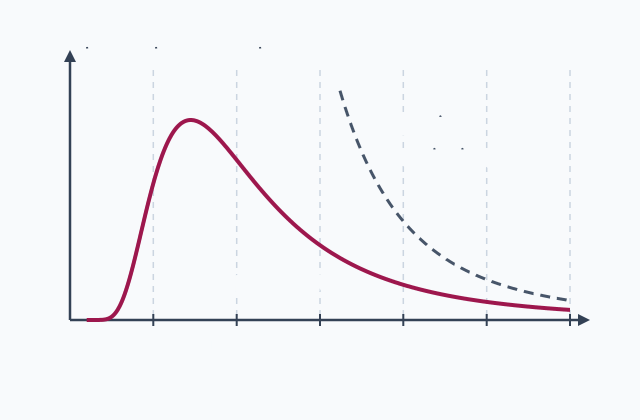
Spread a blackbody's radiation into a spectrum and you get a continuous spectrum: every wavelength is present, with no lines. Its shape depends only on the body's temperature, not on what the body is made of. It is usually drawn as intensity per unit wavelength against wavelength, as in the graph: a hump that rises from almost nothing at short wavelengths to a peak, then falls off slowly toward long ones.
Classical physics could not produce that hump. Treating light as a classical wave, it predicted the dashed curve, with the intensity climbing without limit toward short wavelengths, so that any warm object would blaze with ultraviolet light. Nothing like that happens.
In 1900 Max Planck found a formula that fits the measurements, Planck's law, by assuming that the energy of light is quantized: light of frequency carries energy only in whole-number multiples of . For short-wavelength light that smallest amount, , is so large that the body can rarely supply it, which pulls the curve down at short wavelengths. It was the first step into quantum theory.
Quick check · Sort it
Each card makes a claim about the spectrum a blackbody emits. Tap a card, then whether the claim is true.
True
False
4c. Wien's law
Heat a blackbody and its whole spectrum changes. The peak, the wavelength at which it emits the most radiation per unit wavelength, moves to shorter wavelengths as the temperature rises. Wien's law says how:
with the absolute temperature, in kelvins, and m·K (to more places, m·K). Double the temperature and the peak wavelength halves.
The Sun's surface is near 5800 K, so its spectrum peaks near
in the visible. A burner at 1000 K peaks at 2900 nm, deep in the infrared, so most of what it emits is invisible even while it glows dull red.
Wien's law also runs the other way: measure where a star's spectrum peaks and you have its surface temperature, without going anywhere near it.
Quick check · Calculate
A red giant star has a surface temperature of 3600 K. Modeling it as a blackbody, at what wavelength does its spectrum peak? Use m·K, and give your answer in nanometers.
4d. The Stefan-Boltzmann law
A hotter blackbody also emits far more energy. The rate at which it emits energy, its power, is given by the Stefan-Boltzmann law:
where is its surface area, its absolute temperature and W/(m²·K⁴).
The power is proportional to the area, so twice the surface emits twice the power. It is proportional to the fourth power of the temperature, so small changes in temperature matter a great deal: raising by 10 percent raises the power by a factor of . Always use kelvins.
On a graph of the spectrum, a hotter blackbody's curve is higher at every wavelength, so the area under it is larger. For bodies of the same size, a larger area under the curve means more power.
Quick check · Calculate
A blackbody's absolute temperature is doubled while its surface area is cut in half. By what factor does the power it emits change?
Part 3 Watch it done The power of a lamp filament
Predict first, then watch each step, then finish the problem yourself.
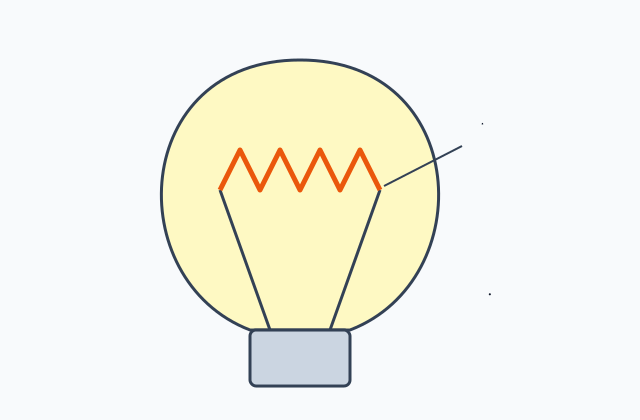
In the picture at the top of this lesson, a lamp's filament, modeled as a blackbody, is at 2900 K and has a surface area of m². At what rate does it emit energy? Use W/(m²·K⁴).
Predict first
Before you open the first step, predict: about how much power does the filament emit?
Step 1 · Choose the law
The rate of emitting energy is the power, , with in kelvins, as it already is here.
Step 2 · Find the power from each square meter
K⁴, so W/m².
Why this step?
Why must the temperature be in kelvins and not degrees Celsius?
The law describes emission that falls to zero only at absolute zero, where the kelvin scale starts. On the Celsius scale zero is not zero emission, so a Celsius temperature raised to the fourth power gives the wrong result.
Your step · Calculate
Finish it. A lamp filament, modeled as a blackbody, is at 2900 K and has a surface area of m². Use W/(m²·K⁴). What power does it emit? Give your answer in watts.
W
Part 4 Try it A book in the dark, and a sketch
Predict first: is a book on your desk, at room temperature, emitting electromagnetic radiation right now? Then judge a claim, and sketch how the peak wavelength depends on temperature.
Try it · Sketch the graph
A blackbody's spectrum peaks at 1200 nm. Its absolute temperature is then raised to 2, 3 and 4 times its starting value. Sketch the peak wavelength against the temperature, in multiples of the starting temperature. The first point is fixed at 1200 nm.
One shape that fits
Drag a point up or down, or tap it and use the arrow keys. The shape is checked, and so are the values the question lets you work out.
Try it · Decide and justify
A book on a desk is at room temperature, about 300 K, and in a dark room it gives off no light that anyone can see. A student says the book is still emitting electromagnetic radiation. Model the book as a blackbody, with m·K. Is the student right?
Which reason supports your answer?
Part 5 Explain it Two stars of equal power
On the exam this is handwritten, so answer on paper first. Nothing you type here leaves this page. Then check your answer against the model and each scoring point.
Free response is 50% of the exam score. This one is shaped like Question 1, Mathematical Routines.
Free-response practice · Question 1 style
Two stars, X and Y, are each modeled as a spherical blackbody; a sphere of radius has surface area . Star X's spectrum peaks at 500 nm, and star Y's peaks at 1000 nm. Measurements show that the two stars emit the same total power. Use m·K.
(a) Derive an expression for the ratio of the radii of two stars that emit equal power, in terms of their temperatures and .
(b) Calculate the temperature of each star, and then the ratio .
(c) A student says star Y must emit less power than star X, because it is cooler. Using your expression from (a), justify why the measurements do not contradict the laws of blackbody radiation.
Model answer
(a) Equal power: . Cancel and take the square root: , so .
(b) By Wien's law, K and K. Then .
(c) Being cooler, Y does emit less power from each square meter: is times smaller. But the power is also proportional to the surface area, and with 4 times the radius, Y has 16 times the area. The two factors cancel, so equal power is exactly what the laws give for a star four times as wide. The student left out the area.
Score your own answer. This is a self-check, not a grade. Tick each point your answer makes.
Part 6 Check yourself Three glowing bodies
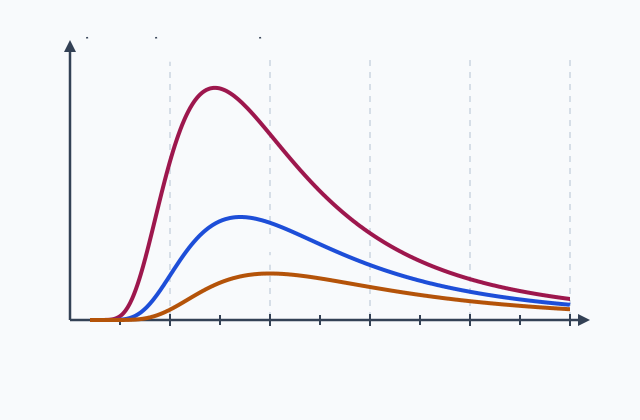
Both case questions use the graph.
The graph shows the spectra of three objects, A, B and C, each modeled as a blackbody and drawn on the same scale. The three objects have equal surface areas. Use m·K.
Case question 1 · Calculate
Using the graph: what is the temperature of object C? Give your answer in kelvins.
Case question 2 · Rank it
Using the graph: rank the three objects by the power they emit.
Greatest power first
Give each one a place, 1 for first. Give two the same place if they are equal.
Your ranking: none yet
The rest stand on their own and do not use the case.
Check yourself · Spot the error
A student finds the surface temperature of a star whose spectrum peaks at 480 nm, using m·K. Tap the first line that goes wrong.
Check yourself · Multiple choice
Classical physics predicted that a blackbody would emit more and more intensity at shorter and shorter wavelengths, but measured spectra fall to almost nothing there. What did Planck assume that accounts for this?
Part 7 Keep it Bring back earlier ideas
Binding energy from the last lesson and photon energy from 15.1 are still part of the course. Retrieving them now, between new ideas, is what makes them easy to find later.
From 15.3 Emission and Absorption Spectra · Calculate
A hydrogen atom is in its state, at eV. Its ground state is at eV. How much energy is needed to remove its electron? Give your answer in electron volts.
From 15.1 Quantum Theory and Wave-Particle Duality · Calculate
A blue-green laser emits light with a wavelength of 496 nm. How much energy does each of its photons carry? Use eV·nm, and give your answer in electron volts.
In three lines
- Matter turns thermal energy into radiation, and a blackbody, which absorbs everything, emits a continuous spectrum set only by its temperature.
- Wien's law, : hotter bodies peak at shorter wavelengths.
- The Stefan-Boltzmann law, , gives the power; Planck's law explains the spectrum by treating light's energy as quantized.
Exam strategy for this topic
- Section I, Multiple Choice: 42 questions in 85 minutes.
- Section II, Free Response: 4 questions in 95 minutes.
- This lesson's Explain it is shaped like free-response question 1, Mathematical Routines.
- A four-function, scientific, or graphing calculator is allowed on both sections of the exam.
For blackbody comparisons, write the ratio before any numbers: or . The constants cancel, and a factor-of-change question is done in one line.
Questions students ask
What is a blackbody?
An idealized object that absorbs all the radiation that falls on it and reflects none. It need not look black: a hot one glows.
Why does a hotter object look bluer?
Wien's law, : as the temperature rises, the peak of the spectrum moves to shorter wavelengths.
How does the power emitted depend on temperature?
As the fourth power: , with in kelvins. Doubling the temperature multiplies the power by 16.
Who was Max Planck?
The physicist who, in 1900, found the formula that fits measured blackbody spectra. His work was the first step toward quantum theory.
Is a blackbody a real object?
No, it is an idealized model. Some real things come close, such as a small hole in the side of a hot, closed oven.
Course alignment, for teachers
AP Physics 2: Algebra-Based topic 15.4, Unit 15: Modern Physics.
- Skill 1.C: Create qualitative sketches of graphs that represent features of a model or the behavior of a physical system.
- Skill 2.C: Compare physical quantities between two or more scenarios or at different times and locations in a single scenario.
- Skill 3.B: Apply an appropriate law, definition, theoretical relationship, or model to make a claim.
- Skill 3.C: Justify or support a claim using evidence from experimental data, physical representations, or physical principles or laws.
This lesson maps all 6 essential knowledge statements of the topic to the part that teaches each one: 6 are checked by a scored question. The map is in the lesson file.