Unit 15 · Topic 15.5 · about 30 minutes · 7 parts · 11 scored checks, 1 of them multiple choice, plus 2 from earlier lessons
AP Physics 2: Algebra-Based 15.5: The Photoelectric Effect
Unit 15: 12 to 15% of the multiple-choice section
What you'll be able to do
- Describe how photons free electrons from a material in the photoelectric effect, using the threshold frequency, the work function and the maximum kinetic energy of the emitted electrons, and how that energy is measured.
Key vocabulary
| Term | What it means | The exam trap |
|---|---|---|
| Photoelectric effect | The emission of electrons when electromagnetic radiation falls on a photoactive material. | The electrons come from the material itself; the light only brings the energy that frees them. |
| Threshold frequency | The frequency of light whose photons each carry exactly a material's work function, so . | It belongs to the material, so a problem gives it, or the work function it comes from. |
| Work function | The minimum energy required to free an electron from the atoms of a material, written . | It is usually given in electron volts; convert before combining it with an energy in joules. |
| Maximum kinetic energy | , the kinetic energy of the fastest electrons the light frees. | Most freed electrons leave with less, because they lose energy on the way out of the material. |
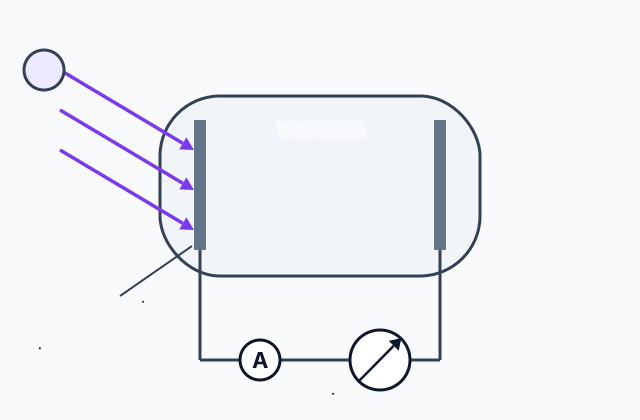 Tap to open the picture full size
Part 1 Think first A bright red lamp and a dim violet one
Commit to a guess first. Being wrong now makes the right idea stick better.
Predict first
A clean plate of a certain metal sits in a vacuum. A very bright red lamp shines on it for an hour, and not one electron leaves the plate. This metal does emit electrons under a bright violet lamp. Then the red lamp is swapped for a dim violet lamp. What happens now?
In short. The photoelectric effect is the emission of electrons from a material when electromagnetic radiation falls on it.
- Each photon gives its whole energy, , to one electron, which must spend at least the work function to leave the material.
- The fastest electrons leave with .
- A potential difference that turns back even the fastest electrons, the stopping potential, measures that energy: .
Part 2 Learn it Photons that free electrons
5a. Light that frees electrons
Shine light on a clean metal surface and, under the right conditions, electrons fly out of it. The emission of electrons when electromagnetic radiation falls on a photoactive material is the photoelectric effect.
Whether any electrons leave depends on the light's frequency. Each material has a threshold frequency , the minimum frequency of light that can free its electrons.
- Light at or above frees electrons, however few photons arrive. Even very dim light works, and electrons leave as soon as it is switched on.
- Light below frees none, however bright it is and however long it shines.
Classical physics could not explain the second result. A light wave spreads its energy over the whole surface, so a brighter wave, or one left on long enough, should eventually hand some electron the energy to escape, whatever its frequency. Experiments found no such thing: below the threshold, nothing ever comes out.
Quick check · Sort it
A metal has a threshold frequency of Hz. Each card describes light shining on it. Tap a card, then what happens.
Electrons are emitted
No electrons are emitted
5b. The work function
Einstein explained the effect in 1905 with photons. Each photon gives its whole energy, , to a single electron. To get out of the material, that electron has to spend some of the energy: at least the material's work function , the minimum energy required to free an electron from its atoms. Whatever is left over is kinetic energy. The electrons that spend only the minimum leave fastest, with
Electrons from deeper in the material lose more on the way out and leave with less, which is why the equation gives the maximum kinetic energy.
The threshold follows at once. At a photon has just enough energy to free an electron, with nothing left over, so . Below it, a photon cannot free an electron, and in ordinary light an electron cannot collect energy from a second photon to make up the difference.
In electron volts, eV·s. A metal with eV has Hz. Work functions differ from material to material, and a problem gives you the one you need.
Quick check · Calculate
Ultraviolet light of frequency Hz falls on a metal whose work function is 2.30 eV. What is the maximum kinetic energy of the electrons it frees? Use eV·s, and give your answer in electron volts.
5c. Brighter light, more electrons
Take light above the threshold and make it brighter, keeping its frequency the same. A brighter beam delivers more photons each second, each with the same energy . More photons free more electrons each second, so the current of electrons leaving the metal grows. Each electron still receives the energy of one photon, so stays the same.
So the energy of the emitted electrons does not depend on the number of photons that strike the material. Classical physics expected otherwise: a more intense wave should shake the electrons harder and send them out faster. Measurements showed nothing of the kind. The fastest electrons freed by dim violet light are exactly as fast as those freed by bright violet light.
A higher frequency is what makes faster electrons. Each photon then carries more energy, and after paying the same work function an electron keeps more of it.
This was the evidence that light is a collection of discrete, quantized packets of energy, photons, each acting on one electron at a time.
Quick check · Match
Light above a metal's threshold frequency shines on it. Assume every photon that strikes the metal has the same chance of freeing an electron. Tap a change, then what it does to the emitted electrons.
5d. Measuring the fastest electrons
To measure , place two metal plates in a vacuum chamber, as in the picture at the top of this lesson, and connect them to a variable source of potential difference with an ammeter in the circuit. Monochromatic light falls on one plate and frees electrons, and those that reach the other plate make a current.
Now make the far plate negative, so the electrons have to cross against the potential difference. Crossing a potential difference costs an electron of kinetic energy. Raise it until the ammeter reads zero. At that stopping potential even the fastest electrons are turned back, so
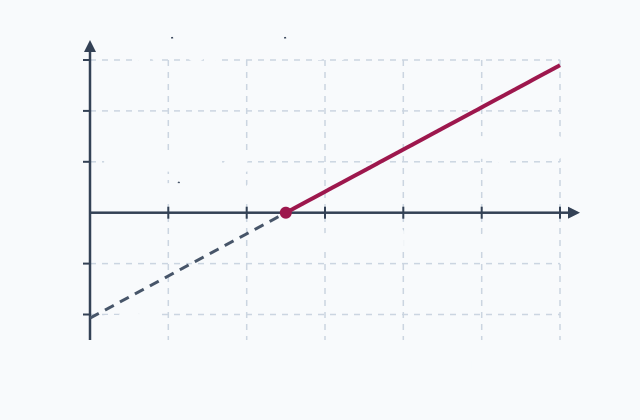
Repeat with several frequencies and plot against , as in the graph. The points fall on a straight line of slope . It meets the frequency axis at the threshold frequency, where , and extended back to it meets the vertical axis at . Below the threshold no current flows at any brightness, so there are no points there.
Quick check · Put it in order
A student uses the two-plate setup to find a metal's work function. Tap the steps in the order she does them.
Part 3 Watch it done Stopping the fastest electrons
Predict first, then watch each step, then finish the problem yourself.
In the picture at the top of this lesson, ultraviolet light of wavelength 200 nm falls on a plate whose work function is 4.50 eV. What stopping potential brings the current to zero? Use eV·nm.
Predict first
Before you open the first step, predict: how does the stopping potential compare with 4.50 V?
Step 1 · Find the photon's energy
eV. That is more than the work function, so this light does free electrons.
Step 2 · Link the stopping potential to the fastest electrons
The current falls to zero when the potential difference turns back even the fastest electrons, so .
Why this step?
Why is the stopping potential set by the fastest electrons?
Slower electrons are turned back by smaller potential differences, so the current falls gradually as the potential difference rises. It reaches zero only when the electrons with the most kinetic energy can no longer cross, and those have .
Your step · Calculate
Finish it. Photons of energy 6.20 eV fall on one plate of a phototube, and the plate's work function is 4.50 eV. What stopping potential brings the current to zero? Give your answer in volts.
V
Part 4 Try it A second metal, and a sketch
Predict first: light that frees electrons from one metal falls on a second metal with a larger work function. Do electrons still leave? Then judge a claim, and sketch how the fastest electrons' energy depends on the energy of each photon.
Try it · Decide and justify
Green light frees electrons from metal X, and the fastest leave with 0.30 eV of kinetic energy. The same lamp then shines on metal Y, whose work function is 0.50 eV larger than X's. A student says electrons will still leave Y, only more slowly than they left X. Is the student right?
Which reason supports your answer?
Try it · Sketch the graph
Light shines on a metal whose work function is 2.0 eV. Its frequency is raised in steps, so that each photon carries 1.0, 2.0, 3.0, 4.0 and then 5.0 eV. Sketch the maximum kinetic energy of the emitted electrons against the energy of each photon. Where no electrons are emitted, draw 0.
One shape that fits
Drag a point up or down, or tap it and use the arrow keys. The shape is checked, and so are the values the question lets you work out.
Part 5 Explain it Planck's constant from a phototube
On the exam this is handwritten, so answer on paper first. Nothing you type here leaves this page. Then check your answer against the model and each scoring point.
Free response is 50% of the exam score. This one is shaped like Question 3, Experimental Design and Analysis.
Free-response practice · Question 3 style
A student wants to find Planck's constant and the work function of a metal. She has a vacuum tube with two plates of the metal, a variable source of potential difference, an ammeter, a lamp, and a set of filters that each pass light of one known frequency.
(a) Describe a procedure she could use to collect data for a graph from which she can find both quantities. Say what she changes, what she measures, and one step that reduces experimental uncertainty.
(b) Her results are below, with the frequency of the light and the stopping potential. Describe what she should plot on each axis so that a straight best-fit line gives Planck's constant and the work function, and explain why. Then make that graph on paper, with a scale on each axis, and draw a best-fit line. Do this by hand before you open the model.
- Hz and 0.35 V
- Hz and 0.72 V
- Hz and 1.17 V
- Hz and 1.55 V
- Hz and 2.00 V
(c) Use your best-fit line to calculate Planck's constant, in J·s, and the work function of the metal, in eV. Use C.
(d) She repeats one trial with the light dimmed to half its brightness, and the stopping potential does not change. Explain what this shows about light.
Model answer
(a) Put one filter in front of the lamp and shine the light on one plate. Raise the potential difference that opposes the electrons until the ammeter reads zero, and record that stopping potential. Repeat with each filter. Approach the zero slowly and repeat each reading two or three times, then average, to reduce the uncertainty.
(b) From , . So plot on the vertical axis against on the horizontal axis. The points fall on a straight line with slope and vertical intercept . See the graph below.
(c) From Hz, 0.54 V) and Hz, 1.78 V) on the line, the slope is V·s. So J·s. Extending the line to : V, so eV.
(d) The fastest electrons have the same kinetic energy in dim light as in bright light. Dimming the light sends fewer photons each second, but each still carries and gives it to one electron. So the light arrives as discrete packets of energy, photons, whose energy is set by the frequency alone.
Stopping potential against frequency, with the best-fit line
The line passes through 0.54 V at 6.0 and 1.78 V at 9.0, with the frequency in units of 10^14 Hz.
Score your own answer. This is a self-check, not a grade. Tick each point your answer makes.
Part 6 Check yourself Two lamps on one metal
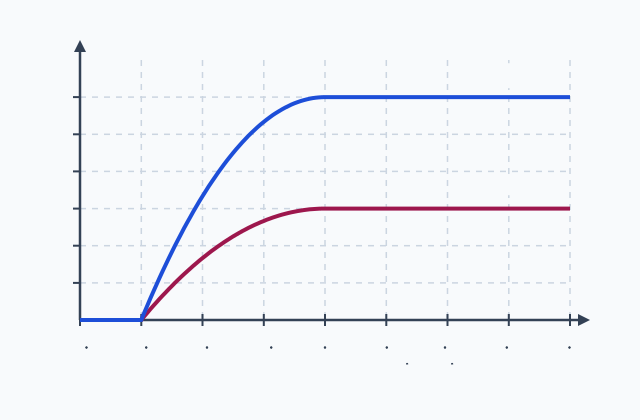
Both case questions use the graph.
Lamps A and B each emit light of a single frequency. Each in turn shines on the same metal plate in a two-plate vacuum tube, and the graph shows the current against the potential difference across the plates. A negative potential difference opposes the electrons. Lamp A's light has a wavelength of 350 nm. Assume every photon that reaches the plate has the same chance of freeing an electron.
Case question 1 · Calculate
Using the graph: what is the work function of the metal? Use eV·nm, and give your answer in electron volts.
Case question 2 · Select all
Using the graph: which two claims does it support? Pick two.
Select 2 answers, then check.
The rest stand on their own and do not use the case.
Check yourself · Spot the error
A student predicts what happens when a lamp of 400 nm light, shining on a metal with a work function of 2.30 eV, is made twice as bright. She uses eV·nm. Tap the first line that goes wrong.
Check yourself · Multiple choice
Light of wavelength falls on a metal whose work function is . Which expression gives the stopping potential , in terms of , , Planck's constant , the speed of light and the elementary charge ?
Part 7 Keep it Bring back earlier ideas
Blackbody power from the last lesson and the Bohr model from 15.2 are still part of the course. Retrieving them now, between new ideas, is what makes them easy to find later.
From 15.4 Blackbody Radiation · Calculate
A blackbody's absolute temperature is doubled while its surface area is cut in half. By what factor does the power it emits change?
Predict first: in an orbit four times as wide, does the electron move faster, more slowly, or at the same speed? Then judge a claim, and count the wavelengths around the smallest orbit.
From 15.2 The Bohr Model of Atomic Structure · Decide and justify
In the Bohr model of hydrogen, the electron's orbit in the state has four times the radius of its orbit in the ground state. A student says the electron moves more slowly in the larger orbit. Is the student right?
Which reason supports your answer?
In three lines
- Light at or above a material's threshold frequency frees electrons at once, however dim; light below it frees none, however bright.
- Each photon gives to one electron, which spends at least the work function to leave: .
- The stopping potential measures ; plotted against frequency it gives a line of slope that meets the axis at the threshold frequency.
Exam strategy for this topic
- Section I, Multiple Choice: 42 questions in 85 minutes.
- Section II, Free Response: 4 questions in 95 minutes.
- This lesson's Explain it is shaped like free-response question 3, Experimental Design and Analysis.
- A four-function, scientific, or graphing calculator is allowed on both sections of the exam.
Keep every energy in one unit. With eV·s or eV·nm, a photon's energy comes out in electron volts, and a work function in electron volts can be subtracted from it directly. Convert to joules, with J, only when an answer is asked for in joules.
Questions students ask
What is the photoelectric effect?
The emission of electrons from a material when electromagnetic radiation falls on it. The electrons that leave are freed by the energy of the light.
What is the work function?
The minimum energy needed to free an electron from a material, written . The threshold frequency is the frequency whose photons carry exactly that energy, .
How is the maximum kinetic energy of photoelectrons measured?
With two plates in a vacuum, connected to a variable potential difference. The potential difference that opposes the electrons is raised until the current stops; then .
Who explained the photoelectric effect?
Albert Einstein, in 1905. He treated light as a stream of photons, each of which gives its whole energy, , to a single electron.
Beyond the AP Exam
College Board sets this limit on what the AP Exam asks about this topic. Anything past it is not on the exam.
Where applicable, work functions for materials will be provided on the exam; students are not expected to know values of work functions or variables of a material that influence the magnitude of its work function.
Course alignment, for teachers
AP Physics 2: Algebra-Based topic 15.5, Unit 15: Modern Physics.
- Skill 1.B: Create quantitative graphs with appropriate scales and units, including plotting data.
- Skill 2.A: Derive a symbolic expression from known quantities by selecting and following a logical mathematical pathway.
- Skill 2.D: Predict new values or factors of change of physical quantities using functional dependence between variables.
- Skill 3.A: Create experimental procedures that are appropriate for a given scientific question.
- Skill 3.C: Justify or support a claim using evidence from experimental data, physical representations, or physical principles or laws.
This lesson maps all 8 essential knowledge statements of the topic to the part that teaches each one: 8 are checked by a scored question. The map is in the lesson file.