Unit 15 · Topic 15.6 · about 30 minutes · 7 parts · 11 scored checks, 1 of them multiple choice, plus 2 from earlier lessons
AP Physics 2: Algebra-Based 15.6: Compton Scattering
Unit 15: 12 to 15% of the multiple-choice section
What you'll be able to do
- Describe how a photon and a free electron interact in Compton scattering, treating the photon as a particle with energy and momentum, and find how the photon's wavelength changes with the angle it is scattered through.
Key vocabulary
| Term | What it means | The exam trap |
|---|---|---|
| Compton scattering | A collision between a photon and a free electron, after which the photon travels in a new direction. | Model the photon as a particle in a collision, with both energy and momentum. |
| Free electron | An electron that is not bound to an atom, or is bound so weakly that its binding can be ignored. | Treat it as at rest before the collision unless a problem says otherwise. |
| Photon momentum | The momentum a photon carries, , even though it has no mass. | cannot give a photon's momentum; use its wavelength. |
| Scattering angle | The angle between a photon's direction before a collision and its direction after. | It is measured from the incoming direction, so a photon that bounces straight back has . |
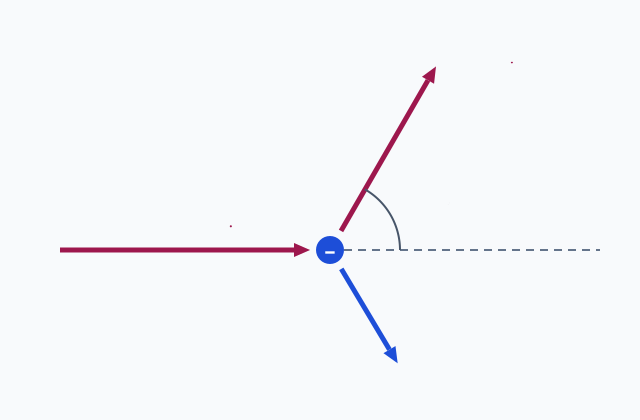 Tap to open the picture full size
Part 1 Think first X-rays off graphite
Commit to a guess first. Being wrong now makes the right idea stick better.
Predict first
A mirror reflects light without changing its color. X-rays of a single wavelength are aimed at a block of graphite, and a detector off to one side picks up X-rays that bounce off the loosely held electrons in it. Compared with the X-rays going in, what wavelength do many of the bounced X-rays have?
In short. In Compton scattering a photon collides with a free electron, and the two behave like colliding particles, with energy and momentum conserved.
- The photon acts as a particle with energy and momentum , and energy and momentum are both conserved in the collision.
- The change in wavelength is , where is the angle the photon is scattered through.
- Like the photoelectric effect, it is evidence that light is a collection of photons.
Part 2 Learn it A photon collides with an electron
6a. A photon bounces off an electron
In 1923 Arthur Compton aimed X-rays of a single wavelength at a block of graphite. Its outer electrons are held so loosely that they act as free electrons. A detector set at an angle picked up X-rays coming off the block, and many of them had a longer wavelength than the X-rays going in.
That is the Compton effect. In Compton scattering, a photon interacts with a free electron. The photon that emerges has lower energy and a longer wavelength, and so a lower frequency, than the photon that came in. The electron, at rest before, moves off with the energy the photon lost.
How much the wavelength changes depends on the photon's new direction. The angle between the photon's path before and after is the scattering angle . A photon that is barely deflected changes very little; one that bounces back the way it came changes the most.
A wave model of light cannot produce this. A wave that sets an electron oscillating makes it radiate at the wave's own frequency, so scattered waves should keep their wavelength.
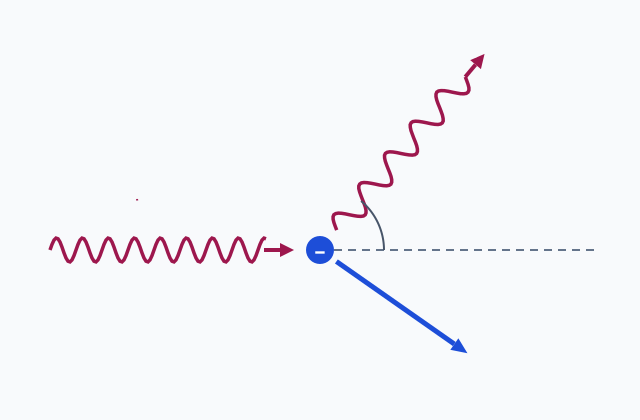
Quick check · Fill the statement
An X-ray photon of wavelength 50.0 pm is scattered through 90° by a free electron that was at rest. Tap a blank, then an answer.
Compared with the photon before the collision, the scattered photon's energy is and its wavelength is . Its speed is .
6b. Photons carry momentum
Compton explained the result by treating each X-ray photon as a particle that collides with one electron. For that, a photon needs momentum as well as energy. It has no mass, so cannot give its momentum. Instead,
The second is the de Broglie relation from 15.1, read the other way. A photon of shorter wavelength carries more energy and more momentum.
So when a photon hands energy to an electron, everything about it changes together: its energy and its momentum fall, its frequency falls, and its wavelength grows. Its speed is before and after.
The numbers are small. An X-ray photon of wavelength 50.0 pm (1 pm is m) has
about the momentum of an electron moving at m/s. That is why a single photon can set a single electron moving.
Quick check · Calculate
An X-ray photon has a wavelength of 62.0 pm (1 pm is m). What is the magnitude of its momentum? Use J·s, and give your answer in units of kg·m/s.
6c. Conserving energy and momentum
Treat the collision like one between two billiard balls, with the photon as one ball and the electron, at rest, as the other.
Energy is conserved. The photon's energy before equals the scattered photon's energy plus the electron's kinetic energy:
Momentum is conserved too, as a vector. Before, all the momentum is the photon's, , along its path. After, the scattered photon's momentum and the electron's momentum must add, head to tail, to that same arrow. Along the original path the total is unchanged, and across it the total is still zero, so a photon that goes off above the line sends the electron off below it.
Worked through, these two laws predict the shift Compton measured, angle by angle. A model in which light is a stream of particles, each with energy and momentum , explained his data, and the wave model could not. So Compton scattering, like the photoelectric effect, is evidence that light is a collection of discrete, quantized packets of energy: photons.
Quick check · Select all
A photon scatters off a free electron that was at rest. Which two statements must be true? Pick two.
Select 2 answers, then check.
6d. How the shift depends on angle
Solving the energy and momentum equations together gives the change in wavelength:
where is the electron's mass and the scattering angle. The factor in front is a constant:
- At , : no change.
- At , , and the shift is 2.43 pm.
- At , straight back, : the largest shift possible, 4.85 pm.
The shift depends only on the angle; the wavelength of the incoming photon does not appear in the equation. That is why Compton used X-rays. For X-rays tens of picometers long, a few picometers is easy to measure. For visible light, hundreds of nanometers long, the same few picometers is far too small a part of the wavelength to notice.
Quick check · Rank it
X-ray photons, all of the same wavelength, scatter off free electrons at rest. Rank these scattered photons by their wavelength after the collision.
Longest wavelength first
Give each one a place, 1 for first. Give two the same place if they are equal.
Your ranking: none yet
Part 3 Watch it done An X-ray scattered through 60°
Predict first, then watch each step, then finish the problem yourself.
In the picture at the top of this lesson, an X-ray photon of wavelength 71.0 pm (1 pm is m) strikes a free electron at rest and is scattered through 60°. What is the energy of the scattered photon? Use pm and eV·nm.
Predict first
Before you open the first step, predict: about how much of its energy does the photon lose?
Step 1 · Find the shift
pm.
Step 2 · Find the new wavelength
pm, which is 0.0722 nm.
Why this step?
Why is the shift added to the wavelength rather than subtracted?
The photon gives some of its energy to the electron. A photon's energy is , so a photon with less energy has a longer wavelength.
Your step · Calculate
Finish it. An X-ray photon scattered off a free electron leaves with a wavelength of 72.2 pm (1 pm is m). What is its energy? Use eV·nm, and give your answer in keV.
keV
Part 4 Try it Two wavelengths, and the electron's momentum
Predict first: two X-ray photons of different wavelengths scatter off free electrons through the same angle. Which loses the larger fraction of its energy? Then judge a claim, and find how hard a photon hits an electron.
Try it · Decide and justify
X-ray photons of wavelength 20.0 pm and 80.0 pm each scatter off a free electron at rest through 90°. A student says the 20.0 pm photon loses a larger fraction of its energy than the 80.0 pm photon. Is the student right?
Which reason supports your answer?
Try it · Calculate
An X-ray photon of wavelength 40.0 pm strikes a free electron at rest and is scattered through 90°, leaving with a wavelength of 42.4 pm (1 pm is m). What is the magnitude of the electron's momentum afterward? Use J·s, and give your answer in units of kg·m/s.
Part 5 Explain it A photon scattered straight back
On the exam this is handwritten, so answer on paper first. Nothing you type here leaves this page. Then check your answer against the model and each scoring point.
Free response is 50% of the exam score. This one is shaped like Question 1, Mathematical Routines.
Free-response practice · Question 1 style
A photon of wavelength strikes a free electron at rest and is scattered straight back, through 180°. Use J·s, kg, m/s and eV·nm.
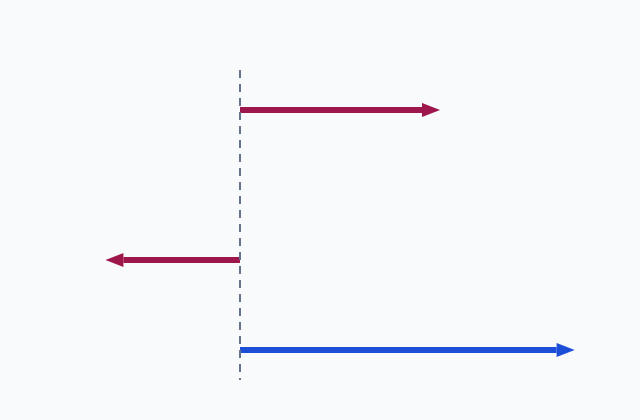
(a) On paper, draw an arrow for the momentum of the photon before the collision, and arrows for the momenta of the photon and the electron after it, with their relative lengths roughly right. Then derive an expression for the electron's kinetic energy after the collision, in terms of , , and .
(b) For a photon with pm (1 pm is m), calculate the wavelength of the scattered photon and the kinetic energy of the electron, in keV.
(c) A student says the same experiment with visible light of wavelength 500 nm would show the photon losing about the same fraction of its energy. Use your results to justify whether the student is right.
Model answer
(a) See the drawing below. The photon's momentum before points forward. After, the photon's momentum points backward and is shorter, since its wavelength is longer. The electron's momentum points forward, as long as the other two together, so that the total stays what it was. For energy, , and at 180°, , so . Then .
(b) m, so pm. The photon's energy falls from keV to keV, so keV.
(c) The student is wrong. The shift at 180° is 4.85 pm whatever the starting wavelength. For the 10.0 pm photon that is about half the wavelength, and it lost , about a third, of its energy. For 500 nm light, 4.85 pm is about of the wavelength, so the photon keeps all but about 0.001 percent of its energy.
Score your own answer. This is a self-check, not a grade. Tick each point your answer makes.
Part 6 Check yourself Measuring the shift
Both case questions use the graph.
A student scatters X-rays of a single wavelength off a target whose electrons act as free electrons at rest. At five scattering angles she measures the change in wavelength , and she plots against with a best-fit line. Her values of are 0.134, 0.500, 1.000, 1.500 and 1.866, and her shifts are 0.30, 1.25, 2.40, 3.66 and 4.50 pm.
Change in wavelength against 1 minus cos theta
Her best-fit line passes through the origin and through 4.84 pm at 2.0.
Case question 1 · Calculate
Using the graph: what mass does the slope of her best-fit line give for the electron? Use J·s and m/s, and give your answer in units of kg.
Case question 2 · Multiple choice
Using the graph: she repeats the experiment with X-rays of a shorter wavelength, at the same five angles. What happens to her points?
The rest stand on their own and do not use the case.
Check yourself · Spot the error
A student finds the energy of a 50.0 pm X-ray photon (1 pm is m) after it scatters off a free electron at rest through 90°. She uses pm and eV·nm. Tap the first line that goes wrong.
Check yourself · Sort it
Each card describes an experimental result. Tap a card, then the model of light it supports.
Light as particles, photons
Light as a wave
Part 7 Keep it Bring back earlier ideas
The photoelectric effect from the last lesson and energy levels from 15.3 are still part of the course. Retrieving them now, between new ideas, is what makes them easy to find later.
From 15.5 The Photoelectric Effect · Sort it
A metal has a threshold frequency of Hz. Each card describes light shining on it. Tap a card, then what happens.
Electrons are emitted
No electrons are emitted
Predict first: an excited atom meets a photon with a little more energy than one of its gaps. Does it take what it needs and let the rest go, or not? Then judge a claim, and rank four transitions.
From 15.3 Emission and Absorption Spectra · Rank it
A hydrogen atom has levels at eV (), eV (), eV () and eV (); level 3 means , and so on. Rank the photons emitted in these transitions by their wavelength.
Longest wavelength first
Give each one a place, 1 for first. Give two the same place if they are equal.
Your ranking: none yet
In three lines
- In Compton scattering a photon collides with a free electron and comes away with less energy, a lower frequency and a longer wavelength.
- The photon acts as a particle with and , and energy and momentum, as a vector, are both conserved.
- : no shift straight on, 2.43 pm at 90°, and the most, 4.85 pm, straight back.
Exam strategy for this topic
- Section I, Multiple Choice: 42 questions in 85 minutes.
- Section II, Free Response: 4 questions in 95 minutes.
- This lesson's Explain it is shaped like free-response question 1, Mathematical Routines.
- A four-function, scientific, or graphing calculator is allowed on both sections of the exam.
Write every wavelength in one unit before adding a shift. m is 2.43 pm, or 0.00243 nm, and adding it to a wavelength written in a different unit is an easy slip.
Questions students ask
What is Compton scattering?
A collision between a photon and a free electron, analyzed by treating the photon as a particle and conserving energy and momentum.
What equation gives the Compton shift?
, where is the electron's mass and the angle between the photon's directions before and after the collision.
How can a photon have momentum without mass?
A photon's momentum is , set by its wavelength. The formula applies only to particles with mass.
Who first measured the effect?
Arthur Compton, in 1923, by scattering X-rays off the loosely held electrons in graphite and measuring the wavelengths that came off at different angles.
Course alignment, for teachers
AP Physics 2: Algebra-Based topic 15.6, Unit 15: Modern Physics.
- Skill 1.A: Create diagrams, tables, charts, or schematics to represent physical situations.
- Skill 2.B: Calculate or estimate an unknown quantity with units from known quantities, by selecting and following a logical computational pathway.
- Skill 2.C: Compare physical quantities between two or more scenarios or at different times and locations in a single scenario.
- Skill 3.C: Justify or support a claim using evidence from experimental data, physical representations, or physical principles or laws.
This lesson maps all 5 essential knowledge statements of the topic to the part that teaches each one: 5 are checked by a scored question. The map is in the lesson file.