Unit 9 · Topic 9.3 · about 30 minutes · 7 parts · 11 scored checks, 3 of them multiple choice, plus 2 from earlier lessons
AP Physics 2: Algebra-Based 9.3: Thermal Energy Transfer and Equilibrium
Unit 9: 15 to 18% of the multiple-choice section
What you'll be able to do
- Describe the transfer of energy between two systems in thermal contact: the three thermal processes, why net energy flows from the higher temperature to the lower, and what thermal equilibrium means.
Key vocabulary
| Term | What it means | The exam trap |
|---|---|---|
| Joule | The SI unit of energy, J, used for internal energy and for every transfer of energy. | Energy moved by heating and energy moved by work are both in joules, so the two can be added together. |
| Insulated | Surrounded by material that lets very little energy pass through it by thermal processes. | Insulation slows a thermal transfer but never stops it completely, so idealized problems assume none leaks. |
| Isolated system | A system that exchanges neither energy nor matter with anything outside it. | A real cup counts as isolated only if almost no energy gets through its walls and lid while you measure. |
 Tap to open the picture full size
Part 1 Think first Two benches on a porch
Commit to a guess first. Being wrong now makes the right idea stick better.
Predict first
A metal bench and a wooden bench have stood side by side on a covered porch all night. In the morning Priya touches each with the back of her hand, and the metal feels much colder. Which bench is at the lower temperature?
In short. Systems in thermal contact transfer energy by conduction, convection or radiation, always on net from the higher temperature to the lower, until they reach the same temperature: thermal equilibrium.
- Heating is energy transferred into a system by thermal processes and cooling is energy transferred out; nothing called cold ever moves.
- In collisions, energy most likely passes from higher-energy atoms to lower-energy ones, so after many collisions the most probable state is one temperature.
- At thermal equilibrium no net energy is transferred, though atoms keep colliding, and equal temperatures do not mean equal internal energies.
Part 2 Learn it Energy moving between systems
2a. Heating and cooling are transfers of energy
Two systems are in thermal contact when energy can pass between them by thermal processes: by touching, through a fluid that flows between them, or just by facing each other across a gap that light can cross.
Heating a system means transferring energy into it by thermal processes. Cooling a system means transferring energy out of it. A cold drink on a warm counter is heated by its surroundings, and the surroundings are cooled by the drink.
Heating and cooling describe a transfer, not a substance. Nothing called "cold" leaves the drink, and a temperature is never handed from one object to another. What moves is energy, and temperatures change because of it.
Doing work is the other way to transfer energy, as when a piston squeezes a gas. Work needs a force acting through a distance. A thermal process needs only a difference in temperature.
Quick check · Multiple choice
A can of soda straight from a refrigerator is set on a kitchen counter in a warm room. Taking the soda as the system, which statement is correct?
2b. Conduction, convection and radiation
Energy moves between systems at different temperatures in three ways.
- Conduction: energy passes through matter, or between objects that touch, by collisions between neighboring particles. The handle of a pot on a stove grows warm by conduction.
- Convection: a warmed fluid, a liquid or a gas, flows and carries its energy along with it. Warm air rising from a radiator and drifting across a room is convection.
- Radiation: energy travels as electromagnetic waves, such as infrared light, and needs no material at all. The warmth you feel on your face from a campfire several meters away is radiation.
Often all three happen at once. A kettle on a stove gains energy by conduction through its base, the water inside spreads it by convection, and the hot kettle radiates energy into the kitchen.
Quick check · Sort it
Tap a card, then the thermal process that does most of the transferring.
Conduction
Convection
Radiation
2c. Why energy flows from hot to cold
Left to itself, energy always flows by thermal processes from the system at the higher temperature to the one at the lower temperature. Kinetic theory says why.
Where two systems touch, their atoms collide. In a collision between atoms from the two systems, energy is most likely to pass from the higher-energy atom to the lower-energy one. Not every time: a fast atom in the cold system can strike a slow atom in the hot one. But on average, collisions pass energy from the system whose atoms have the greater average kinetic energy, and that is the system at the higher temperature.
So temperature, the average energy per atom, decides the direction, not the total energy. A swimming pool at 25 °C holds far more internal energy than a cup of tea at 80 °C, yet float the cup in the pool and energy flows from the tea into the water.
After many collisions, the most probable state is the one in which both systems are at the same temperature. Energy gathering back to make one side hotter is not forbidden by any single collision, just so improbable that it does not happen.
Quick check · Decide and justify
A cup of tea at 70 °C is set on a large block of ice at −10 °C. The block holds far more internal energy than the tea. A student says energy flows from the ice into the tea, because the ice has more internal energy to give. Is the student right?
Which reason supports your answer?
2d. Thermal equilibrium
As energy flows from the hotter system to the cooler one, the hotter one cools and the cooler one warms, so their temperatures close in on each other. When the temperatures are equal, no net energy is transferred between them, and the two systems are in thermal equilibrium.
Equilibrium does not mean the atoms stop. Atoms keep colliding across the boundary and trading energy, but now as much passes one way as the other.
Equal temperatures are the test, not equal energies. A bathtub of water and a glass of water at the same temperature are in thermal equilibrium with each other, even though the bathtub holds far more internal energy.
In an insulated container, where energy passes only between the systems inside, the energy one system loses is exactly the energy the other gains.
Quick check · Select all
A hot metal block is placed against a cold one inside an insulated box and left for a long time. Which two statements are true once the blocks reach thermal equilibrium? Pick two.
Select 2 answers, then check.
Part 3 Watch it done Two blocks, one temperature
Predict first, then watch each step, then finish the problem yourself.
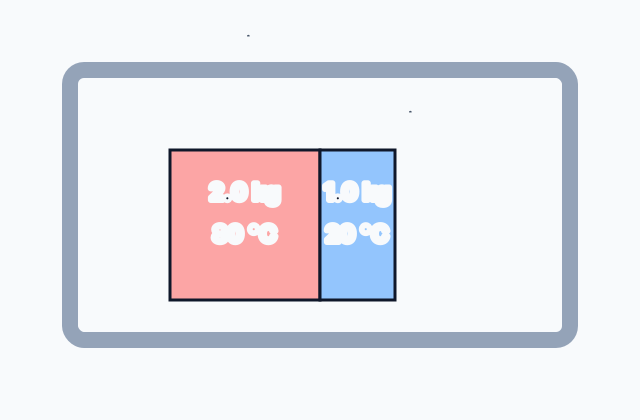
In the picture at the top of this lesson, a 2.0 kg block of aluminum at 80 °C is pressed against a 1.0 kg block of aluminum at 20 °C inside an insulated box. Energy passes only between the two blocks. Each kilogram of aluminum takes the same energy to change its temperature by 1 °C. What temperature do the blocks reach?
Predict first
Before you open the first step, predict the final temperature.
Step 1 · Follow the energy
The box is insulated, so the energy the 2.0 kg block loses is exactly the energy the 1.0 kg block gains. Net energy flows from the 80 °C block to the 20 °C block until both are at the same temperature, .
Step 2 · Compare the temperature changes
Both blocks are aluminum, so each kilogram takes the same energy per degree, and the 2.0 kg block takes twice the energy of the 1.0 kg block for each degree it changes. Setting the energy lost equal to the energy gained:
Why this step?
Why must the blocks end at the same temperature, and not with the same internal energy?
Net energy flows only while the temperatures differ, because collisions most likely pass energy from the atoms with the greater average kinetic energy. When the temperatures match, the flows in the two directions balance, however much internal energy each block holds.
Your step · Calculate
Finish it. A 2.0 kg aluminum block at 80 °C and a 1.0 kg aluminum block at 20 °C reach thermal equilibrium inside an insulated box, where energy passes only between them. Each kilogram of aluminum takes the same energy to change its temperature by 1 °C. What is the final temperature of the blocks? Give your answer to the nearest 1 °C.
°C
Part 4 Try it Which way does it go?
The direction of a net energy transfer follows the average kinetic energy of the atoms, not their speed. Predict first: helium at 300 K or argon at 300 K, whose atoms carry more kinetic energy on average, or is it the same for both?
Try it · Rank it
Four gases are each sealed in a thin metal can. Can A holds helium at 400 K. Can B holds helium at 300 K. Can C holds argon at 300 K. Can D holds neon at 200 K. Rank the cans by the average kinetic energy of the atoms inside, which sets the direction of net energy transfer between any two cans placed in contact.
Greatest first
Give each one a place, 1 for first. Give two the same place if they are equal.
Your ranking: none yet
Now apply equilibrium to the instrument that measures temperature.
Try it · Multiple choice
A thermometer at room temperature, 20 °C, is dipped into a cup of hot tea. After 2 seconds it reads 41 °C and is still rising. What does the reading of 41 °C tell you?
Part 5 Explain it A wall between two gases
On the exam this is handwritten, so answer on paper first. Nothing you type here leaves this page. Then check your answer against the model and each scoring point.
Free response is 50% of the exam score. This one is shaped like Question 1, Mathematical Routines.
Free-response practice · Question 1 style
An insulated box is split into two halves by a thin metal wall. One half holds helium at 300 K, whose atoms each have a mass of kg. The other half holds neon at 500 K, whose atoms each have a mass of kg. Both gases are ideal. Take J/K.
(a) Derive an expression for the ratio of the average kinetic energy of a neon atom to that of a helium atom, in terms of the two temperatures, and evaluate it.
(b) Calculate the rms speed of the atoms in each gas.
(c) A student claims that net energy will pass through the wall from the helium to the neon, because helium atoms move faster and so hit harder. On paper, draw the box with an arrow through the wall for the direction of net energy transfer. Do this by hand before you open the model. Then justify whether the claim is correct, using your answers to (a) and (b).
Model answer
(a) For each gas , so .
(b) . Helium: m/s. Neon: m/s.
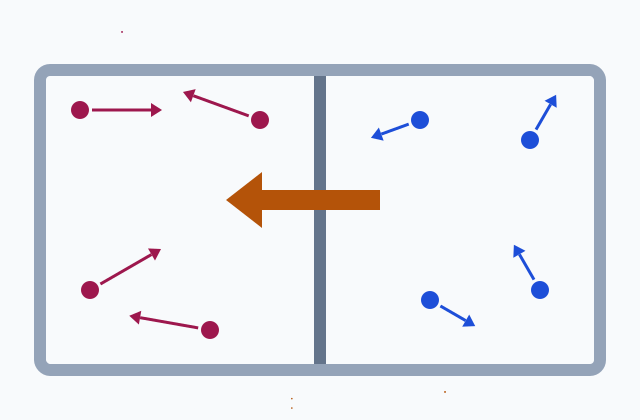
(c) Compare your drawing with the model below: the arrow points from the neon to the helium. The claim is incorrect. Collisions at the wall most likely pass energy from higher-energy atoms to lower-energy ones. Part (b) shows the helium atoms are faster, but part (a) shows a neon atom carries as much kinetic energy on average, because it is at the higher temperature; its five-times-larger mass is why it is still the slower atom. So net energy flows from the neon, at the higher temperature, to the helium, until both reach the same temperature.
 Tap to open the picture full size
Score your own answer. This is a self-check, not a grade. Tick each point your answer makes.
Part 6 Check yourself A hot block in cool water
Both case questions use the table.
An iron block at 90.0 °C is dropped into water at 20.0 °C in an insulated cup, and the water is stirred. A probe in the block and a thermometer in the water record their temperatures. Assume the cup takes in no energy and none leaks out.
| Time (s) | Iron block (°C) | Water (°C) |
|---|---|---|
| 0 | 90.0 | 20.0 |
| 20 | 66.4 | 23.9 |
| 60 | 43.4 | 27.8 |
| 120 | 33.0 | 29.5 |
| 240 | 30.1 | 30.0 |
| 480 | 30.0 | 30.0 |
Case question 1 · Multiple choice
Using the table of temperatures: which statement describes the block and the water at 480 s?
Case question 2 · Calculate
Using the table of temperatures: by 480 s the water has gained 13.5 kJ of energy by thermal processes. How much energy has the iron block lost? Give your answer in kilojoules, to the nearest 0.1 kJ.
The rest stand on their own and do not use the case.
Check yourself · Spot the error
A student explains what happens after an ice cube is dropped into lemonade in an insulated cup. Tap the first line that goes wrong.
Check yourself · Fill the statement
Tap a blank, then an answer.
In one collision between an atom of a hot block and an atom of a cold block, energy is passed to the cold block's atom. Over many collisions, the net transfer of energy is . The most probable final state has the two blocks at .
Part 7 Keep it Bring back earlier ideas
Temperature as average kinetic energy and the ideal gas law both come back here: temperature decides which way energy flows. Pulling them back up is what makes them last.
From 9.2 The Ideal Gas Law · Calculate
A rigid tank with a volume of 0.010 m³ holds 0.50 mol of helium at 27 °C. Treat the helium as an ideal gas and take J/(mol·K). What is the pressure of the helium? Give your answer in kilopascals, to the nearest 1 kPa.
Mass and temperature both set how fast atoms move. Predict first: is argon at 1200 K faster than neon at 600 K, slower, or the same speed? An argon atom has about twice the mass of a neon atom.
Now go from pressure to force on a wall.
From 9.1 Kinetic Theory of Temperature and Pressure · Calculate
A box holds a gas at a pressure of Pa. One flat wall of the box measures 0.30 m by 0.50 m. What is the size of the total force the gas inside exerts on that wall? Give your answer in kilonewtons, to the nearest 1 kN.
In three lines
- Heating is energy transferred into a system by thermal processes and cooling is energy transferred out, by conduction, convection or radiation.
- Net energy flows from the higher temperature to the lower, because collisions most likely pass energy from higher-energy atoms to lower-energy ones.
- Thermal equilibrium is equal temperatures with no net transfer, which is the most probable state after many collisions; atoms keep colliding.
Exam strategy for this topic
- Section I, Multiple Choice: 42 questions in 85 minutes.
- Section II, Free Response: 4 questions in 95 minutes.
- This lesson's Explain it is shaped like free-response question 1, Mathematical Routines.
- A four-function, scientific, or graphing calculator is allowed on both sections of the exam.
When a question asks which way energy flows, compare temperatures, never total energies or atomic speeds. Net energy flows from the higher temperature to the lower until the two are equal.
Questions students ask
What is the difference between heating and temperature?
Temperature measures the average kinetic energy of the atoms in a system. Heating is a transfer of energy into a system by thermal processes, which happens because of a temperature difference.
Why does energy flow from hot to cold?
Where two systems touch, their atoms collide, and energy most likely passes from the higher-energy atom to the lower-energy one. On average that moves energy from the system with the greater average kinetic energy, the hotter one.
What is thermal equilibrium?
The state of two systems in thermal contact when no net energy passes between them, because they are at the same temperature. Their atoms keep colliding, but the trades balance.
What are conduction, convection and radiation?
Conduction passes energy by collisions between neighboring particles, convection carries it in a moving fluid, and radiation carries it as electromagnetic waves that need no material.
Course alignment, for teachers
AP Physics 2: Algebra-Based topic 9.3, Unit 9: Thermodynamics.
- Skill 1.A: Create diagrams, tables, charts, or schematics to represent physical situations.
- Skill 2.C: Compare physical quantities between two or more scenarios or at different times and locations in a single scenario.
- Skill 3.B: Apply an appropriate law, definition, theoretical relationship, or model to make a claim.
- Skill 3.C: Justify or support a claim using evidence from experimental data, physical representations, or physical principles or laws.
This lesson maps all 8 essential knowledge statements of the topic to the part that teaches each one: 8 are checked by a scored question. The map is in the lesson file.