Unit 9 · Topic 9.4 · about 35 minutes · 7 parts · 11 scored checks, 1 of them multiple choice, plus 2 from earlier lessons
AP Physics 2: Algebra-Based 9.4: The First Law of Thermodynamics
Unit 9: 15 to 18% of the multiple-choice section
What you'll be able to do
- Describe the internal energy of a system, and of an ideal monatomic gas in particular, as the kinetic energy of its particles plus the potential energy of their arrangement.
- Describe the behavior of a gas using the first law of thermodynamics, PV diagrams, the work done on the gas, and the isovolumetric, isobaric, isothermal and adiabatic processes.
Key vocabulary
| Term | What it means | The exam trap |
|---|---|---|
| Internal energy | The total kinetic energy of the particles in a system plus the potential energy of their arrangement, U, in joules. | Internal energy is not the same as temperature: at one temperature, a bigger sample of the same gas holds more internal energy. |
| Closed system | A system that no matter enters or leaves, though energy can cross its boundary by heating, cooling or work. | Closed does not mean insulated: energy can still cross the walls of a closed system by heating or cooling. |
| PV diagram | A graph of a gas's pressure against its volume, on which each point is one state of the gas and each path is a process. | Pressure is a coordinate on the vertical axis, so never draw it as an arrow on the diagram. |
 Tap to open the picture full size
Part 1 Think first A warm bike pump
Commit to a guess first. Being wrong now makes the right idea stick better.
Predict first
Mia blocks the outlet of a well-greased bike pump with her finger and quickly pushes the handle down. The air trapped inside gets noticeably warmer. Where did the energy that warmed the air come from?
In short. The first law of thermodynamics, , says a system's internal energy changes by the energy added by heating plus the work done on it, where for a gas at constant pressure.
- For an ideal monatomic gas , so its internal energy depends only on its temperature.
- On a PV diagram the area under the path is the size of the work: negative for an expansion, positive for a compression.
- Isovolumetric means , isothermal and adiabatic ; work and heat depend on the path, internal energy does not.
Part 2 Learn it Energy in, energy out
2a. Internal energy
The internal energy of a system is the kinetic energy of all the particles it is made of, plus the potential energy of how they are arranged, which comes from the forces between them.
In an ideal gas the atoms exert no forces on each other except during collisions, and their inner structure is ignored, so an ideal gas has no internal potential energy. For an ideal monatomic gas, the internal energy is just the total kinetic energy of its atoms:
So the internal energy of an ideal gas depends only on its temperature: no change in temperature means no change in internal energy. Using , it is also .
Internal energy counts motion inside the system, measured from the system's center of mass. A sealed bottle of air thrown across a room has kinetic energy as a whole, but that belongs to the motion of its center of mass; the air inside is no hotter for flying. A change in internal energy changes what happens inside a system without moving its center of mass.
Quick check · Decide and justify
A sealed box of helium rides on a train that speeds up smoothly from rest to 30 m/s. Nothing else about the box changes, and its temperature stays the same. A student says the internal energy of the helium does not change. Is the student right?
Which reason supports your answer?
2b. The first law of thermodynamics
The first law of thermodynamics is conservation of energy for a system that can gain or lose energy by heating or cooling and by work. An isolated system exchanges no energy, so its total energy stays constant. A closed system exchanges no matter, but energy can cross its boundary, and its internal energy changes by exactly what crosses:
is the energy transferred into the system by heating, and is negative when the system is cooled. is the work done on the system. When a constant or average external pressure changes the volume of a gas, for example a piston compressing it,
A compression makes negative, so is positive: energy goes into the gas. In an expansion is negative: the gas does work on its surroundings, and energy goes out.
Watch the sign convention. AP Physics 2 defines as the work done on the gas. Many physics textbooks and most engineering courses write , with the work done by the gas; chemistry courses usually use the same on-the-system sign as this course. The physics is the same with the sign of flipped. In this course, use and .
Quick check · Calculate
A gas in a cylinder is compressed at a constant pressure of Pa from a volume of m³ to m³. During the compression, 120 J of energy leaves the gas by cooling. What is the change in the internal energy of the gas? Give your answer to the nearest 1 J, with its sign.
2c. PV diagrams and work
A PV diagram is a graph of a gas's pressure against its volume. Each point is one state of the gas, with a pressure, a volume and, through , a temperature. A process is a path from one point to another, with an arrow for its direction. Pressure is the coordinate on the vertical axis; it is never drawn as an arrow.
Isotherms are lines of constant temperature. Along one, , so an isotherm is a curve that falls and bends toward the volume axis: twice the volume, half the pressure. It is not a straight line. Isotherms farther from the origin are at higher temperatures.
The area under the path, down to the volume axis, is the size of the work done on the gas. The direction gives the sign: a path to larger volume is an expansion, so is negative, and a path to smaller volume is a compression, so is positive. A vertical path has no area under it, so .
Two paths between the same two states can have different areas under them, so they do different work. The internal energy depends only on the state, so is the same along both, and differs. Work and heat belong to the path, not to the state.
Quick check · Sketch the graph
An ideal gas is held at a constant temperature while it expands slowly from 1.0 L to 4.0 L. At 1.0 L its pressure is 120 kPa. Sketch the pressure of the gas against its volume. The first point is fixed at 120 kPa, its pressure at 1.0 L.
One shape that fits
Drag a point up or down, or tap it and use the arrow keys. The shape is checked, and so are the values the question lets you work out.
2d. Four special processes
Each of the four special processes holds one thing fixed, and the first law then says what the rest must do.
- Isovolumetric (constant volume): a vertical line on a PV diagram. , so .
- Isobaric (constant pressure): a horizontal line. , the area of the rectangle under the line, with its sign.
- Isothermal (constant temperature): a path along an isotherm. For an ideal gas , so . The energy that comes in as work leaves by cooling, or the energy that comes in by heating leaves as work.
- Adiabatic: no energy is transferred by heating or cooling, , so . A gas compressed adiabatically warms up, and one that expands adiabatically cools. A process is nearly adiabatic when the container is insulated, or when it happens too fast for much energy to cross the walls.
Isothermal and adiabatic are easy to confuse. Isothermal means the temperature stays the same, which takes a transfer by heating or cooling. Adiabatic means no transfer by heating or cooling, which lets the temperature change.
Quick check · Match
Tap a process, then what is true of an ideal gas going through it.
Part 3 Watch it done Two steps on a PV diagram
Predict first, then watch each step, then finish the problem yourself.
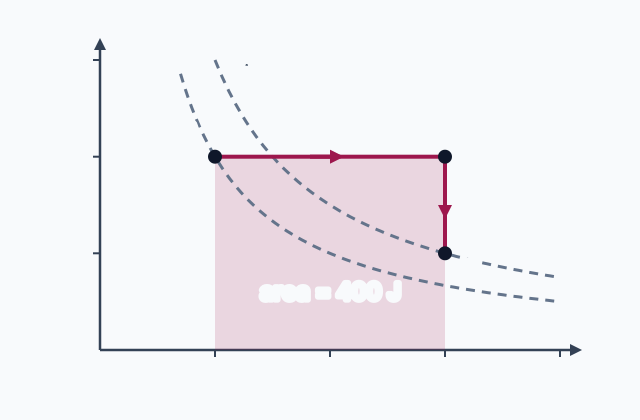
The PV diagram at the top of this lesson shows an ideal monatomic gas taken from state A (1.0 L, 200 kPa) to state B (3.0 L, 200 kPa) at constant pressure, then to state C (3.0 L, 100 kPa) at constant volume. How much energy is transferred to the gas by heating over the whole process from A to C?
Predict first
Before you open the first step, predict: over the whole process, is the energy transferred to the gas by heating positive, negative or zero?
Step 1 · Find the work done on the gas
From A to B the gas expands at a constant 200 kPa, so J, since 1 kPa × 1 L = 1 J. That is the shaded area, negative because the gas expands. From B to C the volume does not change, so . In all, J.
Step 2 · Find the change in internal energy
For an ideal monatomic gas . At A, J, and at C, J. So J. C lies on a hotter isotherm than A, so the internal energy rose.
Why this step?
Why can the change in internal energy be found from states A and C alone, without following the path?
Internal energy depends only on the state of the gas, through its temperature, so every path from A to C gives the same change. Work and heat are different: they depend on the path, which is why the work had to be found step by step.
Your step · Calculate
Finish it. An ideal gas goes from state A to state C. Over the whole process the work done on the gas is −400 J and the change in its internal energy is +150 J. How much energy is transferred to the gas by heating? Give your answer to the nearest 1 J, with its sign.
J
Part 4 Try it Signs of the work
Signs are the hard part of the first law. Predict first: when a gas expands at constant pressure, is the work done on it positive or negative?
Try it · Rank it
A gas goes through four separate processes. Process 1: it expands at a constant 200 kPa from 1.0 L to 2.0 L. Process 2: it expands at a constant 100 kPa from 1.0 L to 3.0 L. Process 3: it is heated at a constant volume of 1.0 L from 100 kPa to 300 kPa. Process 4: it is compressed at a constant 100 kPa from 3.0 L to 1.0 L. Rank the processes by the work done on the gas, counting its sign.
Most positive first
Give each one a place, 1 for first. Give two the same place if they are equal.
Your ranking: none yet
Now a process with no heating or cooling at all.
Try it · Calculate
An insulated cylinder holds 0.10 mol of an ideal monatomic gas. The gas is compressed so that no energy is transferred to or from it by heating or cooling, and its temperature rises from 300 K to 360 K. Take R = 8.31 J/(mol·K). How much work is done on the gas? Give your answer to the nearest 1 J.
Part 5 Explain it Out and back to one temperature
On the exam this is handwritten, so answer on paper first. Nothing you type here leaves this page. Then check your answer against the model and each scoring point.
Free response is 50% of the exam score. This one is shaped like Question 2, Translation Between Representations.
Free-response practice · Question 2 style
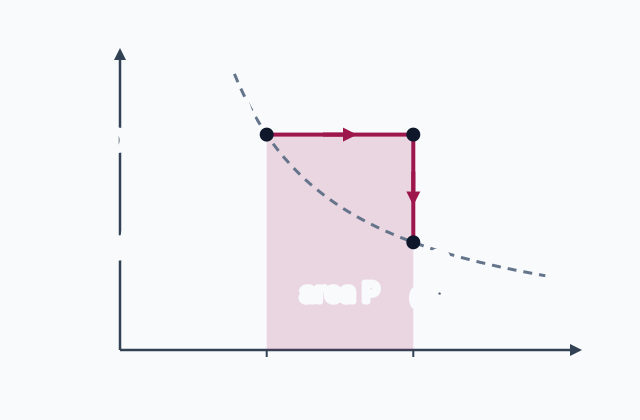
A sample of ideal monatomic gas starts in state A at pressure and volume . It is heated at constant pressure until its volume is , state B. It is then cooled at constant volume until it reaches state C, which is at the same temperature as state A.
(a) On paper, draw the process from A to B to C on axes of pressure against volume. Label A, B and C, mark the pressures and volumes on the axes, and draw the isotherm through A and C as a dashed line. Do this by hand before you open the model.
(b) Derive expressions, in terms of and , for the work done on the gas and for the energy transferred to the gas by heating, over the whole process from A to C.
(c) A student says that the energy transferred to the gas by heating in (b) must be zero, because the gas ends at the same temperature it started at. Use your diagram from (a) and your result from (b) to explain whether the student is correct.
Model answer
(a) Compare your drawing with the model below. A to B is a level line at from to . Since C is on the isotherm through A, , so and B to C runs straight down to . The isotherm is a curve through A and C that bends toward the volume axis.
(b) and , so . A and C are at the same temperature, so for an ideal gas . Then .
(c) The student is incorrect. Ending at the starting temperature means the internal energy is unchanged, , because internal energy depends only on the state. Heat depends on the path. The diagram in (a) has an area of under the path from A to B, so the gas did of work on its surroundings, and (b) shows that the same amount had to come in by heating for to end where it began.
 Tap to open the picture full size
Score your own answer. This is a self-check, not a grade. Tick each point your answer makes.
Part 6 Check yourself Two paths from X to Y
Both case questions use the PV diagram.
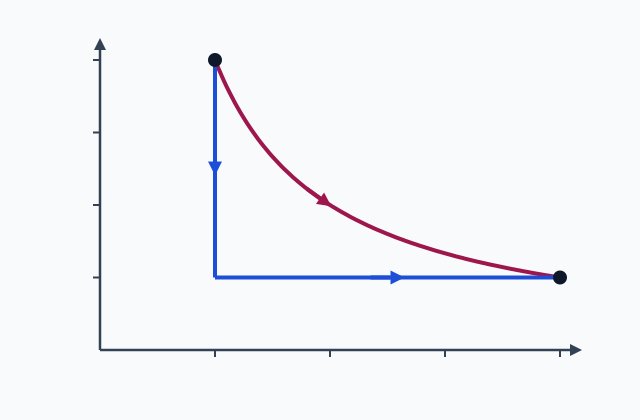
An ideal gas is taken from state X to state Y by two different paths, shown on the PV diagram. Path 1 is a single smooth curve. Path 2 drops at constant volume, then runs across at constant pressure. Use 1 kPa × 1 L = 1 J.
 Tap to open the picture full size
Case question 1 · Calculate
Using the PV diagram of paths 1 and 2: what is the work done on the gas along path 2, from X to Y? Give your answer to the nearest 1 J, with its sign.
Case question 2 · Multiple choice
Using the PV diagram of paths 1 and 2: how does the energy transferred to the gas by heating along path 1, Q1, compare with that along path 2, Q2?
The rest stand on their own and do not use the case.
Check yourself · Fill the statement
Tap a blank, then an answer.
In AP Physics 2 the first law is written ΔU = Q + W, where W is the work done the gas. When a gas expands, W is . For a gas held at constant volume, W is . For an isolated system, the total energy .
Check yourself · Spot the error
A student analyzes an ideal gas that is compressed slowly at constant temperature while 200 J of work is done on it. Tap the first line that goes wrong.
Part 7 Keep it Bring back earlier ideas
Heating as a transfer of energy and temperature as average kinetic energy are the two pieces the first law is built from. Pulling them back up is what makes them last.
From 9.3 Thermal Energy Transfer and Equilibrium · Sort it
Tap a card, then the thermal process that does most of the transferring.
Conduction
Convection
Radiation
From 9.1 Kinetic Theory of Temperature and Pressure · Spot the error
A student compares sample P, helium at 300 K, with sample Q, argon at 600 K. An argon atom has 10 times the mass of a helium atom. Tap the first line that goes wrong.
In three lines
- Internal energy is the kinetic energy of a system's particles plus the potential energy of their arrangement; for an ideal monatomic gas , with no potential energy.
- The first law is , with added by heating and done on the gas; textbooks that write count the work done by the gas.
- On a PV diagram the area under the path is the size of the work and isotherms are curves; isovolumetric gives W = 0, isothermal ΔU = 0, adiabatic Q = 0.
Exam strategy for this topic
- Section I, Multiple Choice: 42 questions in 85 minutes.
- Section II, Free Response: 4 questions in 95 minutes.
- This lesson's Explain it is shaped like free-response question 2, Translation Between Representations.
- A four-function, scientific, or graphing calculator is allowed on both sections of the exam.
Write with the work done on the gas, then fix each sign from the physical story: a compression makes positive, heating makes positive, and a higher final temperature makes positive. Read the size of from the area under the path.
Questions students ask
What is the first law of thermodynamics?
: the change in a closed system's internal energy equals the energy transferred in by heating plus the work done on the system. It is conservation of energy.
Why does AP Physics 2 write ΔU = Q + W instead of ΔU = Q − W?
It defines as the work done on the system, so . Books that write define as the work done by the system. Both describe the same physics, with opposite signs for .
How do you find the work from a PV diagram?
The area under the path, down to the volume axis, is the size of the work done on the gas. It is negative for an expansion and positive for a compression, and zero for a vertical path.
What is the difference between isothermal and adiabatic?
Isothermal means the temperature stays the same, so an ideal gas has . Adiabatic means no energy is transferred by heating or cooling, , so the temperature changes with the work.
Are work and heat state functions?
No. Work and heat depend on the path between two states. Internal energy is fixed by the state alone, so two paths between the same states have the same change in internal energy but can have different work and heat.
Course alignment, for teachers
AP Physics 2: Algebra-Based topic 9.4, Unit 9: Thermodynamics.
- Skill 1.C: Create qualitative sketches of graphs that represent features of a model or the behavior of a physical system.
- Skill 2.A: Derive a symbolic expression from known quantities by selecting and following a logical mathematical pathway.
- Skill 2.C: Compare physical quantities between two or more scenarios or at different times and locations in a single scenario.
- Skill 3.C: Justify or support a claim using evidence from experimental data, physical representations, or physical principles or laws.
This lesson maps all 12 essential knowledge statements of the topic to the part that teaches each one: 12 are checked by a scored question. The map is in the lesson file.