Unit 9 · Topic 9.5 · about 30 minutes · 7 parts · 11 scored checks, 1 of them multiple choice, plus 2 from earlier lessons
AP Physics 2: Algebra-Based 9.5: Specific Heat and Thermal Conductivity
Unit 9: 15 to 18% of the multiple-choice section
What you'll be able to do
- Describe the energy needed to change the temperature of an object by a given amount, using its mass and the specific heat of its material.
- Describe the rate at which energy is conducted through a material, using its thermal conductivity, its dimensions and the temperature difference across it.
Key vocabulary
| Term | What it means | The exam trap |
|---|---|---|
| Specific heat | The energy needed to change the temperature of 1 kg of a material by 1 K, c, in J/(kg·K). | A change of 1 K equals a change of 1 °C, so read a temperature change from either scale; only temperatures themselves differ by 273. |
| Thermal conductivity | How readily a material conducts energy by thermal processes, k, in W/(m·K). | Its unit contains watts, so the conduction formula gives a rate in joules per second, never an amount of energy. |
| Watt | A rate of energy transfer of one joule per second. | Multiply a rate in watts by a time in seconds to get joules, so change minutes to seconds first. |
 Tap to open the picture full size
Part 1 Think first Hot sand, cool sea
Commit to a guess first. Being wrong now makes the right idea stick better.
Predict first
On a sunny afternoon at the beach, the dry sand is hot enough to burn Diego's feet, while the sea is still cool, though both have had the same strong sunshine since morning. What best explains the difference?
In short. Specific heat is the energy needed to change the temperature of 1 kg of a material by 1 K, so , and thermal conductivity sets how fast energy is conducted through a slab: .
- Both are intrinsic properties: they belong to the material, set by how its atoms are arranged and interact, not to the size of the sample.
- The rate of conduction doubles with twice the area or twice the temperature difference, and halves with twice the thickness.
- This course models specific heat as the same at every temperature, and a change of 1 K is the same as a change of 1 °C.
Part 2 Learn it How much energy, and how fast
2a. Specific heat
How much energy does it take to change a material's temperature? This course models a material's specific heat as the same at every temperature, and then
is the energy transferred to the material by heating, its mass and its change in temperature. is its specific heat: the energy needed to change the temperature of 1 kg of the material by 1 K, in J/(kg·K). A change of 1 K is the same size as a change of 1 °C, so can be read from either scale.
Cooling makes negative, so comes out negative: energy leaves.
Some values: water 4190 J/(kg·K), aluminum 900, iron 450 and copper 385.
Warming 0.50 kg of water from 20 °C to 80 °C takes J, about 126 kJ. The same energy would warm 0.50 kg of copper by about 650 K.
Quick check · Calculate
A 0.25 kg block of aluminum, whose specific heat is 900 J/(kg·K), cools from 150 °C to 30 °C. How much energy leaves the block by cooling? Give your answer in kilojoules, to the nearest 1 kJ.
2b. What sets a specific heat
Specific heat is an intrinsic property: it belongs to the material, not to the sample. A thimble of water and a swimming pool of water have the same specific heat, though the pool needs vastly more energy for each degree, because it has vastly more mass.
What sets a material's specific heat is the way its atoms are arranged and the way they interact. Energy added to a material goes into the motion of its particles and into the potential energy of the forces between them, and the split between them differs from one material to another. Water's molecules can take up energy in many ways, by rotating and vibrating and by pulling against their neighbors, which is why water's specific heat is so large.
Keep two ideas apart: the specific heat of a material, , and the energy one particular object needs per degree, , which grows with the object's mass. Doubling the water in a kettle doubles but leaves the same.
Quick check · Sort it
Each card makes one change to a sample. Tap a card, then whether the change alters the specific heat of the material in the sample.
Changes the specific heat
Leaves the specific heat the same
2c. The rate of conduction
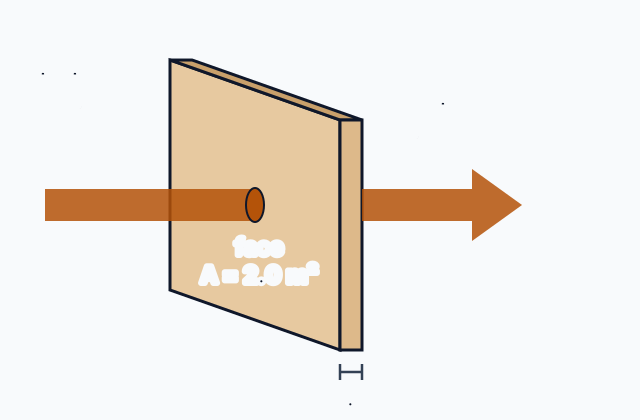
Specific heat says how much energy a temperature change takes. Conduction says how fast energy can get there. For energy conducted through a slab of material, like the door in the picture at the top of this lesson,
is the rate of energy transfer in watts, joules per second. is the area of the face the energy passes through, the thickness it crosses, the temperature difference between the two faces, and the thermal conductivity of the material, in W/(m·K).
A bigger area gives energy more ways through, a thicker slab makes it travel farther, and a bigger temperature difference drives it harder. So doubling or doubles the rate, and doubling halves it.
For the door in the picture, W/(m·K), m², m and K, so the rate is W, from the warm inside face to the cold outside face. Put thicknesses in meters.
Quick check · Fill the statement
Tap a blank, then an answer.
Compared with the original wall, the rate of conduction through a wall of the same material is when the wall is twice as thick, when its area is doubled, and when both the temperature difference across it and its thickness are doubled.
2d. Thermal conductivity
Thermal conductivity, like specific heat, is an intrinsic property that depends on how a material's atoms are arranged and how they interact. In a metal, some electrons are free to move through the whole solid, and they carry energy quickly, so metals conduct well: copper's is about 400 W/(m·K). In wood, plastic foam or wool, energy has to pass from molecule to molecule, often across pockets of trapped air, so is small: about 0.15 W/(m·K) for wood and 0.03 for foam.
That is why a metal bench feels colder than a wooden one at the same temperature. Your hand is warmer than both, and the metal's high conductivity carries energy away from your skin much faster.
Do not confuse the two properties. Specific heat says how much energy each degree of temperature change takes; thermal conductivity says how fast energy moves through the material. Copper has a high conductivity but a fairly low specific heat, while water has a high specific heat but a low conductivity.
Quick check · Decide and justify
A copper spoon and a stainless steel spoon of the same size and shape stand side by side in the same pot of hot soup, starting at room temperature. A student says the two handles warm up at the same rate, because both spoons sit in the same soup. Is the student right?
Which reason supports your answer?
Part 3 Watch it done Hot copper, cool water
Predict first, then watch each step, then finish the problem yourself.
A 0.20 kg copper block at 100 °C is dropped into 0.30 kg of water at 20 °C in an insulated cup. The cup takes in no energy and none escapes. Take the specific heat of copper as 385 J/(kg·K) and of water as 4190 J/(kg·K). What temperature do the copper and the water reach?
Predict first
Before you open the first step, predict the final temperature.
Step 1 · Balance the energy
The cup is insulated, so the energy the copper loses equals the energy the water gains, and both end at the same temperature, :
Step 2 · Put in the numbers
J/K and J/K, so . The water needs about 16 times as much energy per degree as the copper.
Why this step?
Why is the same T used for the copper and for the water?
Net energy keeps flowing from the hotter one until the two reach thermal equilibrium, which means the same temperature. The final state has one temperature for both.
Your step · Calculate
Finish it. A 0.20 kg copper block, specific heat 385 J/(kg·K), at 100 °C is dropped into 0.30 kg of water, specific heat 4190 J/(kg·K), at 20 °C in an insulated cup that takes in no energy. What is the final temperature? Give your answer to the nearest 0.1 °C.
°C
Part 4 Try it Measure it, then block it
Specific heats are measured by mixing, as in the worked example run backward. Predict first: which temperature of the cold water should be read, and when?
Try it · Put it in order
A student finds the specific heat of a metal block by dropping it, hot, into cold water in an insulated cup. Tap her steps in order.
Now turn from storing energy to stopping it from leaking.
Try it · Rank it
Four slabs separate a warm room from the cold outside. Slab 1 has thermal conductivity k, face area A, thickness L and temperature difference ΔT across it. Slab 2 has 2k, A, 2L and ΔT. Slab 3 has k, 2A, L and 2ΔT. Slab 4 has k/2, A, L/4 and ΔT. Rank the slabs by the rate at which energy is conducted through them.
Greatest rate first
Give each one a place, 1 for first. Give two the same place if they are equal.
Your ranking: none yet
Part 5 Explain it Find a specific heat from a slope
On the exam this is handwritten, so answer on paper first. Nothing you type here leaves this page. Then check your answer against the model and each scoring point.
Free response is 50% of the exam score. This one is shaped like Question 3, Experimental Design and Analysis.
Free-response practice · Question 3 style
A student wants to measure the specific heat of aluminum. She has a 1.00 kg aluminum block with two holes drilled in it, a 50 W electric heater that fits one hole, a thermometer that fits the other, a stopwatch, and some insulating foam.
(a) Describe a procedure she could use to collect data for a graph from whose slope she can find the specific heat. Say what she measures, and one step that reduces experimental uncertainty.
(b) Her results are below. On paper, plot the temperature of the block against time, with a scale and units on each axis, and draw a best-fit line. Do this by hand before you open the model.
- 0 s: 20.0 °C
- 60 s: 23.2 °C
- 120 s: 26.6 °C
- 180 s: 29.9 °C
- 240 s: 33.2 °C
- 300 s: 36.5 °C
(c) Use your best-fit line to calculate the specific heat of aluminum, assuming all of the heater's energy goes into the block.
Model answer
(a) Wrap the block in the foam, put the heater in one hole and the thermometer in the other, with a little oil in each hole for good contact. Switch on the heater, start the stopwatch, and record the temperature every 60 s for about five minutes. To reduce uncertainty, insulate the block so little energy leaks out, make sure the heater and thermometer touch the metal well, and repeat the run.
(b) See the graph below: a labeled scale on each axis, six points in a straight line, and one best-fit line. The points lie on a line because this course models specific heat as the same at every temperature.
(c) In a time the heater delivers , so and the slope of temperature against time is . The line rises from about 20.0 °C at 0 s to 36.5 °C at 300 s, a slope of about 0.0551 K/s. So J/(kg·K), about 900 J/(kg·K). Any energy that leaks out makes the slope smaller and this value a little too large.
Temperature of the block against time, with the best-fit line
The line rises about 3.3 °C every minute.
Score your own answer. This is a self-check, not a grade. Tick each point your answer makes.
Part 6 Check yourself Five materials
Both case questions use the table.
The table gives the specific heat and the thermal conductivity of five materials at room temperature.
| Material | Specific heat (J/(kg·K)) | Thermal conductivity (W/(m·K)) |
|---|---|---|
| Water | 4190 | 0.60 |
| Aluminum | 900 | 205 |
| Glass | 840 | 0.80 |
| Iron | 450 | 80 |
| Copper | 385 | 400 |
Case question 1 · Calculate
Using the table of materials: a 0.50 kg block of copper absorbs 6.0 kJ of energy by heating. By how much does its temperature rise? Give your answer to the nearest 0.1 K.
Case question 2 · Multiple choice
Using the table of materials: a cook wants a pan whose bottom spreads the energy from a small burner across its whole base as quickly as possible. Which material from the table should the pan bottom be made of?
The rest stand on their own and do not use the case.
Check yourself · Spot the error
A student finds the rate of conduction through a glass window with thermal conductivity 0.80 W/(m·K), area 1.5 m² and thickness 5.0 mm, when its inner surface is 10 K warmer than its outer surface. Tap the first line that goes wrong.
Check yourself · Select all
A glass window separates a warm room from the cold outside. Which two changes would increase the rate at which energy is conducted through the window? Pick two.
Select 2 answers, then check.
Part 7 Keep it Bring back earlier ideas
The first law and the ideal gas law come back here: Q in the first law is the energy that specific heat turns into a temperature change. Pulling them back up is what makes them last.
Signs are the hard part of the first law. Predict first: when a gas expands at constant pressure, is the work done on it positive or negative?
Now a process with no heating or cooling at all.
From 9.4 The First Law of Thermodynamics · Calculate
An insulated cylinder holds 0.10 mol of an ideal monatomic gas. The gas is compressed so that no energy is transferred to or from it by heating or cooling, and its temperature rises from 300 K to 360 K. Take R = 8.31 J/(mol·K). How much work is done on the gas? Give your answer to the nearest 1 J.
Rearranged, the ideal gas law counts the particles in a container: . Predict first: a container at twice the pressure and twice the absolute temperature of another, with the same volume, holds more gas, less gas, or the same amount?
Now predict factors of change without any numbers.
From 9.2 The Ideal Gas Law · Rank it
Four containers hold ideal gases. Container A's pressure, volume and absolute temperature are P, V and T. Container B is at 2P, V and T. Container C is at P, 2V and 2T. Container D is at 3P, V and 2T. Rank the containers by the number of gas particles they hold.
Most particles first
Give each one a place, 1 for first. Give two the same place if they are equal.
Your ranking: none yet
In three lines
- : specific heat is the energy to change the temperature of 1 kg of a material by 1 K, modeled here as the same at every temperature.
- The rate of conduction through a slab is , with every length in meters.
- Specific heat and thermal conductivity are intrinsic properties set by how a material's atoms are arranged and interact; one sets how much energy, the other how fast.
Exam strategy for this topic
- Section I, Multiple Choice: 42 questions in 85 minutes.
- Section II, Free Response: 4 questions in 95 minutes.
- This lesson's Explain it is shaped like free-response question 3, Experimental Design and Analysis.
- A four-function, scientific, or graphing calculator is allowed on both sections of the exam.
For mixing problems, write for each object, set the energy lost equal to the energy gained, and give every object the same final temperature. For conduction, convert thicknesses to meters before you divide.
Questions students ask
What is specific heat?
The energy needed to change the temperature of one kilogram of a material by one kelvin. Water's is about 4190 J/(kg·K), much larger than most solids, so water warms and cools slowly.
How do you calculate the energy needed to heat something?
Use : the mass times the specific heat times the change in temperature. A negative gives a negative , meaning energy leaves.
What affects the rate of conduction through a material?
The thermal conductivity of the material, the area, the thickness and the temperature difference: .
What is the difference between specific heat and thermal conductivity?
Specific heat says how much energy a material needs for each degree of temperature change. Thermal conductivity says how fast energy moves through it. Both depend on how the material's atoms are arranged and interact.
Course alignment, for teachers
AP Physics 2: Algebra-Based topic 9.5, Unit 9: Thermodynamics.
- Skill 1.B: Create quantitative graphs with appropriate scales and units, including plotting data.
- Skill 2.B: Calculate or estimate an unknown quantity with units from known quantities, by selecting and following a logical computational pathway.
- Skill 2.D: Predict new values or factors of change of physical quantities using functional dependence between variables.
- Skill 3.A: Create experimental procedures that are appropriate for a given scientific question.
- Skill 3.B: Apply an appropriate law, definition, theoretical relationship, or model to make a claim.
This lesson maps all 4 essential knowledge statements of the topic to the part that teaches each one: 4 are checked by a scored question. The map is in the lesson file.